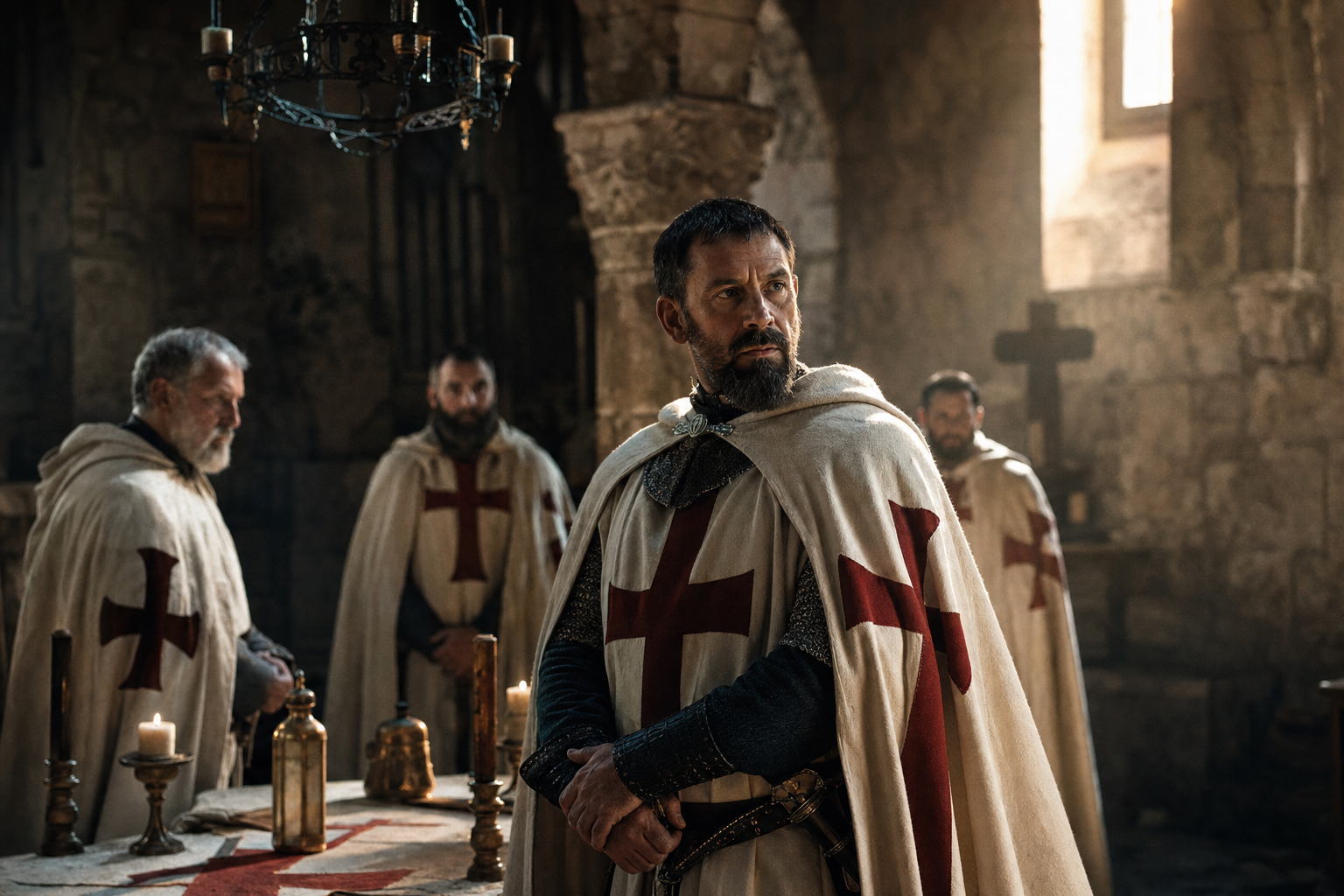
Secrets of the Templar Order: Power, Rituals, and Downfall
The Knights Templar have occupied a unique place in European memory: part religious brotherhood, part elite fighting force, and part bank for medieval pilgrims and monarchs. Born out of the desperate, sacred fervor of the First Crusade's aftermath, the Order of the Poor Knights of Christ and of the Temple of Solomon — commonly called the Knights Templar — grew from a handful of warriors in Jerusalem into an international institution whose influence stretched across Christendom. Their combination of martial prowess, strict monastic discipline, and extraordinary economic reach produced both reverence and suspicion. By the early fourteenth century, that mixture would ignite one of the most dramatic legal and political collapses of the Middle Ages.
This article undertakes a detailed, evidence-based survey of the Templars' recorded history and the persistent secrets that have clustered around them. It will trace their founding in the context of the Latin Kingdom of Jerusalem and the reforming spirit of twelfth-century monasticism; explain the Rule, the internal organization, and the daily rhythms that shaped their identity; examine the Order's economic innovations that functionally made them medieval bankers; assess their military role in the crusading frontier and the fortifications they built across the Levant and Europe; and finally follow the political, fiscal, and legal pressures that culminated in the arrests of 1307, the trials that followed, and the papal suppression declared in 1312. Interwoven with these chapters are the seeds of modern myth — from lost treasure to secret rites — and an account of how the Templars' legacy was absorbed, altered, and repurposed in early modern and modern imagination.
Because many sensational claims about the Templars date from later centuries, this study emphasizes verifiable facts and primary documented milestones: the Order's likely foundation c. 1119, formal recognition at the Council of Troyes in 1129, the papal privileges granted by Pope Innocent II and later by Pope Honorius II and Pope Celestine II, the critical role played by figures like Bernard of Clairvaux, and the grim climax of the early 14th century when King Philip IV of France moved to destroy the Order's power on his own soil. My aim is to separate, as far as sources allow, the known from the speculated and to explain why the Templars attracted so many secrets and why those secrets endure.
Did you know? The Council of Troyes (1129) that endorsed the Templar Rule was heavily influenced by Bernard of Clairvaux, who helped draft the Order's spiritual justification.

Origins and Foundation
The story of the Templars begins in the chaotic, post-First Crusade landscape of Jerusalem. After the success of 1099, Latin Christian pilgrims streamed toward the Holy Sepulchre, and the newly established Latin Kingdom of Jerusalem faced the practical challenge of protecting pilgrims and maintaining control of a fragile territory. Around 1119 a group of knights led by Hugues de Payens (sometimes rendered Hughes of Payens) petitioned King Baldwin II of Jerusalem for permission to live together and defend the pilgrims. Early chroniclers such as William of Tyre describe an initial band of perhaps nine knights whose modest beginnings belie the institutional scale the Order would later achieve.
This small brotherhood took on a striking patronage: they were granted quarters on the Temple Mount in Jerusalem, occupying buildings associated in Latin chroniclers' minds with the biblical Temple of Solomon — a location that lent spiritual and symbolic weight to the new fraternity and gave them their popular designation as the Poor Knights of Christ and of the Temple of Solomon.
Two developments were decisive in transforming the Templars from a local militia into an international order. The first was clerical endorsement and the second was the adoption of a monastic rule. Clerical endorsement came most forcefully through Bernard of Clairvaux, the influential Cistercian abbot and spiritual polymath of twelfth-century Europe. In 1129 Bernard supported the Templars at the Council of Troyes, where their rule was approved. Bernard's public treatise, De laude novae militiae (In Praise of the New Knighthood), articulated the spiritual rationale for a martial order: knights who had taken vows similar to monks could combine monastic poverty, chastity, and obedience with the legitimate use of arms in defense of Christendom. This intellectual framing was crucial: it reconciled the paradox of armed religious men within the Church's broader theology.
Did you know? Templar preceptories functioned both as spiritual centers and as economic hubs, supplying recruits and funds to the Order’s operations in the Levant.
Equally decisive was the papal recognition and privilege that followed in the 1130s. Papal bulls such as Omne Datum Optimum (1139), issued by Pope Innocent II, granted the Order exemptions from local ecclesiastical authority, the right to collect their own revenues, and the protection of the Holy See. These privileges effectively allowed the Templars to answer directly to the pope and to build a corporate structure that operated across diocesan boundaries. Over the middle decades of the twelfth century the Order established preceptories, commanderies, and estates throughout Western Europe to fund its operations in the East. The result was an international, papally-sanctioned brotherhood that combined religious discipline with a military vocation.
The early decades were not merely administrative; they forged an ethos. The Templars adopted distinctive symbols — most famously the white mantle charged with a red cross — and rituals that linked them to both monastic and knightly traditions. The white mantle signified purity and the Cistercian influence; the red cross, a sign of martyrdom and military sacrifice, visually announced their role on the battlefield and in the imagined struggle for the Holy Land. These emblems would make them instantly recognizable across medieval Europe and contribute to the aura of sacred mission that surrounded them.
The Rule, Organization, and Daily Life
Understanding the Templars requires close attention to their Rule and organizational design. The Rule of the Templars evolved from a combination of monastic precedent — especially Cistercian models — and the necessities of a military fraternity. The earliest extant written Rule associated with the Templars dates from the years immediately after their formation and was refined during the Council of Troyes. It established the three monastic vows of poverty, chastity, and obedience, while also prescribing military obligations, discipline, and the internal hierarchy that structured their daily life.
Did you know? The Templars used letters of transference that allowed pilgrims and crusaders to deposit funds in Europe and withdraw them in the Holy Land, an early form of credit.
At its core the Rule distinguished between ranks (knightly brothers, sergeants, chaplains, and servants) and dealt with issues both spiritual and mundane. Knights were expected to attend the divine office and to observe canonical hours; chaplains administered sacraments and ensured that liturgy shaped communal life. Sergeants — less wealthy and often of lower social status than knights — performed many of the Order's practical tasks, including garrison work and some aspects of logistics. The Rule was strict: it contained detailed prescriptions about fasting, the keeping of silence, the distribution of food, and the handling of internal disputes.
Organization was hierarchical and geographically dispersed. At the top stood the Grand Master, elected by the chapter general, who held supreme authority in spiritual and temporal matters within the Order. Below him were high-ranking officers — marshals, preceptors, and commanders — who managed provinces (provinces were often termed “languages” because the Order organized itself roughly along linguistic lines in Western Europe) and commanded preceptories (local administrative centers). Preceptories functioned as recruitment centers, agricultural estates, and financial hubs; they supplied men and money to the Order's operations in the East.
Life in the preceptory combined spiritual regimen with rigorous drill and maintenance tasks. Knights trained in horsemanship, weapons handling, and tactics; the Order kept horses in stud and maintained armories. Yet the monastic element was never negligible. The Templars observed daily prayer, confession, and the liturgical calendar. Many preceptories contained chapels and were run by resident chaplains. The fusion of ascetic discipline and martial training was a defining feature and helped maintain cohesion among brothers drawn from diverse social backgrounds across Europe.
Did you know? The Templars built and held fortresses not only in the Levant but also in Iberia and the Atlantic — their castle at Tomar (Portugal) became a central seat for later successor orders.
The Order also developed formalized admission rituals and oaths that bound members to communal life and obedience. While later sensational accounts would posit secret, heretical initiation rites, contemporary administrative records emphasize the public and regulated character of entry, vows, and penalties. Discipline within the Order could be severe: transgressions were punished by penance, loss of rank, or expulsion, and decisions on major issues were taken collectively at councils where the voice of the leadership was decisive.
A further practical reality of Templar organization was logistical sophistication. Sustaining fortresses, garrisons, and a network of international estates required skilled clerks, stewards, and accountants. Surviving charters, account rolls, and correspondence testify to an administrative capacity often compared by historians to that of a multinational corporation. Yet the Templars were not an impersonal bureaucracy; their Rule and communal life created a corporate identity that fused piety and martial purpose.

Economic Power and Financial Innovations
One of the most important reasons the Templars aroused envy and suspicion was their economic footprint. Beginning in the mid-twelfth century the Order acquired land, manors, churches, mills, and vineyards through donations and purchase. These assets were organized to produce steady revenues that funded fortresses, garrisons, and fleets in the Holy Land. But beyond estate management the Templars developed financial practices that made them distinctive among medieval religious orders.
Did you know? October 13, 1307 — the date often cited for the mass arrest of Templars in France — was indeed a Friday, a coincidence later woven into popular superstition about the Order's curse.
Papal privileges allowed the Templars to receive donations, bequests, and rents without interference from local bishops, enabling them to centralize income and redistribute resources across borders. They leased properties, collected rents, and ran agricultural enterprises that were professionally administered by stewards and proctors. Commanderies in England, France, Iberia, Italy, and the Low Countries formed a network whose combined revenues underpinned the Order's military commitments in the East.
By the late twelfth and early thirteenth centuries the Templars became known for providing certain forms of credit and financial services associated with pilgrim routes and crusading logistics. There is documentary evidence for letters of transference or letters of credit, whereby a pilgrim could deposit funds or valuables at a European preceptory and receive a document that allowed him to withdraw equivalent sums at a preceptory in the Levant. While the Templars were not bankers in the modern sense, their conduct of deposit, safe custody, and relocation of funds was innovative and invaluable in a period when travel was perilous.
Beyond the safekeeping of valuables, the Order lent money to monarchs and nobles on occasion and engaged in commercial contracts. The Templars’ sizable treasure houses within fortresses like Acre are frequently remarked upon in contemporary chronicles. Their financial independence made them able to hire mercenaries, build ships, and maintain garrisons that secular lords sometimes could not afford.
Did you know? Many modern claims linking the Templars directly to Freemasonry are speculative; historians find no continuous institutional link from medieval Templars to modern Masonic lodges.
The accumulation of wealth created tensions. Secular rulers sought access to Templar resources in times of fiscal crisis, and local lords sometimes resented the Order’s exemption from diocesan oversight. The culmination of these tensions would be visible in the early fourteenth century when Philip IV of France, faced with massive debts and a desire to assert control over church assets, moved against the Templars in a political calculation that exploited both popular rumor and legal pretext.
Military Role, Fortifications, and the Crusader Frontier
The Templars were first and foremost a military order, and their history cannot be understood without taking seriously their role on the battlefield and in the network of fortifications that marked the crusader frontier. From the 1120s onward the Order constructed and garrisoned castles, defended key passes and ports, and participated in major engagements against Muslim forces. Their military effectiveness derived from training, discipline, and a willingness to serve as a standing, mobile force — traits that were scarce in feudal armies reliant on temporary feudal levies.
Fortifications associated with the Templars include a range of strongholds in the Levant: the castle at Safita, Templar holdings at Gaza, and most notably the fortress of Château Pèlerin (at Atlit), built in the late 13th century as a coastal stronghold. The Templars also held important positions in Cyprus and in Iberia, where they participated in Reconquista campaigns. In Portugal, the Templars were granted lands that led to the foundation of the Order of Christ (after the suppression), and their castle at Tomar became a central site. In England and France the Temple precincts served both as administrative hubs and as repositories for arms and manpower to be dispatched to the East.
Did you know? The popular image of two knights on one horse from the Templar seal symbolized poverty and communal brotherhood, not necessarily literal shared mount practices.
Battlefield reputation often outpaced their actual numbers. In several key engagements — for example, the Battle of Montgisard (1177) where Christian forces under Baldwin IV defeated Saladin’s army — Templar cavalry played an important role alongside other military orders and local contingents. Yet the Order's fortunes were tied closely to the overall strategic situation in the Levant. The catastrophic loss of Jerusalem in 1187 to Saladin and the gradual erosion of Christian control culminated in the fall of Acre in 1291, after which the Templars lost their last major foothold on the mainland Levant.
The loss of Acre and the naval and territorial retreats that followed changed the Order’s strategic purpose. Without permanent bases in the Holy Land, questions about the Order’s continued raison d'être grew louder among kings and churchmen. The Templars’ remaining fortresses and castles proved costly to maintain and increasingly vulnerable to fiscal demands and political scrutiny at home. Their military prestige did endure in memory and in certain practical engagements — they continued to contribute to military efforts in Cyprus, on the Iberian peninsula, and in the eastern Mediterranean — but the strategic context of crusading had irrevocably shifted by the late thirteenth century.

The Downfall: Arrests, Trials, and Suppression
The dramatic fall of the Templar Order in the early fourteenth century is one of medieval Christendom’s most notorious episodes, a collision of royal ambition, fiscal desperation, popular rumor, and juridical innovation. The key actor in the immediate downfall was King Philip IV of France (Philip the Fair), who began to take decisive action against the Order in 1307. Chroniclers and administrative records demonstrate that Philip, deeply indebted to the Templars and desirous of consolidating authority over both secular and ecclesiastical domains, orchestrated a campaign of arrests and accusations on October 13, 1307. That date — a Friday — would later fuel legend, but the political motivations behind Philip’s move are well attested.
Did you know? After suppression, many former Templars were absorbed into the Hospitallers or returned to secular life; there was no uniform fate for all brothers.
Philip’s officials arrested hundreds of Templars in France on charges including heresy, blasphemy, idolatry, and homosexual practices. The accusations often rested on confessions obtained under torture administered by royal inquisitors, a method now notorious in the medieval legal repertoire but widely used in the period. While some confessions contained lurid details — such as alleged denial of Christ, ritual spitting on the cross, and immoral initiation ceremonies — historians have debated the reliability of these testimonies given the coercive context and Philip’s interest in confiscating Templar wealth.
Papal reaction was complex. Pope Clement V, who had moved the papal curia to Avignon and was politically enmeshed with Philip, was initially cautious; he issued orders for a canonical process and attempted to assert papal jurisdiction over the trials. The situation culminated in the Council of Vienne (1311–1312), where political pressure and legal maneuvering led to the papal bull Vox in excelso (1312) that formally suppressed the Order. The bull did not, however, brand the Order as universally heretical; rather, Clement exercised papal prerogative to dissolve the corporate structure of the Templars. This legal distinction mattered: many individual brothers were acquitted or absorbed into other orders, while others suffered imprisonment or execution.
One of the most dramatic figures of this period is Jacques de Molay, the last widely recognized Grand Master. After years of imprisonment and repeated retractions and confessions obtained under duress, de Molay was burned at the stake in Paris in 1314. Contemporary chroniclers recorded his execution with a tone of solemnity and, in later retellings, with apocalyptic rhetoric. Philip’s confiscations of Templar treasure within France were substantial; in many realms, however, the transfer of Templar assets to the Hospitallers — as ordered by the papacy — was incomplete or resisted, creating further disputes.
The extent to which the Templars were guilty of the specific crimes charged at their trials remains contested among historians. There is ample evidence that some Templars violated their Rule or practiced irregular behavior; yet the weight of the most sensational allegations appears to derive from coerced confessions and politically motivated prosecution. What is indisputable is that the combination of royal avarice, institutional vulnerability, and a medieval legal culture accustomed to extraordinary measures made the Order vulnerable to destruction despite its papal privileges.
Secrets, Myths, and Post-Dissolution Legacy
With the suppression of the Order the raw materials of rumor and myth began to harden into enduring narratives. Stories of hidden treasure, secret initiation rites, and subterranean archives emerged in later centuries as chroniclers, antiquarians, and popular writers sought to explain the Templars’ sudden fall and the disappearance of their wealth. The Templars' distinctive symbols — seals showing two knights on one horse, the white mantle with the red cross, the Temple Mount headquarters in Jerusalem — all provided evocative motifs for imaginative elaboration.
Royal confiscation of Templar property across Europe left behind practical puzzles: where did the treasure go? In some cases the papacy attempted to transfer properties to the Hospitallers, but resistance, obfuscation, and embezzlement were common. In France much of the loot was absorbed by the crown; in other regions, documents show partial transfers and local appropriation by nobles. The uncertainty of these transfers helped fuel legends of hidden hoards, especially when coupled with contemporary allegations that the Templars had secret documents proving their heresy or privileged knowledge.
From the Renaissance onward the Templars reappeared in new guises. Antiquarian interest in medieval chivalry and the rediscovery of crusading sources led to romanticized portrayals in literature and art. In the eighteenth and nineteenth centuries, the Templars were co-opted into narratives of national identity, occult speculation, and later Masonic myth-making. Freemasonry in particular — with its complex ritual symbolism and claims of ancient lineage — sometimes invoked Templar imagery to craft more modern fraternal identities, though direct historical continuity between the medieval Order and modern Masonic lodges is not supported by reliable documentary evidence.
Modern popular culture — novels, films, conspiracy literature — has amplified certain speculative themes: the Templars as guardians of secret relics (notably the Holy Grail), as keepers of arcane knowledge, or as progenitors of hidden networks surviving the purge of the early fourteenth century. While such accounts are often captivating, serious historians differentiate between the Order’s documented institutional practices and the imaginative elaborations that accumulated around them.
At the same time, the Templars’ actual, documented legacy is substantial and less sensational but no less important. Architecturally, Templar churches and fortified sites survive across Europe and the Mediterranean, providing material testimony to their resources and regional influence. Legal and financial innovations associated with the Order reveal medieval adaptability in handling long-distance logistics and credit. Moreover, the manner of their suppression highlights the tensions of late medieval kingship and papal authority, offering historians a case study in how legal procedures, torture, and political calculation could converge to dismantle a powerful transnational institution.

Conclusion: Secrets Reconsidered
The Knights Templar remain an evocative emblem of medieval contradictions: devoted monks who bore arms, lawyers of papal privilege who functioned as practical financiers, elite warriors who owed allegiance to a transnational corporate identity. Their recorded history contains clear milestones — the foundation c. 1119, ecclesiastical endorsement at Troyes in 1129, papal privileges such as Omne Datum Optimum in 1139, the gradual loss of the crusader fortresses culminating with Acre in 1291, and the political cataclysm of October 1307 leading to suppression in 1312 and the execution of Jacques de Molay in 1314. These are verifiable touchpoints around which the true institutional drama of the Templars unfolds.
Yet the Templars’ attraction to secrecy persisted precisely because many aspects of their life were exceptional: cross-border privileges, concentration of wealth, and a monastic-military identity that made them indispensable and threatening at once. Power produces rumors; wealth invites seizure; an international corporate personality unsettles feudal assumptions. When the crown of France chose to eliminate the Order, the mechanisms of medieval governance — arrest, torture, coerced confession, papal adjudication — produced a spectacle that bred rumor and legend for centuries.
Assessing the Templar secrets requires this dual perspective: honoring the documented records without succumbing either to hagiography or to sensational speculation. The Order’s financial practices, castle-building, and martial engagements were real and consequential. The lurid initiatory tales that surfaced during the trials and afterward often reflect the pressures of political expediency and the juridical norms of the time rather than reliable evidence of heretical practice. Moreover, the dispersal and partial appropriation of Templar assets after suppression explain how tangible treasures became the seeds of so many endless searches and conspiratorial readings.
Finally, the Templars' story teaches us about the medieval world: about how religious zeal and practical governance interacted; how international institutions could arise within the medieval Church; and how political power, when combined with fiscal need, could override prior privileges even backed by papal decrees. Their ruins, archives, and the scattered fragments of their material culture remain potent sources for historical inquiry. Far from being a single secret to be discovered, the Templars present a complex archive of institutional innovation, spiritual aspiration, human failure, and historical memory — a set of truths that invite both careful scholarship and continued fascination.
How we verify this article
By the History Unlocked editorial team
This text is built on historical facts stored in our database and drafted with AI assistance. No signed human review is recorded for this article. Report any inaccuracy: we correct it and update the modified date.
Updated on
AI-assisted drafting.
Read our editorial standardsEnjoyed this? Discover more articles in the category Knights Templar