Horns of Hattin: The Day the Crusader Kingdom Died
In the smouldering heat of a Near Eastern summer, history holds its breath. The year is 1187. The Crusader Kingdom of Jerusalem, a sliver of Christendom carved out of the Levant almost a century prior, stands on a precipice. It is a realm of paradoxes, of pious knights and scheming barons, of magnificent castles and a deeply fractured court. For years, a tense and fragile truce has held the ambitions of the brilliant Sultan of Egypt and Syria, Salah al-Din Yusuf ibn Ayyub—known to the West as Saladin—at bay. But the threads holding this peace together have been strained to the breaking point by arrogance, greed, and a fatal underestimation of the storm gathering on the horizon. The air is thick not just with heat and dust, but with the premonition of an apocalyptic clash. This is not merely the story of a battle; it is the anatomy of a disaster, a post-mortem on a kingdom that gambled its very existence on a single, desperate march under a merciless sun. The Battle of Hattin was more than a military defeat; it was a cataclysm that would erase the Crusader field army, surrender the holy city of Jerusalem, and trigger a new, desperate Crusade from the heartlands of Europe. It is a tale of a fateful decision, a thirst-driven march into a perfectly laid trap, and the final, desperate stand of an army abandoned by fortune, strategy, and even, it seemed, by its God. On the barren hills overlooking the Sea of Galilee, the fate of the Holy Land would be sealed in a crucible of fire, steel, and blood. The cross would fall, a king would be captured, and the world would be irrevocably changed by the events of one catastrophic day. This is the story of how it all came to pass.
The Seeds of Disaster: A Divided Kingdom
The road to Hattin was paved not with good intentions, but with the crumbling stones of a kingdom at war with itself. The Kingdom of Jerusalem in the 1180s was a viper's nest of political intrigue. The death of the capable but leprous King Baldwin IV in 1185 had left a power vacuum that lesser men rushed to fill. The court was split into two primary factions, their rivalry poisoning the realm's ability to present a united front against the growing power of Saladin. On one side stood the "court party," a group of relative newcomers and ambitious opportunists. At its center were figures like the swaggering, reckless Raynald of Châtillon, Lord of Oultrejordain, and Gerard of Ridefort, the hot-headed Grand Master of the Knights Templar. Their standard-bearer was Guy of Lusignan, a handsome but weak-willed nobleman from Poitou who, through his marriage to Baldwin IV’s sister, Sibylla, had been crowned king in 1186. Guy lacked the respect of the native barons and the strategic acumen necessary to rule a kingdom perpetually on the brink. Opposing them was the "native baron" faction, led by the astute and powerful Raymond III, Count of Tripoli. Raymond, who had served as regent for the young Baldwin V, was a seasoned veteran of Levantine politics and warfare. He understood the delicate balance of power and advocated for maintaining the truce with Saladin, recognizing that the Crusader states lacked the manpower to risk an open-field battle with the Sultan’s unified Egyptian and Syrian forces. His cautious, pragmatic approach was decried as cowardice and even treason by his rivals, who favored a more aggressive, confrontational stance. The breaking point came from the actions of Raynald of Châtillon. A man whose personal greed and belligerence knew no bounds, Raynald saw truces as mere inconveniences. In late 1186 or early 1187, in blatant violation of the ceasefire, he attacked a massive, wealthy Muslim caravan travelling from Cairo to Damascus. He seized its goods and imprisoned its people, refusing all entreaties to make amends. This was the ultimate provocation. Saladin, who had sworn an oath to kill Raynald for his past atrocities, now had the perfect casus belli. His honor and authority demanded a response. He had a legitimate reason to declare the truce void and unleash the full might of his jihad. The internal fractures of the Kingdom of Jerusalem had provided him with the opening he needed. King Guy, swayed by the war hawks at his court and lacking the authority to control his own vassals, was cornered. When Saladin began to amass his forces, the Crusader kingdom had no choice but to respond by mobilizing its own army, calling in every able-bodied man from every fief and every Military Order. The stage was set for a confrontation that Raymond of Tripoli had desperately tried to avoid, orchestrated by the very men he despised.

The Thirst for Battle: Saladin's Masterful Trap Saladin was not merely a warrior; he was a master strategist, a patient predator who understood his adversaries better than they understood themselves. He knew the internal divisions of the Kingdom of Jerusalem were his greatest weapon. He also knew its geography intimately—the preciousness of water, the unforgiving nature of the summer sun, and the strategic chokepoints of the landscape. His plan was a masterpiece of military deception, designed to lure the Crusader army away from its strength and into a fatal trap of his own choosing. In late June 1187, Saladin made his move. He crossed the Jordan River with his massive army, estimated at around 30,000 men, including 12,000 elite cavalry. But instead of marching directly on a major fortified city like Jerusalem or Acre, he laid siege to the town of Tiberias, on the western shore of the Sea of Galilee. This was a calculated and deeply personal provocation. Tiberias was the personal fiefdom of Raymond of Tripoli, and his wife, Eschiva, was inside the citadel. Saladin’s forces quickly overran the town but left the citadel, and Eschiva, untouched. The bait was set. The Crusader army, the entire military strength of the kingdom, had gathered at the well-watered springs of La Saphorie (modern Tzippori). It was a strong defensive position, with ample water and forage, only a few miles from the coast and the key port of Acre. From here, they could shadow Saladin’s movements and react to any major threat. The news of the siege of Tiberias reached the Crusader camp and ignited the smoldering debate within the leadership. A council of war was convened in King Guy’s tent. Raymond of Tripoli, despite his wife being trapped in the citadel, argued vehemently against taking the bait. He made a prescient and selfless speech, urging the king to remain at La Saphorie. Let Tiberias fall, he argued. It was his own town, and he was willing to lose it to save the kingdom. He explained that a march from La Saphorie to Tiberias—a distance of about 15 miles—would be a suicidal trek across an arid, waterless plateau under the brutal July sun. Saladin’s army held all the sources of water along the way. The Crusader army, heavily armored and with a large contingent of infantry, would be exhausted, dehydrated, and vulnerable to attack long before it ever reached the shores of the Galilee. It was better, Raymond insisted, to let Saladin hold Tiberias. The Sultan's army could not stay there forever, and the kingdom would remain intact. Initially, his logic prevailed. The council agreed to stay put. But the decision did not survive the night. Gerard of Ridefort, Grand Master of the Templars and Guy’s closest advisor, saw this as an act of cowardice. He went to the king’s tent in the dead of night and played on all of Guy's insecurities. He accused Raymond of treason, insinuated that his caution was a cover for collaboration with Saladin, and shamed the king for appearing weak and unwilling to fight. He reminded Guy of his duty to protect his kingdom and its people. Tragically, Guy of Lusignan was too weak to trust his own judgment or the sound advice of his most experienced commander. He reversed the decision. At dawn on July 3rd, the horns sounded. The army of the Kingdom of Jerusalem began its march east, leaving the safety of the springs of La Saphorie behind. They were marching towards Tiberias, towards the relief of Raymond’s castle, but in reality, they were marching directly into Saladin’s perfectly engineered trap.
The March into Hell: A Trail of Dust and Despair The march that began on the morning of July 3rd, 1187, was not a strategic advance; it was a slow-motion funeral procession. The Crusader army, numbering perhaps 20,000 soldiers including around 1,200 heavily armored knights, the Templars, and the Hospitallers, abandoned the life-giving springs of La Saphorie and entered a parched, hostile landscape. The sun climbed in the sky, a merciless white orb beating down on the steel helmets and chainmail of the knights. The heat was suffocating. A vast plume of dust, kicked up by thousands of marching feet and horses' hooves, hung over the column, choking lungs and stinging eyes. The infantry, laden with weapons and armor, began to suffer almost immediately. Their water skins, filled that morning, were quickly depleted under the relentless heat. Saladin, who had been watching their every move, did not need to engage them in a full-scale battle. His light cavalry, predominantly swift horse archers, swarmed the Crusader column like angry wasps. They would ride in, release a volley of arrows into the dense ranks of the marching army, and ride away before the heavily armored knights could mount an effective charge. The pricks of these arrows were galling, but their true purpose was to slow the army down, to harass and demoralize, and to herd them ever deeper into the waterless wasteland. The rearguard, commanded by Balian of Ibelin and the Knights Templar under Gerard of Ridefort, bore the brunt of these attacks. They were forced to halt repeatedly, turn, and fight, which only slowed the entire column further and expended precious energy. The army became a lumbering, wounded beast, bleeding men, morale, and, most critically, time. By midday, the situation was becoming desperate. The intended stopping point, the springs at Turan, was still miles away, and the harassment was intensifying. The infantry, maddened by thirst and exhaustion, began to break ranks. Some simply collapsed, unable to go on. An ominous disquiet settled over the leaders. Raymond of Tripoli, riding near the vanguard, must have felt a cold dread as he watched his dire predictions unfold with terrifying accuracy. The army was not just thirsty; it was disintegrating from within. The cohesion between the infantry and cavalry, essential for the survival of a Crusader army, was breaking down. The foot soldiers could not keep up with the knights, and the knights could not protect the sprawling, faltering line of infantry. King Guy, seeing his army teetering on the brink of collapse, made another fateful decision. Realizing they would never reach Turan, he ordered the army to veer north, towards the twin hills known as the Horns of Hattin, near which he mistakenly believed there was access to water from the Sea of Galilee. It was a fatal error. This change of direction signaled to Saladin that the trap was closing. He ordered his forces to block the path to the water, cutting off the last hope of relief for the tormented Crusader army.

The Horns of Hattin: Encirclement and Annihilation As the sun began to set on July 3rd, the exhausted Crusader army stumbled onto the arid plain near the Horns of Hattin. Their destination, the refreshing waters of the Sea of Galilee, was now tantalizingly close, visible in the distance, yet utterly unreachable. Saladin’s forces, with swift and precise movements, had swept around them, severing their route to the lake. The Christian host was now completely surrounded, trapped in a waterless bowl of earth and rock. The nightmare Raymond of Tripoli had foreseen was now a grim reality. The site of their forced encampment was a vision of hell. The ground was black volcanic rock that had radiated the sun's heat all day. There was no water. There was no escape. As darkness fell, Saladin’s army tightened the ring of steel. The sounds of his soldiers chanting, praying, and celebrating echoed across the valley, a terrifying psychological assault on the silent, despairing Crusaders. Thirst was now the primary enemy, a torment far worse than any sword. Men’s tongues swelled in their mouths. Knights in their hundredweights of armor felt as if they were being cooked alive. Horses, equally desperate for water, grew weak and crazed. Throughout the night, the torment escalated. To add to their misery, Saladin’s troops set fire to the dry brush and grass surrounding the Crusader camp. The wind blew thick, acrid smoke into the faces of the trapped soldiers, further parching their throats and searing their lungs. It was an act of tactical genius and profound cruelty, turning the night into a suffocating, disorienting ordeal. The smoke, the heat rising from the ground, the enemy’s taunts, and the maddening thirst created an apocalyptic atmosphere. Sleep was impossible. Morale, already fragile, shattered completely. The infantry, in particular, was broken. Many felt betrayed by a leadership that had led them into this arid hell. Some foot soldiers simply deserted under the cover of smoke and darkness, crawling towards the enemy lines to beg for a sip of water, choosing servitude over a thirsty death. Inside the royal tent, a terrible silence reigned. King Guy, Gerard of Ridefort, and the other leaders now understood the totality of their blunder. There was no strategic discussion left, no clever plan to be devised. They were surrounded, outnumbered, and dying of thirst. Their only option was to fight their way out at dawn or die where they stood.
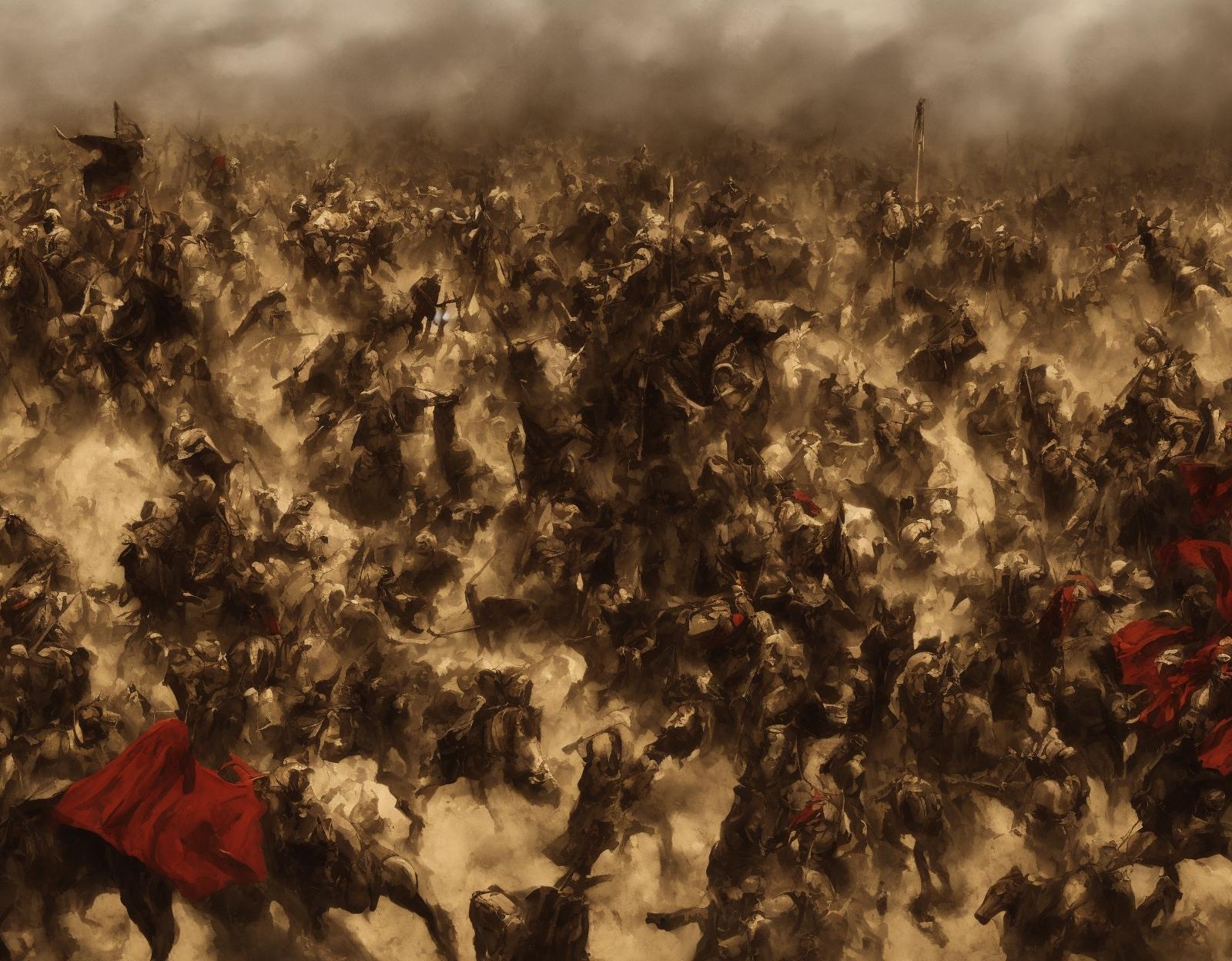
The Final Charge: The Fall of the Kingdom The dawn of Saturday, July 4th, 1187, broke over a scene of desperation. For the Crusader army, there was no choice left. It was victory or death. As the sun began its ascent, the Christian forces, gaunt and dehydrated, prepared for their final, hopeless act. Priests moved through the ranks, giving absolution and carrying the True Cross, its gold and jewels a stark contrast to the grim squalor of the camp. The plan, born of desperation, was simple: the knights would have to charge and break Saladin’s lines to reach the water. The battle began with the Crusader infantry attempting to push down the slope towards the Sea of Galilee. But they were a shadow of a fighting force. Maddened by thirst and demoralized, their charge faltered almost immediately against the fresh, well-supplied Muslim ranks. They were driven back up the hill towards the main body of the army, their retreat sowing chaos. The battle now devolved into a series of desperate cavalry charges. Raymond of Tripoli, leading a contingent of knights, launched a charge against the section of Saladin’s line commanded by his nephew, Taqi al-Din. In a surprising and still-debated moment, Taqi al-Din’s forces seemed to part, opening a gap through which Raymond and his knights, including Balian of Ibelin, escaped. Whether this was a tactical concession by Saladin to remove a capable commander or simply a momentary breakthrough is unknown, but Raymond fled the field, his honor forever stained in the eyes of many chroniclers. With Raymond gone, the remaining knights organized a final, desperate assault on Saladin’s position. King Guy ordered two distinct charges directly at the Sultan’s personal bodyguard, hoping to kill or capture the enemy commander and shatter his army’s morale. The Knights Templar and Hospitaller, the elite fighting forces of Christendom, led the way. They charged with what little strength they had left, crashing into the Ayyubid lines. For a moment, they seemed on the verge of success, pushing close to Saladin himself, who was seen rallying his men. But they were too few, too tired, and too thirsty. Each charge was repulsed, the knights driven back up the hill, their horses collapsing beneath them. The end came when Saladin’s forces launched their final counter-attack. They swarmed up the hill, overwhelming the last pockets of resistance. King Guy’s red royal tent became the focal point of the fighting. Its capture would signal the end. A small group of knights, including the king himself, made a final stand around it, but they were quickly overrun. The tent fell. At the same time, the Bishop of Acre, holding the True Cross aloft, was killed and the sacred relic was captured. A great cheer went up from Saladin’s army. The capture of the enemy king and their most holy object was a total, undeniable victory. The remaining Christian soldiers, seeing the Cross fall and the king
How we verify this article
By the History Unlocked editorial team
This text is built on historical facts stored in our database and drafted with AI assistance. No signed human review is recorded for this article. Report any inaccuracy: we correct it and update the modified date.
Updated on
AI-assisted drafting.
Read our editorial standardsEnjoyed this? Discover more articles in the category Knights Templar