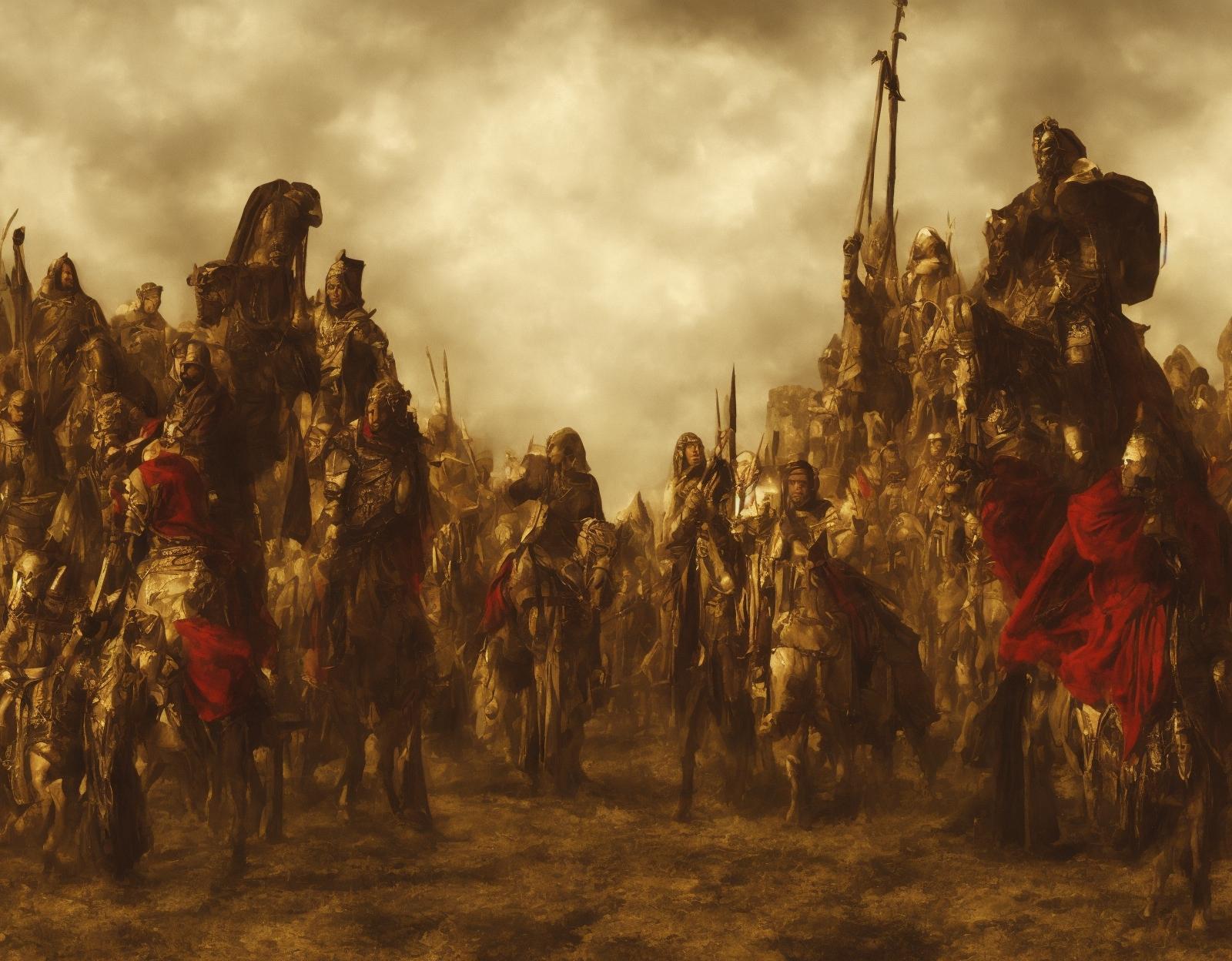
Templars in Jerusalem: Secret History of the Knights of the Temple
The year is 1120. Jerusalem, wrested from Fatimid control just two decades prior by the armies of the First Crusade, is a city living on a knife’s edge. Waves of Christian pilgrims, driven by a fervent desire to walk in the footsteps of Christ, pour into the Holy Land. But the roads are treacherous, patrolled by bandits and Saracen raiding parties. For many, the sacred journey ends in martyrdom long before the golden dome of the city comes into view. In this crucible of faith and fear, a small, unassuming group of nine French knights, led by a nobleman named Hugues de Payens, presents themselves to the Crusader King of Jerusalem, Baldwin II. Their proposal is simple, yet audacious: they wish to form a new kind of brotherhood, a monastic order dedicated not only to prayer but to the sword. Their stated mission is to protect the pilgrim routes, to be the shield for the faithful. King Baldwin, ruling a kingdom desperately short of professional soldiers, grants them a headquarters in a wing of the royal palace, a building with a history more profound and mysterious than any in the world: the Al-Aqsa Mosque, situated on the vast, elevated platform known as the Temple Mount. The Crusaders, believing the mosque to be the remnants of the very Temple of Solomon, called it the Templum Salomonis. It was from this sacred, contested ground that the "Poor Fellow-Soldiers of Christ and of the Temple of Solomon" would take their name. They would become the Knights Templar. For nearly a decade, their numbers remained fixed at nine. They were a curiosity, clad in donated clothes, so poor that their original seal depicted two knights sharing a single horse. But beneath this veneer of poverty and humble service, a legend was being forged in the shadows of the Temple Mount, a legend that would see them rise to become the most powerful and feared organization in Christendom, and one whose secrets may lie buried still beneath the ancient stones of Jerusalem. What were they truly doing during those formative years in the holy city’s most sacred space? Were they merely praying and training, or did they have a second, more clandestine purpose? The answer to that question is the key to understanding the incredible, meteoric rise and the brutal, sudden fall of the Knights Templar.
The Foundation: From Humble Protectors to a Military Powerhouse The initial years of the Templar Order were characterized by an almost theatrical poverty. Hugues de Payens and his eight companions had no significant resources of their own. They lived on the charity of the King and the Patriarch of Jerusalem, a stark contrast to the immense wealth they would later command. This period of obscurity, lasting from roughly 1120 to 1129, is one of the most debated aspects of their history. While their declared mission was the protection of pilgrims on the roads to Jerusalem, the force of just nine men was hardly sufficient to secure vast swathes of hostile territory. This has led many to speculate that their public duty was a cover for a more secret task: a systematic exploration of the Temple Mount itself. Whatever their private activities, their public image was one of pious self-sacrifice. This narrative was crucial for their future success. The turning point came in 1129 at the Council of Troyes, in France. Here, the Order’s founder, Hugues de Payens, made a powerful appeal for official recognition and support. The most influential voice at the council was that of Bernard of Clairvaux, a Cistercian abbot and one of the most charismatic and powerful figures in the medieval Church. Bernard was captivated by the idea of a new knighthood, one that fused the martial zeal of the crusader with the spiritual discipline of the monk. He saw in the Templars the potential for a perfected form of Christian warfare. At Bernard’s urging, the Council officially recognized the Templars as a religious and military order. Bernard himself penned a treatise, *De Laude Novae Militiae* ("In Praise of the New Knighthood"), which served as both a theological justification and a powerful recruitment tool. He contrasted the vain, sinful secular knights with the Templars, the new "knights of Christ," who killed without sin and died for a martyr’s reward. This endorsement was a masterstroke of public relations. The Council also approved the Latin Rule, a strict code of conduct for the knights, which governed every aspect of their lives, from their vows of poverty, chastity, and obedience to the clothes they wore and the number of horses they could own. With papal sanction and the powerful backing of Bernard of Clairvaux, the Templars were transformed. Donations of land, money, and recruits began to flood in from across Europe. The Order was granted unprecedented privileges: its members were exempt from all local taxes, they could pass freely through international borders, and most importantly, they answered to no authority on earth save the Pope himself. This autonomy made them a supranational entity, a kingdom unto themselves, with its heart in Jerusalem but its limbs reaching into every corner of Christendom. The poor knights were now a formidable institution, a spiritual and military enterprise poised for explosive growth.

Headquarters on the Temple Mount: Secrets Beneath the Stone The importance of the Templars’ headquarters on the Temple Mount cannot be overstated. To the Crusaders, this was not just a strategic location; it was the epicenter of biblical history. They identified the magnificent Dome of the Rock as the *Templum Domini* (Temple of the Lord) and the Al-Aqsa Mosque as the *Templum Salomonis* (Temple of Solomon), believing it to be the very structure built by the biblical king. By occupying this site, the Templars were positioning themselves as the inheritors and protectors of a sacred legacy stretching back thousands of years. The Temple Mount is a colossal, man-made platform, and its history is layered with construction, destruction, and reconstruction. Beneath the paved surface lies a network of ancient passages, cisterns, and vaulted chambers. The most significant of these is a vast, subterranean hall at the southeastern corner of the platform, supported by a forest of stone pillars. The Crusaders named this area "Solomon's Stables," believing it to be the place where the wise king had housed his thousands of horses. The Templars took this quite literally. They converted the cavernous space into a functional stable, capable of housing over a thousand of their warhorses, along with the horses of their sergeants and squires. Contemporary accounts, like that of the chronicler William of Tyre, describe the sheer scale of the Templars’ construction projects. They renovated, fortified, and expanded their quarters, effectively turning that entire section of the Temple Mount into a self-contained fortress. But it is the work they did underground that has fueled centuries of speculation. Modern archaeological surveys have confirmed that the Templars undertook significant modifications to these subterranean spaces. They cleared ancient blockages, repaired structures, and likely created new access points. The official reason would have been practical: to create storage, stabling, and secure access to water. However, the sheer length of time they spent there—nearly seventy years—in almost complete secrecy has led to more tantalizing theories. Were they conducting the first great archaeological excavation of the Holy Land? The idea is not as outlandish as it might sound. They were dwelling on a site where, according to the Bible, the Ark of the Covenant had been housed. Legends of immense temple treasures, hidden before the Babylonian conquest, were commonplace. Could the Templars have been systematically searching for these relics and treasures? If they had found something—whether it was gold, sacred relics like the Ark, or even scrolls containing lost knowledge—it would help explain their astonishingly rapid accumulation of wealth and influence. There is no direct, written proof of such a find. The Templars were a secret society, and their initiation rites included vows to never reveal the order’s secrets. But the circumstantial evidence is compelling: a poor order is granted control over a site believed to hold immense secrets, they spend decades working there in private, and they emerge as the wealthiest and most powerful organization in the world. The mystery of what happened in the vaults beneath the Temple of Solomon remains the foundational legend of the Templar Order.
The Bankers of Christendom: An Economic Empire Forged in the Holy Land While the image of the sword-wielding warrior monk is central to the Templar identity, their most lasting innovation was not on the battlefield but in the world of finance. Born from the practical necessities of the Crusades, the Templars created what many historians consider the world’s first multinational corporation and international banking system. The engine of this economic empire was the constant flow of people and money between Europe and the Holy Land. A nobleman wishing to go on crusade or pilgrimage faced a perilous problem: carrying large amounts of gold and silver made him a prime target for robbers. To solve this, the Templars developed a sophisticated system of credit. A person could deposit their funds at a Templar preceptory in London, Paris, or Rome. In return, they would receive a letter of credit, a coded document detailing the amount deposited. Upon arrival in the Holy Land, the traveler could present this letter to the Templar headquarters in Jerusalem or Acre and withdraw their funds in local currency. This system eliminated the risk of transport and was a revolutionary financial instrument. The Templars, with their fortified preceptories spanning the entire continent and their unwavering reputation for honesty and military strength, were the only institution with the infrastructure and credibility to make it work. Their services became indispensable. Kings, nobles, and merchants used them to transfer vast sums of money. This system was not only a service; it was immensely profitable. The Templars engaged in currency exchange and likely charged fees, but their main profits came from having enormous amounts of capital on hand, which they could then loan out at interest. While the Church officially forbade usury (lending at interest), the Templars found clever loopholes, often structuring loans as rent agreements or ventures with delayed profit sharing. Their financial network grew to be incredibly complex. They acted as the official treasury for the Crusader States and often for the monarchies of France and England. They managed estates, collected taxes, and acted as executors for the wills of wealthy patrons. The Templar treasure was not a single chest of gold but a sprawling portfolio of assets: cash, land, castles, farms, vineyards, mills, ships, and entire industries. Their network of commanderies, some 10,000 strong at their peak, functioned as a combination of fortress, monastery, and local bank branch. This immense economic power, independent of any king and answerable only to the Pope, bred both reliance and deep-seated resentment. Rulers became indebted to them, and the local clergy and aristocracy grew jealous of their wealth and privileges. Their financial success, born from the needs of Jerusalem, had made them powerful, but it also made them a target. Their wealth, no longer primarily being used to fight for the Holy Land after its loss, seemed to many like a treasure hoard waiting to be seized.

The Warrior Monks in Action: Templar Military Doctrine and Major Battles The Templars’ financial acumen was built upon their martial reputation. They were, first and foremost, an elite military force. Their battle doctrine was centered on the heavy cavalry charge, a thundering wave of steel and horseflesh designed to shatter enemy formations. A Templar knight was the medieval equivalent of a main battle tank: clad head-to-toe in the best chainmail and plate armor, wielding a lance, a sword, and a mace, and mounted on a powerful warhorse known as a destrier. The Order
How we verify this article
By the History Unlocked editorial team
This text is built on historical facts stored in our database and drafted with AI assistance. No signed human review is recorded for this article. Report any inaccuracy: we correct it and update the modified date.
Updated on
AI-assisted drafting.
Read our editorial standardsEnjoyed this? Discover more articles in the category Knights Templar