The Templar Enigma: Unraveling the True Causes of Their Sudden Downfall
The year is 1307. Across the breadth of France, a sinister plot unfolds, silently, with lethal precision. Under the cloak of dawn on Friday, October 13th, agents of King Philip IV, known as Philip the Fair, sweep across the kingdom, executing secret orders that would send shockwaves through medieval Europe and etch themselves into the annals of history forever. Their target: the Knights Templar, a military order that had stood as a pillar of Christendom for nearly two centuries, embodying chivalry, piety, and immense wealth. From their humble beginnings as guardians of pilgrims in the Holy Land to their formidable status as international financiers and elite warriors, the Templars had ascended to a position of unparalleled influence. Yet, in a single, brutal stroke, their world was shattered, their reputation irrevocably tarnished by a litany of sensational charges. This was no mere judicial process; it was a meticulously orchestrated destruction, driven by motives still debated by historians. Was it the King's insatiable greed for their vast riches, his desperation to consolidate power, or a genuine belief in the heretical accusations leveled against them? The suddenness and severity of their demise left many bewildered, fostering an enduring legacy of conspiracy theories and romanticized narratives. To understand the collapse of this once-invincible order is to peer into the turbulent political landscape of 14th-century Europe, a time when kings challenged papal authority, and the lines between temporal and spiritual power were fiercely contested. This article will delve into the intricate web of events, the key players, and the profound forces that converged to dismantle one of the most powerful and secretive organizations of the Middle Ages, seeking to unravel the true causes behind the enigmatic fall of the Knights Templar.
The Rise to Power: From Humble Beginnings to Unprecedented Influence
To fully appreciate the magnitude of the Templars' fall, one must first grasp the heights from which they plummeted. The Order of the Poor-Fellow Soldiers of Christ and of the Temple of Solomon, or the Knights Templar, originated in 1119. A small band of nine French knights, led by Hugh de Payens, approached King Baldwin II of Jerusalem with a revolutionary proposition: to protect Christian pilgrims traveling to the Holy Land, a journey fraught with peril. Their initial mission was humble, their resources scarce, yet their resolve was unwavering. Bernard of Clairvaux, one of the most influential figures of the 12th century and a key proponent of the Second Crusade, became their most ardent supporter. His eloquent treatise, "In Praise of the New Knighthood," painted the Templars as a new breed of warrior monk, combining monastic piety with military prowess, an ideal that resonated deeply with the spirit of the age. This endorsement, coupled with the official recognition by Pope Honorius II at the Council of Troyes in 1129, cemented their legitimacy and set them on a path to unprecedented growth.
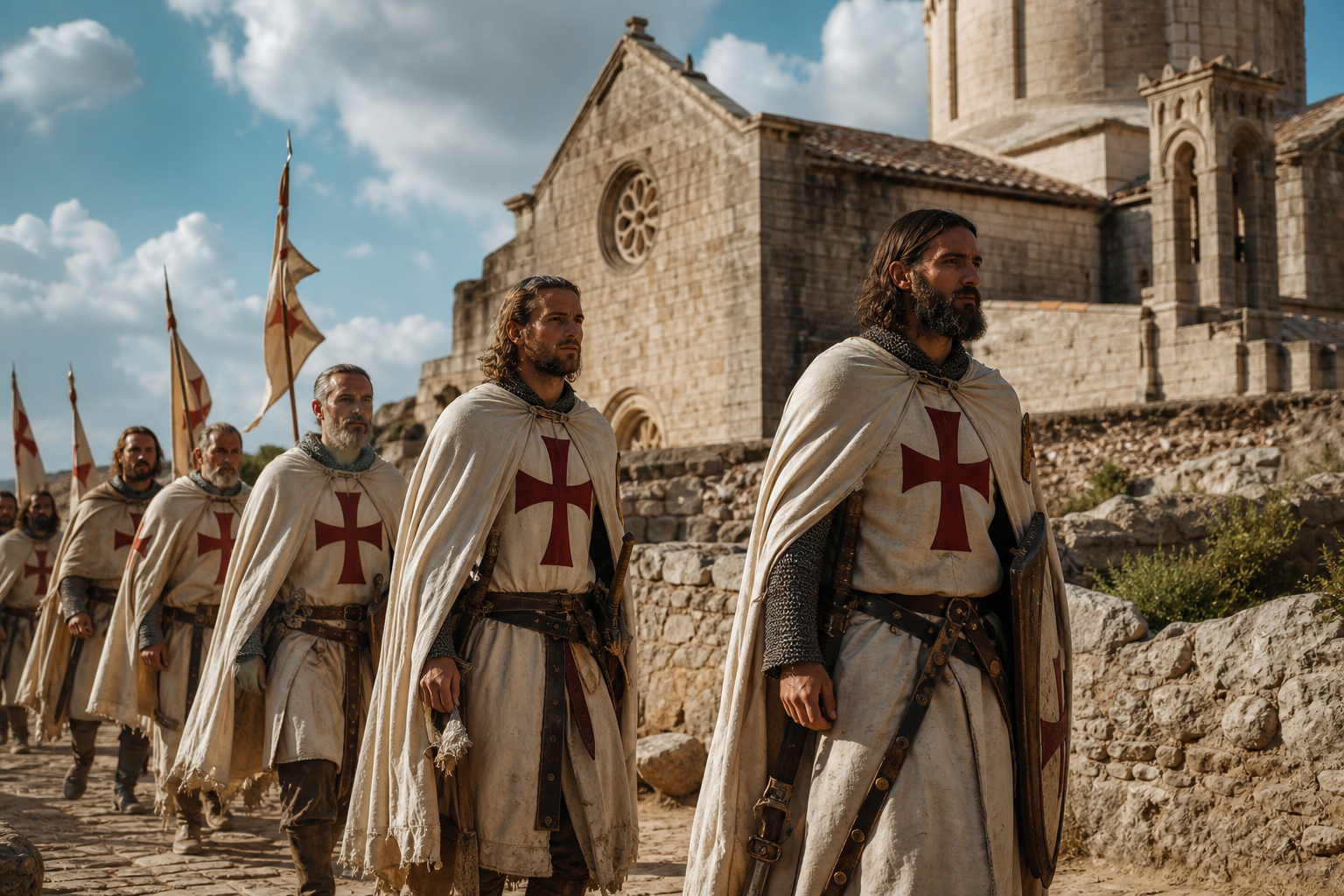
Over the next two centuries, the Templars transformed. Their initial poverty gave way to immense wealth, acquired through donations of land, money, and other valuables from devout patrons across Europe. They established a vast network of preceptories, or commanderies, functioning as administrative and economic centers that spanned from England to the Holy Land. These preceptories were not just military garrisons; they were sophisticated agricultural and financial hubs, managing vast estates, livestock, and industries. Their involvement in the Crusades further enhanced their reputation and attracted more recruits and donations. As an elite fighting force, they were legendary for their courage, discipline, and ferocity on the battlefield, often forming the spearhead of Crusader armies and serving as the last line of defense. Their white mantles, emblazoned with the distinctive red cross, became a terrifying sight for their enemies and a symbol of hope for their allies.
Did you know? The Templars were exempt from local laws and taxes, answering only to the Pope, a privilege that caused considerable friction with secular rulers over time.
Beyond their military might, the Templars developed an extensive and sophisticated financial system. They became the primary bankers for kings, nobles, and even the Pope, managing vast sums of money, facilitating loans, and handling international transactions. Their network of commanderies served as secure depositories for valuables, and they pioneered early forms of banking, such as letters of credit, which allowed pilgrims and merchants to travel without carrying large amounts of cash, thus reducing the risk of banditry. This financial acumen made them indispensable to the European economy, but it also made them incredibly powerful and, ultimately, vulnerable. Their autonomy, granted by papal bulls that made them answerable only to the Pope, further set them apart from secular rulers, creating fertile ground for resentment and suspicion. By the late 13th century, after the fall of Acre in 1291, the last major Crusader stronghold in the Levant, the Templars, along with other military orders, were forced to retreat from the Holy Land. Though their original purpose was curtailed, their wealth and influence remained undiminished, a fact that would prove to be a double-edged sword.
Philip the Fair's Desperate Designs: The King's Motives Unveiled
The immediate catalyst for the Templars' destruction was the French King Philip IV. Known as "Philip the Fair" for his handsome features, he was a monarch with an ambitious agenda: to centralize royal power, assert French dominance in Europe, and fill his treasury, which was perpetually depleted by costly wars, particularly against England and Flanders. Philip was a ruthless pragmatist, willing to employ any means, however Machiavellian, to achieve his goals. He had already demonstrated his willingness to challenge established powers, most notably in his bitter struggle with Pope Boniface VIII, which ultimately led to the Pope's humiliation and death. This conflict showcased Philip's audacious strategy of using legalistic arguments, propaganda, and even physical intimidation to subdue his political opponents.
By the early 14th century, Philip's financial woes were acute. He had already resorted to debasing the coinage, taxing the clergy, and expelling and seizing the assets of the Jews in 1306, incurring widespread popular resentment. The Templars, with their vast wealth, extensive landholdings, and powerful financial institutions, represented an irresistible target. It is important to remember that the Templars, despite their international reach, had their primary European base and a significant number of their members in France. Their principal treasury was located in Paris, within their formidable Temple complex, making it particularly accessible to a determined French monarch. The Order's wealth was not merely about cash; it encompassed extensive feudal estates, castles, and valuable goods across the kingdom, all of which would greatly bolster the royal coffers if seized.
Did you know? The charges of spitting on the cross and denying Christ were often explained by Templars as a simulated apostasy, designed to teach recruits what they might be forced to do if captured by Saracens.
Philip's desire for the Templars' wealth was undoubtedly a major driving force, but it was not necessarily the sole motivation. There were also political considerations. The Templars represented a powerful, autonomous entity within his kingdom, answerable only to the Pope. Such an independent power bloc was anathema to Philip's vision of a strong, centralized monarchy. Eliminating the Templars would remove a significant rival power center and allow Boto consolidate his authority. Furthermore, their role as international bankers and their close ties with other European powers may have been perceived as a threat to French sovereignty. Philip likely aimed not just to seize their assets but also to absorb their functions, particularly those related to finance, into the royal administration, thus enhancing his control over the French economy and strengthening his position on the European stage. The carefully planned and synchronized arrests across France suggest a campaign driven by strategic political and financial objectives rather than spontaneous outrage over alleged heresies. Philip needed a compelling pretext, however, and the growing public resentment towards the Templars, fueled by their perceived arrogance and detachment, provided fertile ground for the accusations he would soon unleash.

The Charges and Confessions: A Web of Heresy and Torture
On that fateful Friday the 13th, thousands of Templars across France were arrested simultaneously. The speed and secrecy of the operation indicate meticulous planning, confirming the king's determination to prevent any resistance or the concealment of assets. The charges leveled against them were shocking and scandalous, designed to utterly destroy their reputation and justify the seizure of their property. These accusations included heresy, idolatry (worshipping a demon called Baphomet), spitting on the cross, denying Christ, engaging in homosexual acts, and holding secret rites where they kissed the officiant on the navel, spine, and buttocks. These were not merely religious transgressions; they were considered an affront to all Christian values and guaranteed to outrage the pious sensibilities of the medieval populace.
Under interrogation, many Templars "confessed" to these heinous crimes. However, it is crucial to understand the context in which these confessions were extracted. The interrogations were conducted by royal agents, often using brutal torture, including methods like strappado, starvation, and the dreaded "water cure." The medieval legal system, particularly in cases of heresy, allowed for the use of torture to elicit confessions, under the misguided belief that no innocent person would confess unless it were true. Faced with unimaginable pain, many knights, even the Grand Master Jacques de Molay, initially admitted to some of the charges. These confessions, however, were often inconsistent, riddled with contradictions, and frequently retracted once the Templars were out of the immediate presence of their interrogators or when brought before ecclesiastical courts.
Did you know? Despite the official dissolution, some historians believe that pockets of Templars continued to exist in secret, particularly in countries like Portugal and Scotland, evolving into new orders or integrating into existing ones.
The inconsistencies in the confessions further highlight their dubious nature. Some Templars confessed to spitting on the cross during initiation, claiming it was merely a symbolic act to prepare them for potential capture and forced conversion by Muslims. Others admitted to worshipping an idol, though descriptions of this idol varied wildly, suggesting a lack of a coherent cult. The accusations of homosexual acts and other immoral behaviors served to blacken their character and dehumanize them in the eyes of the public. Philip and his ministers expertly manipulated public opinion, portraying the Templars as depraved heretics who had betrayed their sacred vows. They used these confessions, however forced, as essential "proof" to legitimize their actions and pressure Pope Clement V to comply. The Pope, a Frenchman highly susceptible to Philip's influence, found himself in an impossible position, caught between defending a powerful order that answered only to him and incurring the wrath of one of Europe's most formidable monarchs. The confessions, extracted under duress, became the lynchpin of Philip's campaign, providing the legal, if ethically questionable, foundation for the Order's dissolution.
The Papal Predicament: Clement V Caught Between King and Conscience
Pope Clement V, born Bertrand de Got, found himself in an unenviable and ultimately precarious position. A Frenchman, he had been elected Pope in 1305, largely through the machinations of Philip IV, and had subsequently moved the papal court from Rome to Avignon in 1309. This move, known as the "Avignon Papacy," placed him firmly within the sphere of French influence and control, severely compromising his ability to act independently. When Philip launched his attack against the Templars, Clement initially reacted with outrage, asserting his papal authority over the Order. He ordered a papal investigation and suspended the power of the inquisitors who were torturing the Templars, insisting that the knights were under ecclesiastical jurisdiction, not royal.
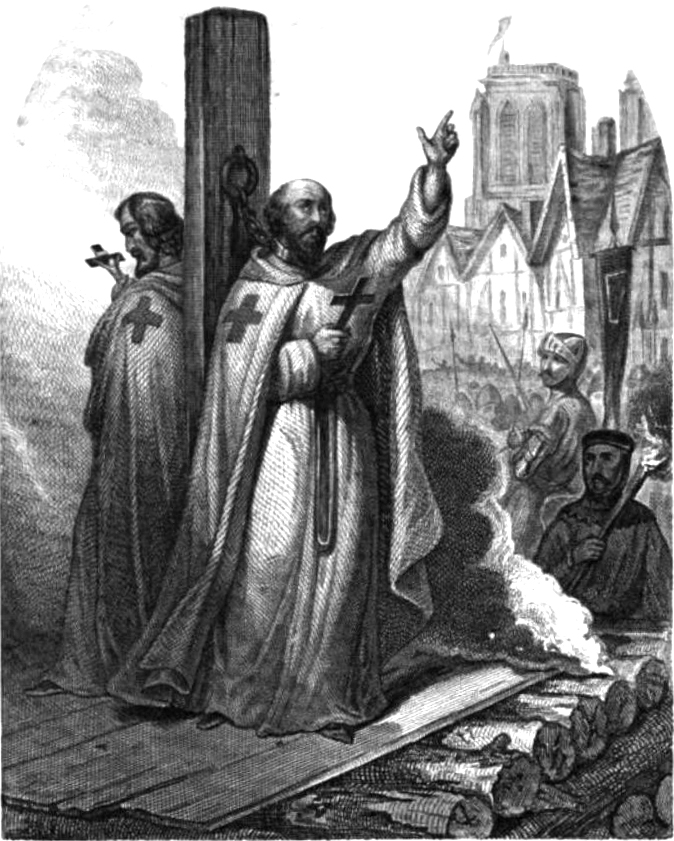
However, Philip's pressure was relentless and multifaceted. He used the "confessions" to paint a horrifying picture of Templar depravity and heresy, mobilizing public opinion against the Order. He threatened Clement with charges of heresy himself, suggesting that the Pope was protecting heretics, a grave accusation that could have severe consequences for a pontiff. Philip also orchestrated a carefully choreographed show trial in Paris, where scores of Templars, having initially confessed under torture, bravely recanted their confessions, only to be burned at the stake as relapsed heretics. These public executions served as a brutal warning to any who might dare to defy the king or question the validity of the charges. Caught between a powerful monarch who controlled his movements and threatened his spiritual authority, and the moral duty to protect an order that was technically under his direct protection, Clement was forced to compromise.
Did you know? The phrase "Friday the 13th" as an unlucky day is popularly, though anachronistically, linked to the Templar arrests in 1307, further cementing their story in cultural folklore.
The Pope initially sought to defend the Templars and conduct a fair inquiry. He tried to organize a council to hear their defense and provide a proper canonical process. However, Philip consistently undermined these efforts, ensuring that no effective defense could be mounted. Faced with overwhelming political pressure, fear for his own safety and the stability of the Church, and perhaps genuinely swayed by some of the evidence presented, however tainted, Clement eventually bowed to Philip's will. At the Council of Vienne in 1312, under immense duress, he issued the papal bull "Vox in excelso," officially suppressing the Order of the Knights Templar. Crucially, Clement did not condemn the Templars for heresy but dissolved the Order "not by definitive sentence, but by an ordinance or provision." This meant he dissolved the Order not because he found them guilty of the specific charges, but because their reputation was so tarnished that they could no longer effectively serve the Church, and peace required their suppression. Their vast possessions were nominally transferred to the Knights Hospitaller, another military order, though in practice, Philip managed to seize a significant portion of the Templar assets in France, effectively achieving his financial and political objectives.

The Final Act: The Fate of Jacques de Molay and the Order's Legacy
The dissolution of the Order brought a grim end to the individual Templars, particularly its leadership. Many languished in prisons, some were executed, and others were absorbed into different monastic orders, often after being forced to confess. The most prominent figure, Grand Master Jacques de Molay, along with the Preceptor of Normandy, Geoffroi de Charney, endured years of imprisonment and torture. Molay, a courageous and devout knight, had initially confessed under torture in 1307, likely in an attempt to save his brothers and himself from further suffering. However, in 1314, before a commission on the Île aux Juifs in Paris, he dramatically recanted his confession, loudly proclaiming the innocence of the Templars and the falsity of the charges against them. He declared that he had lied out of fear and stated that the Order was pure and holy. Geoffroi de Charney also recanted his confession.
This public retraction was a direct challenge to the authority of both the Pope and the King, a defiant act of courage that sealed their fate. Enraged by this open defiance, Philip IV, without consulting the Pope, immediately ordered their execution. On March 18, 1314, Jacques de Molay and Geoffroi de Charney were burned at the stake on a small island in the Seine, near Notre Dame Cathedral. Legend has it that as the flames consumed him, de Molay cursed both Pope Clement V and King Philip IV, summoning them to appear before God's judgment within a year and a day. Both men indeed died shortly thereafter: Clement V died in April 1314, and Philip IV followed in November 1314. While likely a coincidence, this eerie fulfillment of de Molay's curse only fueled the enduring mystique and dark romanticism surrounding the Templars' demise.
The legacy of the Templars' fall is multifaceted. It marked a significant shift in the balance of power between the papacy and secular monarchs, demonstrating the increasing strength of national monarchies. It also profoundly influenced the future of military orders, as no other order would ever again attain such ecclesiastical independence and financial power. The methods employed by Philip IV — the use of propaganda, torture, and a manufactured crisis to dismantle a powerful institution — set a dangerous precedent for future state actions. The Templars' story became a cautionary tale of unchecked royal ambition and the vulnerability of even the most powerful organizations to political machinations.
Echoes Through History: The Enduring Allure and Modern Interpretations
The dramatic downfall of the Knights Templar left an indelible mark on history and continues to captivate the public imagination. Generations of historians, writers, and conspiracy theorists have sought to unravel the "true" secrets of the Templars and the real reasons behind their destruction. The mystery surrounding their immense wealth, their secretive rituals, and the suddenness of their collapse created fertile ground for legends and myths. From tales of hidden treasures to their supposed guardianship of sacred relics like the Holy Grail or the Ark of the Covenant, the Templars have become synonymous with enigma and esoteric knowledge.
In modern times, the Templars feature prominently in popular culture, from novels and films to video games. Works like "The Da Vinci Code" by Dan Brown have reignited public interest, albeit often through highly fictionalized accounts. These narratives frequently depict the Templars as holders of ancient secrets, protectors of a bloodline, or a shadowy organization that simply "went underground" to re-emerge later. While historically inaccurate, these portrayals underscore the enduring fascination with an order that embodied faith, power, and ultimately, betrayal.
Historians, however, continue to analyze the fall of the Templars through a more critical lens. While acknowledging the sensational accusations, modern scholarship tends to focus on the political and economic realities of the early 14th century. The consensus is that Philip IV's actions were primarily driven by financial desperation and a desire to consolidate royal power, with the charges of heresy serving as a convenient and emotionally charged pretext. The Pope's complicity is understood within the context of his weakened position and the immense pressure exerted by the French Crown. The Templars, though powerful, were ultimately isolated; their primary purpose (protecting pilgrims to the Holy Land) had become obsolete after the loss of Acre, leaving them without a strong public mandate to justify their immense wealth and autonomy in mainland Europe. Their internal structure and centralized control, which had once been their strength, made them an easier target for a coordinated attack compared to more decentralized monastic orders.
The Unfinished Verdict: Lessons from a Medieval Tragedy
The story of the Knights Templar's fall is more than just a dramatic historical event; it is a profound lesson in the dynamics of power, justice, and historical interpretation. It serves as a stark reminder that even institutions of immense power and prestige can be vulnerable to the machinations of determined rulers, especially when political and economic interests align. The Templars, who had once been considered God's own warriors, were swiftly and brutally condemned by an alliance of secular and ecclesiastical power, their legacy transformed from piety to infamy almost overnight.
Their demise illustrates the perilous nature of wealth without adequate political protection, and the dangers of maintaining significant autonomy within a kingdom increasingly striving for centralization. The Templars' devotion to the Church, ironically, made them dependent on a Pope who, in the critical moment, was too weak to shield them effectively from royal aggression. Their commitment to their vows, even under torture, speaks volumes about their faith and resilience, yet it ultimately could not save the Order from political expediency.
Furthermore, the Templar trials offer a chilling glimpse into the medieval justice system, where accusations of heresy could be wielded as potent political weapons, and confessions extracted under torture were deemed legitimate evidence. The ambiguity surrounding their guilt and the enduring debate over the veracity of the charges have ensured that the Templars remain one of history's most enduring mysteries. Their story compels us to question official narratives, to critically examine the motives behind historical events, and to consider the profound impact that propaganda and political opportunism can have on the course of history. In many ways, the fall of the Templars continues to resonate, reminding us of the fragility of power and reputation, and the enduring human fascination with the untold secrets of the past.
The meticulous destruction of the Knights Templar, orchestrated by Philip IV and reluctantly endorsed by Pope Clement V, stands as a brutal testament to the cutthroat politics of the Middle Ages. It was a confluence of avarice, political ambition, and a weakened papacy that sealed their fate. While allegations of heresy provided the moral justification, the underlying currents of royal debt and the desire for centralized power truly drove the king's actions. The Templars, once revered protectors of the Holy Land, found their piety and wealth turned against them, serving as the very instruments of their undoing. Their legacy, though shrouded in mystery and legend, serves as a powerful historical marker, reminding us of a time when the sword of a king could cleave through even the most sacred of institutions, reshaping the face of Europe and leaving an indelible mark on the collective historical imagination. The echoes of that fateful Friday the 13th, 1307, continue to reverberate, inviting us to ponder the true cost of power and the enduring enigma of justice betrayed.
How we verify this article
By the History Unlocked editorial team
This text is built on historical facts stored in our database and drafted with AI assistance. No signed human review is recorded for this article. Report any inaccuracy: we correct it and update the modified date.
Updated on
AI-assisted drafting.
Read our editorial standardsEnjoyed this? Discover more articles in the category Knights Templar