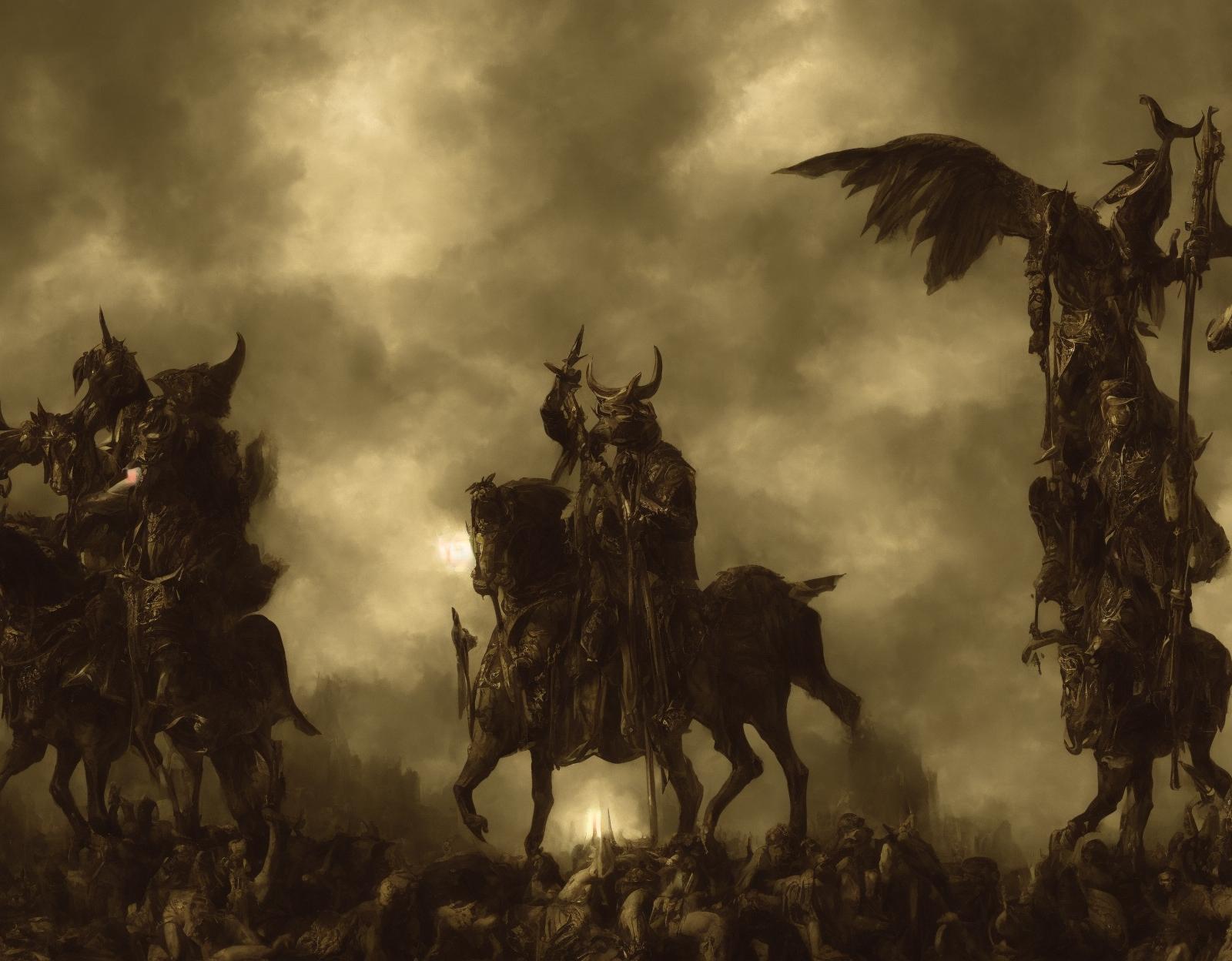
The Baphomet: Unmasking the Truth Behind the Templar's Forbidden Idol
An aura of mystery, heresy, and forbidden knowledge clings to the name "Baphomet," an enigmatic figure forever intertwined with the tragic downfall of the Knights Templar. For over seven hundred years, its name has been whispered in the shadowy corners of history, synonymous with devil worship, arcane rituals, and a conspiracy that brought the most powerful military order in Christendom to its knees. The story of Baphomet begins not in ancient grimoires or pagan temples, but in the torture chambers of medieval France, on the lips of men forced to confess to unspeakable crimes. On Friday, October 13, 1307, agents of King Philip IV of France launched a coordinated strike, arresting Templar knights across the nation. The charges were shocking: heresy, spitting on the cross, engaging in sodomy, and, most damningly, the worship of a mysterious idol, a head said to speak and grant them wealth and power. This idol, their accusers claimed, was Baphomet. But what was it? Was it a genuine artifact of blasphemy, a bearded head kept in a secret coffer? Was it a symbol of a hidden Gnostic doctrine learned in the Holy Land? Or was it merely a phantom, a monstrous fabrication cooked up by a greedy king to justify the seizure of the Templars' immense wealth and the annihilation of an order that had grown too powerful for his liking? The Baphomet of the Templar trials is a ghost, a puzzle whose pieces are scattered across contradictory confessions and the biased chronicles of the Order's enemies. Its journey, however, did not end with the smoke that rose from the pyre of Jacques de Molay, the last Grand Master. The figure would lay dormant for centuries, only to be resurrected and radically transformed in the 19th century into the iconic, goat-headed androgyne that has become a potent symbol in modern occultism, counterculture, and even the fight for religious liberty. To understand Baphomet is to embark on a journey through the darkest chapters of religious persecution, the labyrinthine world of esoteric symbolism, and the fascinating power of a single idea to mutate and survive through the ages.
The Accusation: A Head of Heresy The public emergence of Baphomet is inextricably linked to the meticulously orchestrated and brutal persecution of the Knights Templar. Before 1307, the name was completely unknown in any theological or historical text. Its birth was violent, springing forth from the depths of dungeons where royal inquisitors, under the command of the ruthlessly efficient Guillaume de Nogaret, employed starvation, sleep deprivation, and the rack to extract the desired confessions. The primary purpose of the trials, instigated by a French crown deeply indebted to the Templar banks, was not justice but annihilation. To achieve this, a charge of heresy was essential, as it was the one crime that could dissolve the Order and place its vast assets at the king's mercy. The worship of an idol provided the perfect, sensationalist centerpiece for this campaign. The confessions, extracted under duress, were wildly inconsistent—a key indicator of their fabricated nature. When pressed about the idol, the terrified and broken knights gave a bewildering array of descriptions. Some described a gilded wooden head with a beard. Others claimed it was a head with two or even three faces, capable of looking in all directions. Still others spoke of a figure of a man covered in skin, a skull, or, in a few bizarre cases, a cat. Brother Raoul de Gisy, a preceptor, confessed to seeing a "head of an idol" which he was forced to adore. Another, Jean de Châlons, spoke of a head "in the form of a bust of a man." The specifics changed from one tortured testimony to the next, but the core accusation remained: the Templars, heroes of the Crusades, had a secret, blasphemous object of worship. This inconsistency suggests that the knights, desperate to stop the pain, were either guessing at what their tormentors wanted to hear or that the inquisitors themselves had no clear picture of the alleged idol, feeding leading questions to their victims. The very purpose of this "idol" was also described in contradictory terms. Some said it gave the Order its wealth, others that it made the land fertile, and some that it spoke prophecies. The accusers, led by Philip IV, masterfully wove these disparate threads into a tapestry of demonic conspiracy, painting the Templars not as pious warrior-monks but as a satanic cult operating in the heart of Christendom.
Deconstructing "Baphomet": A Linguistic Puzzle With no physical evidence of the idol ever found—no heads were discovered in any of the ransacked Templar preceptories—historians and linguists have turned their attention to the name itself. The word "Baphomet" is so strange, so alien to European languages of the time, that its very origin is a profound mystery. Over the centuries, scholars have proposed several compelling, yet ultimately unproven, theories. The most widely accepted and historically plausible explanation is that "Baphomet" is an Old French corruption of "Mahomet," the medieval European rendering of the name of the Prophet Muhammad. Given the centuries of conflict and contact during the Crusades, it would have been a potent and easily understood charge to accuse the Templars of having "gone native"—of secretly converting to Islam or, in the distorted imagination of the medieval West, of worshipping Muhammad as a god. Accusations of idol worship were a common feature of Christian polemics against Islam, despite being fundamentally untrue to Islamic theology. For Philip IV’s propagandists, claiming the Templars worshipped "Mahomet" would be a simple and effective way to frame them as traitors to the faith. Another compelling, though more esoteric, theory suggests a Gnostic origin, deriving the name from the Greek words *baphe* and *metis*, which can be combined to mean "baptism of wisdom." This interpretation posits that the Templars were not devil worshippers but secret inheritors of a Gnostic Christian tradition that emphasized direct experiential knowledge (gnosis) over blind faith. In this view, "Baphomet" was not a physical idol but a conceptual symbol for a secret initiation, a "baptism" into a higher level of spiritual understanding. A third line of inquiry looks to the Arabic language, suggesting the name comes from the term *Abu Fihamat*, meaning "Father of Understanding." This again aligns with the idea of the Templars as guardians of hidden knowledge acquired during their time in the East. These theories, while fascinating, remain speculative. What is certain is that the vagueness and foreignness of the name worked to the advantage of the accusers. It sounded sinister and heretical, a perfect label for an imaginary crime. The linguistic puzzle of Baphomet mirrors the larger ambiguity of the charges against the Templars. Was it a simple mispronunciation of "Muhammad," a coded reference to Gnostic wisdom, or just a nonsense word chosen for its terrifying sound? The answer has been lost to time, leaving the origin of Baphomet as one of history’s most tantalizing linguistic enigmas.
Idols and Relics: Was There a Templar "Head"? Beyond the name, the most persistent element of the Baphomet legend is the physical description of a head. While the idea of worshipping a severed head seems grotesque, one must consider it within the context of medieval Christian practice. The veneration of relics, including the bones, skulls, and body parts of saints, was a central pillar of religious life. Churches and monasteries across Europe vied for prestigious relics, which were often housed in elaborate containers called reliquaries, some of which were shaped like heads or busts. It is entirely plausible that the Templars, like other religious orders, possessed a sacred head reliquary. The most commonly cited candidate is the head of John the Baptist, a relic the Templars were rumored to possess or at least have a special devotion to. Another possibility is the legendary Shroud of Turin. Some researchers, like Barbara Frale and Ian Wilson, have argued that the supposed "head" idol was actually the face imprinted on the Shroud, which may have been folded and kept in a special case, showing only the face. In this context, the Templars’ secret veneration of the Shroud—an artifact of immense, perhaps even dangerous, power—could have been easily twisted by their enemies into a narrative of idol worship. Furthermore, a specific artifact adds another layer of intrigue: the Templecombe Head. This painted wooden panel, discovered hidden in the eaves of a cottage in Templecombe, Somerset, a village that once housed a Templar preceptory, depicts a disembodied male head. Carbon-dated to the mid-13th century, it is a tangible object from the right time and place. While some believe it to be the face of Christ or John the Baptist, its enigmatic and somewhat severe expression has led others to speculate that this is the face of the infamous Templar "idol." Could this have been an object used in private Templar ceremonies, one that, seen out of context, could be misconstrued as heretical? The discovery of the Chinon Parchment in the Vatican Secret Archives in 2001 provides a crucial counter-narrative. This document records a papal hearing from 1308 in which Pope Clement V, after hearing the confessions of the Templar leaders (including Grand Master Jacques de Molay), granted them absolution, effectively finding them innocent of heresy. This suggests the Pope understood that the confessions were coerced and the charges, including the worship of Baphomet, were baseless. The tragedy is that the Pope, politically weak and under Philip’s thumb, did not have the power to make this absolution public or to save the Order from its fate. Ultimately, the "Templar head" likely existed, but it was almost certainly a Christian relic or a sacred image, its true nature deliberately and maliciously distorted to fit a predetermined narrative of guilt.
From Heresy to Esotericism: The 19th-Century Reinvention After the suppression of the Templars in 1312, the "Baphomet" vanished from historical discourse for nearly 500 years. It was a footnote in the story of a fallen order, a bizarre accusation from a bygone era. Its dramatic return came in the fertile intellectual and spiritual ground of 19th-century France, a period marked by a surge of interest in occultism, ancient mysteries, and secret societies. Freemasonic lodges and other esoteric groups began to claim a hidden lineage tracing back to the Knights Templar, and with this romantic revival came a renewed fascination with their alleged secrets, including Baphomet. The man who would pluck Baphomet from obscurity and give it its now-famous form was a French occultist, ceremonial magician, and writer named Alphonse Louis Constant, better known by his pen name, Éliphas Lévi. In his seminal 1856 work, *Dogme et Rituel de la Haute Magie* (Dogma and Ritual of High Magic), Lévi included a detailed drawing of a figure he called "The Baphomet of Mendes." This image was not a historical reconstruction but Lévi’s own original artistic and philosophical creation, a composite symbol of his entire occult worldview. Lévi’s drawing is one of the most recognizable icons in the whole of Western esotericism. It depicts a winged, anthropomorphic creature with the head and hooves of a goat, female breasts, and a flaming torch between its horns. A pentagram is inscribed on its forehead, one hand points up to a white moon, the other down to a dark moon, and the words *SOLVE* (dissolve) and *COAGULA* (coagulate) are written on its forearms. Far from being a depiction of Satan or a demonic entity, Lévi intended his Baphomet to be a complex allegory of universal equilibrium and magical pantheism. For him, it represented the absolute, the astral light, and the ultimate synthesis of all dualities: male and female (the androgyne figure), good and evil, spirit and matter, light and darkness. The goat head he linked to the Egyptian god of Mendes, a symbol of fertility and generation. The torch represents the light of divine intelligence. The gestures of the hands symbolize the hermetic maxim "As above, so below." And *Solve et Coagula* is the fundamental principle of alchemy: the power to break down elements and reassemble them into a perfected form. Lévi himself explicitly stated that his creation was a symbol of initiation and not the object the medieval Templars were accused of worshipping. He believed the Templars were victims of a smear campaign but also that they were inheritors of a high Gnostic tradition, and his Baphomet was a symbolic attempt to reconstruct that hidden philosophy.
The Modern Goat: Satanism, Pop Culture, and Misunderstanding Despite Éliphas Lévi’s complex philosophical intentions, the visual power of his goat-headed Baphomet was too potent to remain confined to the esoteric world of high magic. Its monstrous appearance was easily conflated with traditional Christian iconography of the Devil, and its trajectory in the 20th century was one of radical simplification and re-appropriation. The first major step in this transformation came with the popularization of tarot cards. Arthur Edward Waite, a prominent occultist and creator of the hugely influential Rider-Waite tarot deck (1909), based his "Devil" card directly on Lévi’s Baphomet. Although Waite understood the nuanced symbolism, millions of tarot users who saw the card simply reinforced the association between Baphomet and the archetypal figure of evil. The definitive hijacking of the image, however, occurred in the 1960s with Anton Szandor LaVey, founder of the Church of Satan. In his search for powerful symbols to represent his new atheistic, individualistic philosophy, LaVey adopted a specific sigil: a goat’s head inscribed within an inverted pentagram, often surrounded by Hebrew letters spelling "Leviathan." He called this the "Sigil of Baphomet." While this sigil had appeared earlier in French occultist books, it was LaVey who canonized it as the primary symbol of modern Satanism. For the Church of Satan, Baphomet represents not a deity to be worshipped, but a symbol of carnality, earthly delight, and rebellion against the repressive spiritualism of traditional religion. This was the final, critical step in divorcing Baphomet from Lévi’s philosophy and wedding it to the concept of Satan. From this point on, Baphomet’s presence in popular culture exploded, almost always in its satanic guise. It became a staple in heavy metal iconography, a monstrous boss in video games, and a go-to demon in horror films. In a fascinating modern twist, the organization known as The Satanic Temple (a separate entity from the Church of Satan) commissioned a large bronze statue of Baphomet in the mid-2010s. For them, the statue, which depicts Baphomet flanked by two children, is not an object of worship but a political and artistic statement. They use it to challenge the placement of Christian monuments like the Ten Commandments on public grounds, arguing for absolute religious pluralism and the strict separation of church and state under the U.S. Constitution. Thus, in the 21st century, Baphomet has become a symbol of religious freedom and anti-authoritarianism, a meaning that would have been incomprehensible to the Templars, to Éliphas Lévi, and even to Anton LaVey.

The Enduring Legacy of a Manufactured Monster The journey of Baphomet through history is a masterclass in the creation, evolution, and mutation of a symbol. It is a story that begins with a lie, a name likely concocted for the sole purpose of justifying the greed and political ambition of a king. There exists no credible contemporary evidence to suggest the historical Knights Templar worshipped any idol, let alone one named Baphomet. The creature of the trials was a phantom, built from forced confessions and medieval paranoia, a convenient monster to slay a righteous order. Yet, the destruction of the Templars did not destroy the idea. The name lay dormant, waiting for a new context, a new creator to breathe life into it. Éliphas Lévi, in a stroke of occult genius, resurrected Baphomet not as a monster, but as a profound symbol of esoteric unity and the balance of opposites. He gave the formless accusation a specific, intricate, and deeply philosophical form. But this complex vision was perhaps too subtle, too intellectual, for the public imagination. The visceral image of the goat-headed deity was far more powerful than the philosophy behind it. From Lévi, the image was co-opted and simplified, first by tarot, and then decisively by modern Satanism, which stripped it of its esoteric nuance and recast it as an icon of rebellion and carnal reality. Today, Baphomet exists in a state of perpetual paradox. It is simultaneously a symbol of satanic evil for some, a Gnostic allegory of wisdom for others, and a banner for religious freedom and political dissent for a new generation. Its story is not truly about the Knights Templar anymore. It is about us. It is a dark mirror reflecting the fears and fascinations of every era that has invoked its name. Baphomet teaches us a crucial lesson about history: that accusations can be more powerful than truth, that symbols are not static, and that a monster manufactured in a medieval torture chamber can have an afterlife more strange, more complex, and more enduring than its creators could have ever imagined.
How we verify this article
By the History Unlocked editorial team
This text is built on historical facts stored in our database and drafted with AI assistance. No signed human review is recorded for this article. Report any inaccuracy: we correct it and update the modified date.
Updated on
AI-assisted drafting.
Read our editorial standardsEnjoyed this? Discover more articles in the category Knights Templar