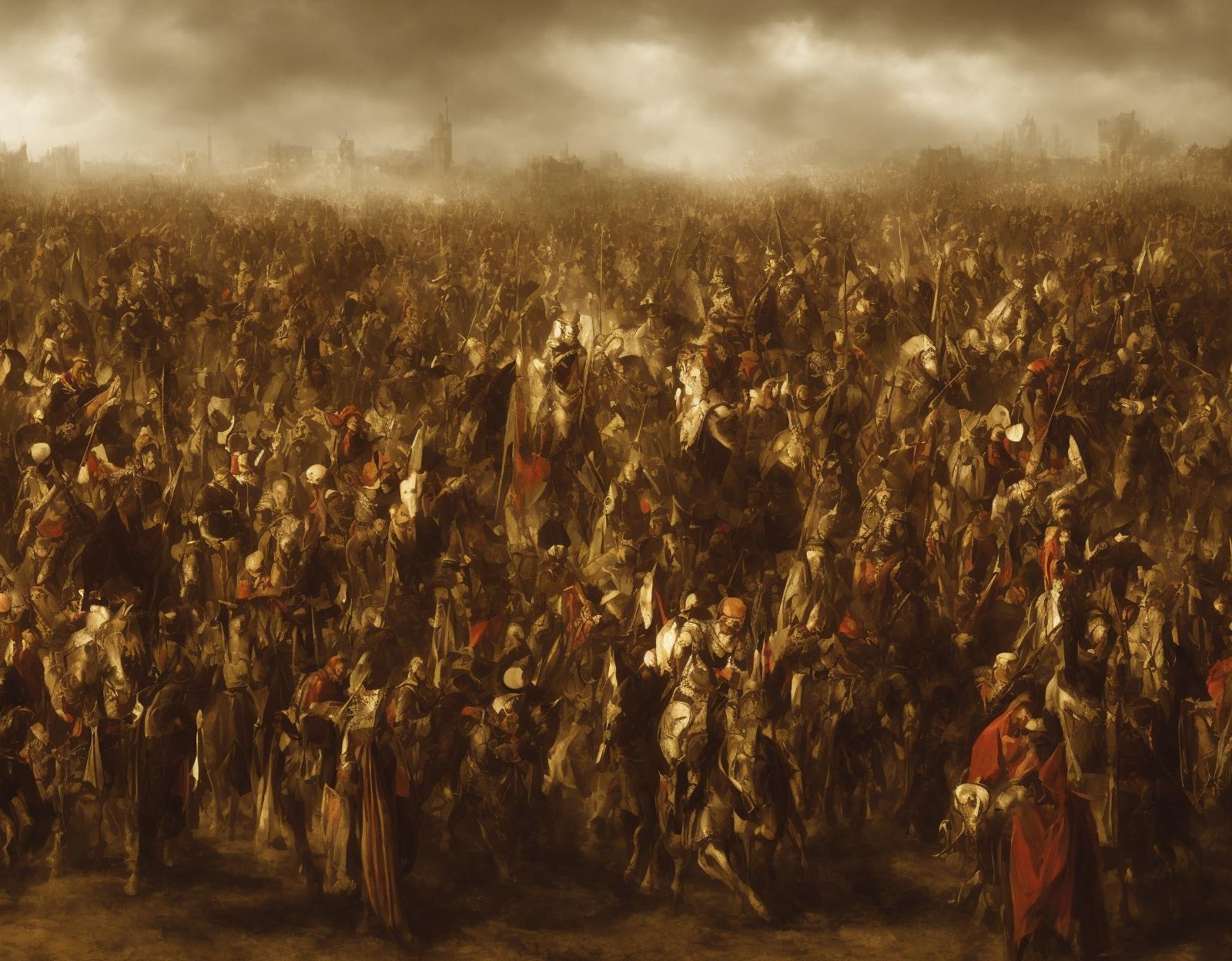
Vox in Excelso: The Papal Voice That Silenced the Templars
In the chill of an early fourteenth-century spring, a single papal voice carried more consequence than the echo of any battlefield trumpet. Vox in Excelso — "a voice from on high" — would arrive not as a hymn but as a juridical blade: a papal bull that, on 22 March 1312, formally extinguished the Order of the Knights Templar. This article follows the tangled threads that led to that day: the rise of a religious-military elite born in the fever of the Crusades; the fractures created by royal ambition and fiscal desperation; the juridical theater of confession and torture; and finally, the curious quiet that followed when the Church chose to dissolve what once seemed immortal.
From the outset this story is part legal drama, part court intrigue, and part mythic tragedy. The Templars had grown — by the thirteenth century — into a transnational institution with fortresses, fleets, and vast treasuries. They were symbols of Christian military piety and, increasingly, instruments of financial innovation. Their visibility and wealth attracted envy and fear as much as admiration. Into that combustible mixture stepped Philip IV of France, known to history as Philip the Fair, whose confrontation with the Templars was motivated by cashflow problems as much as by perceived scandal. When his operatives arrested hundreds of Templars on 13 October 1307, the running drama spilled across Christendom, provoking a reaction from Pope Clement V, who had been elected in 1305 and who presided in the new political climate of Avignon.
Vox in Excelso did not fall from a purely spiritual sky. It was the culmination of a series of legal maneuvers, a papal attempt to reconcile competing narratives — the sensational confessions extracted in France, the equivocal testimonies elsewhere, the claims by monarchs to seize Templar wealth, and the Church's own institutional prerogatives. The bull dissolved the institutional order, but it did not provide the neat moral verdict that either the accused or their accusers might have desired. In that ambiguity, the seeds of legend were planted: doubted guilt, alleged conspiracies, and the echoes of a secret that would be used by later generations to fashion mystery.
Did you know? The Templars maintained an international chancery system that allowed them to issue letters of credit — an early precursor to modern banking instruments.
This piece adopts a narrative, mystery-driven tone to trace the chronology and context of Vox in Excelso, to map the real consequences for the men and the property of the Order, and to separate the verifiable record from the alluring myth. It draws upon council records, surviving bulls, contemporary chronicles, and later legal summaries. Wherever dates and claims are presented they rest on documentary foundations: the arrests of 1307, the Council of Vienne (1311–1312), the issuance of Vox in Excelso on 22 March 1312, and the redistribution of assets by the bull Ad providam on 2 May 1312. But beyond those anchor points, we will wander through the human stories: the confessions, the recantations, and the final public punishment of the last grand master — all parts of a drama that remain as powerful as the papal words that closed the book on the Templar institution.
Origins and Rise of the Templars
The Order of the Poor Knights of Christ and of the Temple of Solomon — soon shortened in common parlance to the Knights Templar — was born amid the tumult of the early twelfth century. In the immediate aftermath of the First Crusade, a handful of knights took vows to protect pilgrims traveling to Jerusalem. They established their first permanent headquarters on the Temple Mount, giving the Order both its name and its symbolic claim to sanctity. From that beginning — traditionally dated to around 1119 or 1120 — the Templars evolved from guardians into a disciplined international order sanctioned by the Church. The Council of Troyes in 1129 provided ecclesiastical recognition and established a rule, influenced by Bernard of Clairvaux, that combined monastic rigor with military function.
What followed over the next two centuries was a dramatic accretion of privileges. Donations poured in from pious aristocrats and monarchs across Europe. The Templars received land, castles, and urban property. They developed administrative networks and treasuries, and by the twelfth and thirteenth centuries, they had become one of the major landowners and lenders in Christian Europe. Their ability to move funds across borders — using letters of credit and other proto-banking instruments — made them especially useful to pilgrims and nobles who needed safe channels for money during wartime. The Order's semi-monastic structure, binding oaths of poverty, chastity and obedience, and a strict hierarchy made it both religious and efficient in military terms.
Did you know? Coordinated arrests on 13 October 1307 were executed at dawn across France on the same day to avoid conspiratorial warnings and to capture Templars before they could regroup.
Yet that same international reach and financial competence made them politically vulnerable. The Templars' holdings were autonomous and often exempt from local episcopal or royal oversight, answerable primarily to the Grand Master and, ultimately, to the Pope. In the age when centralized monarchies were gaining power, such autonomy could breed suspicion. Their wealth and the secrecy of some rituals — especially as described by hostile interrogations and later legendary accounts — made the Order a convenient repository for anxieties about power that operated beyond national control. By the late thirteenth century, with the Crusader presence in the Holy Land shifting and shrinking, the Templars' raison d'etre — the permanent defence of Christian holdings in the East — had become complicated. With diminishing external military tasks, the Order's economic functions and international legal privileges began to stand out more sharply as points of contention.
In the decades before 1307, the Templars had accumulated not only real estate but also political exposure. They lent to kings, handled entrusted valuables, and sometimes acted as brokers in disputes between nobles. Their uniforms and insignia — especially the red cross on a white mantle for higher officers — were at once a religious badge and a symbol of a cross-border corporate identity. This visibility multiplied the potential for enemies, and it set the stage for a dramatic confrontation when a fiscally embattled monarch sought solutions that would reshape European institutions.
The Arrests and Trials: October 1307 to 1311
On 13 October 1307, the French crown carried out a coordinated operation that arrested scores of Knights Templar across France. King Philip IV had spent years building a fiscally strained monarchy and had royal debts, some owed to the Templars. For Philip, the Order’s wealth presented both an opportunity and a threat. He framed his assault through accusations of heresy, sodomy, idolatry, and other startling charges. Under the legal practices of the time, the extraction of confession — often through interrogation and, in France, torture — provided the evidentiary core of the case. That foundation would itself be controversial: the reliability of confessions obtained under duress, and the political motives behind the arrests, would be matters of sharp dispute.
Did you know? The Council of Vienne was originally intended to rally support for a new crusade, but debates over the Templars quickly eclipsed the crusading agenda.
Pope Clement V reacted cautiously. He was a Frenchman by origin (born Bertrand de Got) and had been elected pope in 1305 after a politically contested conclave. The papacy itself was increasingly framed by the tensions between Avignon and Rome: Clement would eventually move the papal curia to Avignon in 1309. In the immediate aftermath of the arrests, Clement issued orders requesting copies of accusations and ordered arrests of Templars only in certain circumstances. Then, in November 1307, he issued the papal letter Pastoralis Praeeminentiae, a circular that instructed Christian rulers to arrest Templars in their realms and to secure their persons and properties. That letter provided rhetorical and juridical cover for the royal actions, but it did not establish guilt. It did, however, ensure that the controversy became pan-European rather than a purely French initiative.
Trials were held in different jurisdictions and with varying standards. In France, under the king’s justices, confessions were numerous after severe interrogation. Across much of Europe, however, the response was more ambivalent. In England, for instance, there were arrests and examinations, but the English crown under Edward II (and his administration) handled the question differently. Many Templars who were arrested retracted confessions when the immediate pressure of torture was removed, while others publicly abjured. The papal inquisitorial process attempted to centralize and standardize inquiries, but jurisdictional complexities — between royal courts, episcopal authorities, and the papal judges — made coherent results elusive.
The evidence produced in trials was messy: allegations ranged from blasphemy to obscene ritual; some testimonies were contradictory; many former brothers insisted upon innocence. The king in France used the resulting convictions to confiscate property and to discredit opponents. Those who were declared relapsed — including prominent leaders such as Jacques de Molay — could be handed to secular authorities for execution. The varied outcomes of trials across different realms, and the mixed nature of the evidence, lent the entire affair a sense of legal and moral ambiguity that would haunt the papacy’s choices.
Did you know? Vox in Excelso did not confiscate Templar property itself; a separate bull, Ad providam (2 May 1312), formally allocated many assets to the Hospitallers.
The Council of Vienne and Papal Deliberations
In October 1311 Pope Clement V convened an ecumenical council at Vienne, in Dauphiné, which would serve as the formal arena to decide the fate of the Templars. The Council of Vienne was itself a patchwork of agendas: the crusading objective, disputes over ecclesiastical reform, and the pressing financial crises of monarchs who sought leverage over Church assets. The Templars were debated not only as alleged heretics but also as an institutional anomaly that forced the Church to examine its own authority. For Clement, the stakes were enormous: suppress the Order and concede ground to a monarch’s will, or defend the canonical protections of a major religious institution and risk confrontation with the French crown.
At Vienne the arguments were manifold. Supporters of suppression emphasized the shocking confessions and the need to demonstrate that no institution could operate beyond the moral oversight of Christian authority. Opponents stressed the procedural irregularities, the possibility of coerced confessions, and the precedent that dissolving a religious order by secular pressure would set for ecclesiastical autonomy. The papal curia itself contained voices urging caution: some advisers argued that a definitive condemnation of every Templar would be impractical and unjust given the varying quality of evidence across Christendom.
Clement V navigated these debates with a legalistic and political calculus. The papacy had the canonical power to suppress an order; indeed, ecclesiastical law allowed the pope to alter or extinguish the existence of corporate religious bodies for the good of the Church. Yet the pope also had to balance that canonical power with considerations of due process and the moral responsibility toward individuals who might be innocent. The eventual papal decision would attempt to square this circle: to extinguish the institution as a corporate entity while leaving open the question of individual guilt to local judges and apostolic authorities. In essence, Clement sought a compromise that both satisfied the French crown’s appetite for resolution and preserved the papacy’s formal competence.
Did you know? Portugal’s Order of Christ (founded 1319) officially absorbed the former Templar infrastructure and played a critical role in financing early Portuguese maritime exploration.
The atmosphere of Vienne was tense and dramatic. Reports from deputies, the reading of depositions, and the rhetorical force of kings’ envoys all combined into a performance of power where the legal and the theatrical mixed. The papal curia framed the decision in language that emphasized ecclesial peace and the prevention of scandal — arguments that, while seemingly neutral, resonated with the political necessity of the moment. The council’s conclusion was therefore less a forensic judgment than a political-juridical settlement intended to stop the spread of instability across Christendom and to channel the aftermath into legal forms acceptable to both pope and king.

Vox in Excelso: Content and Immediate Effects
On 22 March 1312 Pope Clement V issued Vox in Excelso, the papal bull that formally declared the Order of the Temple dissolved. The bull’s wording is careful. It framed the suppression as an exercise of papal authority, necessary for the "peace of the Church" and the prevention of scandal. It insisted that the Order’s rule was to be extinguished and that the brothers were to be released from their vows as members of that order. The document did not, however, pronounce an unequivocal condemnation of every individual member as a heretic; instead, it allocated judgment to local authorities where criminal proceedings had occurred and reserved to the Holy See certain provisions for appeals. In short, the papal measure removed the corporate shell while leaving the fate of individuals in a complex juridical state.
The immediate consequences were seismic. As an instrument of law, Vox in Excelso provided the theological and legal justification for the elimination of the Order as a recognized body. For monks and knights who had taken vows within the Templar rule, the dissolution meant dislocation: some were absorbed into other religious houses, others were pensioned, and some remained imprisoned or were executed depending on the sentence of civil courts. The most dramatic personal consequence was the execution of Jacques de Molay and other leaders who had been convicted in France and declared relapsed at their later abjurations. The last public burning of de Molay in 1314 occurred after Vox in Excelso, underlining that the bull did not grant impunity nor did it halt secular punishments where convictions stood.
Did you know? Jacques de Molay is said in some accounts to have cursed both Pope Clement V and Philip IV from the stake, predicting their deaths within a year; both men did die within months (Clement in 1314, Philip in 1314), a coincidence that fueled legend.
Politically, the bull allowed monarchs such as Philip IV to press claims on Templar wealth under the cover of ecclesiastical legitimacy. The papal response — issuing the suppression but deflecting the precise adjudication of guilt — served a pragmatic purpose: it enabled the papacy to maintain procedural authority while defusing an explosive ecclesiastical crisis. Yet in practice the distribution of the Order’s assets did not unfold smoothly. Many secular rulers had already seized properties; in some realms papal authority was insufficient to force restitution. The disarray produced long-term legal contests and localized grievances, especially where the crown had used the trials to neutralize political opponents and enrich the treasury.
Vox in Excelso thus stands as an ambiguous text: a decisive administrative act by which the pope removed an institution from the roster of legitimate orders, but also a document that sought to avoid a sweeping doctrinal pronouncement about the moral quality of every member. That ambiguity protected the papacy’s theoretical prerogative while inviting suspicion that the pope had yielded to temporal pressure. For later historians and polemicists that doubt would be a fruitful seedbed for conspiratorial readings of the suppression.

Redistribution of Assets and Political Aftermath
If Vox in Excelso dissolved the corporate entity, other legal instruments attempted to manage the fate of Templar wealth. On 2 May 1312 Pope Clement V promulgated the bull Ad providam, which transferred many of the Templars’ lands and possessions to the Knights Hospitaller (Order of Saint John). That arrangement reflected a canonical logic: assets that had been devoted to a religious and military purpose could be reassigned to another similar religious-military institution. But the reality of redistribution was fraught. Where kings had already seized Templar treasuries and estates — most prominently in France and Portugal — secular appropriation complicated papal intentions. Philip IV of France had used the arrests and trials to take control of many properties and to levy fines on the Order; negotiations with the papacy then attempted to regularize those seizures.
Different kingdoms followed different paths. In England, under Edward II, the process of transfer to the Hospitallers was slower and mediated by royal interests; many properties remained under crown control for extended periods. In Iberia, Portuguese and Aragonese rulers were more inclined to create national solutions: Portugal, notably, negotiated the formation of the Order of Christ in the 14th century, which absorbed former Templar properties and personnel under a distinctly Portuguese identity. These national permutations showed how the papal decision intersected with local political calculations, producing a variety of outcomes rather than a single, universal reallocation.
The legal aftermath also included indemnities, pensions, and legal suits. Many former brothers petitioned for pensions or transfers to other religious houses. Some found refuge in hospices, others disappeared into secular life. The legacy of confiscation and redistribution increased royal treasuries in some cases and exacerbated tensions between the papacy and monarchs in others. Over the long term, the suppression shifted the balance of property ownership and altered the symbolic landscape of military orders in Christendom. The Hospitallers gained in prestige and holdings; kings expanded their fiscal reach; and the papal curia invested enormous energy in regulating the transfer to preserve canonical propriety as far as practical.
Culturally, the suppression of the Templars fed a series of narratives — of betrayal, martyrdom, and secret knowledge. The execution of de Molay and the varied fates of many knights produced an image of a noble order cut down by avarice and power. That narrative would be folded into later literary and pseudo-historical accounts that recast the Templars as keepers of forbidden mysteries. In truth, the immediate historical consequence was more prosaic: the dissolution of a transnational corporation, the piecemeal absorption of its assets, and a reconfiguration of religious-military authority that would affect crusading logistics and ecclesiastical property law for decades.
Legacy, Memory, and the Templar Myth
Because Vox in Excelso dissolved the structure of the Templars without issuing a clear moral verdict for every member, the event created fertile ground for mythmaking. Within decades chroniclers and later antiquarians spun narratives that ranged from lurid allegations of secret rites to idealized martyrdom. The tension between juridical ambiguity and political exploitation encouraged stories that imagined hidden archives, secret treasures, and the survival of a spiritual core of Templars who continued their work in hiding. Over centuries, these themes were elaborated in literature, nationalist histories, and the imaginative constructs of fraternal orders such as Freemasonry, which selectively appropriated Templar symbolism.
Modern historians have sought to disentangle kernel from commentary. Archival work demonstrates that the bulk of criminal allegations in France did rely on coerced confessions and that the quality of evidence elsewhere in Europe was considerably weaker. The papal suppression, one could argue, was as much an exercise in crisis management as in disciplinary action. Its legacy therefore raises questions about how legal and political institutions manage scandal and property, and how the historical record becomes interwoven with rumor when powerful actors pursue decisively conflicting objectives.
In legal history, the Templar affair produced important precedents. The papacy’s ability to suppress a widely recognized order showed that the pope could exercise corporate oversight; at the same time, the process revealed the dangers of dependence on secular enforcement and the fragility of procedural protections when states prioritized financial gain. In cultural terms, the narrative of a betrayed brotherhood owes as much to the manner of dissolution as to the modern appetite for conspiracy. The figure of Jacques de Molay, executed in 1314 after being subjected to long imprisonment and trial, became a martyr figure in some tellings precisely because the papal settlement had left unresolved his and others’ personal culpability.
In the long view, Vox in Excelso is less a simple condemnation than a historical pivot. It is the moment when medieval religious-military institutional forms were reconfigured for a Europe moving toward stronger monarchies and more centralized state power. It is also a moment when the papacy negotiated with a secular monarch in ways that would affect its independence and reputation. Finally, the bull’s ambiguous resolution — dissolving a body but leaving moral judgement of individuals diffuse — ensured that the Templars would persist in the imagination far beyond their institutional demise.
Conclusion: Vox in Excelso as Historical Turning Point
To read Vox in Excelso is to read an instrument of governance rather than an act of pure moral judgement. The bull resolved an institutional crisis by extinguishing the corporate identity of the Knights Templar, while leaving intact the messy human consequences of prosecution in different legal environments. The papacy’s choice reflects the political realities of the early fourteenth century: clerical authority constrained by royal power, the vulnerabilities of transnational institutions, and the priorities of fiscal necessity. Clement V’s decision was pragmatic — and therefore unsatisfying to those who sought a clear verdict. The result was not closure but a new frame for understanding what it meant to be an international religious order in a world where secular princes increasingly asserted control over property and justice.
The trials, the Council of Vienne, Vox in Excelso, and the bull Ad providam together form a compact dossier that historians still study for what it reveals about medieval jurisprudence, diplomacy, and the social history of sacred institutions. The Templars’ end was not simply a narrative of injustice or villainy; it was an episode that combined legal innovation, political calculation, and human tragedy. The ambiguities left by Vox in Excelso provided the raw material for a story that would be retold over centuries: a tale of power, of secrecy, and of a vanished order whose echoes reverberate in law, literature, and popular imagination.
If there is mystery in this history, it resides in how institutions fail and how stories multiply in the vacuum left behind. The papal bull that silenced the Templars did not silence the questions: about sanctity and avarice, about procedural fairness and royal might, and about how a medieval pope could wield authority in an age of rising states. Those questions ensure that Vox in Excelso remains not only a document of administrative consequence but also a symbol for the enduring clash between institutional power and human fate.
How we verify this article
By the History Unlocked editorial team
This text is built on historical facts stored in our database and drafted with AI assistance. No signed human review is recorded for this article. Report any inaccuracy: we correct it and update the modified date.
Updated on
AI-assisted drafting.
Read our editorial standardsEnjoyed this? Discover more articles in the category Knights Templar