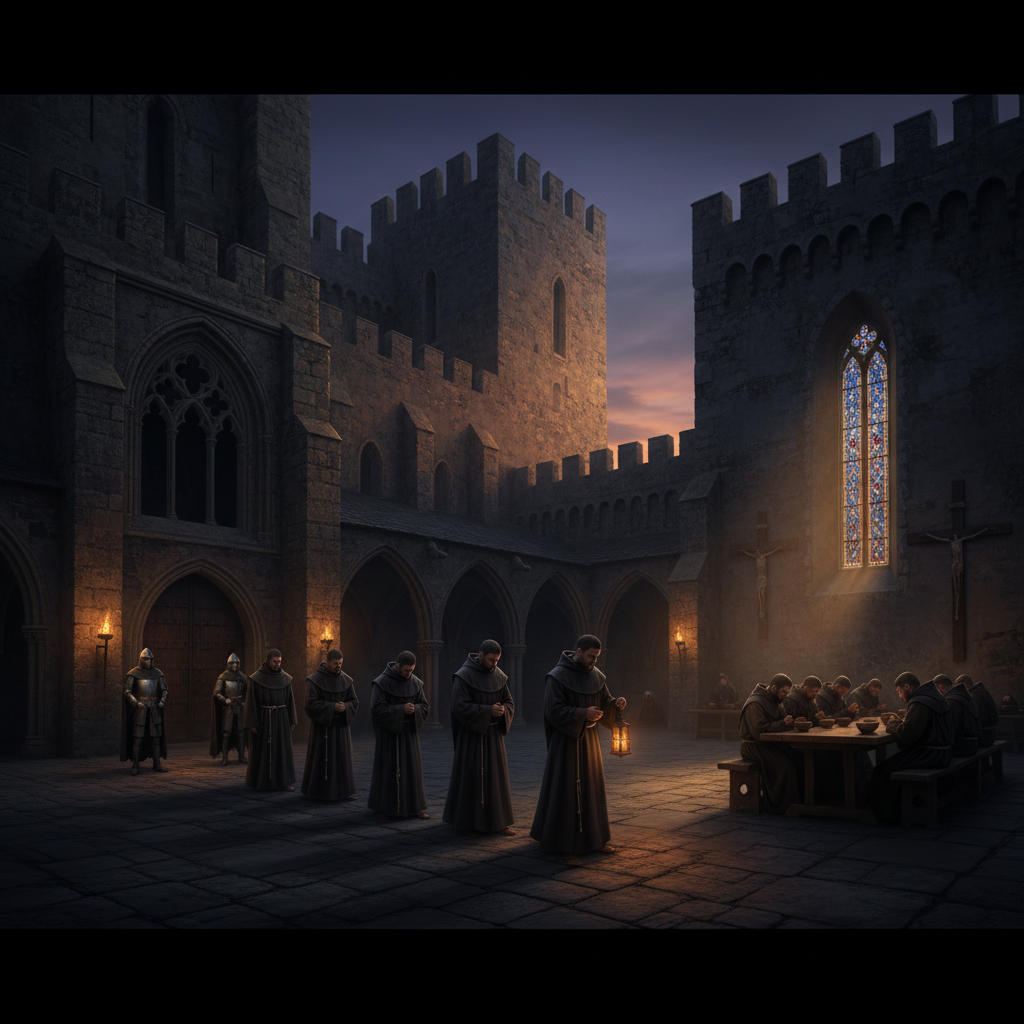
From Night Vigils to Silent Meals: Daily Life of Medieval Monks
Before dawn, when most of the countryside still slept and the last stars trembled above cold tiles and cloister garths, the bell sounded. Its bronze voice rippled across fields and river bends, pulled through oaken shutters and candlelit chapels, and struck the ear of every man or woman vowed to the clockwork of prayer. To step into a medieval monastery was to enter a different grammar of time—measured not by merchants’ bargains or kings’ edicts but by psalms, seasons, and silence. The day of a monk was not a single story but a tapestry woven from repeated days: night offices and daylight labor, fasting and feasts, chapters and corrections, constant returning to the same words until the words remade the soul.
Yet beyond the careful scheduling—beyond the ringing of the bell for Matins and the settling darkness of Compline—unfolded an existence more intricate than clichés of dust and chants allow. It involved skilled hands that copied books and coaxed crops from stubborn soils, eyes trained to read the small letters of both scripture and landscape, ears tuned to choir modes, and stomachs calibrated to the rigors of the Rule. Inside stone, there were gardens and baths, conversation limited to gestured lexicons, and elaborate networks of guests’ benches and almonries that tethered a cloister to the world it renounced. In that dance of withdrawal and welcome, monks and nuns fashioned a civilization within walls—a quiet civilization that preserved texts, regulated labor, refined music, and mapped the hours. What follows is a walk, step by step, through that world: a day among medieval monks, unfolding from the deepest night to the Great Silence.
The Bell and the Hours: A Day from Dark to Dark
The day in a medieval monastery began in the dark. According to the Rule of Saint Benedict (written in the 6th century and foundational for later Western monasticism), the community rose for Vigils—also called Matins—during the deep night, commonly around the second or third watch, well before dawn. Candles were lit; bare feet padded across chill stone; cowls were drawn. The choir filled with the low hum of antiphons and psalms. The office of Vigils was long, a deliberate immersion in scripture and hymnody, structured in nocturns and responsories that shifted with the liturgical calendar. When the eastern sky bruised toward blue, Lauds proclaimed the light, its psalms suffused with morning imagery: dew, birdsong, mercy new each day.
Did you know? Before mechanical clocks spread in the late 13th–14th centuries, monasteries often kept time with water clocks, sundials, and marked candles to cue the Hours.
After a short rest or meditation, the community assembled again for Prime—an hour later suppressed in modern reforms but integral in the medieval rhythm—followed by the daily Chapter. In the chapter house, each monk listened to a reading from the Rule, and faults were confessed and assigned penances. Names were read aloud for the dead to be commemorated. Then the abbot or prior assigned tasks for the day. Work and study took their turns between the minor hours: Terce (around mid-morning) gathered the community once more in church; Sext (near noon) and None (mid-afternoon) punctuated labor with prayer, the bell’s note scattering workers across fields and workshops and then drawing them back again.
Toward sunset, Vespers braided together the day’s strands with the Magnificat, incense rising as shadows yoked the arches. Supper followed in many houses, especially in the longer, warmer days of spring and summer. Compline, the last office, came under the veil of night; monks asked pardon for faults and commended their souls to the keeping of God and angels. Then the Great Silence fell. Only the infirmarian and porter might speak if necessity compelled them. The monastery slept, but not without a sentinel: the bell ringer, the night watch, the rhythm ready to begin anew.

Work, Study, and the Scriptoria: Hands that Prayed and Wrote
Ora et labora—pray and work—was not a slogan but a discipline. In Benedictine and Cistercian houses alike, manual labor was honored as a means of humility and self-sufficiency. Monks tended vegetable plots and orchards, repaired roofing, wove cloth, pressed grapes, brewed ale, and worked at mills. The cellarer oversaw stores; the gardener managed herb beds of rue, sage, and fennel; the infirmarian cultivated simples for the sick. In harsher climates, fuel had to be gathered and rationed for the calefactory, the community’s warm room.
Did you know? Surviving “sign lists” from Cistercian and Cluniac monasteries record dozens of hand signals—covering bread, fish, books, and tools—so monks could communicate while maintaining silence.
Study, too, was work. Many (though not all) monks were trained to read Latin, the language of scripture and liturgy. Lectio divina—slow, prayerful reading—shaped the mind as surely as calloused hands shaped wood and soil. In the scriptorium, the heart of a literate monastery, scribes prepared parchment from sheep or calf hide: soaking, scraping with lunellum knives, stretching on frames, and smoothing with pumice. Quills were cut from goose or swan; ink brewed from oak galls and iron salts slipped across the page in flowing blacks and browns. Ruling frames and leadpoint lines guided neat columns. Rubrics in red signaled liturgical cues; illuminated initials in blue, green, and gold introduced feasts and gospel openings. Wealthier houses could afford lapis lazuli pigment—ultramarine imported by long trade routes—while plainer communities kept their palettes modest.
Books were prized beyond reckoning. Monastic libraries chained volumes for safekeeping, and catalogues listed treasures: scripture, patristic commentaries, sermons, saints’ lives, computus tables for calculating Easter, and practical treatises. Music was copied with neumes; by the early 11th century, the innovator Guido of Arezzo popularized staff notation, making it easier to teach chant to novices. A monk might spend hours rehearsing antiphons in the cloister walk, the choir’s harmonies welding a house into one voice.
But study did not cancel labor. Cistercian practice explicitly balanced the two, assigning fields and forests to granges—outlying farmsteads—managed in part by lay brothers so that choir monks could keep the Hours without neglecting the land. Even in Benedictine houses famed for scholarship, tools and psalters shared space. To bind a book or mend a gate—both, in their way, were prayers with a rhythm.
Did you know? Benedict’s Rule explicitly allows wine “with moderation” because, he concedes, most communities could not do without it—even while warning that drunkenness is never fitting for monks.

Food, Fasting, and the Rule: Eating with Silence
At the refectory, monks ate together not to socialize but to be schooled. The Rule of Saint Benedict prescribes simplicity: two cooked dishes so that if one dislikes a certain food, one may elect to eat the other; a daily ration of bread (a “pound” in the Latin text, though the exact measure varied), and a customary hemina of wine—a small allowance, often around a half-pint in some regions—unless conditions advised abstinence. Meat of four-footed animals was forbidden for healthy monks in the refectory, though the sick and travelers could receive it. Fish, eggs, legumes, cheese, and garden produce formed the backbone of diets across Europe. Pottage—thick vegetable stews—and coarse bread anchored the meal; on feast days, spices and honey might appear.
Season and calendar mattered. From Easter to roughly the autumnal equinox, many houses ate two meals per day; in winter, one. Fasting intensified in Lent and on vigils of feasts, with collation (a light evening drink or small snack) replacing supper. Water, small beer, and watered wine slaked thirst; in northern regions, monastic breweries refined ale into an art that also nourished the poor through almsgiving. The cellarer and kitchener coordinated stores that had to stretch through lean months; salting, smoking, and root-cellaring kept provisions edible.
Meals unfolded in silence while a reader appointed for the week declared scripture, saints’ lives, or moral treatises from a lectern. The lector signaled the beginning and ending of readings with ritual phrases; the board-clapper or bell summoned diners from the cloister. Before entering, monks washed their hands at the lavabo; a server ladled food to each in turn, and a sign language helped request bread or salt without speaking. After finishing, they recited a psalm of thanksgiving and returned to work or to the next hour of prayer.
Did you know? Many medieval monastic latrines (reredorters) were engineered over running water channels; archaeologists have traced sophisticated drainage at Cistercian sites like Rievaulx and Fountains.
Monastic hospitality ensured that travelers, the poor, and even local lords might find a seat at the guest table, separate from the monks’ own but served with care and blessing. The porter, stationed by the entrance, stood ready to welcome “as Christ himself” in the spirit of Benedictine Chapter 53.

Space and Community: Cloister, Chapter, and Cell
Monastic life took place in a deliberately crafted landscape. The standard Benedictine plan—illustrated famously in the 9th-century Plan of St. Gall—arranged spaces for prayer, work, study, and charity around a central cloister garth. The church ran along one side, its choir stalls oriented for the Divine Office. Adjacent sat the chapter house, where daily discipline and governance unfolded. The dormitory, often a long communal hall, connected by a night stair to the church so that sleepy monks could descend straight to Vigils. The refectory lay on another side of the cloister, with kitchen and buttery nearby; the calefactory (warming room) provided a rare refuge from winter cold. Latrines (the reredorter) were ingeniously situated over running water channels when possible, a practical sanitation the Middle Ages did not always lack.
Beyond that core were workshops, a guesthouse, an infirmary with its own chapel and garden, and, in larger communities, a novices’ school. A mill and bakehouse served the community; barns and granaries held tithes and harvests. Water was life: many monasteries engineered leats and conduits to supply fountains and kitchens; Cistercian sites in particular earned renown for hydraulic savvy, routing streams to power wheels and even flush latrines.
Did you know? The Cistercians called their outlying farmsteads “granges”; archaeological surveys show these could be highly organized complexes with barns, mills, fishponds, and worker housing.
Hierarchy was equally structured. The abbot (or abbess) governed; the prior assisted; the cellarer managed goods; the sacristan tended to church linens and vessels; the cantor oversaw chant; the almoner distributed charity; the infirmarian cared for the sick. Each office carried spiritual weight: to account for grain or to tune a psalm was a service to God. Novices tested their call under instruction, memorizing psalms and absorbing the customs; after probation, they professed vows—stability (to remain in that community), conversion of life (a broad promise of monastic discipline), and obedience.
Clothing also taught humility. Monks wore habits of undyed or dark wool depending on custom: Benedictines earned the nickname “black monks,” Cistercians “white monks” for their undyed habit. A scapular hung over the tunic; a hooded cowl provided warmth. The distinctive tonsure—the shaved crown—marked belonging to the clerical state, a visible halo of renunciation. Footwear was simple: sandals or soft shoes, sometimes set aside in church.
Discipline was maintained not only in grand gestures but in small habits. The chapter of faults allowed members to accuse themselves of minor breaches; penances were assigned proportionally. Recreation, when it appeared, often took the form of a quiet walk in the cloister or short conversation on designated days. Except for necessary speech, the Great Silence held from Compline until after Prime. The monastery, so structured, sheltered a paradox: within enclosure, a spacious life unfolded.
Did you know? The Benedictine abbess Hildegard of Bingen wrote one of the earliest known detailed descriptions of hops’ preservative qualities in beer—centuries before hops became standard in brewing.

Orders and Variations: Black Monks, White Monks, and Desert Echoes
To speak of “a monk’s day” is to risk flattening real diversity. The Benedictine Rule provided a skeleton, but particular orders clothed it differently across centuries and regions. In the 10th and 11th centuries, the abbey of Cluny in Burgundy led a powerful reform movement that emphasized the splendor of liturgy. Cluniac monks increased the length and elaboration of the Divine Office and anniversaries for the dead; their choirs could spend many hours a day at prayer. Cluniac wealth—drawn from a wide network of affiliated priories and lay patrons—funded grand architecture and sculpture, as well as expansive almsgiving. Critics complained that Cluny’s liturgical emphasis risked displacing manual labor, but Cluniacs maintained farms and dependencies to sustain their rhythm.
At the turn of the 12th century, a different voice rose from the woods near Dijon. In 1098, Robert of Molesme and companions founded Cîteaux, and not long after, Bernard of Clairvaux’s fierce eloquence helped spread the new Cistercian order. The Cistercians sought a return to simplicity: plain churches without lavish sculpture, a rigorous observance of the Rule, and a conscious relocation to valleys and marginal lands to cultivate them from scratch. Their “white” habit of undyed wool became emblematic. Organizationally, the order established an annual General Chapter and a visitation system to maintain unity—a remarkable administrative innovation. Cistercian lay brothers (conversi) played a crucial role: non-ordained men living under vows who took on much of the heavy work at granges, enabling choir monks to keep the long round of offices and lectio without neglecting agriculture and craft.
Still more austere, the Carthusians, founded by Bruno of Cologne in 1084 at the Grande Chartreuse, blended eremitic and cenobitic life. Carthusian monks lived in individual cells with small gardens, gathered for select offices, and ate alone except on Sundays and feasts. Their houses, called charterhouses, were hushed cities of hermitages arranged around vast cloisters. The Carthusian “Great Silence” was deeper than most, their diet even more restrained; yet their liturgy, quiet and spare, was no less intense.
Other communities sprinkled the landscape with different shades of monasticism. Canons Regular of Saint Augustine were not monks strictly speaking but clergy living a common life; they served parishes and cathedrals and kept a daily office. Military orders like the Templars and Hospitallers adopted rules and kept offices while also undertaking warfare and hospitality; their routine diverged sharply, shaped by the demands of crusading and care for pilgrims.
Mendicant friars—Franciscans and Dominicans—were a 13th-century phenomenon distinct from monks: urban, mobile, and devoted to preaching, study, and poverty in the streets rather than enclosure. Their inclusion here matters only as contrast, for the word “monk” in the medieval West most commonly meant men under a rule like Benedict’s, bound to a place by a vow of stability and to a choir by the bonds of daily chant.
Women, Lay Brothers, and the World Beyond the Walls
Any picture of medieval monastic life is incomplete without women. Convents dotted the same landscapes, from the windswept coasts of England to the wooded valleys of Germany and the plains of Castile. Nuns kept the Hours as faithfully as monks, managed estates, and educated girls. Some houses preserved traditions of learning and music with brilliance: Hildegard of Bingen (1098–1179), a Benedictine abbess, composed soaring chants, wrote theological and scientific works, and corresponded with emperors and popes. Female scriptoria produced and illuminated manuscripts; convent gardens supplied infirmaries and kitchens no less than monks’ did. The vow of enclosure shaped women’s lives even more stringently in many places, but their voices carried far through letters, visions, and song.
Not all who lived and worked with monks were choir monks or nuns. From the 12th century, lay brothers (conversi) entered many orders, especially the Cistercians. They professed vows and followed a modified office—often a shorter, vernacular cycle of prayers—and performed much of the heavy agricultural and artisanal labor. They wore simpler habits and sat apart in church and refectory. Some monasteries also organized lay sisters (conversae) in women’s houses. Their presence bound cloisters to surrounding economies: forests were managed, ironworks and forges operated, fishponds stocked, vineyards planted and pruned in precise seasons. Monasteries became important nodes of technology transfer, where water mills, fulling mills, and improved plows spread.
Hospitality was a sacred duty. Benedict commands that all guests be received as Christ; medieval monasteries answered with guesthouses and almonries. Pilgrims on the roads to Compostela or local markets found shelter and bowls of stew; the sick were tended in infirmaries that, in some places, evolved into hospitals. Nearby villages gathered on saints’ days for fairs held under monastic auspices. Ties with patrons—kings, knights, and townspeople—wove monasteries into the fabric of politics and charity even as enclosure hedged them with walls.
At times, the world intruded violently. Viking raids in earlier centuries had devastated coastal and riverside houses; later, civil wars or feudal conflicts could threaten granaries. Yet monasteries rebuilt and endured, their routines elastic enough to bend in crisis. In all of this, prayer remained the axis. When the bell called, a smith laid down his hammer and a scribe her pen; they stood shoulder to shoulder in choir, breathing chant into memory.

Conclusion: The Rhythm that Outlasted Centuries
To walk through a medieval monastery is to feel how time can be trained. The hours are horses not to be ridden recklessly across a day, but to be led, curried, and set to pasture with care. Monks and nuns built their lives around that care, returning again and again to canonical hours that carved sanctuaries out of ordinary minutes. The Rule of Saint Benedict furnished a framework of obedience, humility, stability, and balanced labor. Within that frame, each community added its own strokes: Cluny’s golden cascades of chant, Cistercian stone and water, Carthusian quiet cells where a single candle could light a life. The common threads are unmistakable: prayer braided through work, meals shaped by discipline and season, silence defended by signs and the measured ring of bells.
Yet nothing here was static. Scriptoria improved notation and guarded ancient texts even as they adopted new hands; gardens experimented with herbs; breweries tuned methods; and in chapter houses, abbots sifted custom as seasons turned. The life was severe, and many found its fasts, vigils, and obediences hard. But its severity had a telos: to make a person free for praise, so that when the bell sounded at midnight, the body could rise without complaint and the tongue find the psalm already waiting. Outside, kingdoms rose and fell, fields changed hands, and roads shifted with trade. Inside, the same words, the same gestures, gathered up generations into a lineage of breath and light.
If we listen closely, we can still hear it—the creak of stalls at Matins, the sibilant brush of a quill, the splash of water at the lavabo, the muted thud of the board-clapper before dinner, the soft thrum of sandals on stone, and at last the hush after Compline when the stars return. The mystery of monastic life is not that it hid from the world, but that it taught the world a different way to measure what a day is for.
How we verify this article
By the History Unlocked editorial team
This text is built on historical facts stored in our database and drafted with AI assistance. No signed human review is recorded for this article. Report any inaccuracy: we correct it and update the modified date.
Updated on
AI-assisted drafting.
Read our editorial standardsEnjoyed this? Discover more articles in the category Middle Ages