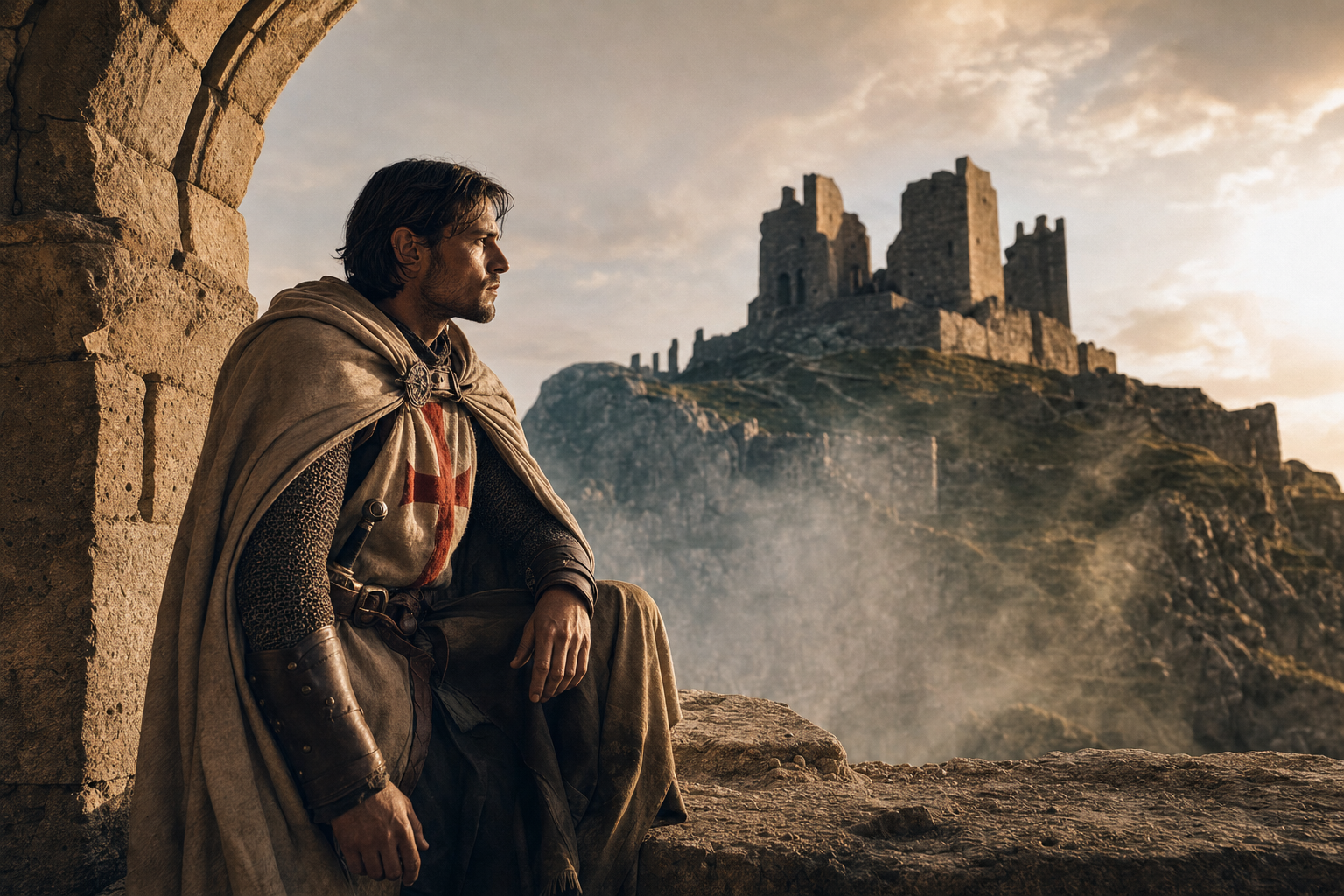
Montségur's Last Secret: The Cathar Fortress That Held the Holy Grail
Perched atop a formidable, isolated peak in the Pyrenees of southern France, the ruins of the Castle of Montségur slice the sky like a stone crown. To the uninformed visitor, it is a breathtaking, if skeletal, remnant of a medieval past. But to those who know its story, this is no mere castle. This is Montségur, the "safe mountain," a name steeped in irony and blood. It was the final sanctuary, the Vatican of a persecuted faith, and the stage for one of history’s most dramatic and tragic last stands. This high fortress became the symbol of the Cathars, a Gnostic Christian sect that flourished in the vibrant, independent-minded lands of the Languedoc during the High Middle Ages. Their beliefs, which posited a dualistic universe where the material world was an evil creation and the spirit was a shard of a good, distant God, were deemed a mortal heresy by the Catholic Church of Rome. The confrontation that followed was not just a theological dispute; it was a brutal, decades-long war known as the Albigensian Crusade, a conflict that drenched the south of France in blood and ultimately bound it to the French crown. Yet, even in this maelstrom of violence, Montségur stood apart. It was less a fortress and more a community, a holy city in the clouds where the elite of the Cathar faith, the ascetic "Perfects," administered to their flock. The story of Montségur is the story of a desperate ten-month siege, of fire and ice, of unwavering faith in the face of annihilation. But it is also a story of enduring mystery, a tale whispered in the winds that whip around its broken walls—a legend of a sacred treasure, spirited away in the dead of night, just before the fortress fell. Was this treasure gold and silver, or was it something infinitely more precious? Was it the secret gospel of the Cathars, or perhaps the most sought-after relic in Christendom: the Holy Grail itself?
The Pog and the People: Before the Fortress The story of Montségur begins not with stone and mortar, but with the land itself. The castle sits upon a terrifyingly steep limestone outcrop known as a "pog," rising 1,207 meters above sea level. Its strategic value is immediately obvious; the sheer cliffs on all sides make it a natural fortress, a place of ultimate refuge. Archaeological evidence suggests that this inherent security was recognized long before the Cathar era. Traces of Roman garrisons, and perhaps even earlier Neolithic settlements, have been found on the mountain, indicating its long-standing importance as a watchtower and a defensible high place. It was a sacred mountain long before it was a holy one, a place that seemed to touch the heavens, separating it from the mundane world below. It was into this landscape of dramatic peaks, lush valleys, and fiercely independent towns that Catharism emerged and took root in the 11th and 12th centuries. The Languedoc was a land apart from the grim, feudal north. Here, Roman law still held sway, trade flourished, and a vibrant culture of poetry and courtly love, championed by the famous troubadours, defined the social landscape. The local nobility, such as the powerful Counts of Toulouse and the Trencavel viscounts, governed with a relatively light and tolerant hand. It was in this fertile ground of intellectual freedom and political fragmentation that the "Good Christians," as the Cathars called themselves, thrived. Their theology was a radical departure from orthodox Catholicism. They were dualists, believing in two opposing principles: a good God, who created the eternal, spiritual realm, and an evil demiurge, Rex Mundi (King of the World), who had crafted the corrupt material world, including the human body, as a prison for the soul. The goal of life was to achieve gnosis, or knowledge, to awaken the divine spark within and escape the cycle of reincarnation in this fallen world. The Cathar church was divided into two tiers: the *Credentes*, or Believers, who lived ordinary lives, and the *Perfects* (*Parfaits* in French), the spiritual elite who had received the faith’s only sacrament, the *Consolamentum*. Through this laying on of hands, they were cleansed of sin and became living vessels of the Holy Spirit, embracing a life of extreme asceticism, poverty, and pacifism. It was their quiet grace, their rejection of worldly wealth, and their stark contrast to the often corrupt and power-hungry Catholic clergy that won them so many converts across all social strata, from peasants to the highest nobility. This growing "heresy" was a direct challenge to the authority and theology of the Roman Church, an institution that could not and would not tolerate such a profound ideological rival within Christendom.
Forging a Sanctuary: The Construction of Montségur II As the 13th century dawned, the shadow of religious persecution was lengthening over the Languedoc. The Catholic Church, under the formidable Pope Innocent III, was escalating its efforts to stamp out the Cathar faith through preaching and debate, but these measures were proving insufficient. The local lords, often sympathetic to their Cathar subjects or simply unwilling to bow to papal authority, offered little help. In this climate of growing dread, the pog of Montségur was transformed. In 1204, the local lord, Raymond de Péreille, was approached by a group of Cathar Perfects and nobles. They asked him to refortify the summit, not merely as a military stronghold, but as the designated seat and capital—the *castellum*—of the persecuted Cathar church. Raymond agreed, and the construction of what is known as "Montségur II" began. This was not the first structure on the peak, but it was the most significant. The castle that rose was a marvel of defensive architecture, perfectly integrated with the mountain’s natural defenses. Its distinctive pentagonal shape has long been a source of fascination and debate. While it cleverly follows the contours of the summit, some researchers, most notably the esotericist Fernand Niel, have argued that its design is far from accidental. They propose that Montségur was a "solar temple," its architecture deliberately aligned with celestial events, particularly the winter and summer solstices. According to this theory, on the winter solstice, the first rays of the rising sun would perfectly illuminate a series of arrow slits, traversing the entire length of the fortress. While this remains a controversial hypothesis, it speaks to the deep spiritual significance imbued in the site. It was conceived as more than a refuge; it was a sacred space, a mountain temple where the Cathar faith could be practiced in safety. For nearly forty years, it served this purpose. It became a haven for *faidits*—local lords dispossessed of their lands by the French crusaders—and a bustling community of hundreds of people. Within its walls lived the Cathar bishop, Bertrand Marty, and the core of the faith’s spiritual leadership. It was a place of prayer, work, and shared belief, a tiny island of Cathar reality in an ocean of Catholic hostility, a symbol of defiance against the might of both Rome and Paris.
The Albigensian Crusade: A Storm Gathers To understand the doom that would eventually befall Montségur, one must understand the unholy tempest that was the Albigensian Crusade. This was not a crusade in the traditional sense, aimed at reclaiming a Holy Land from an external foe. This was a war waged by Christians against other Christians, on European soil. The catalyst came in 1208 with the murder of the papal legate, Pierre de Castelnau, who was excommunicating Count Raymond VI of Toulouse for his perceived leniency towards heretics. Pope Innocent III, enraged, invoked the ultimate weapon: he declared a crusade, offering the same spiritual indulgences (forgiveness of all sins) to those who fought the heretics of the Languedoc as were offered to those who fought in the Holy Land. Crucially, he also offered them the legal right to seize the lands of the heretics and their supporters. This fateful decision unleashed a torrent of violence and ambition. An army of northern French barons and knights, led by the ruthless Simon de Montfort, descended upon the sophisticated and prosperous south. Their goal was twofold: to eradicate the Cathar heresy and to conquer the rich, independent territories of the Languedoc for themselves, and by extension, for the French crown. The crusade began with an act of shocking brutality that set the tone for the next two decades. In 1209, the crusaders besieged the town of Béziers. When the town fell, the papal legate in command, Arnaud Amaury, was asked how the soldiers should distinguish the Catholics from the Cathars within. His alleged reply became infamous: "Caedite eos. Novit enim Dominus qui sunt eius." – "Kill them all. For the Lord knows those who are His." The resulting massacre saw the slaughter of thousands of men, women, and children, and the town was put to the torch. This wave of terror rolled across the land. The great walled city of Carcassonne fell soon after, and for twenty years, the Languedoc was a battlefield, characterized by brutal sieges, mass burnings of captured Cathars, and the systematic dispossession of the local nobility. While the French crown was initially hesitant, it soon saw the crusade as the perfect tool to break the power of the southern lords and annex their territories, a goal it finally achieved with the Treaty of Paris-Meaux in 1229. This treaty officially ended the war and ceded most of the Languedoc to France. But it did not end Catharism. The faith, though battered and broken, went underground, secretly supported by a populace that resented the northern invaders. And throughout this period of clandestine survival, the fortress of Montségur stood as the last, visible bastion of the "Good Faith."
The Point of No Return: The Avignonet Massacre Following the formal end of the crusade, the task of eradicating the last vestiges of Catharism fell to a new and terrifying institution: the Papal Inquisition. Operating with the full backing of the French monarchy, Dominican and Franciscan inquisitors set up tribunals across the Languedoc. They were ruthlessly efficient, employing a network of spies, interrogating thousands, and using torture to extract confessions and names. Their records were meticulous, and their sentences were absolute. Those who confessed and repented might face penances like being forced to wear yellow crosses on their clothing for life. Those who relapsed or refused to cooperate were "relaxed" to the secular arm, a euphemism for being burned at the stake. This systematic persecution created an atmosphere of paranoia and terror. For the fugitives and Perfects sheltering in Montségur, the Inquisition was an existential threat. The fortress’s military commander was Pierre-Roger de Mirepoix, a seasoned and hardened knight. He and the other residents watched with growing anger and desperation as the inquisitors’ net tightened around their friends, families, and followers in the lowlands. The leading inquisitors in the Toulouse region, William Arnaud and Stephen de Saint-Thibéry, were particularly zealous and feared. In the spring of 1242, a decision was made within the walls of Montségur. It was a desperate gamble, an act of vengeful defiance. They would strike back at the head of the snake. Pierre-Roger de Mirepoix dispatched a group of about fifty men, a mix of knights and sergeants, from the garrison. On the night of May 28th, 1242, they crept into the town of Avignonet, where the inquisitors were holding their tribunal. They found William Arnaud, Stephen de Saint-Thibéry, and their entire retinue asleep in the town’s castle. The assassins from Montségur fell upon them, and in a short, bloody slaughter, they killed the entire inquisitorial party with axes and swords. The act was a stunning blow against the Inquisition. For a moment, it must have felt like a great victory for the Cathar cause. But in reality, it was a profound strategic error. It was the point of no return. By murdering the Pope’s representatives, the community at Montségur had declared open war not just on the Inquisition, but on the Church and the King of France. There could be no more tolerance, no more looking the other way. The sanctuary on the pog had signed its own death warrant. The full might of the state and the church would now be brought to bear upon it, and its destruction was now an absolute political and religious necessity.

The Final Siege: Ten Months of Ice and Fire The repercussions for the Avignonet massacre were swift. In May of 1243, almost exactly a year after the assassinations, a royal army under the command of Hugues des Arcis, the king
How we verify this article
By the History Unlocked editorial team
This text is built on historical facts stored in our database and drafted with AI assistance. No signed human review is recorded for this article. Report any inaccuracy: we correct it and update the modified date.
Updated on
AI-assisted drafting.
Read our editorial standardsEnjoyed this? Discover more articles in the category Middle Ages