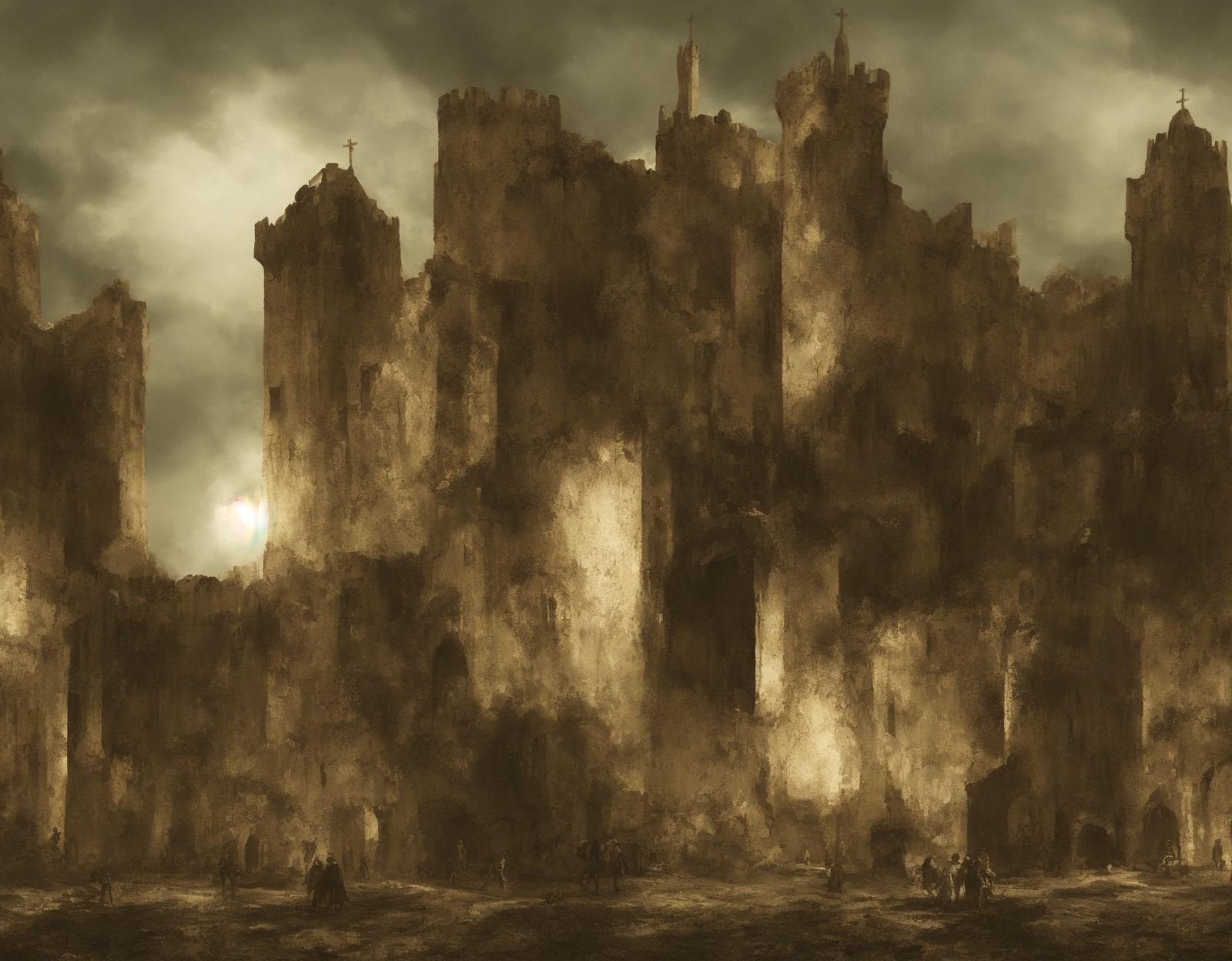
The Cathar Heresy: The Secret Faith the Church Erased with Fire
In the sun-drenched, sophisticated lands of twelfth-century Languedoc, a region in what is now southern France, a different vision of Christianity flourished. This was a land of troubadours, courtly love, and a fierce spirit of independence, where powerful nobles ruled diverse and tolerant cities like Toulouse, Albi, and Carcassonne. But beneath this vibrant cultural tapestry, a spiritual revolution was taking place, one that would ultimately provoke one of the most brutal and defining conflicts of the Middle Ages. This was the age of the Cathars, known to their followers simply as the "Good Christians." They presented not just a critique of the Catholic Church, but a fundamental and irreconcilable alternative to its entire worldview. To the Papacy in Rome, they were not merely misguided souls; they were a cancer, a pestilence of heresy so profound that it threatened the very foundations of Christendom. Their beliefs, rooted in a stark dualism that saw the material world as an evil creation, struck at the heart of Catholic doctrine: the incarnation of Christ, the sanctity of the sacraments, and the authority of the clergy. The Cathars represented a competing, and in many places more popular, path to salvation. They were ascetics, their leaders—known as the Perfects—living lives of such extreme piety and poverty that they made the often worldly and wealthy Catholic bishops look like hypocrites. This potent combination of a compelling theology and a respectable clergy allowed their faith to spread like wildfire through all levels of Languedoc society, from the highest count to the humblest weaver. The story of the Cathars is a dramatic saga of faith, power, and persecution. It is a mystery that begins with secret doctrines whispered in fortified manors and bustling marketplaces, and ends in the smoke of pyres and the ruins of castles. It is the story of how the Catholic Church, faced with a challenge it could not refute through debate, unleashed the full, terrifying force of a crusade and the systematic terror of the Inquisition to utterly annihilate a rival faith. This was not just a theological dispute; it became a war for the soul of Europe, a bloody conquest that would erase a culture and forge a new, more centralized and intolerant, kind of power.
The Dualist Universe: Beliefs of the Good Christians
The theological system of the Cathars was as complex as it was radical, representing a complete departure from the monotheistic framework of mainstream Christianity. At its core lay a powerful and uncompromising dualism: the belief not in one God, but in two opposing divine principles. This was not a simple battle of good versus evil within a single creation, but a cosmic war between two entirely separate creators. First, there was the good God, the true God, who was entirely spirit, light, and love. He was the creator of the immaterial and eternal realm of heaven and the angelic souls within it. This God was the being revealed in the New Testament, particularly the Gospel of John, a book the Cathars held in the highest esteem. Opposing him was an evil, lesser deity, a usurper whom the Cathars often called "Rex Mundi," the King of this World. This being was none other than the vengeful and jealous God of the Old Testament, Satan himself. In the Cathar mythos, this evil god had trapped the angelic souls, born of the good God, within the debased and corrupt prison of the material world. Every physical body, every rock, plant, and animal, was his creation, a cage designed to torment and defile the pure spirit trapped within. Human history was the story of these fallen angels, reincarnated endlessly into the cycle of flesh, forgetting their celestial origins and suffering in a world of decay, lust, and death. This belief had profound consequences. Since the material world was inherently evil, everything associated with it was rejected. This included the Catholic Church, which the Cathars damningly referred to as the "Church of Wolves." They viewed its immense wealth, its landholdings, its political power, and its ornate cathedrals as definitive proof that it served the evil god of matter, not the pure God of spirit. Its sacraments were a mockery. How could baptism with corruptible water cleanse a pure soul? How could the Eucharist, a piece of material bread, possibly become the body of a divine being? The cross, an instrument of torture and death, was for them a symbol of the evil god's triumph in the material realm, and they held it in abhorence rather than reverence. Their view of Jesus was similarly radical. They could not accept that a perfect emissary of the good God would ever take on corrupt human flesh. Therefore, they were docetists: they believed Jesus was a pure spirit, an angel who only appeared to have a human body. He did not truly suffer on the cross or die a physical death, as a spirit cannot be killed. His mission was not to atone for sin through a blood sacrifice—a concept tied to the material world—but to descend as a teacher, reminding the trapped souls of their true home and showing them the spiritual path to escape the cycle of reincarnation, known as metempsychosis. This escape was the central goal of the Cathar faith.
A Life of Purity: The Perfects and the Believers
Cathar society was elegantly divided into two distinct tiers, a structure that allowed the faith to function both as an elite spiritual order and a popular mass movement. These were the Perfecti (the Perfects) and the Credentes (the Believers). The distinction between them was absolute and defined one's role, responsibilities, and path to salvation. The Perfects were the spiritual heart of the Cathar faith, a small, consecrated elite who had undertaken a life of extreme asceticism. To become a Perfect, one had to receive the consolamentum, the one and only Cathar sacrament. This was not a water baptism but a "baptism of the Holy Spirit," conferred by the laying on of hands from two existing Perfects. This ritual was believed to cleanse all past sins and transform the recipient into a living vessel for the Holy Spirit, effectively making them a "Good Man" or "Good Woman." From that moment on, their life was one of profound austerity. They were bound to absolute celibacy, renouncing all sexual contact which they believed only served to trap more souls in flesh. Their diet was a strict form of vegetarianism; they consumed no meat, milk, cheese, or eggs, as these were all products of procreation. Fish were permitted, however, as it was commonly believed in the medieval period that they reproduced asexually. The Perfects owned no personal property, travelled in pairs, and dedicated their lives to prayer, fasting, and preaching their gospel to the Believers who supported them. It was a life of such visible piety that it commanded immense respect throughout Languedoc, standing in stark, damning contrast to the perceived luxury and corruption of the local Catholic clergy. One of the most revolutionary aspects of the Perfects was the full equality granted to women. A woman could receive the consolamentum and become a Perfecta, empowering her to preach, teach, and administer spiritual guidance on par with her male counterparts, an opportunity unthinkable within the rigid patriarchy of the Catholic Church. The vast majority of Cathars were the Credentes, the Believers. They were not expected to adhere to the punishing asceticism of the Perfects. They could marry, own property, eat meat, and participate fully in secular life. Their duty was to believe in the Cathar doctrine, to honor and support the Perfects by providing them with food and shelter, and to attend their preachings. The hope of every Believer was to receive the consolamentum themselves, but for most, this was a deathbed rite. When a Believer felt their life was ending, they would call for the Perfects to administer the sacrament, ensuring their sins were cleansed and their soul, upon death, would be freed from the cycle of reincarnation and return to the realm of the good God.
Did you know? The Cathar ritual of receiving the *consolamentum* on one's deathbed was so final that some devout believers, fearing they might recover and sin again, would undertake a voluntary ritual fast to the death known as the *endura*.
The Church Strikes Back: From Preaching to Persecution The Catholic Church’s reaction to the spread of Catharism evolved from intellectual concern to outright panic. The heresy represented a mortal threat on multiple fronts. Theologically, it dismantled the core tenets of the faith: the goodness of God’s creation, the redemptive power of Christ’s physical sacrifice, and the necessity of the priesthood and sacraments. Economically, by teaching that tithes and donations to the "Church of Wolves" were pointless, it threatened the vast financial infrastructure that sustained the Papacy and its clergy. Politically, its success in Languedoc demonstrated a catastrophic failure of Catholic authority, making the Church appear impotent and irrelevant in one of Christian Europe’s most prosperous regions. Initially, Rome responded with attempts at persuasion. Popes sent a series of papal legates and preachers to the region to engage the heretics in public debate and to win back the hearts and minds of the populace. One of the most famous of these missionaries was the future Saint Dominic, who, along with a small band of followers, adopted a strategy of emulating the ascetic poverty of the Cathar Perfects to regain credibility. They travelled barefoot and begged for their food, engaging in rigorous theological disputes. However, these efforts largely failed. The Cathar doctrines were deeply entrenched, and the local population often admired the Perfects’ piety while viewing the Catholic clergy, with their wealth and worldly baggage, with contempt. The nobles of Languedoc, valuing their political autonomy and the culture of tolerance, were largely uncooperative, offering little more than token resistance to the heresy proliferating in their lands. The turning point from persuasion to persecution came in January 1208 with the murder of the papal legate, Pierre de Castelnau. Castelnau had been trying to build a coalition of nobles to suppress the heretics and had excommunicated the powerful Count Raymond VI of Toulouse for his perceived lack of cooperation. As Castelnau was leaving the region, he was killed by one of the Count’s knights. While Raymond VI’s direct involvement was never proven, the murder provided the ultimate *casus belli*. Pope Innocent III, one of the most powerful and determined pontiffs of the Middle Ages, was enraged. He had exhausted diplomatic and missionary options. Now, he would turn to the sword. He issued a papal bull that declared a crusade—the first ever to be called against fellow Christians within Europe. He offered the same spiritual indulgence—the complete remission of sins—to knights who fought the heretics in Southern France that was offered to those who journeyed to the Holy Land. Crucially, he also declared the lands of unrepentant heretics and their protectors forfeit, to be seized by whichever crusading lord was strong enough to take them. This potent combination of spiritual reward and material greed proved irresistible to the land-hungry barons of northern France. A massive army was gathering, not to fight Saracens, but to march south and purify the lands of Languedoc with fire and steel.

The Albigensian Crusade: A War for Faith and Land The Albigensian Crusade, named after the town of Albi, a major Cathar center, began in the summer of 1209 and would rage for two decades. It was a conflict of shocking brutality that was as much a war of conquest as it was a holy war. The crusading army, composed mainly of nobles from northern France and the Rhineland, was led by ambitious and ruthless men, chief among them Simon de Montfort. The southern lords, led by the beleaguered Raymond VI of Toulouse and his nephew, Raimond-Roger Trencavel, Viscount of Carcassonne and Béziers, were hopelessly outmatched and divided. The crusade began with one of the most infamous episodes of medieval warfare: the sack of Béziers in July 1209. When the crusaders demanded that the city hand over its known heretics, the civic leaders refused. The army stormed the walls and a horrific massacre ensued. Thousands were killed indiscriminately, Catholics and Cathars alike. When the papal legate, Arnaud Amaury, was supposedly asked by a crusader how to distinguish the heretics from the faithful, he is said to have uttered the chilling words, "Caedite eos. Novit enim Dominus qui sunt eius" – "Kill them all. For the Lord knows those who are His." While the authenticity of the quote is debated by historians, it perfectly encapsulates the fanatical and merciless spirit of the campaign. After the horror of Béziers, other towns capitulated quickly. Carcassonne, a seemingly impregnable fortress, was the next major target. After a short siege, Raimond-Roger Trencavel was lured into negotiations, captured, and thrown into his own dungeon where he died shortly after, likely from dysentery or poison. His lands were awarded to the crusade’s new military leader, Simon de Montfort, a brilliant but brutal commander who would become the scourge of the Languedoc. The war ebbed and flowed for years. De Montfort waged a relentless campaign of sieges and terror, seizing castles and burning captured Perfects at the stake. The southern lords, fighting for their lands and their culture, mounted a fierce resistance. The conflict reached its climax at the Battle of Muret in 1213. King Peter II of Aragon, a renowned warrior and the overlord of many southern nobles, finally intervened to halt de Montfort’s advance. Despite having a vastly superior force, the southern coalition was decisively and catastrophically defeated by de Montfort’s disciplined knights. King Peter himself was killed on the battlefield. Muret was the death knell for an independent Languedoc. It shattered the military power of the southern lords and left de Montfort as the de facto ruler of the region. Although the war would continue, with de Montfort eventually being killed by a stone from a mangonel during a siege of Toulouse in 1218, the outcome was no longer in doubt. The French king intervened directly, and the conflict officially ended with the Treaty of Paris in 1229. The terms were crushing: Raymond VII of Toulouse, son of Raymond VI, was stripped of most of his territory, which passed to the French crown. The proud and independent culture of the Languedoc was broken, its fate now tied to the kingdom of France. The crusade had succeeded in its political goal, but the heresy itself was far from extinguished.
The Inquisition
How we verify this article
By the History Unlocked editorial team
This text is built on historical facts stored in our database and drafted with AI assistance. No signed human review is recorded for this article. Report any inaccuracy: we correct it and update the modified date.
Updated on
AI-assisted drafting.
Read our editorial standardsEnjoyed this? Discover more articles in the category Middle Ages