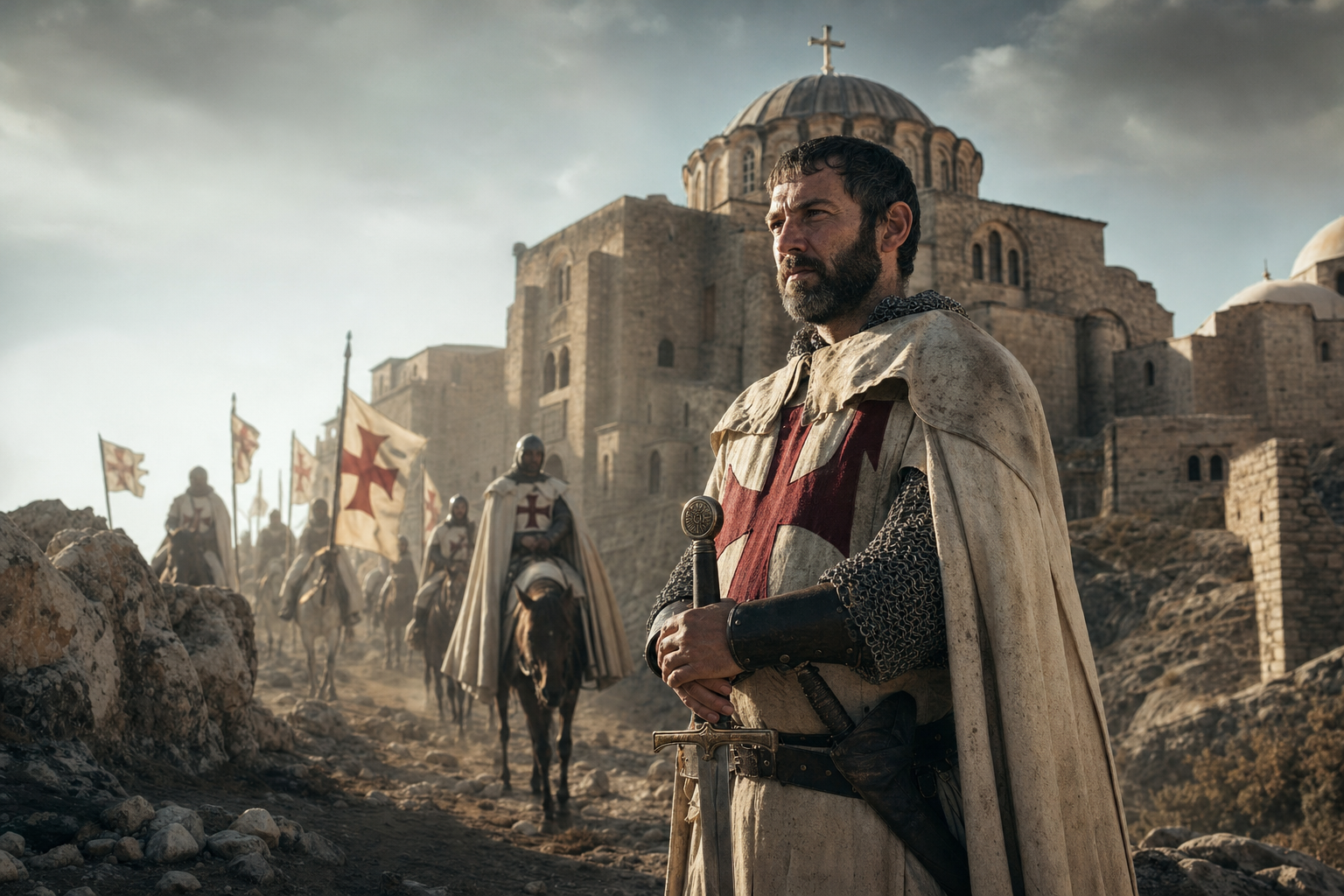
Templars and the Crusades: Secrets, Battles, and the Fall of a Mystic Order
The wind that whistles along the ruins of Crusader castles carries more than the dust of centuries; it carries rumor, devotion, and a discipline that once stood at the crossroads of faith and force. The Knights Templar emerged in the early twelfth century with a simple, terrifying vocation: to protect Christian pilgrims traveling to Jerusalem. Yet from those modest beginnings sprang an institution that combined monastic piety with military rigor, amassed immense wealth, and left a trace so deep in European memory that it has been recast again and again as sacred conspirator, secret banker, and guardian of holy relics. This article sets out to peel back layers of legend and propaganda and to follow the Templars through the crucible of the Crusades—into battle, into finance, into trial by fire.
Soon after their foundation, the Templars became inseparable from the politics and warfare of the Latin East. They built and garrisoned castles that controlled roads and sea approaches, rode into pitched battles alongside kings and princes, and helped shape the fragile geometry of the Crusader states. Yet their power also bred suspicion. Centuries later, when royal coffers ran dry and political rivalries sharpened, accusations of heresy and secret ritual were pressed like a blade against them. The arrests of October 1307, ordered by Philip IV of France, and the slow judicial process that followed culminated in the suppression of the Order in 1312 and the execution of its last Grand Master, Jacques de Molay, in 1314. Those dramatic events did not extinguish the Templar legend; they refracted it, creating myths that would feed novels, art, and modern conspiracy.
To understand the Templars is to move between sources: charters and papal bulls, chroniclers on the battlefield, the remains of concentric fortresses, and the occasional archival needle—like the Chinon Parchment—whose faded ink rewrites what we thought we knew. This narrative seeks to be both captivating and rigorous. It will track the Order’s origins in the shadow of Jerusalem, follow its military engagements during the major crusading campaigns, examine how the Templars became a financial engine for Christendom, and finally, probe the political and legal theater that brought them down. Along the way, we will separate substantiated history from later accretions of myth, while not shirking the darker resonances that have made the Templars forever alluring to storytellers.
Did you know? The papal bull Omne Datum Optimum (1139) exempted the Templars from tithes and local ecclesiastical authority, a legal privilege that accelerated their European growth.
Origins and Foundation
The foundation of the Knights Templar is anchored in the aftermath of the First Crusade and the Latin capture of Jerusalem in 1099. Pilgrimage routes to the Holy Sepulchre became a matter of life and death for Christian pilgrims who traversed hostile territories. Around 1119–1120, a minor knight from Champagne, Hugues de Payens, accompanied by perhaps eight companions—among them Godfrey de Saint-Omer—offered themselves as a small brotherhood to protect pilgrims. Their early existence was humble and precarious; the original group lodged in a wing of the royal palace on the Temple Mount, which is why they later came to be known as the Poor Fellow-Soldiers of Christ and of the Temple of Solomon.
What transformed the Templars from a modest protective band into a pan-European institution was formal recognition by the Church and generous endowments. The pivotal moment came at the Council of Troyes in 1129, where Bernard of Clairvaux, whose ascetic influence was immense, championed the Order. Bernard drafted the Latin Rule that combined monastic discipline with martial obligations and made the Templars a recognized religious order with vows similar to other monks: poverty, chastity, and obedience. Crucially, the Rule permitted them to bear arms in defense of Christendom—a fusion of the cross and the sword that would come to define military orders.
Papal support catalyzed their growth. Pope Innocent II’s papal bull Omne Datum Optimum in 1139 granted the Templars privileges such as exemption from tithes, autonomy from local ecclesiastical jurisdiction, and the right to collect donations across Christendom. This exceptional independence freed them to build networks of commanderies (also called preceptories) and accumulate landed estates, enabling both recruitment and supply for ventures in the East. The Order developed an organizational structure with a Grand Master at its head, supported by marshals, preceptors, and chaplains. Their signature attire—a white mantle bearing a red cross—signaled a blend of sanctity and martial identity.
Did you know? At the Battle of Hattin (1187), many Templar knights were captured by Saladin; the loss of their leadership contributed directly to the subsequent fall of Jerusalem.
From the beginning, the Templars were international. Their membership drew from across Western Europe, and their preceptories functioned as economic hubs that supplied the order’s investments in the Holy Land. Through careful record-keeping and a centralized command, they could marshal knights and resources at a scale that local nobles could not easily match. This structural advantage made them indispensable allies to Latin rulers in Outremer but also sowed the seeds of later suspicion: they answered primarily to the papacy and the Grand Master, not to local kings, making them a transnational power that could be resented by monarchs seeking greater control.
Military Role in the Crusades
The Templars’ military reputation was forged in the violent, fluid theaters of the Crusader states where fortified towns, desert roads, and mountain passes dictated strategy. Unlike secular knights, Templars were vowed religious warriors who combined monastic discipline with battlefield tactics. Their role evolved: initially as escorts for pilgrims, they soon operated as an elite heavy cavalry, garrison forces in key fortresses, and shock troops in major engagements. Their presence could be decisive in both offensive campaigns and static defense.
One of the earliest large-scale tests came during the consolidation of the Latin states in the 1120s and 1130s when the Templars helped to secure roads and garrisoned castles crucial to the Kingdom of Jerusalem. They were noted participants in the Battle of Montgisard (1177), where the forces of Baldwin IV of Jerusalem struck a dramatic victory against Saladin—an event chroniclers describe with near-miraculous fervor. Their most humiliating defeat came with the Battle of Hattin in 1187, a catastrophic clash in which Saladin’s forces captured or slaughtered much of the Crusader field army and took many Templars prisoner. Hattin precipitated the fall of Jerusalem later that year and exposed the vulnerability of the Latin states.
Did you know? The Templars operated an early network of letters of credit, letting travelers and nobles deposit funds in one preceptory and withdraw them elsewhere—an innovation comparable to a medieval banking system.
Despite such setbacks, the Templars were central to the defense during the pivotal Siege of Acre (1189–1191). Acre’s long, grinding siege was a focal point of the Third Crusade, and the Templars played a prominent role in manning the walls and sorties. The protracted defense showcased the order’s discipline and logistical capacity: maintaining supply lines, rotating garrisons, and coordinating with incoming crusading contingents from Europe, including those led by Richard I of England and Philip II of France. Acre’s eventual fall to the Crusader coalition in 1191 demonstrated both the tenacity of the defenders and the strategic importance of the Templar garrisons.
Templar fortifications were part of their strategic doctrine. Castles like Château Pèlerin (Atlit), built on the coast north of Acre, and other fortified positions allowed them to project power and secure pilgrimage routes. The Templars also held inland strongpoints—though some famous castles commonly associated with crusading images, such as Krak des Chevaliers, were actually headquarters of the Hospitallers rather than the Templars. The Templars’ fortresses often combined forward defense with the capacity to launch raids against Muslim-held territory, thereby shaping the tactical chessboard of the Levant.
Beyond pitched battles, the Templars conducted patrols, escorted convoys, and engaged in intelligence-gathering. Their cloistered discipline enforced rigorous training and regimentation, and their willingness to undertake suicidal charges or last stands earned them a fearsome reputation. Medieval chroniclers and eyewitnesses chronicled episodes of Templar bravery and fanaticism alike, feeding a narrative of holy militancy that would be retold for centuries.
Did you know? October 13, 1307—the mass arrest date of many Templars in France—fell on a Friday, and this event is one of the popular origin stories tied to the superstition around Friday the 13th.

Economic Power and Organizational Innovations
If the Templars were soldiers, they were also administrators and innovators. Their rapid accumulation of wealth across Europe and the Levant was not accidental: it resulted from a conscious combination of donations, agricultural estates, rental incomes, and commercial ventures. European nobility donated lands and revenues to the Order—often in return for spiritual benefits—and the Templars converted these into steady incomes by managing estates through local commanderies that functioned like landed businesses.
One of the Templars’ most influential innovations was their role as early providers of credit and safe transport for pilgrims and nobles. While medieval financial systems lacked formalized banks as we understand them today, the Templars developed mechanisms—letters of credit, custodial finance, and a networked accounting practice—that allowed funds to be transferred across long distances without the physical carriage of coin. A pilgrim or noble could deposit assets with a European preceptory and obtain a document enabling withdrawal in Outremer, reducing the risk of theft. This service proved invaluable and made the Templars a conduit for international funds, including revenues destined for crusades.
Their record-keeping and centralization were remarkable for the age. The Order maintained registers, inventories, and detailed accounts connecting the preceptories with the central treasury in the Holy Land. This bureaucratic capacity allowed the Templars to allocate resources efficiently between fortresses, ships, and recruiting needs. Their fleets—small but significant—moved men and supplies across the Mediterranean, and their control of port facilities in places like Acre amplified their logistical importance.
Did you know? The Chinon Parchment (discovered in the Vatican archives and revealed publicly in 2001) indicates Pope Clement V heard confessions from Templar leaders in 1308 and granted absolution, complicating the narrative of straightforward papal condemnation.
The wealth and autonomy of the Templars, however, created tensions. Kings and princes coveted their lands; local bishops bristled at their papal exemptions. Their economic reach implied political leverage. In France, by the late thirteenth and early fourteenth centuries, the French Crown carried significant debts to the Templars—debts that would become a factor in Philip IV’s decision to act against them in 1307. Additionally, accusations—often spurious—about secret ceremonies and the breach of vows found fertile ground when combined with fiscal motives. The very systems that sustained and empowered the Order made it vulnerable to attack from those who sought to appropriate its resources or neutralize its independence.

Arrest, Trials, and the Suppression of the Order
The dramatic downfall of the Templars is as much a tale of medieval politics as of ecclesiastical jurisprudence. By 1307, the Order possessed extraordinary wealth and privileges in Europe, and King Philip IV of France—nicknamed Philip the Fair—was both deeply indebted to them and intent on consolidating royal authority. On October 13, 1307, Philip ordered the mass arrest of Templars in France on charges ranging from heresy and idolatry to obscene rituals and sexual misconduct. Contemporary chroniclers described scenes of violence and confusion as knights were seized, property catalogs were drawn, and testimony—often extracted under torture—was taken.
The procedure that followed was complex. The papacy, residing in Avignon under Clement V, could not ignore the king’s actions. Initially, Pope Clement issued orders to investigate and, at times, attempted to protect the Order’s rights while also placating Philip. Trials were held in many jurisdictions across Europe. Torture was used in France to extract confessions, which in turn were publicized to justify the Crown’s actions. The reliability of these confessions is highly suspect; methods of interrogation and the political incentives to produce incriminating testimony undermined their credibility.
Did you know? Much of the Templar property formally passed to the Knights Hospitaller after suppression, but in practice many assets were seized by local rulers, especially in places like France where royal expropriation was aggressive.
A crucial and often overlooked document is the Chinon Parchment (discovered in the Vatican archives and publicized in 2001), which records that in August 1308 Pope Clement V and cardinals heard confessions from leading Templar figures, including Jacques de Molay, the Grand Master. According to the parchment, the pope granted absolution to some Templar leaders and recommended penitential measures. Despite this papal act, political pressure from Philip and a desire to pacify secular rulers led to an outcome that diverged from full papal forgiveness: the Order was formally suppressed by the papal bull Vox in excelso in 1312. Philip’s financial interests and the popular scandal created by the confessions worked together to ensure the Order’s end.
After suppression, assets of the Templars were generally transferred to the Knights Hospitaller, though in practice much of the wealth was seized by local monarchs or lost in legal wrangling. The last Grand Master, Jacques de Molay, was burned at the stake in Paris in 1314 after retracting earlier confessions and publicly protesting the injustice of the proceedings. His execution galvanized sympathy and fed the narrative of martyrdom that would help sanctify the Templars in later centuries.
Historians debate motive and culpability. While there were certainly abuses and internal deviations in any large medieval institution, the predominant modern view emphasizes Philip IV’s fiscal motives and political calculation, coupled with a legal process that tolerated coercion. The Templars’ suppression was less a clean legal adjudication of doctrinal crime than a violent reconfiguration of power in early fourteenth-century Europe.
Did you know? The Temple Church in London, founded by the Templars in the 12th century, preserves architectural and documentary evidence of their presence in England and was used as a treasury and legal center by the order.

Myth, Legend, and Cultural Afterlife
The Templars’ historical record is inseparable from the legends woven around them. From the fifteenth century onward, writers and storytellers married fragments of fact with invention. The Order’s secretive rituals, sudden disappearance as an institution, and reputed treasure made fertile ground for tales of hidden relics, secret initiation rites, and custodianship of sacred objects like the Holy Grail. Literary treatments—from medieval romance to modern bestsellers—have often projected onto the Templars the qualities of epic guardians of esoteric truth.
The association between the Templars and Freemasonry emerged in the eighteenth century. While no direct medieval continuity exists, the reframing of Templar imagery—crossed swords, cloaks, and ritual—became part of Masonic symbolic repertory. Romantic and nationalist movements in Europe later appropriated Templar symbolism for causes ranging from chivalric revival to political mystique. In modern popular culture, the Templars occupy a range from straightforward villain to tragic hero, appearing in novels, films, and video games.
But legend should be carefully disentangled from archival facts. Claims that the Templars guarded the Holy Grail, possessed the Ark of the Covenant, or maintained a continuous secret order after 1314 are products of later imagination, not documentary evidence. Yet those imaginations reflect real anxieties and fascinations: about secret power, the mingling of the sacred and the secular, and the fate of wealth and authority. The myths are themselves an important part of the Templars’ legacy because they demonstrate how historical memory is reshaped to serve new needs.
Modern scholarship, aided by discoveries like the Chinon Parchment and by systematic archival work, has corrected many sensational claims while also underscoring the remarkable reality: the Templars were both pious monks and accomplished administrators, warriors and innovators. Their suppression did not erase their influence. Buildings like the Temple Church in London, surviving charters, and scattered preceptory ruins testify to an organization that once spanned Christendom.
Legacy and Historical Interpretation
The legacy of the Knights Templar is a palimpsest of military achievement, economic innovation, institutional hubris, and mythic afterlife. Historically, they helped to shape the militarized spirituality of the Crusades at a time when Europe experimented with what it meant to be a soldier of Christ. Their fusion of monastic rule with martial obligation influenced subsequent military orders, most notably the Knights Hospitaller and the Teutonic Order. The Templars’ administrative models—centralized command, divisional preceptories, and cross-regional financing—left a mark on medieval institutional practice.
From a political perspective, the Templars represent a problem that medieval rulers and popes had to manage: an international corporation subject to papal authority but wielding economic and military power that could rival secular states. The conflict between Philip IV and the papacy over the Templars foreshadows later struggles over sovereignty, taxation, and judicial authority. The Crown’s ability to neutralize the Order in France changed the balance of power between a rising centralized monarchy and transnational ecclesiastical institutions.
Culturally, the Templar image has been mobilized for many narratives: as a symbol of lost chivalry, as a villainous cabal, and as an emblem of secret resistance. The modern fascination—reborn in the nineteenth-century Gothic and Romantic revivals and persisting into contemporary fiction—says less about the medieval Templars than about modern needs for mystery, order, and the intrigue of hidden knowledge. Yet that continued fascination also guarantees ongoing scholarly attention: archaeologists, historians, and archivists keep unearthing new layers that refine our understanding.
The Order’s material legacy—castles, churches, and charters—offers a rich terrain for interdisciplinary research. Excavations at sites across the Levant and Europe illuminate daily routines, military architecture, and economic connections. Archival finds continue to nuance our picture: the Chinon Parchment, account rolls, and papal correspondence allow historians to reconstruct institutional dynamics more precisely. That work emphasizes a key lesson: the Templars were neither wholly saintly nor utterly corrupt; they were a medieval organization whose strengths and failings reflected the turbulent era that produced them.
Conclusion: Between Fact and Legend
To stand before a Templar ruin or leaf through a dusty charter is to confront an object that asks both for sober interpretation and for imagination. The Knights Templar were a paradox: monastics and warriors, custodians of piety and proprietors of wealth, internationally empowered yet locally vulnerable. Through the crucible of the Crusades they forged reputations for courage and controversy. Their suppression by Philip IV and the papacy combined political expedience, fiscal calculation, and a medieval theater of confession and condemnation—producing a dramatic end that fed centuries of speculation.
Yet stripping away later myths reveals an organization that contributed materially and institutionally to medieval Christendom: its castles and patrols defended pilgrims and built geopolitical infrastructures; its administrative methods presaged later financial practices; its diplomatic and military engagements shaped the history of the Latin East. The Templars’ dramatic fall did not erase these contributions, but it did transform them into legend—an afterlife that ensures the Order remains a prism through which modern readers explore questions of faith, power, secrecy, and memory.
In the end, the Templars are both a subject of serious historical inquiry and a vessel for storytelling. A rigorous study honors both dimensions: it separates what can be documented from what only later imagination supplied, while acknowledging the enduring allure of a brotherhood that, for two centuries, sat at the dangerous intersection of devotion and force.
How we verify this article
By the History Unlocked editorial team
This text is built on historical facts stored in our database and drafted with AI assistance. No signed human review is recorded for this article. Report any inaccuracy: we correct it and update the modified date.
Updated on
AI-assisted drafting.
Read our editorial standardsEnjoyed this? Discover more articles in the category Knights Templar