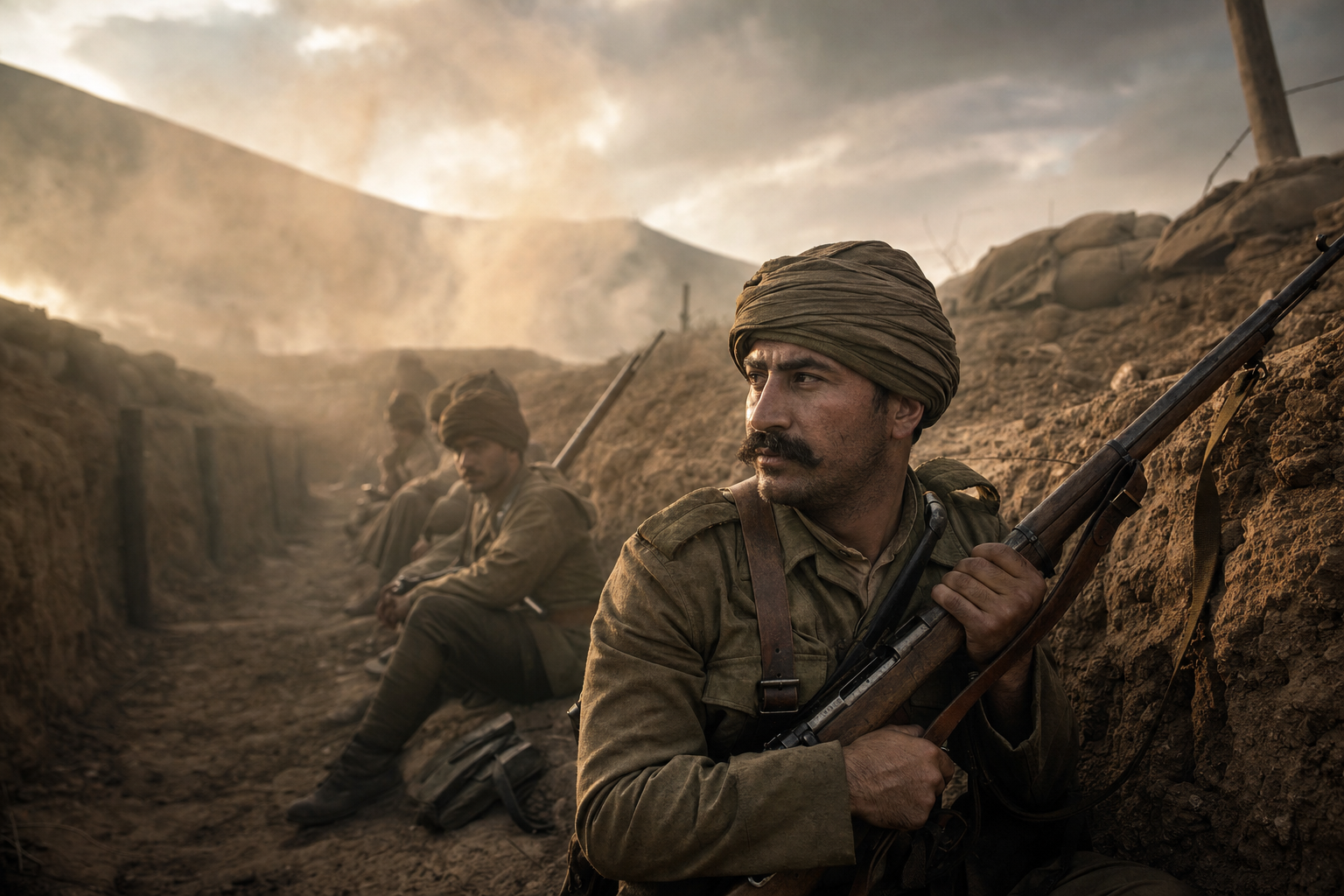
Shadow of Empires: The Ottoman Empire in World War I
The Ottoman Empire in 1914 was a realm of echoes — of sultans and janissaries remembered more as stories than as instruments of power, of reformers who had tried to drag an ancient polity into the modern world, and of provincial loyalties that sometimes outweighed imperial coherence. By the time Europe erupted into total war in August 1914, the empire’s territory had shrunk from its nineteenth‑century zenith, its finances were precarious, and its political elite were fractious. Yet the imperial shadow still stretched across Anatolia, the Levant, North Africa’s edges, and the Arab deserts. Into that shadow came the thunder of modern artillery, the rattle of machine guns, and the mechanical logic of empires pressing their last claims.
This article takes a long, close look at the Ottoman journey through World War I: the decisions that bound it to Germany, the naval gambit that pushed it into conflict with the Entente, the epic struggles at Gallipoli and in the Caucasus, the grinding campaigns across Mesopotamia and Palestine, the convulsions within Ottoman society that produced deportations and new nations, and, finally, the armistice that ended a six‑century empire. My approach will be narrative and at times intentionally mysterious — to reconstruct not only the dates and battles but the choices, miscalculations, and human consequences that shaped the Ottoman experience.
Readers will encounter familiar names — Enver, Talat, Djemal, Mustafa Kemal — but also the tens of thousands of soldiers, civilians, refugees, and administrators whose stories add texture to the broad sweep of diplomacy and strategy. The Ottoman case in World War I shows how alliances can both promise salvation and accelerate collapse, how geography and logistics can defeat strategic will, and how the war’s violence transformed the region’s demographic and political map for generations.
Did you know? The German military mission led by Otto Liman von Sanders arrived in 1913 and became a central influence in reorganizing the Ottoman Fifth Army, which would be decisive at Gallipoli.
History here is not a closed ledger; it is a contested narrative with ghosts in every footnote. I will highlight recorded facts and commonly accepted scholarly conclusions, avoiding speculation about invented events. But the past retains its mysteries: why certain decisions were taken at particular moments, the extent to which German officers truly controlled Ottoman strategy, or how local commanders improvised in the fog of war. To follow these threads is to enter a complex tapestry in which honor, desperation, ideology, and routine administration intertwine.
In the sections to follow I will move roughly chronologically but also thematically: first laying out the empire’s precarious background, then explaining the entry into the war, then tracing the major theaters and the internal convulsions that defined the Ottoman wartime state. Each section aims to be rich in detail and grounded in verifiable evidence; together they should provide a comprehensive portrait of an empire at war.
Background and Decline of Ottoman Power
The Ottoman Empire that entered World War I was larger in reputation than in consolidated power. Throughout the late nineteenth and early twentieth centuries it had faced repeated territorial contraction — the loss of the Balkans after the Balkan Wars of 1912–13, mounting European economic penetration, and internal pressures from nationalist movements among Greeks, Bulgarians, Armenians, and Arabs. The Young Turk Revolution of 1908 and the rise of the Committee of Union and Progress (CUP) brought a new generation of officers and bureaucrats to the fore. These men promised centralizing reform and national rejuvenation but also carried the scars of defeat and a readiness to adopt modern, often militarized, solutions.
Did you know? The transfer of SMS Goeben and Breslau to Ottoman control in August 1914 was negotiated while the ships’ German captains technically remained in command — a legal fiction that allowed Germany to retain influence.
Economically, the Ottoman state owed large debts to European creditors and ran a complex system of capitulations that privileged foreign merchants within Ottoman markets. Politically, the sultan still reigned as a figurehead even as the CUP reshaped the administration. The triumvirate that would steer Ottoman policy during the war — Enver, Talat, and Cemal Pasha, often called the Three Pashas — combined nationalist zeal, administrative cunning, and sometimes ruthless methods. Enver Pasha, minister of war, was charismatic and ambitious; Talat Pasha, as interior minister, was the bureaucratic engine; Cemal Pasha dominated the Syrian provinces and naval affairs. Their leadership style blended modern bureaucracy, secret police, and military-minded centralization.
Militarily, the Ottoman army had undergone reforms and possessed a core of capable officers, but it lacked industrial backing, modern supply lines, and an effective modern navy. The German military mission to the Ottoman Empire, led by officers such as General Otto Liman von Sanders, played a decisive role in training and reorganizing the army. German advisers were welcomed as a way to modernize and as a counterbalance to British and French influence. Diplomatically, the Ottomans oscillated between fear of Russian expansion, hopes for German protection, and attempts to preserve autonomy. The prewar years were therefore a period of anxious repositioning: the empire did not possess the strategic margin to absorb a long, attritional war without severe domestic consequences.
The empire’s social fabric was also fraying. Urbanization, new intellectual currents, and nationalist agitation among subject peoples strained the old systems of governance. Armenians and other Christian minorities had long agitated for reform; Ottoman authorities perceived some nationalist movements as existential threats. The state’s response often combined promises of reform with episodic repression. Meanwhile, the empire’s Arab provinces retained local identities and loyalties that were not easily governed from Constantinople. Tribal leaders, provincial elites, and urban notables could tip the balance in uncertain regions, and the CUP’s attempts to centralize control would produce resistance and, ultimately, collaboration with foreign powers.
Did you know? Mustafa Kemal's order to his troops on the morning of 25 April 1915, reportedly "I do not order you to attack, I order you to die," became a powerful rhetorical emblem of resolve in Turkish memory.
These structural weaknesses explain why the Ottoman leadership saw war as a risky gamble but one that might produce strategic reversal of fortune. An alliance with Germany could bring military aid and the cover to reassert authority over restive provinces. Yet it also meant committing an already fragile empire to the vicissitudes of a great power contest that in many respects it could not win.

Entry into the War and Alliance Choices
The Ottoman decision to enter World War I was not instantaneous; it was the result of diplomatic maneuvering, covert operations, and a fateful naval episode. In late July and early August 1914, Germany moved to secure an alliance with the Ottoman leadership. A formal Ottoman–German alliance treaty was signed on 2 August 1914, binding the two states in mutual defense. That diplomatic pivot, however, did not by itself mean immediate belligerency. The critical accelerant was naval: the German battlecruiser SMS Goeben and light cruiser SMS Breslau evaded British pursuit in the Mediterranean in August 1914 and reached Constantinople under shelter from Ottoman ports. The ships were formally transferred to Ottoman control and renamed Yavuz Sultan Selim (Goeben) and Midilli (Breslau), but they retained their German crews and commanders.
The presence of those modern capital ships created a political and military temptation. On 29 October 1914 the Ottoman fleet, including the German-crewed Yavuz and Midilli, shelled Russian Black Sea ports — an action that provoked Russia and the Entente. By 31 October, Britain and France had declared war on the Ottoman Empire, and on 5 November Russia had formally done the same. The Entente’s declarations were in part a reaction to Ottoman naval action and in part a recognition that the Ottoman entry had immediate strategic consequences: control of the Dardanelles and the Bosporus meant potential threats to Russian supply lines and access to the Mediterranean.
Did you know? The Siege of Kut ended on 29 April 1916 with the surrender of 13,000 British and Indian troops — one of the largest surrenders of British forces until World War II.
German strategy benefited from the Ottoman decision. Germany secured a new front against Russia and tied up Entente resources. Ottoman leaders, for their part, believed that a German alliance might help restore imperial prestige and provide military aid. The reality, however, was that Germany’s ability to project sustained material support to the Ottoman fronts was limited by geography and naval constraints. The empire therefore entered the war with a strong ideological commitment among its leadership but with chronic shortages in ammunition, medical supplies, and industrial capacity.
The early wartime months also saw the extension of German influence beyond advisers. German officers took senior commands, and the Ottoman army was reoriented to coordinate with German strategic aims. Yet tensions existed: Ottoman generals sometimes resented German directives, and the unique demands of fighting in Anatolia, the Caucasus, and the deserts required local knowledge that German advisers occasionally lacked. The alliance was thus asymmetric: Germany gained allied manpower and geographic leverage; the Ottomans received technical and tactical support but became increasingly enmeshed in German strategic priorities.
The Ottoman entry into the war had immediate political consequences at home. Civil liberties were curtailed, censorship increased, and the CUP consolidated power. The Interior Ministry under Talat Pasha expanded surveillance and control over dissent, a development that would have catastrophic consequences for Ottoman minorities in 1915. The state’s mobilization transformed social life, as men were conscripted, wartime taxation increased, and wartime shortages began to bite into daily existence.
Did you know? The defeat at Sarikamish during the winter of 1914–1915 led to catastrophic frostbite and death for tens of thousands of Ottoman troops, weakening Ottoman control in Eastern Anatolia.

Gallipoli Campaign: Defiant Defense
The Gallipoli Campaign is perhaps the most famous Ottoman military episode of World War I, not least because it produced one of the war’s most evocative national narratives. Winston Churchill, as First Lord of the Admiralty, argued that a naval breakthrough through the Dardanelles could knock the Ottoman Empire out of the war and open a sea route to Russia. The Allied expedition — combining naval attacks with amphibious landings in April 1915 — aimed to seize control of the peninsula and ultimately to capture Constantinople. On 25 April 1915 Allied troops landed at multiple points; what the planners had not fully accounted for was the tenacity of Ottoman defense, the power of terrain to favor defenders, and the capabilities of Ottoman commanders who understood both the ground and the stakes.
Two figures loom large. Mustafa Kemal, a divisional commander at the time, ordered his troops to hold the high ground that dominated the ANZAC (Australian and New Zealand Army Corps) landings and famously defied orders to withdraw. His decisive leadership helped secure key positions and later became a cornerstone of Turkish national myth. Another critical figure was Otto Liman von Sanders, the German general advising and commanding the Ottoman Fifth Army; his reorganization of defenses and insistence on strong fortifications paid dividends. The Ottoman army fought with ferocity and with an intimate knowledge of the ridgelines, gullies, and choke points; the Allies, for all their firepower and naval backing, could not force a decisive breakthrough.
The campaign became a protracted trench war reminiscent of the Western Front, with high casualties, disease, and the harshness of coastal climate. Allied forces, including British, Australian, New Zealander, French, and Indian troops, suffered heavy losses, with combined Allied casualties estimated at roughly 250,000. Ottoman casualties were also enormous, by many counts near parity. The human cost was staggering: wounded and dying men lay within meters of each other across opposing lines, and attempts at evacuation and resupply were perilous. By January 1916 the Allies had evacuated most of their forces, leaving Gallipoli as an Ottoman strategic victory, a bitter Allied failure, and a defining episode for the emerging national narratives of several states.
Did you know? On April 24, 1915, roughly 250 Armenian intellectuals and community leaders were arrested in Constantinople, a day now commemorated as the start of the Armenian genocide.
Gallipoli’s significance transcended military metrics. For the Ottoman leadership, it was a moment of national assertion — proof that the empire could defend its core territories against the great powers. For the Allies, it was an embarrassment that led to political fallout in London and a reassessment of amphibious operations. For the combatants, it was a crucible that produced leadership and trauma in equal measure. The campaign’s memory would feed postwar politics: Mustafa Kemal transformed his Gallipoli reputation into the political capital that propelled him to leadership in the Turkish nationalist movement after the war.

Caucasus, Mesopotamia, and Palestine Fronts
Beyond Gallipoli the Ottoman war was fought across a diverse and unforgiving geography. In the Caucasus the empire faced Russia. The winter of 1914–1915 saw the ill‑fated Ottoman offensive at Sarikamish, led by Enver Pasha, which attempted to encircle Russian forces. The plan collapsed in the face of extreme cold, inadequate supplies, and the resilience of Russian defenses. Tens of thousands of Ottoman soldiers froze or died of starvation; the campaign exposed logistical weaknesses and poor planning at the highest levels. The defeat at Sarikamish weakened Ottoman presence in Eastern Anatolia and contributed to the harsh measures that the central government later enacted against Armenian populations, whom some leaders blamed for collaboration with the Russians.
In Mesopotamia (modern Iraq), a prolonged struggle unfolded between British Indian forces seeking to protect imperial lines to India and the Ottoman garrisons attempting to hold the Tigris‑Euphrates basin. Early British advances culminated in a precarious overreach: the siege of Kut (December 1915–April 1916) ended disastrously for the British when General Charles Townshend surrendered in April 1916. The British later reorganized and captured Baghdad in March 1917 under General Maude. These campaigns revealed how rivers, marshes, and heat could shape strategic possibilities: disease and supply problems were as deadly as enemy fire.
Did you know? The Armistice of Mudros was signed on the British ship HMS Agamemnon at Mudros harbor on the island of Lemnos on October 30, 1918.
In Palestine the Ottoman defense collapsed gradually under the British Egyptian Expeditionary Force led by General Edmund Allenby. After successes at Gaza in 1917 and the decisive breakthrough at the Battle of Megiddo in 1918, Allenby entered Jerusalem on December 11, 1917, a symbolic moment that marked the beginning of the end of Ottoman control over the Levant. The Allenby campaign combined mobility, improved logistics, and coordination with local Arab forces inspired by the Arab Revolt — a rebellion declared in 1916 by Sharif Hussein of Mecca and supported covertly by the British under officers like T.E. Lawrence (Lawrence of Arabia). The Arab Revolt’s contribution to undermining Ottoman logistical lines and provoking local defections accelerated the empire’s disintegration in the region.
Each theater also involved complex interactions between military operations and ethnic, religious, and political cleavages. Ottoman atrocities and mass deportations, particularly against the Armenian population in 1915, became both a humanitarian catastrophe and a political instrument. The empire’s leadership, fearing an internal fifth column and influenced by the pressure of wartime exigencies, adopted policies that would lead to the deaths and displacements of hundreds of thousands of Armenians and other minorities. This tragedy reshaped the human geography of Anatolia and fuelled enduring grievances and diasporas.
The logistics of sustaining multiple fronts stretched the Ottoman state near breaking. Railroads, limited industry, and an overstretched medical corps meant that losses were poorly replaced and that the civilian population suffered shortages and requisitions. Despite moments of successful defense and tactical brilliance, the Ottoman forces were increasingly on the defensive as 1917–18 progressed, pressured by Allied advances in Palestine and British reshuffling of forces after the Russian Revolution removed the eastern adversary from the field.
Did you know? After the war, several Ottoman leaders were assassinated by Armenian Operation Nemesis agents in revenge; Talat Pasha was assassinated in Berlin in 1921.

The Home Front: Society, Politics, and Genocide
Wartime pressures transformed Ottoman society in ways both immediate and enduring. The CUP’s wartime governance increasingly relied on emergency decrees, centralization, and policing. Internal security measures tightened, and loyalty to the state was enforced through surveillance and, in some cases, coerced relocation. The arrests of Armenian intellectuals and community leaders in Constantinople on April 24, 1915, marked the opening of a campaign of deportations and massacres that many historians now classify as genocide. Over the following months and years, mass marches, forced labor camps, and killings removed large swathes of Armenian communities from Anatolia. Contemporary estimates vary, but the commonly cited range is roughly 600,000 to 1.5 million Armenian deaths; scholarly debate focuses on scale and intent, but the weight of evidence supports the conclusion of systematic mass murder and forced removals conducted under central authority.
The Ottoman state’s actions against Armenians did not occur in a vacuum. Wartime fear, local vendettas, and mistrust of minority loyalties all played roles. The government justified measures as military necessities, accusing segments of the Armenian population of collaboration with the Russians. Whatever motivations are advanced in official documents, the outcomes were catastrophic for civilian populations. Other groups — Assyrians, Greeks in Anatolia, and various Muslim communities displaced by the conflict — also suffered violence and forced migrations. The war accelerated demographic transformations that would be made permanent by postwar treaties and nationalist projects.
The CUP’s internal politics were also fraught. Talat Pasha, as interior minister, oversaw much of the deportation machinery; Enver Pasha directed military campaigns that yielded mixed results; Cemal Pasha’s governance of Syria and the Arab provinces produced harsh measures and later resistance. The cumulative effect of war, repression, and administrative collapse was a rise in refugees and famine in parts of Anatolia, compounded by the 1918 influenza pandemic and the general breakdown of prewar economic patterns. These social stresses undermined the legitimacy of the sultanate and set the stage for nationalist movements.
Did you know? The defense of Gallipoli is commemorated annually in Turkey on 18 March (Çanakkale Victory and Martyrs' Day) and in Australia and New Zealand on 25 April (ANZAC Day).
Politically, the end of Russia’s imperial presence on the Eastern Front after the 1917 Revolution briefly opened a window for Ottoman hopes of regaining territory, but the empire lacked the resources for extended offensives. Instead, the war’s end found Constantinople occupied by Allied forces, and Ottoman leaders facing war crimes investigations, exile, and executions. Some CUP leaders fled and were later assassinated by Armenian nationalists in retribution; others were tried in absentia. The cumulative moral and political accounting of Ottoman wartime conduct would influence interwar diplomacy and the historical memory of entire peoples.

Armistice, Treaty, and Dissolution
The Ottoman Empire sought an honorable exit as its fronts collapsed in 1918. The Armistice of Mudros, signed on October 30, 1918, between the Ottoman government and the Allies, effectively ended Ottoman participation in the war. The terms were severe: the Allies gained control of strategic points, and the empire’s military capacity was drastically curtailed. Allied occupation of Constantinople began almost immediately; French, British, Italian, and Greek troops took positions in the imperial capital and across the Anatolian littoral. The armistice paved the way for the Treaty of Sèvres in 1920, which proposed to partition large parts of the Ottoman domains and to create zones of influence for Allied powers. The Treaty's harsh terms ignited nationalist resistance.
Mustafa Kemal emerged as the leader of that nationalist reaction. Returning from Anatolia, he convened the Grand National Assembly at Ankara in 1920 and rejected the Treaty of Sèvres as a national surrender. A new Turkish national movement fought the Greco-Turkish War (1919–1922) and negotiated from a position of strength with the Allies. The resulting Treaty of Lausanne in 1923 superseded Sèvres, recognized the sovereignty of the Republic of Turkey, and established the borders of the modern Turkish state. The Ottoman sultanate was abolished in 1922, and Mustafa Kemal became the Republic’s first president in 1923.
Did you know? Many graves and memorials to Ottoman soldiers at Gallipoli were established after the war, including the large Çanakkale Martyrs' Memorial erected in 1960.
The empire’s dissolution was not merely a diplomatic reconfiguration; it was a human upheaval. Population exchanges, notably the Greco-Turkish exchange formalized in 1923, uprooted hundreds of thousands. The geopolitical map of the Middle East was redrawn: British and French mandates replaced direct Ottoman rule in Mesopotamia, Syria, and Palestine, creating new political entities whose borders were often arbitrary. The Sykes-Picot secret agreement of 1916 had already sketched a postwar order that privileged European strategic interests. The legacy of wartime violence, demographic engineering, and foreign mandates shaped the subsequent century’s conflicts and nationalisms across the Levant and Anatolia.
Legal and moral reckonings followed. Ottoman war criminals were tried in Istanbul, although many escaped. The narratives of victimhood and culpability hardened in the interwar years, shaping diplomatic relations between Turkey and diaspora communities, and influencing how historians and governments remember the events of 1915–18. Meanwhile, the revolutionary project of Mustafa Kemal’s republic sought to secularize and modernize Turkey, drawing both continuity and rupture from the Ottoman past.

Conclusion: Memory, Legacy, and the Long Shadow
A century after the guns fell silent, the Ottoman Empire’s experience in World War I continues to reverberate. The conflict catalyzed the empire’s final political metamorphosis: it turned a multiethnic empire into a nation-state, reoriented political loyalty from caliphate to republic, and left scars in every society that had been under Ottoman rule. The war’s human toll — soldiers slain on Gallipoli’s ridges, civilians marched from Anatolian villages, refugees starving on desert roads — is neither reducible to diplomatic treaties nor forgotten by communities who passed memory across generations.
History must reckon with complexity. Ottoman leaders made choices shaped by fear, ambition, and perceived necessity; they also presided over policies that produced catastrophic human suffering. The diplomatic games of Europe collided with local grievances and imperial anxieties in ways that magnified tragedy. At the same time, the postwar emergence of Turkish nationalism and the leadership of figures like Mustafa Kemal reshaped the region’s political destiny. The modern Middle East, in many of its contested borders, governance problems, and social traumas, bears the imprint of the war and the empire’s collapse.
For historians and readers today the Ottoman wartime story is a study in contingency. Different decisions — more supplies, different alliances, less paranoia about internal dissent — might have produced variations in outcome, but the structural constraints were severe. The Ottoman case also illustrates a perennial lesson: empires are brittle when stretched across diverse peoples and when their economic and administrative bases are eroded. Military valor and tactical skill can win battles, but they cannot always compensate for strategic insufficiency.
The shadow of empires persists, however. Monuments, cemeteries, and museums retain the memory of those who fought and died. Diplomatic disputes over recognition and memory remain alive, as do ongoing scholarly efforts to understand what happened and why. Reading the Ottoman experience in World War I today is to confront not just a past of maneuverings and massacres but a foundation for many of the modern Middle East’s abiding questions.


The Ottoman Empire’s World War I story is therefore a tale of dramatic reversals — of empire meeting modern total war, of national myth being forged in the crucible of defeat and survival, and of geopolitical reshaping that still informs our present. To read it is to confront both the machinery of great power politics and the tragic human consequences when states employ that machinery against their own populations and neighbors.
How we verify this article
By the History Unlocked editorial team
This text is built on historical facts stored in our database and drafted with AI assistance. No signed human review is recorded for this article. Report any inaccuracy: we correct it and update the modified date.
Updated on
AI-assisted drafting.
Read our editorial standardsEnjoyed this? Discover more articles in the category World War I