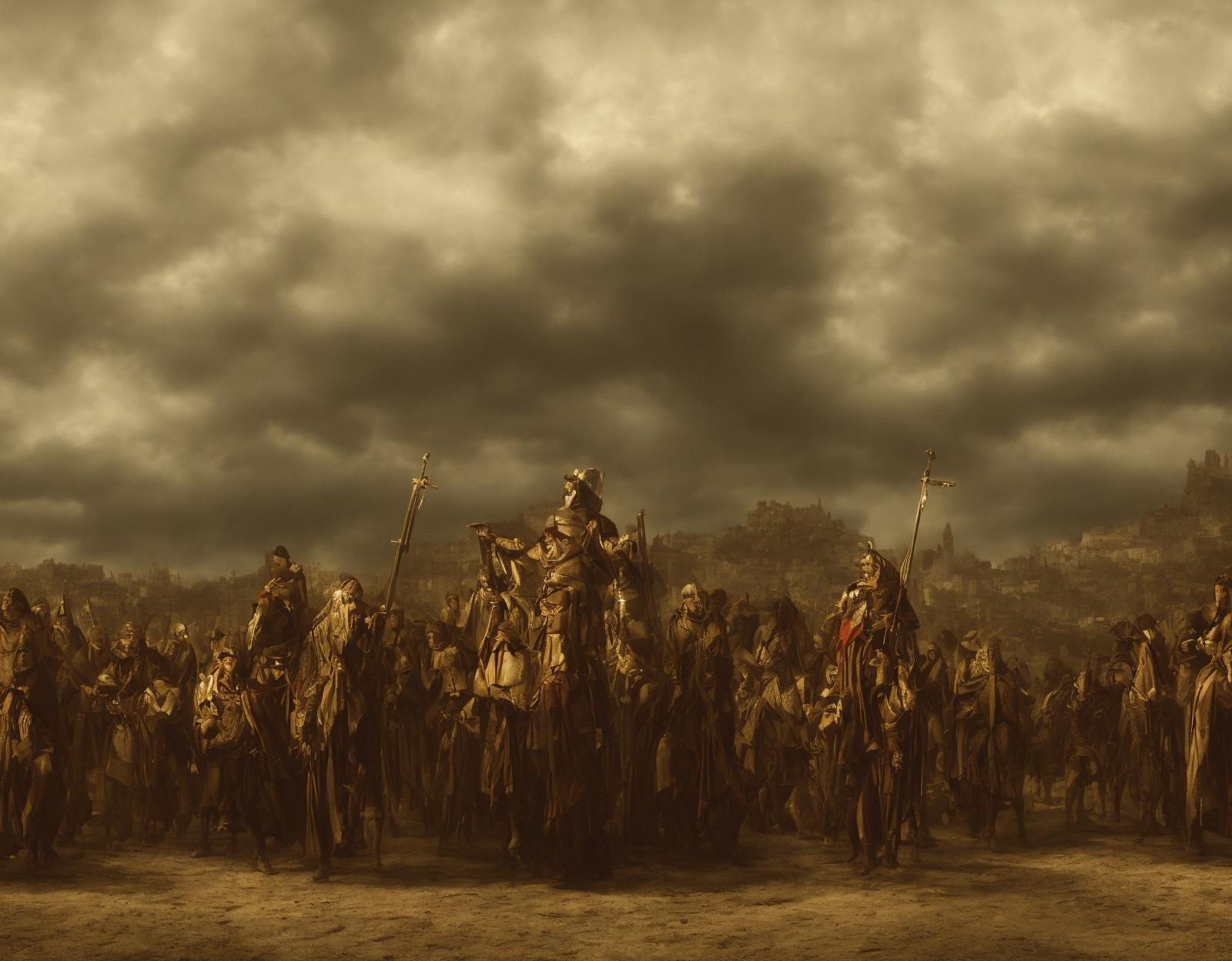
Templars and the Holy Grail: Origins, Myths, and Historical Truths
The story of the Knights Templar and the Holy Grail occupies a unique place where documentary medieval history and modern imagination meet. For centuries the Templars were a respected military and religious order born of the Crusading era; for nearly as long, the Grail has existed in the literature of chivalry as an object at once sacred and enigmatic. Over time, these two threads of Western cultural memory — the very real power and dramatic fall of the Templars, and the evolving literary symbol of the Grail — became entwined, producing one of the most persistent historical myths in European history. This article seeks to separate verifiable fact from alluring fiction, tracing the authentic medieval origins of both the Templars and Grail lore, the reasons later generations conflated them, and the cultural forces that have kept that conflation alive through modern novels, films, and conspiracy theories.
We begin with the foundation of the Knights Templar in the early twelfth century, a compact group of knights whose mission — to protect Christian pilgrims traveling to Jerusalem — was soon amplified by papal recognition, rich endowments, and a remarkable expansion of property across Europe and the Levant. We will examine the primary medieval sources: council records, papal bulls, chronicles, and charters that reveal their organization, rule, and financial innovations. Parallel to this institutional history, the Grail appears in the late twelfth-century poetry of Chrétien de Troyes and is reinterpreted by Robert de Boron and Wolfram von Eschenbach; these literary works do not mention the Templars, yet later medieval and post-medieval writers began to graft Grail imagery onto the Templar memory.
The dramatic collapse of the Templar order in the early fourteenth century — arrests ordered by Philip IV of France on 13 October 1307, trials beset by torture, papal inquiries, the suppression by Pope Clement V in 1312, and the execution of the last Grand Master Jacques de Molay in 1314 — created a powerful narrative of sudden downfall and possible hidden secrets. This narrative proved fertile ground for later speculation that the Templars had guarded something extraordinary: a relic, a book, or knowledge connected to the Grail. We will explore how these claims arise in the historical record, in the marginalia of later chroniclers, and, most importantly, in the centuries following the order's suppression.
Did you know? The Templar Rule promoted a simple diet and communal living; Bernard of Clairvaux’s writings stressed humility and the merging of monastic discipline with knightly duty.
Finally, the article analyzes how modern culture — from nineteenth-century romantics and occultists to twentieth- and twenty-first-century popular fiction — transformed scholarly gaps and ambiguities into sweeping conspiracies. We will consider archaeological evidence connected to Templar sites, scrutinize primary documents used by scholars, and present a nuanced conclusion: the Templars were neither the custodians of a single mythic cup nor mere fabrications of legend; they were an order whose real achievements and dramatic end were enough to seed centuries of myth-making. Along the way the reader will encounter curiosities and precise historical images that illuminate how real events produced enduring mysteries, keeping the Grail and the Templars locked in an imaginative embrace from which modern audiences still cannot look away.
The Historical Rise of the Knights Templar
The Knights Templar emerged in the volatile context of post-First Crusade Latin Christendom, when the new Crusader states required both martial protection and administrative structures to survive amid hostile neighbors. Founded around 1119–1120 in Jerusalem, the order originated with a small group of knights led by Hugues de Payens and Godfrey de Saint-Omer, who took vows to protect pilgrims and to live a communal life under a religious rule. Their initial chapel and headquarters were located near the ruins traditionally associated with Solomon's Temple on the Temple Mount, which is the origin of their popular name, the Templars, or officially the Poor Fellow-Soldiers of Christ and of the Temple of Solomon. The order’s early years were precarious; it lacked wealth and manpower but compensated by aligning itself with influential ecclesiastical patrons.
The turning point came with ecclesiastical endorsement at the Council of Troyes in 1129. At Troyes, Bernard of Clairvaux, an immensely influential Cistercian abbot, provided theological support and a written rule for the order that combined monastic discipline with martial duties. Bernard's tract, often translated as "In Praise of the New Knighthood," framed the Templars as a divinely sanctioned form of knighthood, reconciling martial valor with spiritual devotion. Papal recognition followed: Pope Honorius II confirmed their rule and privileges in 1129–1130, facilitating their rapid expansion. This official imprimatur allowed the Templars to receive donations of land, income, and rights across Western Europe as grateful pilgrims and nobles endowed the order with property.
Did you know? Chrétien de Troyes’ Perceval (1180s) is the first known text to use the word "graal" in a chivalric narrative, but it does not define the graal as the cup of Christ.
The Templars’ administrative genius lay partly in their ability to manage scattered estates — preceptories — which supplied recruits, agricultural produce, and income. More than a military brotherhood, they developed a nascent financial infrastructure: the order accepted deposits, issued letters of credit to pilgrims, and maintained treasury houses. By the later twelfth century, the Templars had become wealthy and powerful actors with significant property holdings in Iberia, France, England, the Italian peninsula, and the Holy Land. Their distinctive white mantles bearing a red cross made them emblematic figures of the Crusading age.
Yet this growth bred suspicion as well as admiration. Contemporary chroniclers recorded admiration for Templar discipline but also whispered about secretive rituals and exceptional privileges. The order’s exemption from local ecclesiastical supervision — reporting directly to the pope — added to perceptions of mystery. Historically verifiable facts, however, show that much of the order's distinctiveness derived from institutional privileges and centralized rules rather than occult practices. Their military engagements are documented in chronicles and charters: Templars fought in sieges and pitched battles such as Montgisard (1177) and the catastrophic Battle of Hattin in 1187, where the loss signaled a turning point for the Latin Kingdom of Jerusalem.
The order's reputation for austerity and secrecy, however, would later be reinterpreted. Wealth accumulation, political entanglements, and an international network that answered directly to the pope created both envy and fear among secular rulers. That fear would culminate in the early fourteenth century when Henry II’s descendant, King Philip IV of France, confronted the order's wealth and privileges. The seeds of suppression were sown in the complex interplay between the Templars' genuine medieval role and the anxieties their success provoked among kings and chroniclers alike.
Did you know? October 13, 1307, the date of mass arrests of French Templars, later became a reference point in conspiracy lore associating the order with ominous secrets.
The Medieval Origins of Grail Literature
The Holy Grail as a concept in Western culture does not originate in any single Christian text or biblical account. Instead, the Grail emerges in the later twelfth century as a product of courtly literature — a symbol subject to poetic invention, reinterpretation, and theological overlay. The earliest surviving narrative to center on a Grail-like object is Chrétien de Troyes’s unfinished romance Perceval, written in the 1180s. Chrétien uses the term "graal" in his Old French poem to describe a serving dish or platter associated with a mysterious procession that the young knight Perceval witnesses at a household of a wounded king. Chrétien’s account offered tantalizing suggestions — a miraculous procession, a lance, a sick king — but did not identify the graal as a sacred Christian relic such as the cup of the Last Supper. The poem ends abruptly, and its incompleteness left ample room for later authors to interpolate religious meanings.
Robert de Boron, writing around the turn of the thirteenth century, is critical to later Christianizing interpretations. In his verse romance Joseph d'Arimathie (or Joseph of Arimathea), Robert explicitly identifies the Grail as the cup used by Christ at the Last Supper and later connected to Joseph of Arimathea, who bears the cup to Britain. This move fused the earlier courtly object with Christian relic veneration and established a narrative where the Grail becomes an object of holy lineage and miraculous properties. Robert de Boron’s work thus supplied the central motif that would dominate later Grail cycles: the Grail as a vessel intimately connected to Christ’s passion and to a sacred lineage of guardians.
Wolfram von Eschenbach’s Parzival (early 13th century) offers another influential variant. Wolfram reworks the Grail into the telos of a chivalric quest, embedding it within a theological framework and expanding motifs of ritual, guardianship, and spiritual testing. Wolfram’s Grail is not merely an object but part of a larger cosmology and community that tests the hero’s moral and spiritual worth. These medieval narratives — Chrétien’s fragmentary wonder, Robert de Boron’s Christianization, Wolfram’s spiritual quest — establish a plural, evolving tradition rather than a single, uniform doctrine.
Did you know? Many Templar properties were transferred to the Knights Hospitaller after the order's suppression; local records show the reassignment of commanderies rather than mythical relic recoveries.
Crucially, none of these primary medieval Grail texts link the object to the Knights Templar. The Templars, being an order founded in the early twelfth century with specific responsibilities in the Holy Land, do not appear in the extant Grail romances. That absence is an important empirical point: the Grail’s earliest and most influential textual history is literary and theological rather than institutional. It is only in later medieval retellings and in early modern antiquarian speculation that the Grail and the Templars begin to be associated. Yet even then, the connections are inferential and often hinge upon symbolic readings of the Templars’ occupation of the Temple Mount and medieval fascination with relics and secret wisdom.

Understanding the Grail’s literary evolution clarifies why later authors found it easy to graft Templar associations onto the symbol. The Grail’s mutable meanings allowed medieval and post-medieval imaginations to project onto it the anxieties and hopes of their age: questions about relics, about secret knowledge, and about the moral integrity of Christian institutions. When an order like the Templars, cloaked in white mantles and wielding unquestionable privileges, collapsed in dramatic fashion, it became plausible to some that the order had been a custodian of something more than wealth.
The Downfall: Arrests, Trials, and Suppression (1307–1314)
The dramatic unraveling of the Knights Templar in the early fourteenth century is one of the most thoroughly documented and simultaneously most sensationalized episodes of medieval history. On 13 October 1307, agents of King Philip IV of France arrested scores of Templars in Paris and across France. Philip had long been indebted to the order and resented its fiscal independence and exemptions. To secure the crown’s financial interests and to seize Templar wealth, Philip orchestrated an inquiry with charges of heresy, blasphemy, sodomy, and other crimes. Many confessions were extracted under torture — a fact that modern scholars emphasize when evaluating the reliability of the accusations.
Did you know? Nineteenth-century Romantic writers played a key role in recasting the Templars as mystical guardians, drawing on medieval iconography and selective archival materials to fashion new legends.
Pope Clement V’s role was complex and cautious. Initially responsive to the crown’s charges, the pope nonetheless attempted canonical procedures and set up inquiries. On 22 November 1307, Clement issued the papal letter Pastoralis Praeeminentiae, which effectively instructed Christian monarchs to arrest Templars and safeguard their properties — a step that internationalized the crisis. Over the next five years, papal commissions and French inquisitors collected testimony, much of it coerced, and debated the appropriate canonical response. The process culminated in the papal bull Vox in excelso in 1312, through which Clement V formally dissolved the order. He did so under intense pressure from Philip IV and in the context of wider papal-state politics, notably Clement’s own fraught relationship with the French crown.
The final, tragic chapter of the Templar story took place in March 1314. The last Grand Master, Jacques de Molay, along with other high-ranking knights, recanted previous confessions made under torture and asserted the order’s innocence. Philip IV had them sentenced and executed: Jacques de Molay was burned at the stake in Paris on 18 March 1314. Contemporary chronicles record the dramatic atmosphere of the executions and the shock they produced across Christendom. While some later legends propose secret proclamations or curses by de Molay, the verifiable record centers on coerced confessions, political expediency, and the legal mechanisms used by monarchs and the papacy to undermine an order that had become politically inconvenient.
The dissolution did not simply erase the Templars’ presence. Property holding and local preceptories were often transferred to other orders, notably the Knights Hospitaller (Order of Saint John). In many regions, former Templar estates continued to function under new administration, and former members sometimes joined other military orders. Nonetheless, the abruptness of the arrests, the salacious nature of the accusations, and the dramatic execution of the last leaders left a potent narrative impression: an image of a powerful, secretive order destroyed overnight, possibly because it had guarded something profane or precious. This open lacuna in documentation — what happened to centralized Templar treasuries and whether important documents or relics were spirited away — fueled subsequent speculation and myth-making.
Did you know? Archival inventories from French royal seizures list liturgical vessels and goods but do not record a named object identifiable as the Holy Grail.

Modern historians, working with notarial records, trial depositions, and papal registers, emphasize the primacy of political and fiscal motives behind the suppression. Philip IV sought to neutralize a potential source of independent wealth and power; Clement V balanced canonical propriety against political pressure. The charges, many of which are demonstrably the result of tortured confessions, do not provide reliable evidence of occult Templar practices. Still, the spectacle of the trials, and the gaps in the archival record, left enduring questions about whether the Templars had secret archives or relics removed from official inventories.
Provenance, Possessions, and the Myth of Hidden Treasures
One of the most persistent strands of the Templar-Grail mythos concerns tangible objects: relics, books, and treasure. The medieval Templars were indeed wealthy in land and property; they held commanderies across Europe that produced income and sustained their military activities. Their treasuries and fiscal operations were real, and they employed an extensive administrative apparatus to manage them. When the arrests occurred, the French crown seized many Templar assets; inventories and notarial records show systematic appropriation of properties. However, the idea that the Templars guarded a single, extraordinary relic such as the Holy Grail lacks direct medieval documentary support.
Some later sources and modern speculators point to the Temple Mount as a symbolic connection. The Templars initially took their headquarters in proximity to the Al-Aqsa Mosque, which Crusaders associated with the biblical "Temple of Solomon." This association with Solomon — a figure linked in medieval lore to wisdom and (in some Jewish and Islamic traditions) to hidden knowledge — provided fertile symbolic soil for later writers to posit that the Templars may have retrieved arcane texts or relics during their occupation of Jerusalem. Yet there is no contemporaneous inventory or chronicle recording the discovery of the Grail or an analogous relic by Templars in Jerusalem.
Did you know? Jacques de Molay’s execution in 1314 marked the symbolic end of the order; tales that he uttered a curse on his persecutors belong to later legend rather than contemporary legal records.
Furthermore, medieval relic culture favored objects associated with Christ, the Virgin, or apostles, and these relics were typically venerated publicly, with records of translation, donation, or display. A miraculous cup of Christ’s Last Supper — if it had been claimed by the Templars — would likely have left traces in pilgrimage accounts, wills, or ecclesiastical inventories. Instead, the documentary trail shows the transfer of material assets: lands, rents, and income streams. What likely contributed to myth-making was the combination of real wealth, the Templars’ sacramental-sounding name linked to Solomon's Temple, and the period’s appetite for relic narratives.
Additional fuel for treasure theories came from the disarray of trial records and the fact that some French Templar houses disappeared from royal inventories, suggesting that certain goods had been moved or hidden before seizure. Scholars caution, however, that this is not proof of a single legendary object but could reflect ordinary dispersion of movable goods amid crisis. Later antiquarians and, centuries later, esoteric writers would amplify these gaps into romantic stories of secret vaults, buried caches, and ritual objects passed into secretive hands.

Archaeological projects at some former Templar sites have revealed architectural features and material culture typical of military orders, but none has produced incontrovertible evidence of a Grail relic tied to the Templars. The real archaeological and documentary record speaks to an order engaged in land management, military defense, and ecclesiastical patronage rather than guardianship of a single extraordinary relic. The persistence of treasure tales tells us more about human appetite for hidden knowledge and the rhetorical power of religious artifacts than about verifiable medieval practices.
Did you know? The transfer of many Templar properties to the Hospitallers meant that, in some localities, memory of Templar presence persisted in place-names and architectural features long after the order’s dissolution.
The Evolution of the Templar-Grail Link in Early Modern and Modern Thought
From the sixteenth century onward, the medieval past became a field for reinterpretation. Renaissance and Enlightenment antiquarians began collecting, editing, and sometimes embellishing medieval chronicles. The Templars' dramatic end made them particularly attractive to writers seeking explanations for their suppression beyond the plain record of politics and debt. In the nineteenth century, Romanticism and a revived interest in medieval chivalry sparked speculative histories that often conflated symbolism, myth, and selective archival evidence. Occultists and esoteric societies, interested in secret wisdom and lost traditions, adopted the Templars as emblematic guardians of hidden lore. Authors such as Joseph von Hammer and later Victorian antiquarians helped circulate narratives that linked the Templars with esoteric knowledge.
The twentieth century saw a flowering of creative reconstructions. In fiction and popular historiography, writers posited that the Templars protected the Grail, the Ark of the Covenant, or secret documents revealing alternative lines of descent to Christ. Some of these works drew on medieval texts creatively, while others invented elaborate modern conspiracies. The postwar period and the late twentieth century gave rise to a surge in best-selling historical mysteries and thrillers that blended facts — the dates of arrests, the execution of Jacques de Molay, the Templars’ role as bankers — with speculative claims about hidden vaults and sacred relics. These narratives were often promoted as corrective to official histories, though they tended to prioritize suspense and sensationalism over archival precision.
The popular imagination further consolidated with works like those claiming continuity between Templars and later organizations, or suggesting that modern Freemasonry inherited Templar rituals — assertions that are historically tenuous and debated by specialists. The Grail-Templar connection proved especially tenacious because it combined several compelling elements: the romance of chivalry, the piety of relic veneration, and the political drama of the order’s suppression. Modern media — films, television, and blockbuster novels — have distilled and standardized these themes into widely recognized tropes that often overshadow the historical nuance.
Scholars responding to this popularization have emphasized methodological rigor: distinguishing documentary evidence (charters, papal bulls, notarial inventories) from imaginative reconstructions. This critical scholarship does not deny the enduring cultural power of the Templar-Grail myth; rather, it aims to show how real institutions and real events generated symbolic associations that later cultures reshaped in line with their own spiritual and political projects.
Archaeology, Archives, and the Continuing Search for Evidence
In the twenty-first century, the investigation of Templar history has benefited from meticulous archival work and archaeological fieldwork. Scholars access notarial records, papal registers, royal accounts, and local inventories to trace the movement of property and the administrative life of the order. On the archaeological front, excavations at sites associated with the Templars — in Portugal, Spain, France, and the Levant — have revealed construction phases, chapel layouts, and material culture that illuminate daily life, devotional practices, and military technologies. None of this work, however, has unearthed incontrovertible proof that the Templars guarded the Holy Grail.
The Temple Mount itself presents a complex terrain of archaeology and contested narratives. Crusader-era remains around the Temple Mount have been studied for evidence of the Latin Kingdom’s institutions, including the Templar presence. Excavations have documented the Crusaders’ reuse of the site and the shifting architectural imprint of successive rulers. Yet the evidence speaks to material occupation, not to mythical artifacts. Archaeology can confirm dimensions: where the Templars lived, how their buildings were organized, and what liturgical objects were used in chapels. It cannot, without documentary corroboration, recover a unique relic like the Grail.
Archive researchers have done valuable work reconstructing inventories of seized Templar goods. These inventories show the distribution of ordinary movable property — vestments, liturgical vessels, land rents — rather than a single famed relic. Where inventories are silent, scholars remain cautious: the absence of evidence is not evidence of absence, but neither does it provide grounds for extraordinary historical claims. Responsible historians insist on correlating physical finds with documentary traces and on acknowledging the interpretive limits imposed by fragmentary records.

As long as archival gaps remain, the temptation to fill them with speculative narratives will persist. The healthy approach, pursued by many historians, is to allow myths to inform cultural history without conflating them with institutional history. That is to say: one can study the myth of the Grail-Templar connection as a real cultural phenomenon — tracing its genealogy through texts and art — while maintaining a clear separation between what medieval documents attest and what later imaginations project.
Conclusion: Between Fact and Legend — Why the Grail and the Templars Still Captivate Us
The entwining of the Knights Templar and the Holy Grail is emblematic of how history and myth interact. The Templars were a real order, founded in the early twelfth century, recognized by ecclesiastical authorities, and active in both martial and administrative spheres across the Crusader states and Europe. The Grail began as a literary object in the late twelfth-century romances and was later reinterpreted as a Christian relic in works such as those by Robert de Boron. These two origins — institutional and literary — did not intersect in the medieval textual record in a way that would support a straightforward historical claim that the Templars guarded the Grail. What did occur is more subtle but no less important: the order’s public success, secretive aura, and violent suppression created conditions in which later generations could plausibly imagine the Templars as custodians of extraordinary sacred items.
The persistence of the Templar-Grail myth owes much to psychological and cultural dynamics. Societies attach significance to abrupt collapses and to the image of an elite possessing secret knowledge. The Templars’ confiscated wealth, the spectacle of their trials, and the romance of Crusader chivalry offered perfect raw material for storytelling. When nineteenth- and twentieth-century writers sought heroes, villains, and conspiracies, they returned repeatedly to the imagery of white mantles, underground vaults, and lost cups of Christ. Modern popular culture — which often prioritizes narrative momentum over archival nuance — has ensured that these images remain vivid.
For historians and inquisitive readers alike, the Templar-Grail story provides a useful lens: it illuminates medieval institutions and literature, it reveals how social memory can transform political events into myth, and it cautions against accepting sensational claims without documentary corroboration. The available evidence supports a narrative in which the Templars were significant medieval actors whose wealth and eventual suppression left archival and architectural marks; the Grail, by contrast, belongs primarily to literary tradition and ritual imagination. Where the two overlap today is in the realm of cultural history: the study of how myths arise, persist, and influence modern identity and storytelling.

In the end, both the Templars and the Grail continue to fascinate because they embody deep questions about faith, power, and secrecy. The scholarly task is not to extinguish mystery but to contextualize it — to show how real documents, artifacts, and literary creations gave rise to the myths that still animate museums, novels, and films. When the historian steps back, what remains astonishing is not a single hidden chalice but the human propensity to invest institutions with symbolic meaning. That propensity ensures that, centuries after their suppression, the Knights Templar and the Holy Grail remain intertwined in the collective imagination, a testament to the continuing allure of the past.
How we verify this article
By the History Unlocked editorial team
This text is built on historical facts stored in our database and drafted with AI assistance. No signed human review is recorded for this article. Report any inaccuracy: we correct it and update the modified date.
Updated on
AI-assisted drafting.
Read our editorial standardsEnjoyed this? Discover more articles in the category Knights Templar