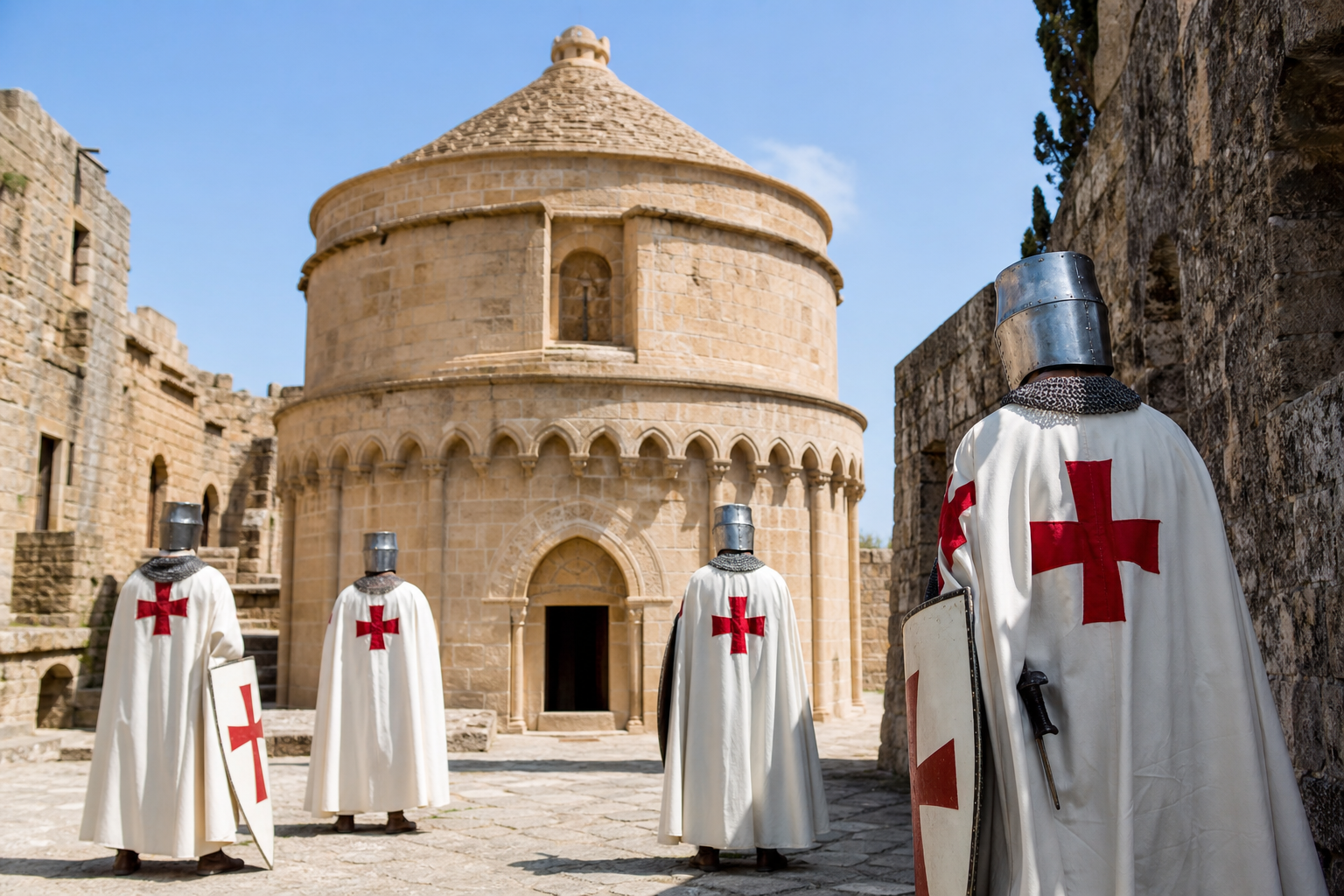
Templar Churches: Secrets of the Round Temples
For centuries the Knights Templar occupied a place somewhere between rigorous medieval institution and whispered legend. Their churches and chapels—stone sanctuaries scattered from the crowded alleys of medieval Acre to the quiet fields of rural England—were not merely places of worship. They were nodes in a transnational network of faith, finance, and military purpose. The architecture of Templar temples married symbolic liturgy with functional needs: round naves that echoed Jerusalem’s rotunda, hidden crypts that kept relics safe, and austere chancels that underscored a warrior-monastic asceticism. To walk into a Templar church in the twelfth or thirteenth century was to step into a tightly woven world where the sacred and the strategic overlapped.
The history of these sacred spaces is layered and complex. Founded in 1119 by Hugh de Payens and a handful of knights pledged to protect pilgrims in the Holy Land, the Poor Fellow-Soldiers of Christ and of the Temple of Solomon—known today simply as the Knights Templar—quickly gained papal recognition and vast landed wealth. Their churches reflected that unique identity. Congregations were small and tightly controlled; chaplains celebrated the canonical hours in Latin for the brethren, and the architecture often emphasized vertical contact with God and horizontal lines of communal life. After the dramatic arrests of 1307 and the order’s suppression by Pope Clement V in 1312, many Templar churches were repurposed, razed, or given to other orders. Yet their stones kept stories: carvings that survived inquisitorial logs, foundations that hint at lost crypts, and urban plots that still recall the route of medieval processions.
This article takes a guided, slow walk through those stones and stories. We will examine origin myths and sacred geographies, unpack the iconography and design of the famous round churches, survey notable Templar temples across Europe and the Levant, and follow the afterlives of those places through suppression, reuse, and modern myth-making. Throughout, the tone will favor the lived, sensory details—a torch-lit nave, a choir intoned in Gregorian chant—while keeping strictly to verifiable history. The aim is to reveal why Templar churches continue to fascinate: they were both singular in their devotion and thoroughly integrated into the medieval world, and their architecture still speaks of a faith that was at once militant and contemplative.
Did you know? The Templars took their name from the Temple Mount in Jerusalem, where their first headquarters were located near the ruins associated with Solomon's Temple.
Origins and Sacred Geography of Templar Temples
The earliest Templar churches are best understood against the backdrop of sacred geography in the twelfth century. Jerusalem—the ultimate axis mundi for Latin Christendom—was the decisive reference. The Order’s name itself—‘of the Temple’—derived from the Templars’ initial quarters on the Temple Mount in Jerusalem, where the ruins associated with Solomon’s Temple and Herodian structures were venerated as a living locus of biblical memory. Although the Templars did not build Solomon’s Temple, their identification with the Temple Mount shaped how they imagined sacred space: a convergence of biblical past, holy warfare, and custodial duty. The Church of the Holy Sepulchre, with its rotunda and concentric spatial logic, became the spatial archetype for many Templar churches built in Europe after the First Crusade. The circular form evoked the centrality of Christ’s resurrection and provided a tangible link to the topography of Jerusalem.
Foundational documents also played a role in shaping Templar chapels. At the Council of Troyes in 1129, clerical authorities formalized the Templars’ rule and status, granting them privileges that included rights over their chapels and the freedom to celebrate their own rites under clerical supervision. Papal bulls such as Omne Datum Optimum (1139) from Pope Innocent II granted the Templars exemptions and immunities that encouraged rapid expansion. As the Order acquired properties across Europe—donations from nobles, royal patronage, and strategic purchases—these lands often included churches or sites where new chapels were built. Thus the Templar network became a patchwork of rural commanderies and urban priories, each with its own chapel, sometimes modest and sometimes grand.
The Templars’ sacred geography was also pragmatic. Chapels within commanderies served everyday liturgical needs for resident brothers and visiting patrons; larger churches in cities performed public functions and symbolized Orderly presence. The positioning of many Templar churches—on elevated ground, within fortified enclosures, or near trade routes—spoke to the dual functions of sanctuary and strategy. In the Holy Land, Templar churches were often integrated into fortresses: in Acre, for example, the Templar compound included a significant church within the fortified precinct, combining liturgical space with the logistic realities of crusader warfare.
Did you know? Temple Church in London preserves a medieval round nave inspired directly by the Church of the Holy Sepulchre and served as a model for other Templar rotundas in Europe.
Archaeological studies have revealed the ways medieval builders transplanted Jerusalemic forms to European soils. The round nave—inspired by the Anastasis rotunda—recurred in England, France, Portugal, and elsewhere, signaling a deliberate act of architectural memory. In some cases the round sanctuary was a symbolic statement: a claim of spiritual custody of Jerusalem’s holies without physical possession. The idea that building a round church in Lincolnshire or London acted as a miniature Jerusalem for Western devotees is supported by the liturgical layout and the focus on relics and processions that mirrored practices in the Holy City. The Templar church thus functioned as a medial device, close enough to the Holy Land in symbolic terms to sanctify the Order’s mission across borders.

Architectural Features: The Round Church and its Symbolism
One of the most enduring architectural signatures associated with Templar churches is the round, centrally planned nave—a conscious echo of the rotunda of the Church of the Holy Sepulchre. The most famous surviving example is London’s Temple Church, built by the Templars in the later twelfth century as part of their London complex. Its circular nave leads into a chancel, and the symbolism is immediate: the rotunda form signals resurrection, wholeness, and a direct visual connection to Jerusalem. Yet the meaning runs deeper than mere imitation. The round plan served liturgical functions (a processional circuit around a central focus point), offered acoustic benefits for chant, and visually emphasized the communal identity of the Order. These spaces were experienced in motion—brothers processed, relics were exhibited, and the architecture guided the liturgy.
Across medieval Europe, round churches created a visual language of Templar identity. Examples include the Church of the Holy Sepulchre in Cambridge, the remains of the circular nave at Tomar (Portugal), and several rotundas in France and Italy influenced by Templar patronage. In Portugal, the Convent of Christ in Tomar is particularly instructive: the inner charola (rotunda) was inspired by the Holy Sepulchre and served as the private chapel of the Templar convent. After the Templars in Portugal were reconstituted as the Order of Christ in 1319—an adaptation authorized by King Dinis and later shaped by Prince Henry the Navigator—the charola remained a potent symbol of continuity.
Did you know? The Templar seal depicting two knights on one horse symbolized the Order's initial poverty and the close fraternity of its members.
Beyond circularity, Templar churches exhibit other architectural features with symbolic or practical purpose. Thick walls, narrow windows, and elevated chancels speak to defensive concerns as well as spiritual separation. Crypts and reliquary chambers were common; relics functioned as cosmological anchors, and Templar commanders guarded these objects closely, sometimes integrating them into the liturgy of the house. Decorative programs often combined martial imagery—shields, swords, equestrian scenes—with classical Christian motifs: Christ in Majesty, evangelist symbols, and images of pilgrimage. The visual program underscored the dual identity of the Templars as monks and warriors: sanctity and soldiery coexisted in stone.
Yet the round plan was not a universal Templar prescription. Regional building traditions, available materials, and financial resources shaped each chapel. In urban centers like London, the circular nave was paired with an elongated chancel, producing a hybrid plan that accommodated both the brotherhood’s private rites and a larger lay congregation. In rural commanderies, simple rectangular chapels sufficed for daily offices. The adaptability of Templar architecture—respectful of local vernaculars while embedding Jerusalemic memory—helps explain why so many forms can be identified as ‘Templar’ without a single canonical blueprint.

Rituals, Liturgy, and Sacred Objects in Templar Chapels
Templar chapels were not mere ornaments: they were centers of devotional life governed by a specific liturgical rhythm consistent with monastic practice. The brothers followed a regula—the Latin Rule—approved in 1129 at the Council of Troyes, which set out hours of prayer, communal meals, and martial obligations. Chaplains attached to the Order celebrated the canonical hours and the Mass, often with a focus on the Passion and Resurrection—appropriate themes for an Order obsessed with holy warfare and martyrdom. In addition to routine liturgy, the Templars celebrated special commemorations tied to the Holy Land: feasts of the Holy Sepulchre and other Jerusalemic observances that reinforced the spiritual connection between the European houses and their East Mediterranean origins.
Did you know? Temple Church in London was consecrated in 1185 and later became associated with England's legal institutions after the Templars' suppression.
Relics played a central role. Medieval piety placed enormous importance on physical artifacts associated with Christ, the Virgin, and saints. Templar commanders acquired relics through donation and purchase, and these objects often became the focus of pilgrimage to commanderies and urban churches. The presence of a significant relic could transform a modest chapel into a destination for pilgrims, bringing both spiritual prestige and financial income. Records show that the Templars possessed and guarded relics carefully; inventories and donation charters sometimes list items such as fragments of the True Cross or objects associated with the Passion, though the exact provenance of many of these items is difficult to verify.
Liturgical furnishings and imagery also told a story. Altars were consecrated for Mass and decorated with liturgical textiles; reliquaries—boxes or shrines containing relics—were sometimes elaborately worked and placed in crypts or behind high altars. The Templars used seals, banners, and heraldic devices to mark sacred objects and spaces. The Order’s seal, famously showing two knights on one horse, appears in ecclesiastical contexts and may have functioned as a reminder of collective vows of poverty and fraternity more than an official liturgical emblem. Additionally, the chapel served as the location for investiture ceremonies where new brothers took vows, and for funerary rites when brethren died within the house.
Chapel architecture engaged the senses: incense, candlelight, choir antiphony, and vestments created an atmosphere that fused ascetic discipline with sensory devotion. The Templars balanced austerity—with vows of poverty and communal simplicity—with a liturgical richness that echoed larger monastic traditions. This tension helped define their identity: not a militant sect divorced from ecclesial life, but a fully embedded religious order with martial responsibilities.
Did you know? After the Order's suppression, Pope Clement V's bull Ad providam (1312) largely transferred Templar properties to the Knights Hospitaller, though monarchs often seized holdings first.

Templar Presence Across Europe: Notable Churches and Commanderies
The Templars’ European footprint was vast. From fertile lowlands to the Iberian frontier, their commanderies combined religious, military, and economic functions. In England and France alone dozens of sites once bore Templar chapels; continental Europe contained a similar array of houses. Notable urban churches include Temple Church in London, consecrated in 1185 and prominently located between the Inns of Court. Temple Church served not only as a spiritual heart for the English brothers but also as a legal and communal landmark—the surrounding precinct became synonymous with legal learning in later centuries as the Knights’ urban holdings passed into civilian use. In Portugal, the Convent of Christ in Tomar emerged as the Templar headquarters after the reconquest efforts of the twelfth century. Its charola—an inner round chapel—exemplifies the cross-cultural architectural conversation between Jerusalem and western Christendom.
In Italy and the German lands, the Templars sponsored churches and hospices for pilgrims traveling to and from the Holy Land. San Bevignate in Perugia is an outstanding example: a Romanesque chapel decorated with frescoes depicting Templar knights and ritual scenes, offering rare visual testimony to Templar devotional practices in Italy. In France, commanderies such as La Couvertoirade and many rural preceptories preserved chapels used by garrisons of brothers. Iberia presented a distinct context: the Reconquista created a martial-religious frontier where the Templars played active military roles and established fortified chapels that combined worship with defense. Castilian and Portuguese Templar houses became centers of colonization and agricultural management, their chapels anchoring communities.
The archaeological footprint varies. In some locations—the Temple Church, Tomar, and San Bevignate—the architectural record is robust and continuously documented. In many rural commanderies, only earthworks, foundations, or documentary references remain. Archivists and archaeologists have pieced together inventories, donation charters, and building accounts that reveal how chapels were funded, decorated, and maintained. Property transfers after the order’s suppression in 1312 further altered the church landscape: many Templar chapels were handed over to the Knights Hospitaller, while others were secularized or appropriated by local lords.
Did you know? San Bevignate in Perugia contains rare medieval frescoes showing Templar knights and ritual scenes, offering visual evidence of Templar devotional life in Italy.
These sites also demonstrate the Order’s adaptive strategies. Urban churches catered to lay devotion and legal patronage; rural chapels managed local agricultural tithe economies and served as centers of social administration. The multiplicity of functions explains why Templar churches range from spectacular to humble. Their distribution shows a network designed for resilience—sufficiently dispersed to support crusading ventures and yet intimate enough to sustain a brotherhood’s spiritual life across continents.

Suppression, Transformation, and Legacy of Templar Sites
The dramatic fall of the Knights Templar irrevocably altered the fate of their churches. Beginning with mass arrests on Friday, October 13, 1307, instigated by King Philip IV of France, the Order’s leaders were accused of heresy, blasphemy, and other crimes. Torture and coerced confessions in France produced sensational charges, but legal scrutiny across Christendom varied. Pope Clement V, under political pressure, disbanded the Order in 1312 at the Council of Vienne. The last Grand Master, Jacques de Molay, was executed in 1314—burned at the stake in Paris—a symbolic end that crystallized into legend.
After suppression, papal bulls such as Ad providam (1312) directed much of the Templars’ movable and immovable property to the Knights Hospitaller, but the transfer was uneven and contested by monarchs eager to appropriate valuable urban sites. In England, the Crown seized many Templar holdings before redistributing them; in Portugal and Aragon, kings negotiated continuity through the creation of successor orders—the Order of Christ in Portugal (1319) and the Order of Montesa in Aragon (1319) among them—allowing for a more seamless passage of property and personnel in those realms. These political variations shaped the physical afterlives of many Templar churches.
Did you know? Jacques de Molay, the last Grand Master of the Knights Templar, was executed in 1314, an event that fueled centuries of legend about the Order's sudden end.
Physical transformation ranged from respectful continuity to outright demolition. Some chapels continued in use under Hospitaller administration, their liturgies and communities refurbished for new orders. Others fell into ruin or were repurposed into parish churches, barns, or even prisons. Urban Templar precincts often had greater commercial value; their churches sometimes survived because municipal authorities or emerging institutions such as inns and courts found civic uses for the buildings. In other cases, architectural materials from Templar chapels were quarried for local rebuilding projects, dispersing carved capitals and sculptural fragments across later medieval constructions.
Archaeology has been crucial in reconstructing disrupted histories. Excavations at sites like Temple Church in London and Tomar reveal stratified building phases, repairs, and additions that reflect centuries of reuse. The material record shows how certain symbolic features—rotundas, charolas, and crypts—were preserved, modified, or erased depending on changing liturgical needs and political ownership. Additionally, inventories and legal records help historians trace what relics and furnishings survived suppression; occasionally items recorded in medieval catalogs can be matched to extant medieval reliquaries in local treasuries.
The suppression also fed legend. The sudden disappearance of a wealthy, quasi-monastic military order spawned conspiracy theories almost immediately: tales of secret treasures, suppressed knowledge, and hidden rituals. While many of these narratives are modern inventions, they are rooted in real disruptions: abrupt arrest, confiscation of wealth, and the dramatic execution of leaders. Those events left a lacuna that imagination readily filled, and the physical remains of Templar churches became fertile ground for myth-making.
Myth, Memory, and Modern Pilgrimage to Templar Temples
The ruins and reused sanctuaries of the Templars have long attracted more than scholarly attention. From early modern antiquarians to nineteenth-century romantics and twenty-first-century tourists, Templar churches captivate as loci of mystery. This fascination is not simply due to the medieval order’s dramatic fall; it is also bound up with the evocative architectural language of their churches—the round naves, the secretive crypts, the placelessness of a commandery tucked into a field. The symbolic potential of these places encouraged associations with esoteric orders, Freemasonry, and speculative histories that connect the Templars to lost treasures, the Holy Grail, or suppressed doctrines. Most such associations are ahistorical, but they have profoundly shaped popular perceptions of Templar architecture.
Pilgrimage to Templar sites today is a mix of serious heritage tourism, devotional curiosity, and mythic seeking. Visitors to Temple Church in London, Tomar, or San Bevignate often expect an atmosphere of revealed secrets—and while they seldom find occult chambers, they do encounter layered histories visible in stone, painting, and archival plaques. Heritage professionals now face the dual task of conserving fragile sites while addressing popular narratives that may oversimplify or sensationalize. Interpretive panels, guided tours, and museum displays attempt to situate Templar chapels within concrete historical frameworks—explaining patronage networks, liturgical life, and the political complexities of suppression—while acknowledging the cultural power of myth.
Academic study has also complicated the picture in productive ways. Recent scholarship emphasizes the Templars’ role not as isolated crusaders but as actors embedded in medieval socioeconomic systems: bankers, land managers, royal allies, and local lords’ partners. Architectural historians trace building campaigns and stylistic transfers across the Mediterranean, showing how Templar sites participated in broader Romanesque and early Gothic currents. Conservation work—ground-penetrating radar, careful stratigraphic excavation, and the digital reconstruction of lost phases—has recovered architectural plans and liturgical layouts, providing a more nuanced understanding of how chapels functioned within commanderies.
At the same time, the Templar brand has migrated into modern subcultures and popular media. From novels to video games, the Order’s churches are frequently deployed as atmospheric settings. This cultural afterlife has a feedback effect: popular demand fuels conservation funding, but it also risks privileging sensational narratives over rigorous history. Museums and site managers must juggle visitor expectation, scholarly accuracy, and financial sustainability—an ongoing challenge for the stewardship of Templar heritage.

Conclusion: The Enduring Mystique of Templar Churches
Templar churches remain compelling because they embody a set of tensions: monastic devotion and martial obligation, local architectural tradition and distant Jerusalemic memory, institutional transparency and sudden historical rupture. The stones of their chapels tell stories that are part liturgical, part military, and part political. They were nodes in an international Order that shaped medieval geopolitics and local economies, and their architecture was a language of identity, memory, and authority. Their later suppression and the dispersal of their assets created a narrative vacuum that fostered myth; their material survival provided the canvas upon which centuries of imagination painted extraordinary claims.
Yet the facts persist. The order’s formation in the wake of the First Crusade, its endorsement at Troyes in 1129, papal protections like Omne Datum Optimum, and the violent suppression beginning in October 1307 are firmly documented events that frame the story of Templar worship spaces. The physical evidence—rotundas at London and Tomar, frescoes at San Bevignate, archival inventories—grounds those events in lived religious practice. Modern archaeology and archival research continue to refine our picture, revealing incremental details about building phases, liturgical furnishings, and the transfer of property after 1312. These discoveries confirm that Templar churches were far more than symbols: they were functional, adaptive, and deeply integrated into the medieval Christian world.
Walking into a former Templar chapel today, one may still feel the layered presence of liturgy and duty. A round nave invites contemplation; a weathered capital hints at a vanished procession; a buried foundation awaits excavation to speak once more. The Templars’ temples, whether standing or fragmented, remain places where history and imagination converge. Their endurance is not merely architectural but narrative: even when stripped of romantic exaggeration, Templar churches retain the ability to tell a complex story about faith, power, and the human longing to connect sacred space with sacred purpose.

How we verify this article
By the History Unlocked editorial team
This text is built on historical facts stored in our database and drafted with AI assistance. No signed human review is recorded for this article. Report any inaccuracy: we correct it and update the modified date.
Updated on
AI-assisted drafting.
Read our editorial standardsEnjoyed this? Discover more articles in the category Knights Templar