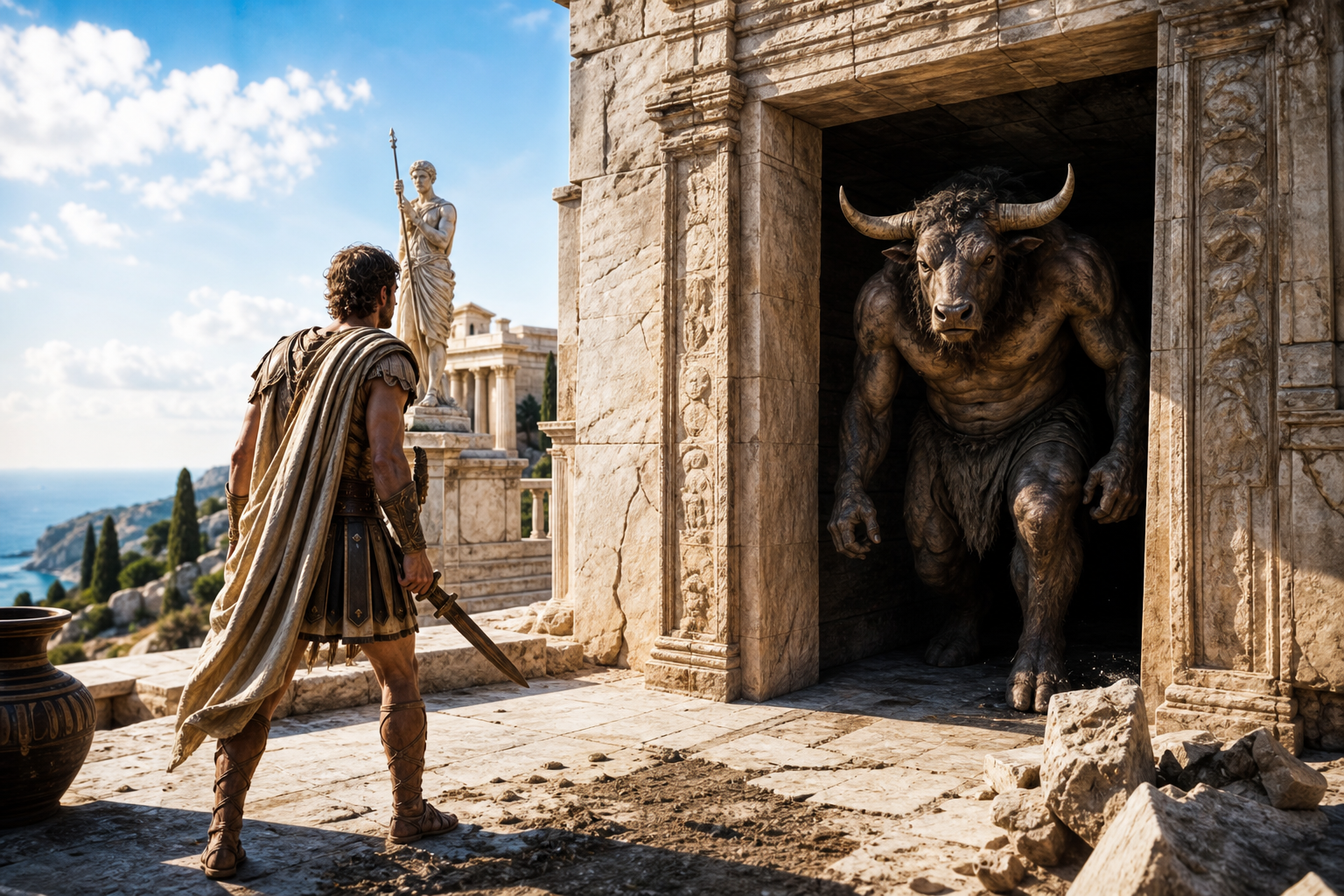
Theseus and the Minotaur: Inside the Labyrinth's Dark Secret
In the half-light between archaeology and myth there lies a story that has gripped imaginations for nearly three millennia: the saga of Theseus and the Minotaur. It is a tale of a hero crossing the sea to confront a monster in a maze so complex that only divine cunning could ensure escape. Yet the narrative is not merely a fairy tale tucked into the comfortable cloak of ancient Greece; it is a knot of possible historical memories, archaeological traces, ritual symbolism, and political propaganda. In this introduction I will lead you along the thread of those converging strands—literary, archaeological, and interpretive—so that what appears at first as a simple hero-versus-beast story unfolds into a richer portrait of Bronze Age Crete, Archaic and Classical Athens, and later receptions.
The persona of Theseus, the tributes from Athens, the labyrinthine palace of Knossos, and the half-man, half-bull Minotaur have been recorded, reframed, and reimagined by poets, historians, and excavators from antiquity to the present. Classical authors such as Plutarch, Pausanias, and the compilers of mythographical handbooks preserved multiple variants of the myth. Meanwhile, archaeologists in the early 20th century—most notably Sir Arthur Evans—opened the ruins of Knossos and found a sprawling palace complex whose complexity invited comparisons with the legendary labyrinth. The frescoes of bulls and acrobats, the abundance of bull iconography, and the ceremonial architecture of the Minoans made it tempting to see in the myth an echo of Cretan religious practice.
But the past resists simple alignment with later stories. Archaeologically, there is no direct evidence for a monstrous hybrid animal housed in a subterranean maze. Historically, the political motives behind the myth—Athenian claims, Cretan hegemony in the Bronze Age, later Athenian identity—are often as important as the myth’s narrative content. Modern scholarship treats the myth as a palimpsest: layered, revised, and used to legitimate institutions and memory. My aim across the following sections is to peel back those layers: to examine the origin and transmission of the myth in ancient texts, to situate it against the material culture of Minoan Crete, to consider Theseus as an Athenian foundation-hero, to probe the symbolism of the Minotaur and bull imagery, to contrast the voyage and labyrinth in myth against historical realities, and finally to trace how the story has been received and reinterpreted over centuries.
Did you know? The oldest full narrative versions we rely upon come from authors living more than a thousand years after the Bronze Age events that may have inspired the myth.
This exploration is both archaeological detective work and literary exegesis. We will walk room by room through the palace at Knossos, follow the literary traces in archaic and classical authors, and listen for the echoes of ritual and politics in each telling. Along the way I will point out curious facts—little details that often surprise modern readers—and place evocative images to anchor the narrative in tangible artifacts. Above all, I will keep the tone of the old storytellers: mystery-driven, vividly descriptive, and attentive to the unsettling possibility that the labyrinth’s true secret may be less a creature in a maze than the human capacity to shape, remember, and mythologize defeat and dominion.
Origins of the Myth and Literary Sources
The myth of Theseus and the Minotaur survives for us primarily through the writings of ancient authors who collected, adapted, and sometimes rationalized older oral traditions. The earliest fully developed literary accounts date to the classical and post-classical eras: Plutarch’s Life of Theseus (1st–2nd century CE) offers a biographical, moralizing treatment intended to link mythic deeds to civic virtues; Pseudo-Apollodorus’ Bibliotheca (a mythographic handbook likely compiled in the 1st or 2nd century CE from earlier sources) supplies a systematic retelling of the episodes that make up Theseus’ career; Pausanias in the second century CE records local traditions and cultic practices relating to Theseus and to Cretan connections. Other classical references appear in literary fragments, tragedians, and later Roman poets—Ovid in his Metamorphoses and Hyginus in his Fabulae both provide synopses that circulated widely in antiquity.
However, mythographers and historians of the ancient world stress that these preserved accounts are the tip of a far older oral tradition. Some motifs and names may have existed already in the Bronze Age Aegean as part of local heroic lore, only to be recast in the ideological contexts of Archaic and Classical Athens. The process through which a hero like Theseus becomes central to Athenian identity involves selective preservation: establishment myths, genealogies linking rulers to gods, and tales of civic founding are repeatedly reshaped to provide moral exemplars and political justification. For Athens, emphasizing Theseus’ triumph over Cretan power served to underline its authority and independence in later centuries.
Did you know? Arthur Evans used reinforced concrete in his restorations of Knossos, a decision later criticized by preservationists for mixing modern materials with ancient ruins.
It is also important to emphasize the multiplicity of competing versions in antiquity. Depending on the author or region, Theseus might be conceived as the son of Aegeus the Athenian king or of Poseidon; Ariadne’s role varies from helpful ally to the rejected lover abandoned on Naxos; the Minotaur’s origins are narrated differently in various sources. The details matter because they reflect the interpretive frameworks through which ancient communities remembered their past. For instance, Plutarch, writing centuries after the events supposedly occurred, sought to reconcile conflicting traditions and to anchor mythic memory in local cults and monuments he could inspect. Where temples, tombs, or inscriptions existed he attempted to align these with the stories recorded by earlier poets.
Beyond literary testimony, material culture—particularly vase paintings, seals, and fresco imagery—provides another channel through which motifs of bulls, labyrinthine motifs, and hero-monster struggles travelled across the Greek world. Archaic and Classical vase-painters frequently depicted episodes of Theseus’ labors, his encounters with bandits and villains, and moments with Ariadne; these images, however stylized, reflect the potency of the story in the popular imagination. Scholars therefore read myth as a living tradition: part narrative, part visual culture, and part civic ritual. By combining textual analysis and material evidence, modern scholars reconstruct not a single fixed tale but a spectrum of traditions that fed into the canonical forms we encounter in Plutarch and Apollodorus.
The Archaeological Context: Minoans, Knossos, and the Labyrinth
When Sir Arthur Evans began excavating at Knossos on Crete in 1900, he uncovered a palace of such complexity that the parallels to the legendary labyrinth were irresistible. The palace at Knossos—its multiple levels, interlocking corridors, megarons, and lightwells—struck Evans as architecturally labyrinthine. The finds at Knossos belong to the Minoan civilization, which flourished on Crete approximately from 2700 to 1450 BCE (with regional and chronological variation). The Minoans developed an urbanized society with large palatial centers—Knossos, Phaistos, Malia, and Zakros—characterized by rich frescoes, complex administrative rooms, storerooms, and ritual spaces.
Did you know? The sea called the Aegean is, according to myth, named after Aegeus, who leapt into it believing his son had died when he saw a black sail.
Key evidence that linked the archaeological site to the Minotaur myth included the prevalence of bull imagery: frescoes of bull-leaping, rhyta depicting bulls, horns of consecration, and scenes that suggested ritualized interaction with bulls. Evans interpreted the double-axe symbol (the labrys) found throughout the site as a signifier of a Cretan bull-cult and proposed an etymological link between labyrinth and labrys. His reconstruction—highly restored and sometimes speculative—popularized the image of Knossos as the historical seed of the labyrinth. Yet subsequent scholarship has tempered Evans’ certainty. The labrys connection remains debated: while the double-axe appears in Minoan contexts, direct linguistic derivation of labyrinth from labrys is not universally accepted by linguists, and the symbolic meanings of the labrys are likely plural.
Archaeological stratigraphy also complicates the neat mapping of myth onto material culture. The heyday of Minoan palaces falls in the Middle and Late Bronze Age (c. 2000–1450 BCE). Around 1450 BCE there is clear archaeological evidence for destructive events at many Minoan sites, after which Mycenaean influence grows on Crete—a transition visible in changes of pottery, burial practices, and the rise of Linear B administration. Some scholars have argued that memories of Cretan political power and Aegean tributes might have been transmitted and reinterpreted as the Minotaur-tribute motif in later Greek imagination. Others caution that mythic elements like the half-man beast have no direct archaeological correlate and are better understood as mythic synthesis.
Moreover, the palace at Knossos contains specific features—store rooms, a central court used for large gatherings, and ritual paraphernalia—that offer plausible contexts for elite ceremonies and animal-related rites such as bull-leaping. Bull-leaping frescoes suggest ritualized acrobatic engagement with bulls rather than sacrificial immolation, and some interpretations view bull-leaping as a display of elite prowess or initiation rite. The Minoan emphasis on bulls and maritime power, combined with Knossos’ prominence, makes it conceivable that post-Bronze Age Greeks remembered a powerful Cretan center connected with bull-related ritual and represented that memory in mythic form.
Did you know? Bull-leaping frescoes in Knossos show acrobats vaulting over bulls, which some scholars read as evidence of ritual rather than straightforward sacrifice.
Theseus: The Athenian Hero and City-Builder
Theseus functions in ancient tradition not only as a slayer of monsters but as a foundational figure for Athens. As a mythic personality he is associated with acts that concretize civic identity: the unification of Attica (synoikismos), the reform of legal and religious institutions, and the establishment of Athens as a city-state with central authority. Plutarch’s Life of Theseus presents him as the embodiment of moderate, civic virtue, and scholars note that the Athenians appropriated his image to legitimize territorial consolidation and political evolution.
The hero’s parentage is itself telling: two primary versions coexist in ancient sources. In one, Theseus is the son of Aegeus, the king of Athens; in another, he is the son of Poseidon, establishing a dual divine-mortal origin that confers both civic legitimacy and heroic charisma. This duality—mortal ruler on one side, godly favor on the other—is a common feature of Greek foundation myths, where heroes often mediate between human polity and divine sanction. Theseus’ journey from Troezen to Athens, his laborious encounters with brigands and tyrants on the road (such as Procrustes, Sciron, and the Crommyonian Sow), and his eventual establishment as ruler all serve to depict a hero who cleanses and secures the landscape for Athenian habitation.
Moreover, the tale of the tributes—seven youths and seven maidens sent periodically from Athens to Crete to be devoured by the Minotaur—carries political overtones. In later Athenian contexts, the story can be read as a narrative of liberation from Cretan domination, where Theseus rescues Athens from humiliation and tribute payment. That interpretation aligns with how founding myths function: they narrate a past in which local enemies are overcome and civic honor restored. At the same time, such stories may incorporate real memories of Aegean power dynamics in the Bronze Age, perhaps reflecting centuries-old interactions and rivalries between island polities and mainland communities.
Did you know? Some ancient accounts suggest that Ariadne was not abandoned but was found and married by Dionysus, indicating multiple, regionally diverse versions of her fate.
Theseus’ relationships also tell us about social values. His connection with Ariadne—the daughter of King Minos who aids him with a thread that allows him to escape the labyrinth—can be read as a civilizing alliance between hero and foreign princess, though later versions complicate the political reading by presenting Ariadne as abandoned and then woven into other myths (including those of Dionysus). In short, Theseus’ role in Athenian myth functions both as a charter for civic institutions and as a repository for a tangled set of motives: heroism, diplomacy, ritual exchange, and masculine civic identity.

The Minotaur and Its Symbolism: Bull Cults and Ritual Memory
The figure of the Minotaur—a human body with a bull’s head—has no direct analogue in the archaeological record, yet its elements resonate with what we know about Minoan religious iconography and the ancient Mediterranean’s symbolic economy. Bulls were central to Minoan visual culture; they appear in frescoes, pottery, jewelry, and ritual objects. The act of bull-leaping, seen in vivid fresco cycles at Knossos, suggests a ritual performance engaging human bodies with bulls in a non-lethal, acrobatic contact that celebrated prowess and perhaps sacred communion with animal potency. Sir Arthur Evans and some subsequent scholars interpreted bull imagery as evidence of a bull cult or a central sacrificial institution.
The Minotaur, however, is more than bull iconography personified. Mythically, the creature is born of Pasiphaë, wife of King Minos, and a bull sent by Poseidon, a narrative that fuses divine anger, sexual transgression, and ritual taboo. Such motifs are common in myth when discussing the origins of monstrous beings: the monstrous offspring often emerges from a transgressive union that in narrative terms must be contained, either with imprisonment or ritualized sacrifice. The labyrinth becomes the architectural device for containment: a subterranean, claustrophobic space that hides the abject and channels human fear into controlled ritual drama.
Did you know? The word labyrinth has never been unambiguously proven to derive from the Minoan labrys, but the double-axe motif appears repeatedly in Minoan iconography.
Interpretations vary. Some scholars propose that the Minotaur myth encodes memories of human sacrifice—perhaps exaggerated or transformed in retelling—where young people were handed over to a powerful maritime polity. Others argue that the story is allegorical, representing a ritualized confrontation with the forces of nature (the bull) or a socio-political allegory for Athenian subjugation and eventual liberation. The cultural practice of using animal imagery to mark elite identity (for example, sealing bull motifs for palatial power) could also have fed into the creation of a monstrous bull-person as the emblem of foreign rule.
It is important to stress caution: no archaeological evidence confirms the existence of hybrid creatures or systematic human devouring in palatial contexts. Instead, the Minotaur stands as a mythic synthesis that fused real elements—bull veneration, hierarchical power, and maritime hegemony—into a narrative emblem. The potency of the Minotaur image lies in its ability to embody both sacred and profane elements: sacred bull power that can be harnessed in ritual, and monstrous bestiality that must be slain for civic survival. As such, the Minotaur continues to function as a symbol open to multiple readings: religious, political, psychoanalytic, and literary.

The Voyage to Crete, Ariadne, and the Mechanics of the Labyrinth
The voyage of Theseus to Crete reads like a smaller epic within Greek myth: an Athenian fleet crossing the Aegean, a clandestine plan to put an end to tribute, a lover’s aid from within an enemy court, and a cunning escape aided by a thread. Ariadne’s gift of the thread—alternatively conceptualized as a clew or ball of yarn—has been endlessly interpreted. The most literal reading is practical: a linear guide through an otherwise disorienting maze. A more symbolic reading presents the thread as the gift of civilization: reason, cunning, and female resourcefulness enabling male heroic success. Ariadne herself is a liminal figure: a princess who switches allegiance, aiding an outsider to defy her father and his house.
Did you know? Modern literary and cinematic retellings often highlight the moral ambiguity in Theseus’ actions—particularly his abandonment of Ariadne—reflecting contemporary concerns about heroism and complicity.
The figure of Daedalus, the craftsman who built the labyrinth, compounds the technological and cultural dimensions of the myth. Daedalus is celebrated as an inventor, an architect, and a fugitive genius who, after constructing the labyrinth, is later confined to Crete with his son Icarus. The story of Daedalus and Icarus—especially the tragic flight and fall—adds a humanistic counterpoint to the brutal heroics of the Theseus saga and testifies to Greek interest in the limits of ingenuity and the costs of hubris. The craftsman figure might reflect real-world recognition of specialized technical knowledge in Bronze Age palaces: engineers, metallurgists, and master builders who commanded significant social prestige.
Comparing mythic labyrinths with the physical layout of palaces like Knossos reveals both resonances and tensions. Knossos’ plan is indeed complex, but it does not contain an enclosed maze explicitly designed to confine an animal-monster. The labyrinth in myth functions less as a literal map and more as a metaphor for political complexity, cultural estrangement, and ritual secrecy. Theseus’ penetration into the heart of the Cretan power structure—solving the maze, slaying the monster, and getting out—can be read as the narrative fantasy of political infiltration and liberation. The abandonment of Ariadne on Naxos in many versions opens another line of interpretation: the hero’s return home is never purely triumphant; it is stained by betrayal, loss, and moral ambiguity.

Legacy: Reception, Scholarship, and the Labyrinth's Modern Afterlife
From antiquity to the present the Theseus and Minotaur myth has been reworked repeatedly, its meaning adapting to the needs of new audiences. In classical Athens the figure of Theseus was appropriated for civic mythmaking; in Hellenistic and Roman literature the tale became part of a broader mythic canon; during the Renaissance artists and writers recast the drama in allegorical and decorative forms. In modern scholarship the myth inhabits two complementary worlds: the historian’s careful parsing of evidence and the creative retellings that keep the story alive in popular culture.
Archaeology has shaped modern receptions. Arthur Evans’ early 20th-century restorations of Knossos popularized the palace-as-labyrinth image, even as his reconstructions and interpretations have been critiqued for anachronistic readings and heavy-handed reconstruction methods. With advances in Aegean archaeology, including the decipherment of Linear B and more nuanced understandings of palatial economies, scholars now approach the myth with greater caution, distinguishing between symbolic resonance and literal archaeological claims. Post-war scholarship increasingly situates the myth within the politics of memory and identity: reasons why later Athenians would want to narrate liberation from a powerful maritime neighbor.
The Minotaur has also proven irresistible to psychoanalytic and allegorical readers. From Freud’s and Jung’s allusions to modern literary and philosophical uses, the half-man half-bull makes for a compelling symbol of the unconscious, the repressed, and the monstrous within the civic self. Contemporary novels, films, and visual art use the myth to explore identity, colonialism, and the limits of human control. In museological contexts, artifacts from Knossos and elsewhere are presented to the public with interpretive narratives that often balance mythic storylines with archaeological caution. Tourism at Crete continues to be animated by the myth: the palace of Knossos is marketed as the “labyrinth” and visitors experience exhibitions that frame the Minoan past in dramatic, sometimes romanticized terms.
Finally, the persistence of the myth underscores the ancient world’s capacity to transform geopolitical memory into moral narrative. Whether read as a memory of Bronze Age power relations, a ritual allegory of bull-centric cults, or a founding charter for Athenian identity, the story’s adaptability is its real durable power. Each era rewrites the labyrinth to reflect contemporary fears and aspirations, just as Ariadne’s thread is always passed on to the next teller, enabling new escapes from old confusions.

The story of Theseus and the Minotaur has the simplicity of a folk tale and the depth of a cultural complex. As myth it offers a compact narrative—hero sails, hero enters maze, hero kills monster, hero escapes—that satisfies narrative appetites for conflict and catharsis. As historical memory it is more ambivalent: a matrix of possible echoes from a Bronze Age Mediterranean world shaped by palatial power, ritual display, and maritime networks. As archaeological tableau it is a provocation: how to read frescoes and foundations without imposing modern storylines on ancient evidence. And as cultural archive it is a mirror for successive ages, each one reading its own anxieties and hopes into the image of the horned beast coiled at the center of a maze.
If the labyrinth contains a secret, it is this: human communities do not simply forget; they fold their experiences into stories that can be carried for centuries. The Minotaur, whether symbolic of bull cults, civic humiliation, or internal monstrosity, endures because it answers existential questions that persist: How do we confront what we fear? Who tells the tale of victory? Who learns from the thread of another’s cunning? Where the archaeological record is silent the myth speaks; where the myth is fanciful the archaeology provides ballast. Taken together, they show us a Bronze Age world that gave rise to dramatic images, and a later Greek world eager to claim them as its own. The resonance of the labrys, the fresco, the palace, the thread, and the half-man bull suggest a shared cultural vocabulary that the Greeks translated into story.
Even now, when you imagine a dark maze and hear the scrape of a beast’s heavy breath, the image summons the same questions that gripped ancient audiences: how to get in, how to get out, and what will be left of the city if you fail. That is why, millennia later, the myth of Theseus and the Minotaur remains alive—an imaginative tool for probing the tangled relationship between power and ritual, human cunning and monstrous excess. And as long as we question the past and pull on the threads of evidence, the labyrinth will not be a place to become lost but a structure that teaches us how ancient people made sense of their world.

How we verify this article
By the History Unlocked editorial team
This text is built on historical facts stored in our database and drafted with AI assistance. No signed human review is recorded for this article. Report any inaccuracy: we correct it and update the modified date.
Updated on
AI-assisted drafting.
Read our editorial standardsEnjoyed this? Discover more articles in the category Mythology & Ancient Gods