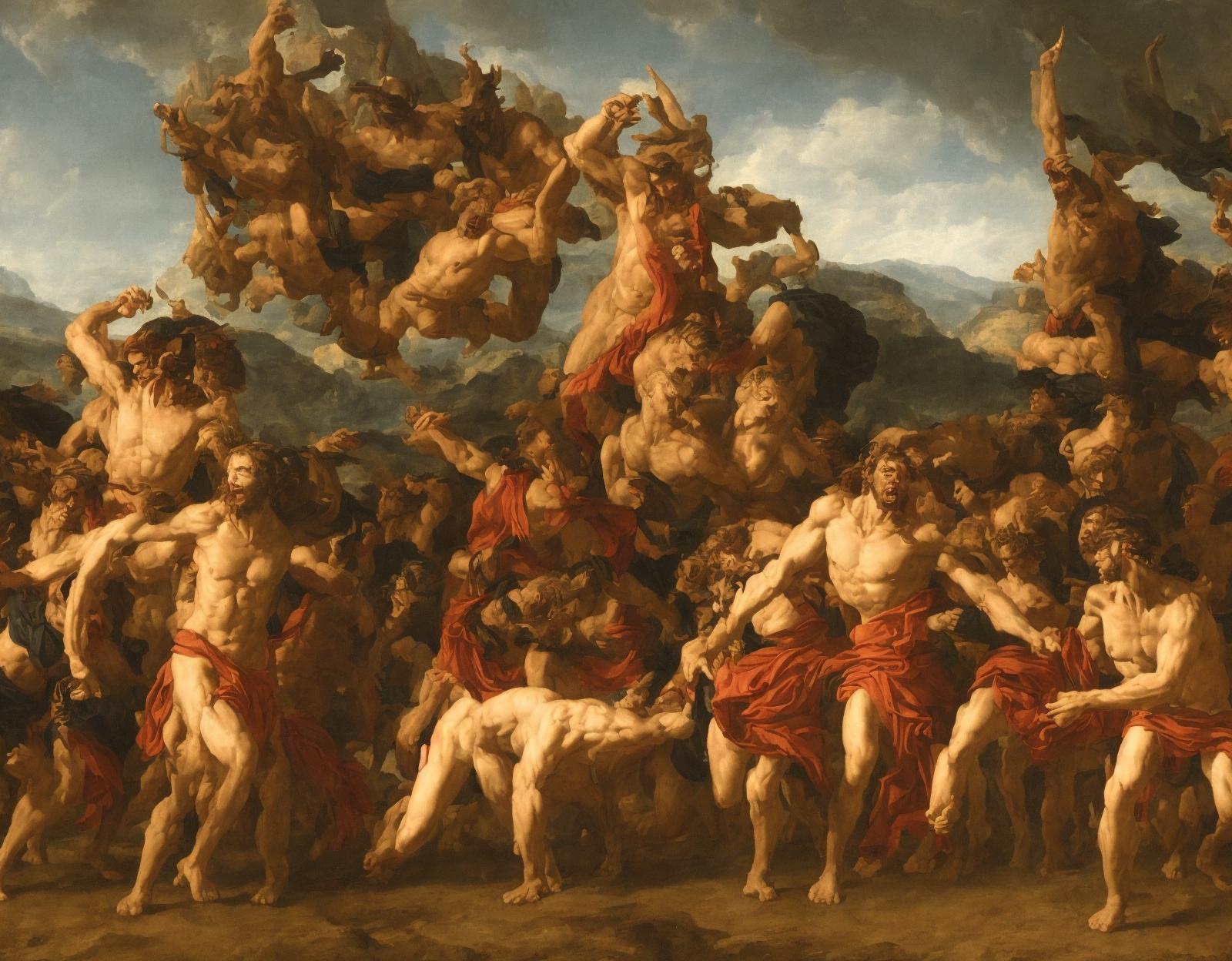
The Minotaur's Labyrinth: The Dark Truth Behind the Cretan Myth
Deep beneath the sun-drenched island of Crete, in a darkness untouched by daylight, a monster was born of shame and divine retribution. It was a creature of impossible contradiction: the body of a man, the head and tail of a bull. This was the Minotaur, a name that would echo through millennia as the embodiment of primal terror and brutal savagery. Trapped within an inescapable maze built by a genius, it awaited a grim tribute of human flesh, a constant reminder of a king's hubris and a queen's cursed passion. The story of the Minotaur, his labyrinthine prison, and the hero who dared to face him is one of the most enduring and chilling tales from Greek antiquity. But is it just a story? For centuries, it was believed to be nothing more than a product of the fertile Hellenic imagination, a cautionary tale about defying the gods. Yet, buried beneath the Cretan soil, archaeologists unearthed the ruins of a colossal palace, a sprawling, bewildering structure whose complexity mirrored the legendary Labyrinth itself. They found a civilization obsessed with bulls, its art filled with images of dangerous rituals and sacred horns. Suddenly, the line between myth and reality began to blur. The tale of the Minotaur ceased to be a simple fantasy and became a tantalizing puzzle, a dark reflection of a lost world. What historical truths, what forgotten rituals, and what political realities could have inspired the creation of such a potent and terrifying monster? To understand the Minotaur is to journey back in time, not just into the heart of the Labyrinth, but into the very soul of the mysterious Minoan civilization and its complex relationship with its rivals across the sea.
The Curse of King Minos: A Sin Against the Gods
The genesis of the Minotaur begins not with a monster, but with a king and his ambition. Minos, one of the three sons of Zeus and Europa, vied with his brothers for the throne of Crete. To prove his divine right to rule, he stood on the seashore and prayed to Poseidon, the mighty god of the seas, to send him a sign. Minos vowed that if a bull were to emerge from the waves, he would sacrifice the magnificent creature in the god's honor. Poseidon, hearing the plea, obliged. From the churning sea foam emerged a bull of breathtaking beauty and power, its coat as white as snow, a perfect specimen of divine craftsmanship. The people of Crete were awestruck, and Minos's claim to the throne was immediately secured. However, when the time came to fulfill his vow, Minos was overcome by greed and arrogance. The bull was simply too spectacular to kill. Believing he could fool a god, he hid the white bull among his own herds and sacrificed a lesser, unremarkable animal in its place. This act of hubris, of placing his own judgment above that of a powerful Olympian, was a grave miscalculation. Poseidon was not a deity to be trifled with. His fury was swift and terrible, but his revenge was not aimed directly at Minos. Instead, the sea god devised a punishment that was far more insidious, one that would strike at the king's pride, his family, and his legacy. Poseidon afflicted Minos's wife, Queen Pasiphae, with a curse of profound and unnatural desire. She was consumed by an overwhelming, maddening lust for the very creature her husband had failed to sacrifice: the divine Cretan Bull. This curse was not just a punishment; it was a form of poetic justice, twisting Minos's sin of coveting the bull into a source of his family's ultimate shame and horror.

Birth of a Monster: The Abomination of Crete
Queen Pasiphae's life became a torment. Haunted by her divinely-inflicted zoophilia, she could think of nothing but coupling with the white bull. Her desperation led her to seek the help of the most brilliant mind on Crete: Daedalus, a legendary craftsman, inventor, and architect who had been exiled from Athens and had found refuge in Minos's court. Pasiphae confessed her terrible affliction and begged the inventor to devise a way for her to satisfy her desire. Whether through pity, fear of the queen, or the sheer intellectual challenge of the problem, Daedalus agreed. He set to work, employing all his legendary skill to construct one of history's most infamous devices. He built a hollow wooden cow, so lifelike that it was indistinguishable from the real thing. It was covered with a genuine cowhide and mounted on wheels so it could be moved into the meadow where the Cretan Bull grazed. Following Daedalus’s instructions, Pasiphae concealed herself within the wooden automaton. The deception was perfect. The divine bull, tricked by the artifice, mounted the wooden cow and impregnated the queen hidden inside. The result of this cursed union was a monstrous hybrid. The creature had the powerful, muscular body of a man, but the head and tail of a bull. It was given the name Asterion, or "the starry one," but he would be known to the world by his more infamous title: the Minotaur, meaning "the Bull of Minos." As the creature grew, its savage, bestial nature became terrifyingly apparent. It had an unnatural craving not for grass or grain, but for human flesh. King Minos was filled with horror and disgust, but he could not bring himself to kill the creature. After all, it was his stepson, a living, breathing symbol of his own sacrilege and his wife's shame. Trapped by his past, Minos needed a solution to contain the abomination he had indirectly created.
Did you know? The name Minotaur literally translates to "Bull of Minos." His birth name, Asterion, which means "starry one," connects him to his grandmother Europa's new husband, Asterion, suggesting a once-noble lineage before his story became one of pure monstrosity.
Daedalus's Masterpiece: The Unescapable Labyrinth
Once again, King Minos turned to the genius of Daedalus, the man whose craft had enabled the monster's conception. The commission was grim and absolute: design and build a prison from which the Minotaur could never escape, and into which no one could venture and find their way out. The solution became Daedalus’s most iconic and terrifying creation: the Labyrinth. This was not a simple garden maze of hedgerows. As imagined by the ancient writers, it was a colossal architectural nightmare, a three-dimensional prison of shifting walls, endless corridors that turned back on themselves, spiraling staircases leading to nowhere, and halls that opened into pitch-black chambers. It was designed to psychologically dismantle anyone who entered, their sense of direction utterly obliterated, their hopes slowly eroded by the endlessly repeating patterns and dead ends. The constant darkness, the chilling echoes, and the ever-present scent of the beast would combine to create an atmosphere of pure dread. The genius of the Labyrinth was its chaotic perfection. Daedalus poured all his knowledge into its construction, creating a puzzle of stone and shadow so complex that, upon its completion, he and his son Icarus were said to have only barely managed to find their way out. The Minotaur was cast into the dark heart of this structure, its prison becoming its kingdom. There it roamed, a solitary horror waiting in the gloom, forever cut off from the world. For Minos, the Labyrinth was the perfect, terrible solution: it hid his shame from public view while creating a uniquely terrifying instrument of power that he would soon unleash upon his enemies.

The Blood Tribute of Athens: A City in Chains
The existence of the Minotaur and its prison was a closely guarded secret, but it was soon transformed into a brutal tool of political subjugation. The catalyst was another family tragedy for King Minos. His human son, Androgeus, had traveled to Athens to participate in the Panathenaic Games. A gifted athlete, he dominated the competition, winning every event. According to one version of the myth, the Athenian king, Aegeus, grew jealous and fearful of Androgeus’s prowess and had him ambushed and assassinated. Another version claims that Aegeus, impressed by his strength, sent him on an impossible quest to kill the Marathonian Bull (in some accounts, the very same Cretan Bull that had been brought to the mainland by Heracles). Whatever the cause, Androgeus was killed, and the news sent Minos into a vengeful rage. He amassed the formidable Cretan fleet, at the time the most powerful navy in the Aegean, and declared war on Athens. The Athenians, unable to withstand the might of the Minoan thalassocracy, were soundly defeated. Minos’s terms of surrender were cruel and designed to inflict long-term psychological terror. He did not raze the city or enslave its entire population. Instead, he demanded a periodic blood tribute. Every nine years (though some sources claim every year), Athens would be required to select its fourteen finest youths—seven young men and seven young women—and send them by ship to Crete. These young Athenians were not to be slaves or prisoners. Their fate was far worse. Upon arrival, they were cast unarmed into the Labyrinth, becoming a living sacrifice to the Minotaur. This tribute served a dual purpose: it was a perpetual punishment for the death of Androgeus, and it served as a horrific demonstration of Cretan dominance, reminding all of its subject states of the price of defiance. The story of the Minotaur thus evolves from a family tragedy into a political allegory for the historical power imbalance between the sophisticated, sea-faring Minoan civilization and the developing city-states on the Greek mainland, like Athens.
The Hero's Quest: Theseus and Ariadne's Thread
For two cycles, the city of Athens suffered this dreadful humiliation, sending its children to their doom. As the time for the third tribute approached, a new hero emerged, determined to end the cycle of terror. His name was Theseus, the secret son of King Aegeus. Having recently arrived in Athens and proven himself a hero through a series of epic labors, Theseus was horrified by the weeping and mourning that gripped the city as the lots were drawn. In a display of supreme courage, he volunteered to go as one of the seven young men, vowing to his father and the people of Athens that he would not be a victim, but a slayer. He promised that if he were successful, his ship would return flying white sails instead of the black sails of mourning. Upon his arrival in Crete, the handsome and charismatic Athenian prince immediately caught the eye of Ariadne, the daughter of King Minos and Queen Pasiphae, and half-sister to the Minotaur. She was instantly infatuated with him and, torn between loyalty to her father and her love for the hero, she made a fateful choice. She could not bear the thought of Theseus being devoured by the monster in the dark. Desperate for a solution, she, like her mother before her, turned to the master craftsman Daedalus. The old inventor, perhaps feeling a pang of guilt for his role in the saga, provided Ariadne with the key to conquering the Labyrinth—not with a weapon, but with a simple ball of flaxen thread and a small sword. The plan was as brilliant as it was simple. Theseus was to tie one end of the thread to the entrance of the Labyrinth and let the ball unwind as he ventured deeper into the maze. No matter how many twists and turns he took, the thread would serve as his lifeline, a guide back to the light. This simple "clue" (a word which derives from "clew," an old term for a ball of thread) would be the hero’s most critical tool against the architectural horror.
Did you know? The word "labyrinth" is likely derived from the "labrys," a symbol of a double-headed axe that was a recurring motif in the Minoan palace at Knossos. The original meaning of Labyrinth might have been, simply, "The House of the Double Axe."

The Final Confrontation and the Echoes in History
Clutching the sword and the life-saving ball of thread, Theseus was thrown into the Labyrinth. He plunged into a world of absolute darkness, the great stone door sealing him inside. He navigated the disorienting corridors, the silence broken only by the dripping of water and the distant, terrifying bellows of the monster. Following the twisting paths, he finally reached the center of the maze and came face-to-face with the Minotaur. The ensuing battle was a legendary clash representing order versus chaos, humanity versus beast. The Minotaur was a creature of immense power and rage, but Theseus was a clever and seasoned warrior. In the claustrophobic confines of the Labyrinth’s heart, Theseus fought and, using the sword Ariadne had given him, slew the monster. His mission complete, he did not succumb to panic. He calmly gathered the thread and began the long journey back, retracing his steps through the bewildering maze until he emerged, victorious, into the daylight. He quickly found the other Athenian youths, and together they fled to their ship, taking Princess Ariadne with them. But Ariadne’s fate was a tragic one. For reasons still debated by scholars, Theseus abandoned her on the island of Naxos while she slept. Was it a command from the god Dionysus, who wished to take Ariadne as his own bride? Or was it a callous act of political pragmatism by a hero who had no more use for her? This act forever adds a layer of moral ambiguity to Theseus's heroic triumph. The story, however, finds its most fascinating postscript in the 20th century with the work of archaeologist Sir Arthur Evans. At the site of Knossos in Crete, he unearthed a gigantic palace complex, a sprawling, multi-storied structure with over 1,300 rooms connected by a bewildering network of corridors and staircases, built without a clear central layout. It was, in effect, a real-life labyrinth. Evans’s team discovered a culture saturated with bull imagery, most famously the "Bull-Leaping Fresco," which depicts young men and women performing daring acrobatic vaults over a charging bull. This has led many to theorize that the myth is a distorted Greek memory of this dangerous Minoan ritual, where "tributes" from subject nations were forced to participate, with failure resulting in death by goring or trampling.
Conclusion: The Monster in the Maze
The tale of the Minotaur is far more than a simple campfire story about a monster and a hero. It is a rich, layered narrative that operates on multiple levels: as a cautionary tale of divine punishment, a tragic family drama, a political allegory of power and oppression, and, most intriguingly, as a possible cultural memory of real historical events and practices. The Minotaur himself is not just a mindless beast; he is a tragic figure, born of a curse he did not cause, imprisoned in darkness, and ultimately slain by a hero who represents the rising power of mainland Greece. He is the ultimate "other," a symbol of the dark, untamable forces that civilization seeks to control and contain. The Labyrinth, his prison, finds its stunning real-world counterpart in the labyrinthine Palace of Knossos, suggesting the story was the Greek attempt to make sense of the bewildering and perhaps intimidating sophistication of Minoan Crete. The myth of human tributes being fed to the beast may be a metaphorical retelling of a dangerous bull-leaping ritual, or a stark memory of the political dominance Crete once held over its neighbors, including Athens. The story
How we verify this article
By the History Unlocked editorial team
This text is built on historical facts stored in our database and drafted with AI assistance. No signed human review is recorded for this article. Report any inaccuracy: we correct it and update the modified date.
Updated on
AI-assisted drafting.
Read our editorial standardsEnjoyed this? Discover more articles in the category Mythology & Ancient Gods