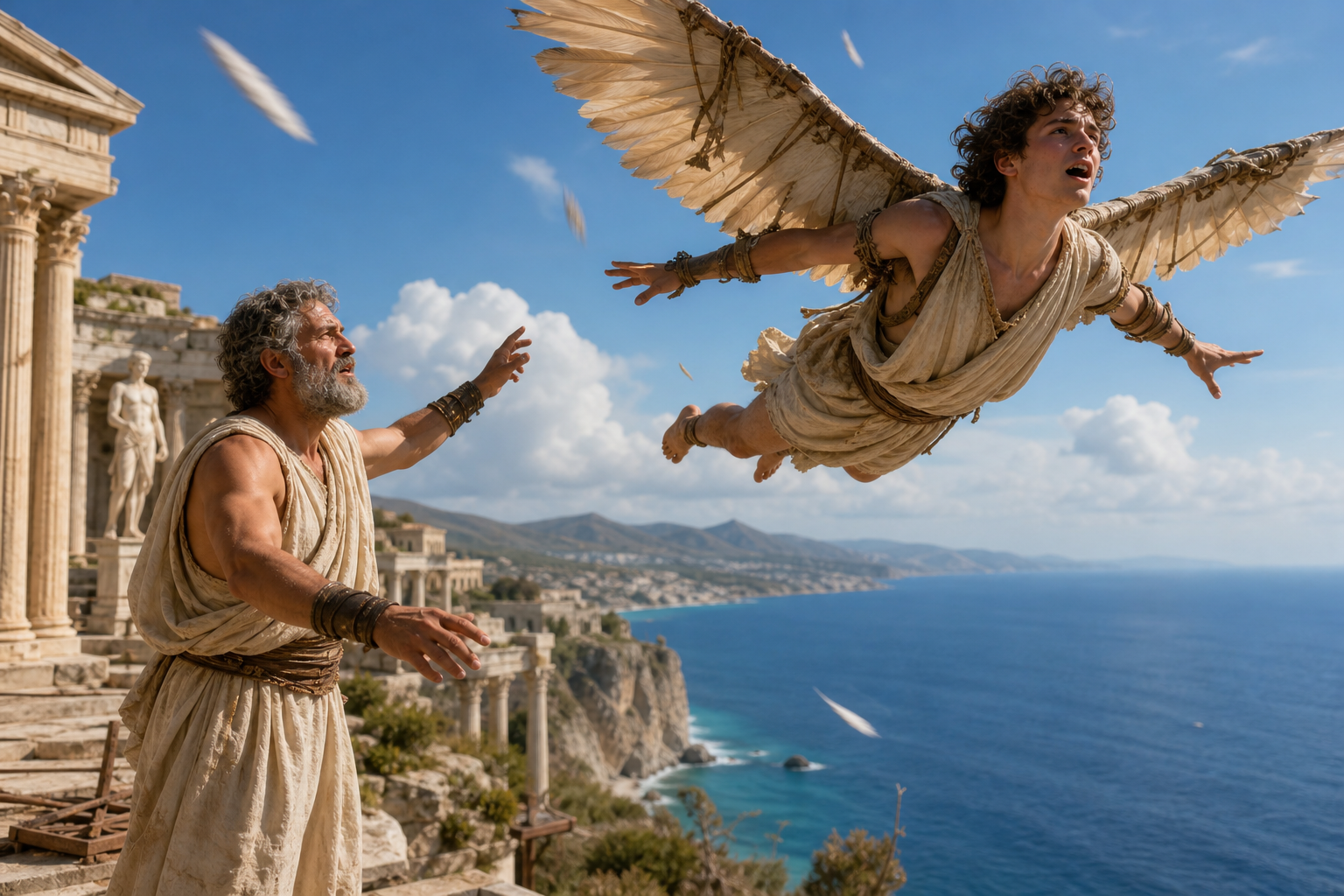
Daedalus and Icarus: The Tragic Flight of Genius and Hubris
The myth of Daedalus and Icarus is etched into the very soul of Western civilization, a story so potent and universally understood that its imagery—a boy with wax wings plummeting from the sky—requires no explanation. It is the ultimate parable of human ambition, a tragic symphony conducted in three movements: the spark of genius, the desperate flight to freedom, and the fall from grace. But to reduce this powerful narrative to a simple cautionary tale against youthful arrogance is to miss the profound and complex layers woven into its fabric. This is not merely the story of a foolish boy who flew too close to the sun. It is the story of a father, a genius haunted by his own dark past, whose desperate act of love and ingenuity inadvertently leads to his greatest sorrow. It is the story of a tyrannical king, a monstrous beast born of divine wrath, and the intricate, inescapable prison that binds them all. It is a story that interrogates the very nature of creation, questioning whether the same hands that can build wonders can ever truly control their consequences. Long before the first feathers were gathered, the seeds of this tragedy were sown in the fertile soil of Athens, within the heart of a man named Daedalus, an artist and inventor of such renown that his creations were said to be alive. His journey from celebrated artisan to a grieving father on a foreign shore is a labyrinth in itself, a twisting path of pride, jealousy, murder, and exile that ultimately culminates in that fateful, iconic flight across the Aegean Sea. To understand the fall of Icarus, we must first understand the man who gave him wings, and the crushing weight of the past from which they were both trying to escape.
The Genius of Athens: Daedalus's Rise and Fall
In the sprawling, vibrant city of Athens, a hub of culture and intellect, the name Daedalus was synonymous with genius. He was not merely a craftsman; he was a revolutionary artist and inventor, a direct descendant of the mythical Athenian King Erechtheus, blessed by the gods with an almost supernatural talent. The statues he carved from marble and wood were so lifelike that they seemed to breathe, their eyes appearing to follow those who passed by. It was whispered that they had to be chained down to prevent them from walking away, a testament to a level of artistry that blurred the line between the artificial and the divine. His mind was a fountain of innovation, constantly producing new tools and techniques that pushed the boundaries of what was thought possible. He was the master, the undisputed pinnacle of his craft, a figure celebrated and revered throughout the city. But genius is often a close companion to darker, more destructive emotions. The same passion that fuels creation can also ignite the fires of jealousy and pride. The catalyst for Daedalus's downfall was not a rival or an enemy, but his own blood: his nephew and apprentice, a young man named Talos (or Perdix in some versions of the myth). Talos was a prodigy. He possessed an observational genius that even Daedalus had to admire. Walking along the seashore, he picked up the spine of a fish and was inspired to invent the saw. Observing the way a snake used its fangs, he replicated the design in metal. He is even credited with inventing the potter's wheel, a device that would revolutionize craftsmanship. In the young apprentice, Daedalus saw a reflection of his own brilliance, but magnified and sharpened. He saw the future, and in that future, his own legacy was eclipsed. The admiration he felt curdled into a corrosive envy. He could not bear the thought of being surpassed. In a moment of madness, consumed by this dark passion, Daedalus led Talos to the high roof of the Acropolis, the sacred heart of Athens. Under the pretense of showing him the view, he pushed the boy from the edge. As Talos fell, the goddess Athena, patron of Athens and of wisdom, took pity on the young inventor. She transformed him into a partridge, a bird that, forever mindful of its fall, never flies high but instead flutters close to the ground, nesting in hedges. The crime, however, did not go unnoticed. The stain of familial murder was upon Daedalus. Though he tried to hide the body, the evidence was discovered, and he was brought to trial before the Areopagus, the high court of Athens. Found guilty, he was banished from the city he had so brilliantly adorned. A fugitive and an exile, Daedalus fled across the sea, seeking refuge in a place where his skills would be not just valued, but essential: the powerful and formidable island kingdom of Crete, ruled by the mighty King Minos.
The Labyrinth and the Beast: Serving King Minos
Arriving on the shores of Crete, the disgraced Athenian inventor found a new and powerful patron in King Minos. Minos was a son of Zeus, a ruler of immense power and influence whose dominion over the Aegean was absolute. He immediately recognized the extraordinary value of Daedalus's talents and welcomed him into his court, not as a lowly craftsman, but as a prized asset. However, the first great task Minos had for Daedalus was not one of celebration, but of concealment and shame, born from a curse that had befallen the royal house. The story begins with a magnificent white bull. Poseidon, god of the sea, had sent the bull to Minos as a sign of divine favor, with the understanding that the king would sacrifice it in the god's honor. But Minos, captivated by the creature's beauty, decided to keep it for himself and sacrificed a lesser bull in its place. Enraged by this act of hubris, Poseidon exacted a terrible and bizarre revenge. He did not strike Minos down directly but instead afflicted his wife, Queen Pasiphaë, with a maddening, unnatural lust for the divine bull. Consumed by this horrifying desire, the queen sought out the one man who could turn her monstrous fantasy into a reality: Daedalus. The inventor, now bound to the will of the Cretan court, was commanded to build a device that would allow the queen to couple with the animal. In an act of morally ambiguous but technically brilliant engineering, Daedalus constructed a hollow wooden cow, draped it with a real cowhide, and placed it in the meadow where the white bull grazed. Pasiphaë concealed herself inside, and the monstrous union was consummated. The result of this cursed coupling was the Minotaur, a creature of nightmare with the body of a burly man and the fearsome head and tail of a bull. He was a living symbol of the royal family’s shame and Poseidon’s wrath. Horrified and desperate to hide this aberration from the world, King Minos once again turned to his master inventor. He commanded Daedalus to design a prison from which the Minotaur could never escape. This was the genesis of Daedalus’s most famous creation: the Labyrinth. It was a structure of pure genius, an architectural paradox of winding passages, dead ends, and confusing turns, so complex that once inside, one would wander aimlessly until they were eventually found and devoured by the monster at its center. The design was so intricate that Daedalus himself, upon its completion, had difficulty finding his way out. Here, the Minotaur was imprisoned, and to feed its unnatural hunger, Minos exacted a grim tribute from the city of Athens, which had recently lost a war to Crete. Every nine years, seven of Athens’s finest youths and seven of its most beautiful maidens were sent as tribute, sacrificial lambs led into the Labyrinth to meet their doom. For Daedalus, this must have been a particularly bitter irony: his genius was now being used to imprison a monster and facilitate the murder of children from his own homeland.
Did you know? The name Daedalus (Δαίδαλος in Greek) is often translated as "cunning worker" or "skillfully wrought," directly reflecting his mythological role as the ultimate artisan.

A Hero's Thread and a Tyrant's Wrath
The grim cycle of tribute and death continued until a hero emerged from Athens. Theseus, the son of the Athenian king Aegeus, announced that he would not stand by and allow his people to be sacrificed. He volunteered to be one of the seven youths sent to Crete, vowing to enter the Labyrinth, kill the Minotaur, and end the bloody tribute once and for all. When the Athenian tributes arrived in Crete, their noble bearing and the determined presence of Theseus caught the eye of Ariadne, one of King Minos’s daughters. She was instantly captivated by the handsome Athenian hero and, horrified at the thought of him being torn apart by her monstrous half-brother, she resolved to help him. But defying her father, the powerful King Minos, was a perilous act. The Labyrinth was designed to be infallible. There was only one person in all of Crete who held the key to its secrets, the man who had conceived its impossible architecture: Daedalus. Ariadne secretly approached the Athenian inventor, pleading with him to provide a way for Theseus to survive. Perhaps Daedalus was moved by the princess’s love, or perhaps he was stirred by a pang of guilt for the Athenian youths his creation was designed to kill. It’s also possible he saw in Theseus a chance to disrupt the tyrannical order of the king he served under duress. Whatever his motivation, Daedalus provided the elegant and ingenious solution that would become legendary. He gave Ariadne a simple ball of flaxen thread and instructed her to give it to Theseus. The hero was to tie one end of the thread to the entrance of the Labyrinth and let it unspool behind him as he ventured into the maze. After slaying the Minotaur, he could simply follow the thread back to the entrance and escape. The plan worked to perfection. Theseus navigated the twisting corridors, found the sleeping Minotaur in the heart of the maze, and killed it in a brutal struggle. Following the life-saving thread, he led the other Athenian tributes out of the darkness and back into the light. Without a moment’s delay, they boarded their ship, taking Ariadne with them, and set sail from Crete, leaving King Minos to discover the carnage. When Minos learned of the Minotaur’s death and Theseus’s escape, his rage was immense. He quickly deduced that only one man could have been clever enough to thwart his perfect prison. His fury turned upon Daedalus. The inventor’s genius had become his curse once more. Minos could not simply execute Daedalus; his knowledge was too vast, his skills too indispensable. To let him go free was unthinkable, as he could sell his secrets and talents to rival kingdoms. Thus, Minos ordained a cruelly ironic punishment. He had Daedalus and his young son, Icarus, who had been born during the inventor’s time on Crete, imprisoned. Their jail was either a high, isolated tower overlooking the sea or, in some versions of the tale, the Labyrinth itself. The master creator was now trapped within his own masterpiece, a prisoner of both his king and his own mind.
The Audacious Escape: Wings of Wax and Feathers
Trapped on the island of Crete, a gilded cage that had become a literal prison, Daedalus descended into despair. From the heights of his tower, he would watch the sea, a vast, watery barrier patrolled by Minos's formidable navy. He would observe the land, an island completely under the thumb of the tyrant king. Every conventional path of escape was blocked. Minos, he knew, controlled the earth and the water. But as he watched the gulls and eagles soaring freely on the wind, a desperate and brilliant idea began to form in his mind—the most audacious project of his life. "Minos may command the land and the waves," Daedalus declared to his son, Icarus, "but he does not command the air. We will go that way." The plan was radical, bordering on insane: he would build wings for himself and his son, and they would fly to freedom. The creator would imitate nature itself. So began the secret, painstaking work. Daedalus gathered all the feathers he could find, from the smallest down to the longest plumes of eagles, shed by the birds that circled their prison. He began by laying them out in overlapping rows, sorted by size, creating a gentle, elegant curve that mimicked the structure of a bird’s wing. The project was a study in patience and precision. He bound the feathers in the middle with strong linen thread and then, using beeswax he had collected or acquired, he fastened the larger feathers at the base. It was a delicate, unprecedented form of engineering. During this process, his son Icarus was by his side. Too young to grasp the deadly seriousness of the project, the boy played as children do. He would chase the feathers as they were caught by a breeze, his laughter echoing in their prison. With his thumbs, he would playfully soften the wax, getting in his father’s way, a carefree and innocent presence in the midst of a life-or-death endeavor. This image, so beautifully captured by the Roman poet Ovid, adds a layer of heart-wrenching poignancy to the narrative. Daedalus was not just an inventor at work; he was a father, watching his oblivious son play with the very tools that would determine his fate. After many weeks of labor, two magnificent pairs of wings were complete. The moment of truth arrived. Daedalus fitted the first pair to his own shoulders. He flapped them cautiously at first, then more boldly, and felt an incredible sensation: the air caught, and he was lifted from the ground, hovering. The invention worked. Now came the most difficult part. He turned to Icarus, the fragile wings in his hands. As he fitted the apparatus onto his son’s small shoulders, his own hands trembled. He looked his son in the eye and delivered the famous, fatal warning. "Let me warn you, Icarus," he began, his voice thick with a father’s fear, "to take the middle way. If you fly too low, the damp from the sea will clog your wings. But if you fly too high, the heat from the sun will melt the wax. Stay close to me. Do not chart your own course. Follow my lead." As he spoke, he felt tears on his cheeks, the terror of a parent sending his child into the great, unknown danger of the sky. He kissed his son, a kiss he would never be able to give again, and rose into the air, leading the way.

The Flight and the Fall: Icarus's Tragic Hubris
Lifting off from their prison, father and son ascended into the vast emptiness of the sky. The sensation was one of pure, unadulterated freedom. Below them, Crete shrank into a map of green and brown, the Labyrinth a mere speck, King Minos and his power rendered insignificant. The sight they must have presented to those on the ground was one of divine wonder. A fisherman tending his lines, a shepherd leaning on his crook, a farmer guiding his plow—all looked up in stunned amazement. They could not believe their eyes. Surely these were not mortals, but gods descending from Olympus. As they journeyed across the Aegean, the initial fear gave way to exhilaration. They passed over the islands of Samos, Delos, and Paros, leaving the Cyclades behind them. The wind rushed past, the sun warmed their backs, and the world unfolded beneath them like a tapestry. For Daedalus, it was the validation of his genius. For Icarus, it was a rapturous discovery of a power he had never imagined. It was this rapture that would prove to be his undoing. Icarus, a boy on the cusp of manhood, was intoxicated by the sheer joy and power of flight. The world was his, the sky his playground. His father’s solemn warnings, once so urgent, began to fade from his mind, replaced by a reckless, youthful ambition. He started to test the limits. He swooped and climbed, feeling the strength in his new wings. The "middle way" felt safe and boring. He was drawn upward, compelled by an irresistible urge to soar higher, to leave his father’s cautious path and climb towards the dazzling, fiery chariot of the sun god, Helios. This was the moment of hubris—the fatal pride and overconfidence that the Greeks believed invited the wrath of the gods. He abandoned his guide and flew higher and higher in his joyous, tragic ascent. The higher he soared, the warmer the air became. The sweet smell of melting wax began to permeate the air, a scent of impending doom. He felt a strange looseness in his wings. Looking down, he saw with horror that the largest feathers were beginning to detach, drifting away like snowflakes in the wind. The sun’s intense heat was dissolving the very bond that held his freedom together. Panic seized him. He flapped his arms, now nearly bare, but they found no purchase on the air. He was no longer a bird; he was just a boy, suspended in the terrifying emptiness between the heavens and the sea. He screamed his father’s name—"Father! Father!"—his voice lost in the vastness of the sky. Daedalus heard the desperate cries and turned back, his heart freezing with terror. But he could not see his son. He saw only a scattering of feathers floating gently upon the surface of the waves below. The awful truth crashed down upon him. Cursing his own brilliant invention, he circled frantically, his own flight now a torment. Eventually, he spotted the small, broken body of his son, washed ashore on a desolate island. Heartbroken and utterly defeated, the great inventor landed. He gently lifted the lifeless form of his only child and buried him in the island’s soil. In perpetual memory of his beloved son, he named the island Icaria. The stretch of sea that had claimed him would forever be known as the Icarian Sea. As Daedalus performed the sorrowful burial rites, a lone partridge landed in a nearby tree and began to chatter. It was not a random bird. It was Talos, the nephew Daedalus had murdered in Athens, now transformed. The bird’s cheerful chirping was not a sound of comfort, but a note of perfect, poetic justice, a final, cruel reminder of the inventor’s past crimes coming full circle in his present grief.
Did you know? Ovid's "Metamorphoses," written in the 1st century AD, is one of the most detailed and influential ancient sources for the story of Daedalus and Icarus, shaping how the myth has been understood for millennia.

The Aftermath and the Enduring Legacy
The death of Icarus did not mark the end of Daedalus’s story, but it defined the rest of his sorrowful existence. With a heavy heart, the grieving father took to the skies again, his miraculous invention now a source of profound anguish. He flew onward, leaving the site of his greatest tragedy behind, and eventually found a new, final refuge in Sicily, at the court of King Cocalus. The king and his daughters were enthralled by the Athenian genius and offered him sanctuary. But the wrath of King Minos was not so easily escaped. The Cretan king was relentless, obsessed with recapturing his prized inventor. Unable to find him by force, Minos devised a cunning puzzle, confident that only Daedalus's unique mind could solve it. He traveled from city to city, offering a great reward to anyone who could pass a thread through a spiraled seashell. The challenge seemed impossible. At last, Minos arrived in Sicily and presented the puzzle to King Cocalus. Cocalus, knowing his guest’s reputation, secretly brought the shell to Daedalus. For the inventor, it was a trivial problem. He tied the gossamer thread to an ant, drilled a tiny hole at the apex of the shell, and smeared a drop of honey at the opening. The ant, drawn by the honey, crawled through the intricate spiral passages of the shell, pulling the thread along with it. When Cocalus presented the solved puzzle to Minos, the Cretan king knew his search was over. "Only Daedalus could have done this," he declared, demanding that the inventor be handed over immediately. King Cocalus promised to comply, but his daughters had grown fond of Daedalus and would not let him be taken. They persuaded their father to invite Minos to a bath to refresh himself after his long journey. While the tyrant was relaxing, the princesses, with Daedalus’s connivance or perhaps by his design, funneled boiling water into the tub, scalding him to death. The great King Minos, son of Zeus, met his end not in a grand battle, but in a bathtub, his pursuit of genius leading to his own ignominious demise. Daedalus lived out the rest of his days in Sicily, revered for his skills but forever haunted by the memory of the son he had lost. His story, and that of Icarus, has echoed through the ages, a rich and complex myth that speaks to the deepest parts of the human condition. It is a timeless warning against hubris, a reminder that our ambitions, if untempered by wisdom and humility, can lead to our destruction. It is a profound exploration of the relationship between a father and a son, of the desperate desire to protect a child and the painful reality of letting them go. More than anything, the myth of Daedalus and Icarus is the eternal story of humanity’s reach exceeding its grasp. In their flight, we see our own technological and scientific aspirations—the drive to conquer the atom, to walk on the moon, to create artificial intelligence. Daedalus represents our magnificent ability to innovate and create, to solve the impossible. Icarus represents the exhilarating, dangerous freedom that comes with those creations, and the tragic potential for them to consume us. The wax wings are a permanent metaphor for the fragile line between triumph and catastrophe, a line that humanity has walked since the dawn of time and continues to walk today.", word_count=2855, reading_time=14)) ας) is often translated as "cunning worker" or "skillfully wrought," directly reflecting his mythological role as the ultimate artisan. ## The Labyrinth and the Beast: Serving King Minos Arriving on the shores of Crete, the disgraced Athenian inventor found a new and powerful patron in King Minos. Minos was a son of Zeus, a ruler of immense power and influence whose dominion over the Aegean was absolute. He immediately recognized the extraordinary value of Daedalus
How we verify this article
By the History Unlocked editorial team
This text is built on historical facts stored in our database and drafted with AI assistance. No signed human review is recorded for this article. Report any inaccuracy: we correct it and update the modified date.
Updated on
AI-assisted drafting.
Read our editorial standardsEnjoyed this? Discover more articles in the category Mythology & Ancient Gods