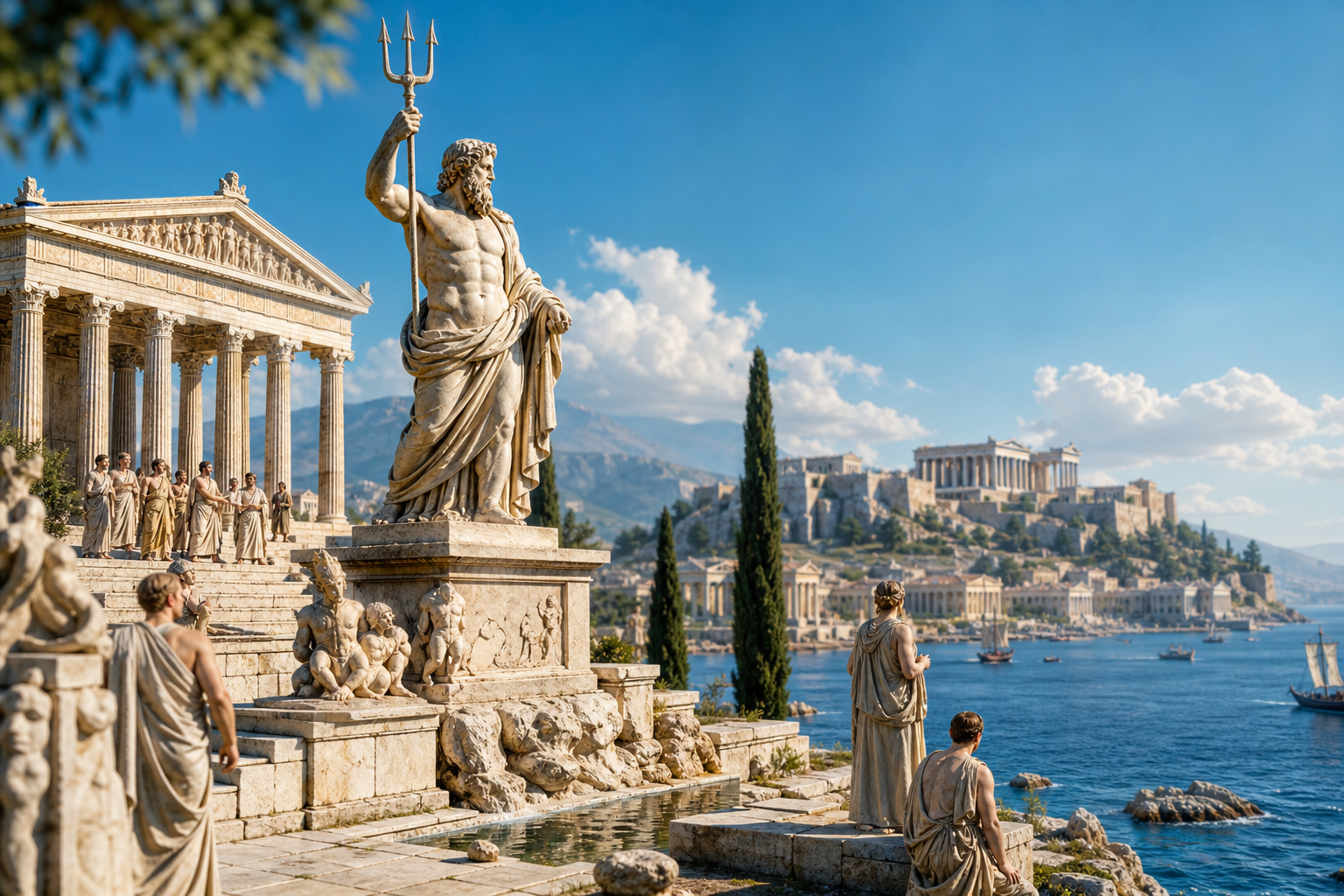
Poseidon: King of the Sea — Myths, Worship, and Legacy
The salt air carries stories older than cities. Poseidon, the earth-shaking god of the sea, rides the imagination of ancient Greece as both benefactor and terror. He is the force that parts the horizon and overturns ships; the patron of horsemen and floodwaters; the deity whose temperament could bless a voyage with calm or provoke a tempest to swallow fleets and cities. This article seeks to guide the reader into the maze of Poseidon’s identity: tracing his genealogy among the Olympians, following the contours of cult worship that sustained coastal communities, unraveling the mythic episodes that reveal his character, examining the visual languages ancient artists used to portray him, and surveying his enduring legacy across cultures and time.
To approach Poseidon is to stand at the edge of two worlds—land and sea—and to feel the ambivalence they inspire. For seafarers, merchants, and fishermen the deity was an essential negotiation partner; for farmers and inland communities he could be both a threat in the form of floods and an ally in the form of springs. Ancient Greeks did not think of gods as morally monolithic; they were complex powers woven into the fabric of daily life, capable of generosity, jealousy, vengeance, and inexplicable whim. Poseidon’s narratives, like the braided manes of his horses, connect him to earthquakes, horses, and the deep—symbols of primal energy that can be shaped by ritual but never fully tamed.
In what follows, I offer a narrative that is historically grounded yet written with the mystery of story—because the Greeks narrated their world through myth. Sources range from Homer and Hesiod to archaeological findings: sanctuaries and votive dedications, inscriptions, vase-paintings, and large sculptural monuments. Each source is a shard of a larger reflection on the sea’s role in Greek life. The sea was a conduit of trade and ideas; it was also a corridor of danger. Poseidon sits at the crossroads of these realities.
Did you know? Linear B tablets from Pylos and Knossos include the theonym po-se-da-o, an early attestation of Poseidon’s name in Mycenaean Greece.
As we move into the first section, we will anchor Poseidon in his genealogy and early development within the Greek pantheon, probing how an ancient Indo-European substratum and regional pre-Hellenic cults contributed to the god we recognize on the Parthenon frieze and in Homer’s epics.
Origins and Genealogy: From Prehistory to Homer
Poseidon’s presence in the Greek religious imagination predates the classical age and even, in many respects, the Homeric epics that so famously record his deeds. To trace his origins is to traverse millennia of cultural synthesis. In Hesiod’s Theogony, Poseidon appears as a son of Cronus and Rhea, sibling to Zeus and Hades. He is allocated dominion over the sea when the cosmos is apportioned by lots among the brothers, but his character and domains—horses, earthquakes, springs, and the sea—reflect layers of meaning that point to older, regional cultic identities.
Archaeological and linguistic evidence suggests that Indo-European religious frameworks brought storm and sky deities into the Greek world; yet Poseidon incorporates features that recall indigenous Aegean and Minoan beliefs. The horse association, for instance, might derive from pre-Greek cults where chthonic or water-associated deities were linked to equids. The Linear B tablets of Mycenaean Greece (circa 1400–1200 BCE) contain the theonym po-se-da-o (often read as Poseidao), attesting to a deity of considerable antiquity and possibly familial linkage to the later Poseidon. Such references demonstrate that Poseidon was already established as a significant figure in palatial religion.
Did you know? The Isthmian Games, held near Corinth, were dedicated to Poseidon and included athletic, musical, and equestrian events that drew competitors from across Greece.
Homeric poetry (8th century BCE) both consolidates and expands the deity’s character. In the Iliad and Odyssey, Poseidon is a volatile force who interacts with heroes—supporting Greek warriors in the Iliad and opposing Odysseus in the Odyssey when the hero blinds Polyphemus, a son of Poseidon. These literary representations emphasize his personal agency and capacity for vengeance. Yet even in Homer, the god’s functions are plural and sometimes contradictory: he aids sailors at times, punishes them at others, and exerts influence over the land through earthquakes.
The wider Greek world sustained numerous local epithets and cult forms for Poseidon: Poseidon Asphaleios (safeguarder), Poseidon Hippios (of horses), Poseidon Helikonios (linked to Helikon), and Poseidon Erechtheus in Athens, a syncretic form that merges local hero worship with the Olympian portfolio. This multiplicity suggests a religious environment where gods were adapted to civic needs and regional mythologies. Over centuries, civic cults and pan-Hellenic mythology layered upon one another to produce the Poseidon of classical antiquity—a deity whose identity was polysemous, shaped by both elite poetry and grassroots ritual.
Scholars have long debated whether the horse and earthquake aspects of Poseidon indicate a chthonic origin or simply the accretion of multiple cults. Some argue for a primarily maritime deity evolving through contact with seafarers and coastal populations, while others emphasize inland worship centers where freshwater springs and horses dominated cultic life. The truth likely lies in the intersection: Poseidon’s mythic web was formed by islanders and inland plainsfolk alike, by sailors who feared sudden squalls and farmers who revered springs that sustained life.
Did you know? In the Odyssey, Odysseus’s blinding of Polyphemus, a son of Poseidon, directly triggers the god’s wrath and Odysseus’s prolonged journey home.

Cult, Sanctuaries, and Ritual: How Greeks Worshiped the Sea-God
The worship of Poseidon was as varied and adaptive as his mythic persona; sanctuaries ranged from cliff-top altars overlooking the Aegean to modest inland chapels beside springs and stables. Cult practice offers tangible evidence for how communities negotiated the power of the sea-god: votive offerings, festivals, and rituals addressed both the practical needs of sailors and the civic aspirations of city-states.
One of the most notable sanctuaries was at Isthmia, near Corinth, where the Isthmian Games were held in honor of Poseidon. These games, second in prestige only to the Olympic Games in many regards, included athletic contests and ritual sacrifices that reinforced communal identity and celebrated the god’s favor. The Isthmian sanctuary underscores the civic dimension of Poseidon’s worship: he was not only a maritime deity but also a protector whose patronage enhanced a polis’s prestige.
Maritime rituals often focused on placating the god before voyages. Offerings of first-fruits from the sea—fish, oil, and occasionally miniature boat models—were left at coastal shrines. Sailors sought amulets and made vows to Poseidon, invoking epithets that emphasized safe passage: Poseidon Halios or Poseidon Naus (in certain local usages). In many Greek harbors, small chapels or altars provided a ritual point where captains and crews could give thanks or seek propitiation.
Did you know? The Artemision Bronze, recovered from a shipwreck, is debated by scholars as either Zeus or Poseidon, highlighting ancient sculptural ambiguity.
Animal sacrifice, especially of bulls, appears frequently in Poseidon’s cult. The bull’s association with potency and power resonates with Poseidon’s stormy temperament and his connection to horses (both animals are often presented as manifestations of virility and raw force). In some locales, elaborate feasting followed sacrifices, creating moments of social cohesion and religious reaffirmation. Certain rituals, however, suggest an older, even quasi-chthonic dimension: votive offerings placed in springs or caves point to rites that sought to engage subterranean forces associated with Poseidon’s control over earthquakes and springs.
In Athens, the temple complex associated with Poseidon included the Erechtheion on the Acropolis—a structure that reflects complex syncretism. The Erechtheion housed cults to both Poseidon-Erechtheus and Athena, merging heroic local cults with Olympian worship. The mythic contest between Athena and Poseidon for the patronage of Athens—often interpreted as a mythic rationalization for civic choice—was ritually remembered in Athenian festivals, showing how myth, politics, and ritual interwove.
Marine iconography and looted votive objects, excavated from sanctuaries, supply additional clues. Terracotta figurines, dedicatory inscriptions, and amphorae decorated with seafaring scenes reveal a culture profoundly shaped by maritime concerns. Offerings to Poseidon thus functioned as petitions for livelihood, memorials for lost sailors, and tangible acknowledgments of the sea’s caprice.
Did you know? Sailors and captains often left small votive offerings—miniature boats, oil, or fish—at coastal shrines to secure Poseidon’s favor for safe voyages.

Major Myths and Narratives: The God at Work in Epic
Poseidon’s role in mythological narratives ranges from cosmic to personal. Homeric epics frame him as a force whose emotions shape human fate. The Odyssey contains the most intimate portrayal: Poseidon’s wrath against Odysseus for blinding his son Polyphemus is more than a personal vendetta; it showcases the ancient belief that gods could intrude into human journeys with life-altering consequences. Poseidon’s pursuit of vengeance prolongs Odysseus’s wanderings and underscores the fragility of human agency in the face of divine will.
The contest for Athens is a foundational myth that encapsulates Poseidon’s ambivalent relationship to civic life. Competing with Athena for the city’s allegiance, Poseidon offered a saltwater spring (or a horse, in some versions), while Athena’s gift of the olive tree ultimately wins the city’s favor. The myth embodies competing values—maritime power versus agricultural stability—and reflects how urban communities chose symbols that represented their economic and political priorities. The presence of Poseidon’s trident and his gift in civic iconography suggests that the god remained a recognized local patron even when Athena reigned supreme in Athens.
Other mythic episodes emphasize Poseidon’s role as progenitor and primordial power. His unions produced numerous offspring—both divine and monstrous. The sea-god sired the Cyclops Polyphemus (in some accounts), the sea-nymph Rhode, and numerous horses and heroes. One of his more intriguing roles is his collaboration with other deities to shape the world: he battled Typhon alongside Zeus, and in some local myths he grants kingship and legitimacy to founders.
Did you know? The Roman Neptune is a direct adaptation of Greek Poseidon, absorbing many of his attributes while being repurposed in Roman state and maritime iconography.
Poseidon’s characterization also encompasses transformations and urban etiologies. Many cities had foundation myths where Poseidon intervened—either by providing water, founding springs, or bestowing equine gifts. Such myths were civic strategies of legitimation, binding a city’s origin to divine favor. The near-universal presence of these stories across the Greek world underscores a cultural need to anchor human institutions within a cosmic order governed by gods like Poseidon.
The monstrous and liminal aspects of Poseidon’s offspring—sea serpents, hybrid creatures, and giants—express ancient anxieties about the border between the known and the unknown. The sea, as a space of commerce and conquest, was also a reservoir of terror. Poseidon’s offspring frequently instantiate that terror, providing mythic explanation for shipwrecks, inexplicable drownings, and the hazards of transmarine travel.
Iconography and Artistic Representations: How Poseidon Was Seen
Poseidon’s visual identity evolved across epochs but consistently emphasized power and motion. In vase painting, sculpture, and coins, he is typically represented as a mature, bearded man wielding a trident—a three-pronged implement that, although not described in early literary sources with technical detail, became the god’s emblem by the classical period. The trident symbolizes control over the sea’s threefold power: storms, currents, and the unseen depths.
Did you know? The multifaceted epithets of Poseidon (e.g., Poseidon Hippios, Poseidon Asphaleios) reflect his diverse roles across regions and communities.
Archaic representations sometimes show Poseidon in the company of horses or sea creatures: hippocamps (mythical sea-horses with the forepart of a horse and the tail of a fish) and tritons (half-man, half-fish) populate vase scenes. These figures emphasize Poseidon’s dominion over liminal creatures and underscore his association with both the horse and the sea. The artistic motif of Poseidon leading a chariot drawn by hippocamps appears in relief and later in Roman mosaics, offering a visual shorthand for his movement between worlds.
The Artemision Bronze, discovered in the early 20th century in a shipwreck off Cape Artemision, remains one of the most debated monumental pieces associated with the god. Scholars have argued whether the figure represents Zeus or Poseidon—if the figure originally held a thunderbolt it would be Zeus; if it held a trident, it would be Poseidon. Regardless, the statue’s dynamic pose and monumental scale capture the power that classical sculptors sought to confer upon the chief gods.
In Athens and other city-states, coins and small reliefs often paired Poseidon’s head or trident with civic emblems, signaling both religious devotion and political identity. Temple sculptures, like those of the Parthenon area where Poseidon appears in certain metopes and friezes, embedded his image within civic narratives and mythic histories. The iconographic repertoire thus served multiple functions: devotional, commemorative, and propagandistic.
It is also worth noting the diversity of regional iconographies. In some places Poseidon appears with fish or maritime symbols; in others, horse imagery predominates. This visual variability maps onto the broader multiplicity of the deity’s cults and underscores how local needs shaped portrayal. Ancient artists, like the poets who wrote about Poseidon, adapted the god’s visage to suit patrons’ desires and the narrative contexts of artworks.

Poseidon and Ancient Seafaring: Practical Beliefs and Maritime Culture
The sea was not merely a poetic backdrop in antiquity; it was the highway of the ancient Mediterranean and a crucible of cultural exchange. Poseidon’s place within maritime culture reflects practical anxieties: voyages could be profitable or deadly, and the gods were enlisted as partners in risk management. Sailors performed rituals against specific threats—storms, pirates, shoals—and Poseidon was central to many of those practices.
Ship inscriptions, graffito, and votive dedications recovered from harbors and shipwrecks reveal sailors’ everyday religiosity. Vessels often carried amulets or small figurines dedicated to Poseidon and other protective deities. Sailors invoked a range of epithets when making vows: the language of these votive inscriptions frequently promises thanksgiving sacrifices in return for a safe return. Such records demonstrate a transactional understanding of divine favor: offerings in exchange for protection, visibility into gods’ preferences, and structured rites that could be performed under constrained conditions.
Naval power and Poseidon had a close political relationship. City-states that relied on navies—Athens at the height of its power, for instance—often emphasized maritime deities in their civic cults. Triumphant naval battles were commemorated in public monuments and dedications to Poseidon, reinforcing the god’s association with state power. In the Athenian imagination, Poseidon’s earlier contest with Athena did not negate his civic relevance; if anything, it enabled the city to claim both agricultural and maritime virtues.
Seafaring narratives also shaped legal and practical responses to the sea’s dangers. Maritime laws, such as those recorded in Hellenistic and Roman legislations, developed to manage the economic fallout of shipwrecks and piracy. Although these laws are secular, they operated within a worldview that acknowledged divine agency—sacrilegious acts committed against sanctuaries or dedications to Poseidon could draw civic penalties, reflecting the blurred line between religion and public order.
Rituals intended to placate Poseidon could be local and ad hoc. Coastal communities might time festivals with shipping seasons or perform piacular rites—rituals seeking atonement—after storms. The memory of shipwrecks sometimes crystallized into local taboos and commemorations, where the dead were honored and the sea’s inscrutability was acknowledged through mourning rituals.
Legacy: Poseidon in Later Cultures and Modern Imagination
Poseidon’s influence did not end with the collapse of classical polytheism. Hellenistic and Roman periods reinterpreted his imagery and epithets, often merging him with local water deities and adapting his symbolism for imperial contexts. In Roman iconography, Neptune became the linguistic and cultic heir of Poseidon, though Roman religious practice recontextualized many Greek deities within its own pantheon and ritual system.
Medieval and early modern receptions of Poseidon—or Neptune—took him into literature, cartography, and the arts as a symbolic ruler of the sea. Renaissance artists revived classical imagery, deploying tridents, hippocamps, and sea-nymphs in frescoes and sculptures that emphasized ordered beauty more than terrifying power. The Enlightenment and Romantic periods continued to reinterpret Poseidon through literary lenses, shifting emphasis between rational order and sublime terror depending on intellectual fashions.
Modern scholarship has broadened our understanding of Poseidon by integrating philology, archaeology, and anthropology. Contemporary researchers interrogate the social functions of cults, the intersection of myth and polis identity, and the ways iconography circulated across the Mediterranean. At the same time, popular culture—films, novels, and games—repackages Poseidon for present-day audiences, often drawing selectively on the mythic reservoir to craft compelling narratives. While these modern retellings sometimes sanitize or mythologize, they perpetuate the enduring fascination with a god who occupies the liminal space between the human and the elemental.
The mystery of Poseidon persists because the sea itself remains a place of unknowns. Ancient Greeks looked to myth and ritual to manage that uncertainty, and in doing so they produced a deity whose reach extended from harbor to hearth, from royal palace to humble spring. Poseidon’s multifaceted nature—benevolent patron, fearsome punisher, civic symbol—continues to resonate because it mirrors a perennial human condition: our simultaneous mastery and vulnerability in the face of nature’s forces.
Poseidon stands as a complex symbol of ancient humanity’s relationship with the sea and the uncertain forces that shaped history. Through his narratives, cults, and images, we glimpse how the Greeks sought to explain, negotiate, and sometimes ritualize the caprices of nature. From Homeric wrath to coastal votive offerings, Poseidon’s presence in ancient life was both practical and deeply symbolic. His mythic narratives provided explanations for natural disasters and civic origin myths, while his cult practices integrated religious devotion with everyday economic and political concerns.
The god’s legacy—through Roman adoption, artistic revival, and modern reinterpretation—attests to the enduring power of a deity cast from the primal elements. As archaeology uncovers more sanctuaries, inscriptions, and iconography, and as philologists continue to read ancient texts anew, our understanding of Poseidon will inevitably deepen and complicate. Yet the fundamental appeal remains: Poseidon personifies a profound human anxiety and fascination with the sea, and in doing so he becomes an eternal figure in the story of civilization.

How we verify this article
By the History Unlocked editorial team
This text is built on historical facts stored in our database and drafted with AI assistance. No signed human review is recorded for this article. Report any inaccuracy: we correct it and update the modified date.
Updated on
AI-assisted drafting.
Read our editorial standardsEnjoyed this? Discover more articles in the category Mythology & Ancient Gods