Athena: Goddess of Wisdom — Origins, Cult, and Legacy
A hush seems to fall over the stone when one walks beneath the shadow of the Parthenon. Even when the air is clear and the city hums with traffic, the carved figures that once crowned that temple evoke an older pulse: a tension between intellect and power, craft and violence, civic pride and private piety. At the center of that tension — both literally in ancient Athens and symbolically throughout the classical world — stands Athena. She is at once strategist and patron, virgin and warrior, artisan and lawgiver. Her contradictions are not failings but the warp and weft of a goddess who embodies the messy intelligence of city life.
To approach Athena is to enter a maze of stories and artifacts that do not simply tell who she was; they ask us who we are when we claim wisdom as a civic virtue. The earliest glimpses of Athena appear in Greece's epic and poetic traditions: Homer gives her the clear-eyed cunning that aids Diomedes and Odysseus; Hesiod locates her among the Olympian orders, sprung fully armed from Zeus’s head. Later, Herodotus, Pausanias, and innumerable local cult episodes show Athena braided into the life of poleis, especially Athens, in ways that made theological belief indistinguishable from civic identity.
This article traces Athena not as a static idol but as an active presence — a deity whose image, cult, and stories evolved across centuries, influencing art, politics, and conceptions of wisdom. We will begin with her origins in myth and poetry, move through the symbols and iconography that made her recognizable across the Mediterranean, explore the temples and festivals that anchored her worship, and then follow her long shadow into Roman times, Renaissance art, and modern symbolism. Along the way, we'll pause for curious facts that reveal how ancient people themselves treated the goddess: practical, paradoxical, and often unpredictable.
Did you know? The earliest literary account of Athena’s dramatic birth comes from Hesiod’s Theogony (8th–7th century BCE), where she springs formed and armed from Zeus’s head.
Throughout, the tone will be a blend of narrative curiosity and careful historical framing. Athena’s myths brim with drama — a full-grown goddess stepping from a god’s skull, a contest with Poseidon decided by a humble olive tree, mortal women punished for matching a goddess at their own craft. Yet behind these dramatic beats lie institutional realities: temple treasuries, priesthoods, pan-urban festivals, and sculptors like Phidias whose hands shaped how Athena would be remembered for millennia. The goal here is not to exhaust an inexhaustible figure but to present a dense, evidence-grounded portrait that respects the mystery at the heart of ancient religion while remaining anchored to the material and textual records the ancients themselves left us.
Origins and Divine Birth
Athena’s origin story is among the most vivid in Greek myth — her birth is an image meant to shock and to explain. In Hesiod’s Theogony, a foundational account of divine genealogies, Athena emerges fully grown and armored from the brow of Zeus, after Hephaestus (or, in some variants, Prometheus) cleaves Zeus’s skull with an axe. The scene is dramatic and symbolic: from the head of the supreme god springs intellect and strategic warfare — not mere brute force but reason partnered with combat prowess. The symbolism is purposeful: Athena represents a kind of rational, civic-minded power that contrasts with other forms of violence that are more chaotic or personal.
Homer, writing in a different poetic register, presents Athena primarily as a guiding presence in epic warfare and cunning. In the Iliad she is a patron of heroes like Diomedes and in the Odyssey she is the protector and mentor to Odysseus and his son Telemachus. Her character in Homeric epics is less cosmogenic than functional: she appears disguised, intervenes in human affairs, and uses cunning as well as brute force. Homer’s Athena is a model of strategic intelligence — she can shift forms, inspire courage, and manipulate outcomes without the caprice often attributed to other gods.
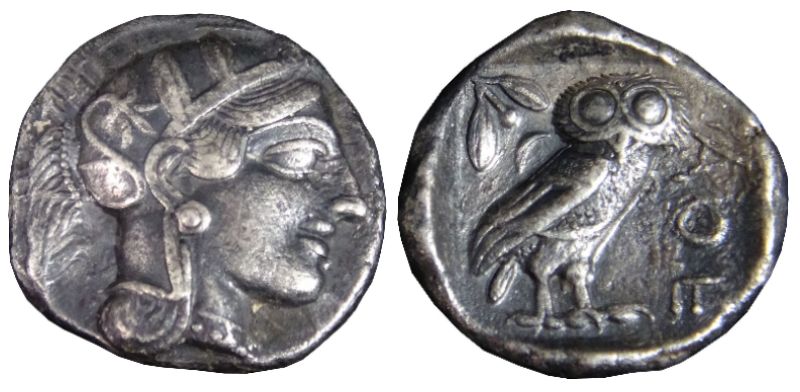
Did you know? Athenian silver "owl" coins (tetradrachms) became a recognizable symbol of the city and often bore Athena’s helmeted profile and the owl motif from the late 6th century BCE.
Historical reading of these myths must account for regional variation. Athena appears under different epithets and with varying emphases across Greece: Athena Polias (“of the city”) emphasizes her role as protector of urban centers, especially Athens; Athena Ergane highlights her function as patron of craftsmanship and artisans. In some local cults, older pre-Hellenic deities or local fertility goddesses may have been syncretized into Athena’s image, or vice versa. The famous contest with Poseidon over the patronage of Athens — in which Poseidon produces a salt spring and Athena offers the olive tree — is an etiological myth explaining both the city’s name and the agricultural and maritime balance that would shape Athenian life. That contest, celebrated in Athenian art, encapsulates the duality that Athena represents: practical prosperity grounded in civic institutions rather than mere elemental force.
Archaeological and literary records show Athena’s cult consolidating especially in the Archaic and Classical periods (roughly 8th–4th centuries BCE), when city-states built monumental temples and organized pan-civic festivals. Yet Athena’s roots are older and more diffuse: she may recall a complex of goddess-types that predate the classical pantheon. We can balance poetic testimony with archaeological evidence — votive offerings shaped like owls, terracotta figurines of armed females, and early temples dedicated to Athena — to see how myth and cult reinforced each other. Where myth answered cosmic questions of origin and character, cult practices provided a social and economic framework: temples held treasuries, festivals redistributed honor, and priesthoods mediated between mortal communities and the divine patron.

Symbols, Iconography, and Visual Language
Athena is one of the most visually distinct deities in the ancient world. Her iconography crystallized into several recurring emblems: the owl, representing wisdom and nocturnal vigilance; the olive tree, a symbol of peace, fertility, and civic sustenance; the aegis — often shown as a goatskin cloak or shield edged with snakes and sometimes bearing the Gorgoneion (Medusa’s head) — an attribute signaling protective power; and the spear and helmet, denoting martial capability. Together, these items form a visual shorthand that allowed ancient viewers — across pottery, sculpture, coins, and frescoes — to recognize her even when narrative context was absent.
Did you know? The Great Panathenaia was held every four years and included a specially woven robe (peplos) presented to the cult statue of Athena as a central act of civic devotion.
The owl, perhaps the simplest and most enduring symbol, appears on Athenian coinage from the late 6th century BCE onward. The so-called "Owl tetradrachm" of Athens became an emblem of Athenian economic reach during the Classical period. The bird’s association with Athena may have older roots in local cult practice; in Athens, the owl’s nocturnal watchfulness made it a fitting companion to a civic goddess who was as much guardian of the polis as of individual intellect. Modern viewers often think of the owl as a universal sign of wisdom in Western culture — that association owes much to the prominence of Athena in classical education and iconography.
The olive tree, central to the mythic contest between Athena and Poseidon, had tangible economic and symbolic value. Olive cultivation in Attica was less about bulk export and more about sustaining local economies — oil for lighting, food, trade, and ritual. Athenian festivals and temple offerings frequently involved olive products, and sacred olive groves near temples were carefully preserved. The olive thus tied Athena’s image to the land and to civic endurance: an emblem not of raw conquest, but of cultivated prosperity.
The aegis and the Gorgoneion complicate Athena’s image. On one hand, the aegis marks her as a fearsome protector — it is literally terrifying when it bears the Gorgon’s head, capable in myth of turning onlookers to stone. On the other hand, the aegis also serves as a symbol of authority and sacred protection often worn, metaphorically, by city institutions. The presence of snakes on the aegis also links Athena to chthonic imagery and older, earth-bound cults, suggesting a layered history wherein a city deity incorporates pre-Greek or non-Olympian motifs.
Did you know? In myths of the Trojan War, Athena supports the Greeks with cunning strategies rather than pure brute force, highlighting her role as goddess of strategic warfare.
Artists rendered Athena in many media: the colossal chryselephantine Athena Parthenos by Phidias inside the Parthenon (described in Pausanias’ travel writings), painted pottery scenes showing her intervening in the Trojan War, Hellenistic bronze statuettes meant for household shrines, and Roman copies that adapt her features into the Minerva persona. Across these representations, variations exist — sometimes she is more martial, sometimes more serene; sometimes she emphasizes craft, as when shown with a spindle or working-tool. Yet the iconographic constants made her one of the most instantly recognizable figures of the ancient Mediterranean.

Cult, Temples, and Festivals: Athena in Public Life
Athena’s presence in ancient Greece cannot be separated from the physical places where she was honored. The most famous center of her cult was, unsurprisingly, the Acropolis of Athens. The Parthenon, completed under Pericles in the mid-5th century BCE (the principal building program dated to c. 447–432 BCE), served both as a temple to Athena Parthenos and as a treasury that reflected Athenian ambition after the Persian Wars. Within it stood the gold-and-ivory statue by Phidias — the Athena Parthenos — famed in antiquity for its magnificence and for the civic narratives painted and carved into the temple’s metopes and frieze.
The smaller Erechtheion, also on the Acropolis, housed sacred relics connected to Athena’s local myths — the salt spring associated with Poseidon and the olive tree Athena is said to have planted. The Erechtheion’s famous Caryatid Porch (the Porch of the Maidens) and its complexity hinted at an intertwining of multiple cultic traditions, including the veneration of an early king-hero (Erechtheus) thought by the Athenians to be intimately connected with the goddess. The ritual landscape of the Acropolis thus mapped myth onto urban topography: sacred trees, altars, and shrines worked in concert to assert Athenian identity.
Did you know? Pericles’ building program on the Acropolis (c. 447–432 BCE), including the Parthenon, reinforced Athena’s image as a civic patron for Athens’ golden age.
Panathenaia was the major festival of the goddess in Athens, occurring annually with a grander Great Panathenaia every four years. These festivals celebrated Athena’s protective role and the city’s unity. The highlight of the Great Panathenaia was a grand procession that carried a specially woven peplos (robe) to clothe the cult statue of Athena; athletic, musical, and poetic contests accompanied the procession, and victories were celebrated with prizes. The peplos itself often bore scenes of mythic significance, reinforcing civic memory and narrative. Sacrifices, public feasts, and dramatic competitions made the Panathenaia a vital civic ritual that fused religion with politics and social life.
Outside Athens, Athena was worshipped under various local epithets: Athena Nike emphasized victory and military success; Athena Polias underscored her protection of the city; Athena Hygieia (in later syncretic contexts) might emphasize health-related aspects. Temples dedicated to Athena appear across the Greek world, from Corcyra (Corfu) to Lindos on Rhodes, and her image also circulated widely on civic coinage. Priesthoods associated with her cult varied: some were hereditary functions within aristocratic families, others appointed by civic councils. The administration of temple treasuries, the management of sacred property, and the provision of public rituals gave Athena’s cult very real economic and political weight.
The archaeological record complements the literary accounts: votive offerings, inscribed dedications, and temple remains document how worshipers addressed Athena in practice. These everyday acts of piety — a votive bowl offered by an artisan, a dedicatory inscription after a battle won, the maintenance of sacred olive trees — show the goddess woven into life at every level, from household devotion to state identity.
Did you know? The Elgin Marbles controversy began in the early 19th century when Lord Elgin removed sculptures from the Parthenon, sparking ongoing debates about cultural heritage and restitution.

Athena in Myth: Stories, Contests, and Mortal Encounters
Athena’s mythic repertoire is rich and often morally complex. Beyond her dramatic origin and the contest with Poseidon, she appears in tales that illuminate Greek values and anxieties about skill, hubris, and the boundary between mortal and divine craft. The story of Arachne, told most famously by the Roman poet Ovid in his Metamorphoses (a later retelling but drawing on Greek motifs), frames Athena as a goddess intolerant of mortal pride in skill. Arachne, a Lydian weaver, boasts that her tapestry surpasses the gods. Atenea (Athena) challenges her to a contest; when Arachne’s work mocks the gods for their failings, Athena’s outrage leads to the mortal’s transformation into a spider. The narrative lingers on themes of competitive craft, divine authority, and the price of daring to equal a god.
In the epic cycle and Homeric poems, Athena’s interventions are decisive and practical. She guides Odysseus with disguise and counsel, helping him navigate a world of chance and deception. In the Iliad, she encourages and aids Greek heroes in battle, often embodying the Greek ideal of prudent strategy married to valor. Her support for Diomedes and other champions is not mindless; she seeks to shape outcomes through counsel, enhancing human agency with divine insight.
Athena’s role in the Perseus myth is another example of her patronage of heroic craft. According to mythic variants, Athena gives Perseus the polished shield he uses to view Medusa indirectly and avoid petrification, as well as guidance that allows the hero to succeed. In this and similar tales, Athena functions as sponsor for heroes who must combine cunning, skill, and courage.
Did you know? Phidias’ original chryselephantine Athena Parthenos is lost, but ancient descriptions and Roman copies allow scholars to reconstruct elements of its appearance and cultural role.
Her relationship with other gods is also revealing. Athena’s rivalry with Poseidon is the most famous; beyond the contest for Athens, the two gods represent complementary domains — the sea and the city, raw elemental force against cultivated civil order. In other stories, Athena’s interactions with Aphrodite, Ares, Hermes, and even Zeus reflect different aspects of her portfolio: wisdom, martial strategy, craft, and statecraft.
Athena also appears in tragedies and local lore as an enforcer of social and moral norms. Her associations with virginity and the vow of chastity can be punitive — mortal women who fail to respect the boundary between human and divine skill or who challenge established hierarchies may face her wrath. At the same time, her patronage of crafts and the arts also marks her as a protector of civilian skills and civic institutions, not merely a punitive presence.
Political Symbolism and Philosophical Resonances
Athena’s influence extended beyond ritual; she served as a political symbol and a philosophical touchstone. In the civic imagination of Athens, she embodied the ideals the city wished to project: measured power, law, public deliberation, and cultural patronage. Under Pericles in the 5th century BCE, the building of the Parthenon and the sponsored festival culture elevated Athena’s visible presence as a marker of Athenian superiority. The temple program was political: sculptural narratives on the Parthenon’s metopes and frieze celebrated not only mythical battles but also the city’s leadership in Greece after the Persian Wars.
Philosophers and political thinkers appropriated Athena’s image in different ways. Plato, though not systematically invoking Athena as an ideological trope, embedded in his dialogues a certain model of reasoned governance — the philosopher-king whose intellectual discipline recalls Athena’s attributes. The Stoics and other Hellenistic schools often emphasized the unity of virtue and wisdom, conceptual affinities that could be read back into the figure of Athena. In civic rhetoric, orators and statesmen evoked Athena to legitimate policies or to claim continuity with the city’s sacred past.
Athena’s symbolic flexibility allowed enemies and allies alike to recast her image. For example, during periods of Athenian hegemony, rivals could accuse the city of hubris, framing its appropriation of Athena as an arrogant monopolization of a goddess whose protection should be more diffuse. Internal political factions also used cultic imagery: dedications, dramatic performances, and public festivals became vehicles for contestation as much as piety. The goddess’s image could sanction imperial overreach or, alternatively, be deployed to argue for moderation and deliberative governance.
The philosophical resonance of Athena also plays out in private life. As patron of crafts (Athena Ergane), she stands for trained skill — not mere technical ability but an ethical, socialized expertise that binds individuals to communal standards. That notion parallels classical Greek concerns about education (paideia), the cultivation of the soul, and the balance between emotion and reason. In the polis, Athena’s balance of martial and civic virtues provided a model for responsible citizenship: one ought to be capable in war but disciplined enough to prioritize law and culture.

Reception, Roman Minerva, and Later Legacy
In the centuries after the classical Athenian era, Athena’s identity shifted and spread. The Romans identified her with Minerva, a member of their Capitoline triad alongside Jupiter and Juno. Minerva retained many of Athena’s attributes — wisdom, crafts, and strategic warcraft — but Roman religion gave her new contexts. The Etruscans, who predated Roman dominance in Italy, worshipped Menrva, a goddess who likely contributed to the Roman synthesis that produced Minerva. Thus, Athena’s character refracted through multiple cultural lenses as she was adapted into Italic and imperial worship.
Art and literature preserved and transformed Athena’s image. Hellenistic and Roman copies of earlier Greek statuary spread her visual profile across the Mediterranean, and sculptors repurposed her attributes for local civic and imperial agendas. In the Renaissance, classical revivals reintroduced Athena/Minerva as emblems of learned virtue; artists and humanists invoked classical iconography to legitimate new intellectual and political projects. Phidias’s lost chryselephantine Athena Parthenos survives in literary descriptions and in Roman-era copies, allowing modern scholars to reconstruct aspects of its appearance and meaning.
The modern era has continued to appropriate Athena’s imagery. Museums, coins, and national monuments have used her as a symbol of civic virtue and wisdom — often under the Roman name Minerva. Yet not all modern invocations are straightforward. The 19th-century controversy over the removal of the Parthenon sculptures (the Elgin Marbles) to Britain after their acquisition by Lord Elgin raised questions about cultural patrimony, imperial collecting, and the ownership of shared heritage. Athena’s representation in that controversy is emblematic: the fragments of a civic goddess wound up in foreign museums, prompting debates that continue into the present about restitution and historical memory.
Scholars today study Athena across disciplines — archaeology, philology, anthropology, and art history — to understand both the goddess and the societies that venerated her. Excavations on the Acropolis and comparative studies of votive practice in other poleis reveal a living, contested set of beliefs. Athena’s story is therefore a window not only on ancient religion but on processes of cultural adaptation, appropriation, and reinterpretation. Her survival in art and thought highlights the elasticity of myth: a single figure can mean different things in different eras, yet remain recognizable.
Conclusion: The Enduring Enigma of Athena
Athena resists simple categorization. She is more than a goddess of wisdom in an abstract sense; she is a social force, an icon of civic identity, and a repository of moral and political ideals. Through her, ancient Greeks articulated a vision of reason paired with readiness for conflict, of craft elevated to civic virtue, and of a city’s soul expressed in marble and ritual. Her myths dramatize the tensions that attend any civic life: the balance between individual skill and communal order, between pride and prudence, between the terror of raw power and the discipline of law.
The mystery at Athena’s center is part theological and part historical. The image of a goddess springing whole from a god’s head is theological spectacle; the carved marbles and ritual peplos are historical artifacts. Together they remind us that ancient religion married the dramatic to the administrative, the mythic to the mundane. Athena’s presence in festivals, treasuries, and poetic narratives made her both an imaginative figure and a practical agent in civic life.
In modern times, Athena’s figure continues to be mined for meaning. She becomes a shorthand for civic-minded wisdom in political iconography, an emblem in academic heraldry, and a subject for artists interested in the classical past. But the most compelling reason to study her lies in the mixture of paradoxes she embodies: a goddess who is at once fierce and orderly, a patron of both war and weaving, a virgin and a protector of family and city. Those contradictions reflect ancient realities: the polis itself was a site of constant negotiation between competing goods.
Ultimately, Athena’s endurance matters because she offers a model — not a prescription — for thinking about public life. Her myths and cults invite questions rather than deliver neat answers. How do communities cultivate wisdom? How should skill be honored without breeding hubris? What does it mean for a city to claim a protector deity? These questions were alive to the ancients and remain ours. The carved gaze of Athena, whether in fragments on a museum wall or imagined beneath the Parthenon’s pediment, still asks us to consider how intellect, power, and civic duty should be balanced in any age.

How we verify this article
By the History Unlocked editorial team
This text is built on historical facts stored in our database and drafted with AI assistance. No signed human review is recorded for this article. Report any inaccuracy: we correct it and update the modified date.
Updated on
AI-assisted drafting.
Read our editorial standardsEnjoyed this? Discover more articles in the category Mythology & Ancient Gods