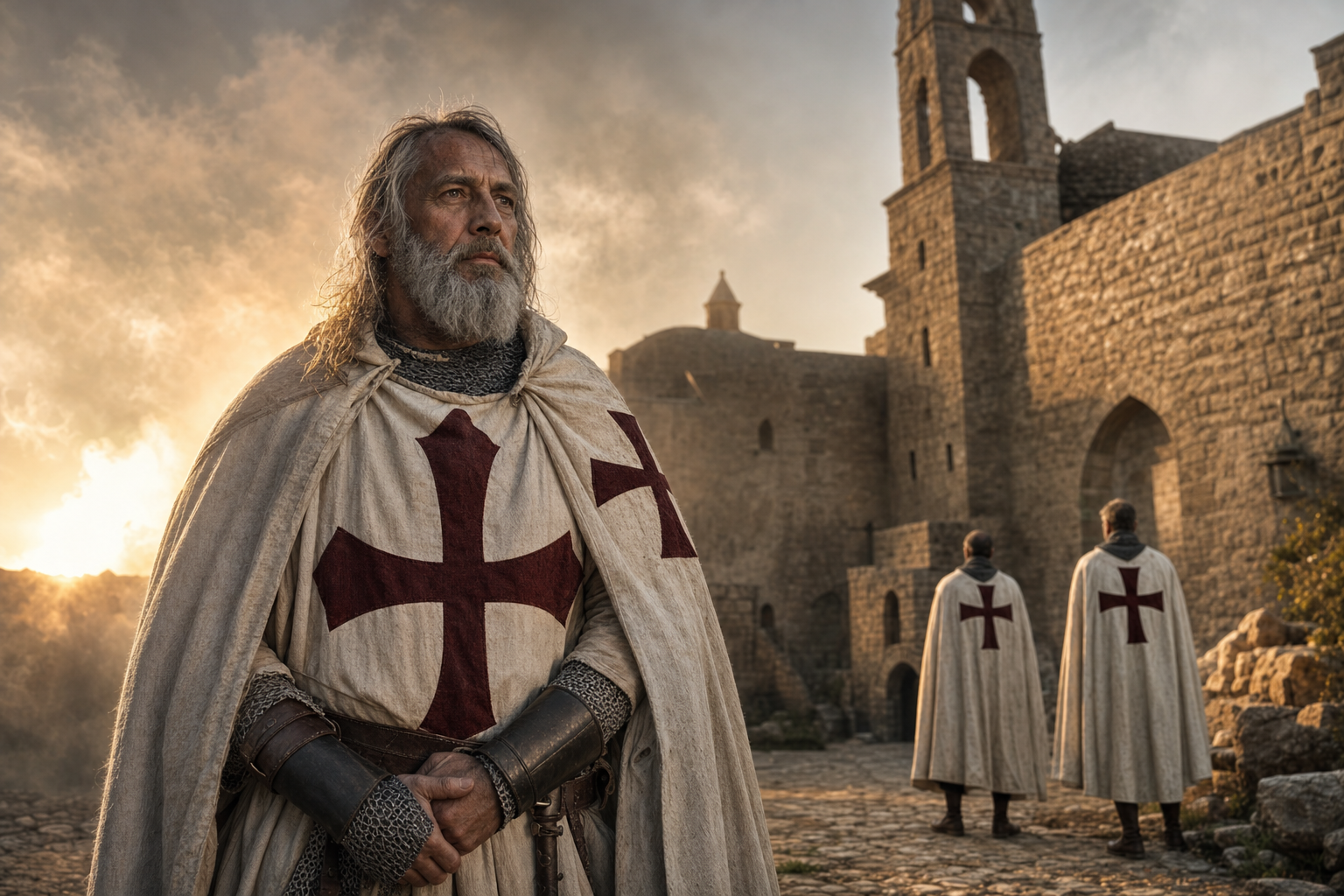
The Curse of Jacques de Molay: History, Myth, and Memory
The last cries of a man on a pyre, the shudder that ripples through kingdoms, and the slow accretion of rumor into legend: the story of Jacques de Molay and his supposed curse is one of the most enduring narratives in the history of medieval Europe. It is a tale that blends brutal political calculation, judicial abuse, religious authority, and the human need for moral recompense. At the heart of that story stands a man who was both a high-ranking military religious leader and, to creditors and kings, a wielder of enormous wealth and international influence. His name — Jacques de Molay — was invoked not only in legal proceedings and papal bulls but also later in novels, plays, and the imaginations of conspiracy theorists.
To understand why the legend of a curse could take root and thrive, we must begin with the concrete facts of his life and death. Jacques de Molay was the twenty-third and last Grand Master of the Knights Templar, an order founded in the early 12th century to protect Christian pilgrims and participate in the Crusades. By the turn of the 14th century the Templars had evolved into a transnational organization with fortresses, farms, banking operations, and political reach across Christendom. Such wealth and autonomy made the order an irresistible target in the turbulent politics of late medieval France.
The episode most often singled out as the seed of the curse is the dramatic arrest of Templars across France on October 13, 1307, ordered by King Philip IV (Philip the Fair). The king had multiple motives: vast debts owed to the Templars by the crown, a desire to seize their property, and a perception of the Templars as a semi-autonomous power whose allegiance might threaten the centralizing ambitions of the monarchy. The arrests were executed with ruthless efficiency, led by agents such as Guillaume de Nogaret, and followed by interrogations under torture that produced confessions of heresy, blasphemy, idolatry, and sexual misconduct. Those forced admissions, whether true or not, provided a legal pretext for the suppression of the order.
Did you know? The arrests of the Templars were coordinated to occur on 13 October 1307, a date later associated with superstition, though the ominous significance of 'Friday the 13th' developed in later centuries.
Yet the legal and religious processes that followed were tangled and slow. Pope Clement V, a French pope elected in 1305 and heavily pressured by Philip, moved with caution. The papacy convened investigations and councils that dragged on for years. In 1312 the Council of Vienne issued a judgment dissolving the order by papal authority in the bull Vox in excelso, making the suppression an act of the Church itself rather than solely of a secular crown. Even so, Jacques de Molay and several of his companions were held and retried. In the end, de Molay publicly recanted his earlier confessions to save the honor of the order. That recantation and his subsequent execution on March 18, 1314, became the flashpoint for later stories. According to later accounts, from the stake de Molay cried out, accusing both Pope Clement and King Philip of lying and injustice — and invoked divine judgment upon them.
Whether or not Jacques de Molay formed a carefully worded curse, the rapid deaths of both Clement V (April 20, 1314) and Philip IV (November 29, 1314) within the same year of de Molay's execution created an eerie coincidence that fed rumor, resentment, and myth-making. Chroniclers, pamphleteers, and storytellers stitched the sequence into a moral parable: a proud king and a compliant pope punished, as if by supernatural retribution, for the sacrilegious destruction of a holy order. The result was a narrative that served multiple purposes: a cautionary tale about divine justice, a rallying symbol for those disenchanted with royal overreach, and a convenient scaffold for later historical romanticism. Over the centuries this narrative has been embellished, contested, reinterpreted, and used to justify everything from literary drama to speculative fiction and conspiratorial claims.
This article follows the factual course of events that led to the fall of the Templars, examines the documented trial and execution of Jacques de Molay, traces the origin and evolution of the alleged curse, and analyses why the legend persisted. Throughout, it keeps a cautious eye on sources; where the documentary record is thin or later accounts emerge, the distinction between documented history and myth will be made clear. It is only by separating verifiable facts from later imaginations that we can appreciate both the truth of what happened in Paris in 1314 and the reasons why a curse attached to a dying Templar would long haunt European culture.
Did you know? The papal bull Vox in excelso (1312) dissolved the Templars by papal authority, but it did not order the mass executions; secular courts carried out many of the punishments.
The Arrest of 1307: Political Motives and the Use of Torture
The arrest of the Knights Templar on October 13, 1307, stands as one of the most dramatic political operations of the medieval period. It was not a spontaneous uprising of public opinion but a calculated, premeditated action by King Philip IV of France, who had been planning against the Templars for months. Philip was deeply in debt to the order; the crown had borrowed heavily to finance wars and royal expenses, and the Templars had served as international bankers. Beyond money, the king was driven by political imperatives: in an age when monarchs were attempting to consolidate power, the existence of a wealthy, international military order with its own chain of command and privileges struck at the heart of sovereign authority.
Guillaume de Nogaret, a shrewd royal jurist and advisor, has traditionally been credited with masterminding the operation. Nogaret worked with other officials to coordinate simultaneous arrests across France on a single day — a swift blow designed to prevent any organizational response by the Templars. There is documentary evidence that Philip issued secret orders and that agents were prepared to seize Templar houses and archives. The timing of the arrests — on a Friday the 13th, though the significance of that superstition is mostly a later invention — fed later romanticization. Nevertheless, the essential facts remain clear: mass arrests were carried out; Templar property was confiscated; and many brothers were subjected to brutal interrogation.
What followed was a juridical process tainted by torture and confessions obtained under duress. Medieval inquisitorial practices permitted, and in some cases endorsed, the use of pain to extract admissions that could then be used in ecclesiastical or secular trials. Under torture, numerous Templars admitted to practices that would constitute heresy: denial of Christ, spitting on the cross, idolatrous worship of an object called the Baphomet (a term whose origin and meaning are debated), and immoral sexual acts. Modern historians warn that confessions under torture are inherently unreliable; men and women will confess to anything to end suffering. Yet in the eyes of the royal administration and many contemporary observers, those confessions sufficed to justify severe measures.
Did you know? Pope Clement V died on April 20, 1314, less than five weeks after de Molay's execution; King Philip IV died on November 29, 1314, within the same calendar year.
Papal reaction was complex. Pope Clement V, elected in 1305 and residing in Avignon rather than Rome, was a Frenchman dependent to a degree on Philip's influence. He could not simply ignore the king's accusations, but he also hesitated to endorse wholesale destruction without careful investigation. Thus the papacy initiated inquiries, summoned Templar leaders to answer, and sought to manage the situation in a way that preserved papal authority while placating the crown. The result was an extended juridical limbo: the Templars were officially under suspicion and many remained imprisoned for years while decisions about suppression and the disposition of their goods were debated.
The violent mechanics of October 1307, the royal motive of both financial gain and political consolidation, and the role of torture in producing accusations all created fertile ground for rumor and outrage. For supporters of the Templars, the arrests were a crime; for many ordinary people, the lurid accusations made for sensational gossip. In this atmosphere the idea that the Templars had committed sacrilegious acts could be both an explanation for their downfall and an instrument used by the crown to justify seizure of their wealth.
The Trial of Jacques de Molay: Recantation, Retrial, and Political Theater
Jacques de Molay's legal ordeal must be understood against the backdrop of the extraordinary legal architecture of the time: a tangle of royal courts, papal commissions, inquisitorial procedures, and diplomatic negotiation. As Grand Master, de Molay was a symbol and practical leader of the order; Philip and his agents understood that bringing him to heel — or to public dishonor — would signal the collapse of Templar resistance. Initially de Molay and other high-ranking brethren were taken into custody and transported, in the case of de Molay, to Paris where the crown could keep tight control over the proceedings.
Did you know? The term 'Baphomet', used in some confessions of Templars under torture, only appears in medieval sources under various spellings and may have been a corruption or misunderstanding rather than proof of idolatrous worship.
Under severe pressure and likely torture, de Molay eventually confessed to certain charges in the early years of his imprisonment. But the narrative takes a critical turn in 1313 and early 1314 when de Molay, having spent years in custody and appearing before papal commissions, publicly recanted his coerced confessions. He asserted his innocence of the most serious charges, appealed to the pope, and sought a restoration of the order’s reputation. These acts of recantation were dangerous: to renounce previous confessions made under coercion could be construed by secular authorities as a defiant refusal to accept the judgment that had been orchestrated on political lines.
The papacy's position was delicate. The Council of Vienne (1311–1312) ultimately decided to suppress the order by issuing the bull Vox in excelso (March 22, 1312), which formally dissolved the Knights Templar. This dissolution, however, did not mean that every individual accused would be left unpunished: secular courts retained authority over criminal matters. Consequently, some Templar leaders were transferred to royal jurisdiction. In de Molay's case, the French crown declared him relapsed — that is, having returned to heresy after abjuration — making him subject to the customary penalties for relapsed heretics, including execution.
On March 18, 1314, de Molay and Geoffroi de Charney, another senior Templar, were led to execution on an island in the Seine known as the Île aux Juifs. Accounts from the time describe them being marched through Paris to the place of burning, made to wear their Templar robes, and bound to stakes. The spectacle was intended as both punishment and deterrent. It was also highly theatrical: the king's agents had arranged for a public demonstration of royal and ecclesiastical power. Yet the certainty of guilt remains historically problematic: many confessions, including those attributed to de Molay earlier in his imprisonment, likely stemmed from extraordinary duress.
Did you know? Romantic-era writers and 19th-century antiquarians played a major role in popularizing the Templar legend and the specific image of de Molay's curse.
The image of a dignified Grand Master choosing to speak truthfully at the end, recanting previously obtained confessions, fed what came next. Contemporary observers and later chroniclers noted that de Molay's final words were a blunt indictment of those who had condemned him. Whether de Molay intended those last words to be a theological curse, a prayer for justice, or a political rebuke, they were seized upon by opponents of the king and amplified by rumor. The judicial performance of his trial and the spectacle of his execution thus provided the raw material for the legend of the curse.

The Moment of Death and the Alleged Curse: Contemporary Records and Later Embellishments
The most combustible moment in the story is Jacques de Molay's death on the pyre. Here the historical record is simultaneously solid and porous: it is solid in its basic facts — the date (18 March 1314), the place (Île aux Juifs in Paris), and the names of principal victims (de Molay and Geoffroi de Charney). It is porous in its details about the exact wording of any final pronouncements and the immediate reactions of the crowd. The earliest accounts record that de Molay declared his innocence and protested the injustice of his treatment, and some go further to describe an outcry in which he invoked divine vengeance.
Later chroniclers and popular narratives, however, transformed those declarations into a neat prophecy. The legend runs that de Molay, with a final burst of righteous fury, said that within a year Pope Clement V and King Philip IV would be called before God to answer for their deeds. Remarkably, Clement died on April 20, 1314, only about a month later; Philip died on November 29, 1314, eight months after the execution. For contemporaries already suspicious of royal motives, this sequence — execution followed by the rapid deaths of both pope and king — appeared as an uncanny alignment, a moral accounting that seemed to vindicate de Molay's last protest.
Did you know? The Council of Vienne (1311–1312) was where European prelates debated the fate of the Templars before Pope Clement V issued Vox in excelso to dissolve the order.
Historians caution against seeing direct causality in this alignment. Medieval Europe was plagued by disease, political stress, and the vicissitudes of health imperceptible to contemporaries; both Clement and Philip were in their fifties and had existing health issues. Clement had been ill for some time, and his death in April is not inherently mysterious when placed in the context of his medical and political condition. Philip, meanwhile, had suffered physically and mentally under the long pressures of kingship and war; his death in November 1314 followed a hunting accident and a brief illness. That said, the human mind seeks pattern; the proximity of these deaths to de Molay's execution supplied a narrative frame that made sense to people feeling injustice.
Because many of the more dramatic versions of the curse come from sources that postdate the events, scholars emphasize the evolution of the story: early mentions are terse and focused on de Molay's last affirmations of innocence, while later retellings, particularly from the Renaissance and Romantic periods, expanded the language into a precise and theatrical prophecy. These retellings often served ideological aims — attacking royal tyranny, mourning the loss of chivalric ideals, or enriching literary drama. The 'curse' thus moves between the registers of fact, rumor, and purposeful fiction, and to disentangle them we must trace both documentary evidence and cultural reception.

Why the Curse Took Hold: Social Memory, Political Utility, and Moral Narrative
Why did the story of a dying Templar's curse persist for centuries? The reasons are layered—psychological, social, and political. On a psychological level, humans are pattern-seeking; when a dramatic injustice is followed by misfortune for the perceived perpetrators, the temptation to see divine retribution is strong. This reasoning has been a staple of moral narratives throughout history: extraordinary wrongdoing invites extraordinary punishment, and stories that embody that moral logic are emotionally satisfying.
On a social level, the destruction of the Templars resonated with many constituencies. The order had many friends and supporters across Europe: nobles who relied on Templar military services, debtors who had borrowed from their financial networks, and communities who benefited from their local commanderies. The abrupt dismantling of the order and the seizure of their assets produced numerous losers, many of whom were motivated to frame the events as a scandal. For these groups, the idea that the king and pope would suffer divine judgment was a form of rhetorical reparation. Moreover, the spectacle of public executions and the use of torture generated sympathy for victims among observers who later passed down critical narratives.
Politically, the curse narrative proved useful. It could be wielded by opponents of royal centralization as an emblem of tyrannical excess. Writers in later centuries exploited the story to warn against unchecked monarchical power or to lament the loss of older institutions of chivalry and piety. During periods of anti-clerical or anti-establishment sentiment, the Templars' victimization served as a potent emblem of institutional corruption and the vulnerability of those who served higher ideals.
Religious and literary culture also played a role. Medieval and early modern Europeans were deeply attuned to providential readings of history; they frequently saw political events as manifestations of divine will. As the centuries passed, the Templar story attracted embellishment from chroniclers, poets, and playwrights who sought dramatic material. The Romantic movement, in particular, revived interest in the mysterious orders of the Middle Ages and elevated the figure of the doomed Templar to a near-mythic status. Thus, the 'curse' gained traction because it fit existing narrative frameworks and could be adapted to various ideological uses.
Legends, Literature, and Modern Myths: From Ballads to Conspiracy Theories
The story of Jacques de Molay and his alleged curse migrated from chronicles into popular culture in waves. In the medieval and early modern periods, troubadours and chroniclers recited the dramatic events; pamphlets and chansons de geste recycled elements of the tale to comment on contemporary politics. By the nineteenth century, Romantic writers and historians resurrected the Middle Ages as a source of mystery and moral grandeur. The Templars, with their secretive rites, martial mystique, and sudden downfall, proved irresistible to Victorian and post-Victorian imaginations.
In literature, the Templars became symbols: of betrayed piety, of heroic resistance to despotism, or of hidden treasure and forbidden knowledge. Authors from Walter Scott to later novelists borrowed Templar motifs to add exotic color and moral gravitas to their narratives. In the twentieth century, the Templars entered the sphere of mass-market conspiracy thinking. Connections were forged—sometimes creatively—between the Templars and the Freemasons, the Holy Grail, or secret caches of royal treasure. Much of this modern myth-making is anachronistic: it stitches together disparate symbols and institutions that had different meanings in earlier eras.
The 'curse' specifically served as a dramatic hinge for fiction. Novelists and filmmakers found in the image of a dying Grand Master pronouncing doom a potent narrative device. Over time, the more sober chroniclers of the Middle Ages were overshadowed in public imagination by these dramatic retellings. Consequently, popular representations often emphasize prophecy and mysticism over the grim legal and political realities that were the real drivers of the Templars' suppression.
In academic history, the Templar case is treated as an instructive example of how power, law, and rumor intersect. Scholars study the archives — not only the grand events but also the small procedural records and correspondence — to reconstruct the political motivations behind the persecution. At the same time, cultural historians trace how the image of de Molay evolved into a symbol, which is a separate but interrelated kind of truth: the story of the curse tells us as much about later societies' anxieties as it does about early 14th-century Paris.

Historical Assessment: Separating Fact from Fiction
The historian's task with the de Molay narrative is to hold two truths at once: to recover the solid documentary record of arrest, trial, and execution, and to understand the social life of the story that turned those facts into legend. Key verifiable claims include the coordination of arrests on October 13, 1307; the use of torture to extract confessions; Pope Clement V's role in convening inquiries and issuing the bull Vox in excelso in 1312; Jacques de Molay's recantation; and his execution on March 18, 1314. Another verifiable element is the close temporal proximity of the deaths of Clement V and Philip IV to de Molay's death.
What is far less certain are the precise words de Molay spoke and whether he intended them as a formulated curse or as an anguished prayer and protest. Contemporary chroniclers differ in detail; many accounts of the curse appear later and reflect the sensibilities of their authors. That does not mean the curse is pure invention: it reflects a communal interpretive response to conspicuous events and thus carries real historical meaning as an example of social memory.
Moreover, the judicial process against the Templars is itself a revealing historical fact. It demonstrates how royal power could manipulate legal institutions and exploit ecclesiastical processes for secular ends. It also shows how confession extracted under torture was transformed into documentary proof. These realities help explain why so many observers — at the time and later — found the Templars' destruction morally problematic.
In assessing the 'curse' we should also be attentive to historiographical caution. Pattern-recognition in historical causality is a psychological hazard: temporal succession does not prove moral or supernatural causation. Yet the willingness of contemporaries and successors to connect events reveals the cultural logic of medieval and post-medieval Europe. The curse, therefore, is best understood as both a symbolic act (a public denunciation at the stake) and as a cultural artifact that shows how people have processed injustice.

Jacques de Molay's story resists a single register of meaning. As a historical episode it exemplifies the violent politics of early 14th-century France: a crown eager for revenues and power, a papacy susceptible to secular pressure, and an order whose international scope made it politically vulnerable. As a cultural event, de Molay's death produced a moment of symbolic power that later writers and communities would rework into an enduring legend: the 'curse' that seemed to afflict his persecutors.
Understanding why the curse took hold requires a dual approach. We must respect documentary facts — the arrests of 1307, the use of torture, the papal suppression in 1312, de Molay's recantation, and his execution in March 1314 — while also acknowledging the power of narrative. The dramatic proximity of subsequent high-profile deaths made the story of divine retribution plausible to contemporaries and irresistible to storytellers. Over centuries, the image of de Molay on the pyre, pronouncing doom, became a flexible symbol, useful to poets, polemicists, conspiracists, and novelists.
For modern readers the lesson is nuanced: historical causality is rarely black and white, and the line between fact and legend is porous. The 'curse' may not have been a supernatural act, but it was a real historical force — shaping memory, influencing art, and offering a moral vocabulary for resistance to unchecked power. Jacques de Molay's last moments, whether prayer, prophecy, or political denunciation, continue to resonate because they compress into a single human image the themes of injustice, spectacle, and the search for redress. In that sense, the curse is less a literal spell and more a mirror reflecting how societies reckon with the aggressive exercise of authority and the fate of those who stand against it.
How we verify this article
By the History Unlocked editorial team
This text is built on historical facts stored in our database and drafted with AI assistance. No signed human review is recorded for this article. Report any inaccuracy: we correct it and update the modified date.
Updated on
AI-assisted drafting.
Read our editorial standardsEnjoyed this? Discover more articles in the category Knights Templar