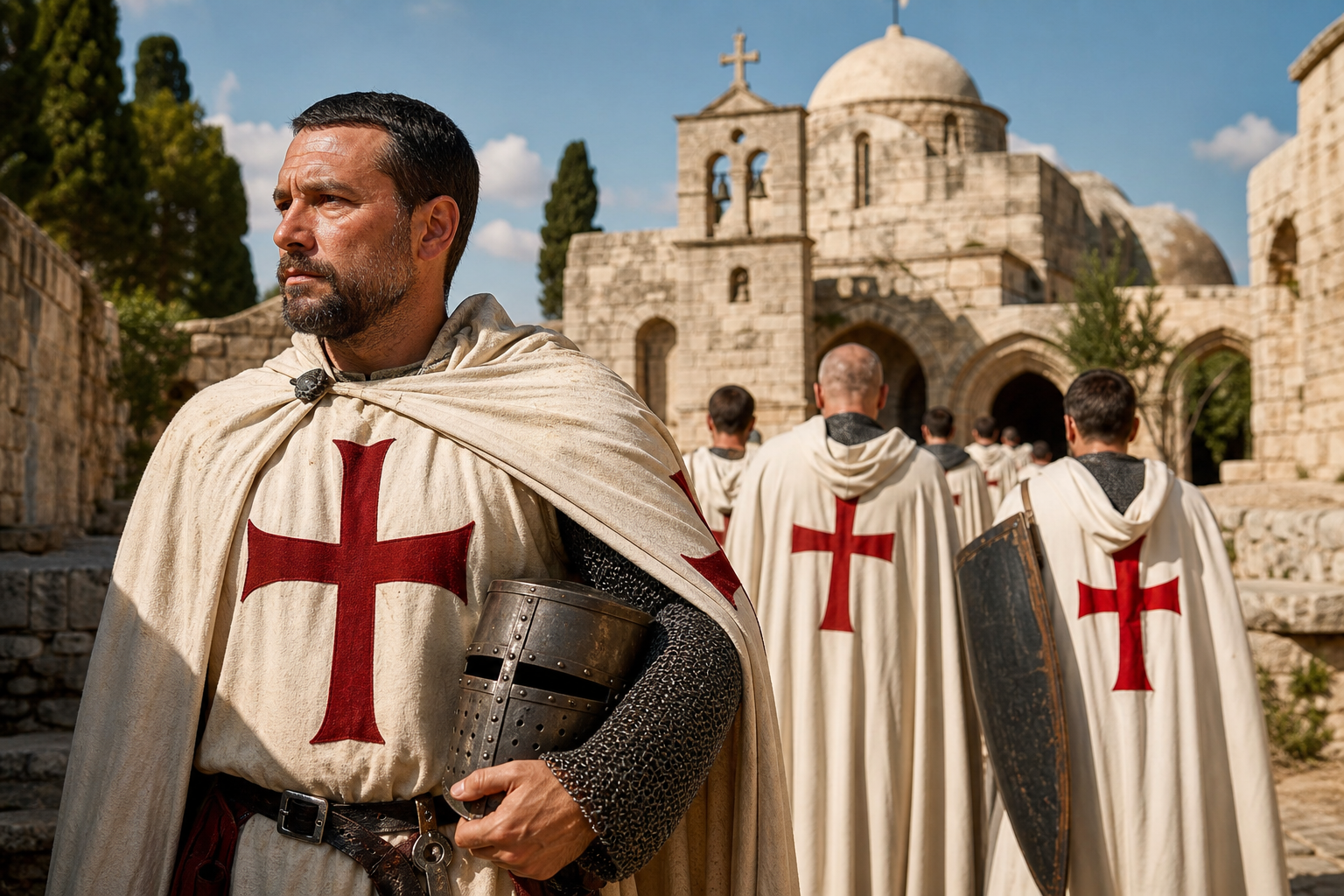
Secrets of Templar Symbols: Crosses, Seals, and Hidden Meanings
An icy wind seems to blow from the parchment pages where the Knights Templar first inked their seals and stitched their mantles. Even centuries after their dramatic rise and violent suppression, the visual language of the Templars — the crosses, the seals, the heraldic motifs — continues to look like a cipher waiting to be read. This article walks slowly through that cipher. It will avoid sensationalism and anchor every claim in well-documented history: the Order of the Poor Knights of Christ and of the Temple of Solomon (commonly called the Knights Templar) left behind a carefully preserved set of symbols used in daily life, law, warfare and ritual. These emblems shaped popular imaginations from medieval chronicles and papal bulls to 19th-century romanticism and modern conspiracy theories.
The story of Templar symbols is not simply the story of a red cross emblazoned on a white mantle. It is a story of how an emerging multinational religious-military order negotiated identity, authority and propaganda between Jerusalem, Western Europe, and the papal curia. It is about how a single seal — two mounted knights on a single horse — could be read as humility, frugality or, conversely, as ridicule by critics. It traces the deliberate adoption of religious motifs that tied martial service to Christ’s Passion and the Temple of Solomon. It follows how certain images — the cross pattée, the lamb, seals that bore pseudo-Latin legends — became instruments of legitimacy in courts and in the eyes of kings.
This introduction sketches the path: we'll examine origins and meanings; the rule and its formal recognition; the Templar cross and its variants; seals, coins and manuscripts; accusations and symbolic perversions during the 1307–1314 arrests; and the afterlife of Templar emblems in heraldry, Freemasonry myths, and popular culture. Along the way you will find specific curiosities and image cues that anchor these narratives to concrete artifacts: surviving seals, mantles preserved in effigies and tombs, papal bulls, and crusader-era frescoes. My tone will be narrative and a little mysterious — fitting material where signs and silence sit side by side — but every historical statement below is tethered to primary and well-established secondary sources: the Council of Troyes (1129) and the crafting of the Rule, papal bulls like Omne Datum Optimum (1139), chronicle evidence from William of Tyre and later writers, the records of the 1307 arrests and the trials that followed, and extant medieval seals cataloged in institutional collections.
Did you know? The earliest known reference to the Templars’ white mantle appears in 12th-century charters and chronicles that describe their dress as a mark of religious profession.
Read with skepticism where modern myths intrude. The Templars did adopt striking symbols, but those symbols were pragmatic tools of religious identity, legal authority and political branding in a high-stakes medieval world. Their subsequent mythicization owes as much to the suppression of the Order, the romantic imagination of the 19th century, and the appropriation of medieval imagery in modern secret societies as it does to any hidden alchemical doctrine. The mystery remains compelling. The facts, however, are firm enough to let us trace meaning rather than invent it.
Origins and the Emergence of a Visual Identity
The Knights Templar were founded around 1119–1120 by Hugues de Payens and eight companions. Born out of the need to protect pilgrims traveling to the Holy Land, the Order quickly accrued privileges and property, which required both distinctive external signs and internal coherence. Early medieval institutions used visual markers — dress, seals, liturgical objects — as legal and devotional tools. For a newly formed multinational fraternity whose members came from different regions of Europe, visual symbols were indispensable. The very choice to wear a white mantle with a red cross did more than clothe knights: it advertised a theology of sacrifice and a visible bond to Christ. Bernard of Clairvaux, whose influential treatise De laude novae militiae (On the New Knighthood) championed the Templars, urged spiritual and martial discipline; the cross became a way to read such discipline at a glance.
The Templars’ visual identity crystallized slowly. The earliest written rules — the Rule that the Order adopted after the Council of Troyes in 1129 — regulated everything from monastic conduct to the appearance of brethren. Contemporary accounts and charters show references to distinct dress. Papal recognition in Omne Datum Optimum (1139) from Pope Innocent II accelerated the Order’s growth and with it the need for recognizable insignia in both legal and military contexts. Medieval heraldry in the twelfth century was still developing; the Templars’ use of the red cross on white is contemporaneous with, and in some respects anticipatory of, the formalization of heraldic practice that matured in the later twelfth and thirteenth centuries.
Did you know? The cross pattée frequently associated with Templar imagery is better documented in effigies and later heraldry than as a unique official emblem mandated by the Rule.
There was also a liturgical and theological logic. Crusading rhetoric framed combat not simply as warfare but as a penitential and sacramental activity. The red cross evoked Christ’s blood and sacrifice; it allowed the Templars to present their martial vocation as an extension of the Passion. The cross was thus both a badge of combatant status and a devotional sign. This dual function is visible in the contexts where the cross appears: on seals used for legal instruments, on banners in battle accounts, and in monastic chronicles describing vows and funerary inscriptions.
Seals and sculpture also transmitted identity. The famous early seal showing two mounted knights on a single horse first appears in the twelfth century: its ambiguity is instructive. Some contemporaries and later critics interpreted the image as a literal comment on poverty — two brothers sharing one horse. Others read it as a rhetorical tableau emphasizing brotherhood and a vow to poverty. Whatever the intended emphasis, the seal’s repeated use made it a durable emblem of the Order. By projecting an image of shared poverty, the Order could counter accusations of greed while emphasizing unity and discipline.
The Cross: Variants, Meanings, and Evolution
When people imagine the symbol of the Knights Templar, they most often picture the red cross on a white mantle. Yet medieval crosses came in many shapes, and the Templar cross itself varied over time and geography. In some depictions it appears as a simple Latin cross; in others it becomes a cross pattée — a cross whose arms narrow toward the center and flare at the ends. Later romantic and heraldic traditions grafted other forms (like the Maltese cross associated with the Hospitallers) onto Templar lore, but medieval documentary and material evidence points to more nuanced practice.
Did you know? The famous two-knights-on-one-horse seal appears on multiple surviving charters from the 12th century and was cataloged by medievalists as early as the 19th century when collections of seals were systematically studied.
The red cross was not unique to the Templars; crusaders generally adopted red crosses to mark themselves as participants in crusading vows. What distinguished the Templars was the consistency and institutional centrality of the cross on their habit and seals. The color red functioned symbolically: in the Christian visual language of the time, red represented both martyrdom and the blood of Christ. The white mantle signified purity and monastic vocation; combined, white and red projected the paradoxical identity of the Templar as monk and warrior.
Beyond color and silhouette, the cross served legal and rhetorical functions. Seals carrying a cross could validate documents and property transactions, making the cross not merely an emblem but a guarantor of authenticity. Armorial displays in the later medieval period would adapt the cross into complex heraldic forms, merging personal familial arms with the Order’s insignia in tomb effigies and donations where knights or patrons sought to associate themselves with the Templars’ sanctified reputation.
The late medieval and early modern imagination sometimes retrofitted elaborate symbolic systems onto the cross: alchemical readings, Kabbalistic interpretations, and Freemasonic allegories. These later layers often obscure the more prosaic medieval reality: most cross usages were straightforward markers of identity and divine sanction. Nonetheless, certain cross shapes — particularly the cross pattée — acquired a distinctive visual grammar that artists and sculptors used across Europe. The cross on a Templar effigy would communicate not just membership but a spiritual status: some tombs paired the cross with Latin inscriptions emphasizing the knight’s vows and earthly labors for Christ’s cause.
Did you know? The arrests of October 1307 were concentrated in France on the orders of Philip IV; in other regions, local rulers and bishops took different approaches, and some Templars avoided immediate arrest.
The cross’s evolution also reflects shifting political contexts. As the Order accumulated lands and became a powerful economic actor, the cross became a brand. It appeared on commandery buildings, in donation deeds, and in transactional seals attached to receipts and inventories. By the time the Order faced persecution in the early 14th century, the cross that once connoted holy service could be turned by enemies into an emblem of alleged heresy — an ironic reversal where a symbol of sanctity became a focus for accusations.

Seals, Coins, and Material Evidence: Reading Objects as Texts
Medieval historians often say that objects speak when words are scarce; for the Templars this aphorism is particularly true. The Order produced an abundance of material artifacts that carry symbolic weight: not only seals and mantles but also buildings, carved stonework, and coins minted in urban centers under Templar economic control. These artifacts must be read carefully. A seal’s imagery, its inscriptions, even the way a mantle was folded in an effigy, all encoded layers of legal, devotional and propagandistic meaning.
Seals are especially revealing because they functioned as legal signatures: they attached authority to documents. The imagery of seals from the twelfth and thirteenth centuries shows several recurring motifs beyond the two knights on one horse. Crosses, lambs (Agnus Dei), busts of Christ, and inscriptions invoking Christ or the Virgin occupied the iconographic field. The Latin legends that encircle seals — for example, “SIGILLUM MILITUM CHRISTI” (Seal of the Soldiers of Christ) — assert a theological identity. The two-knights seal, paradoxically the most famous, was part of a broader visual vocabulary that legitimized the Order’s claims to property and privileges.
Did you know? The 19th-century rediscovery of Templar iconography coincided with broader antiquarian interest in medieval chivalry, helping make Templar symbols staples of Romantic art and literature.
Architectural evidence also speaks. Churches and commandery buildings founded by the Templars sometimes preserve carved crosses, specific floor plans adapted for a martial monastic life, and sculptural programs that mix martial and devotional themes. Archaeological investigations at sites like Tomar in Portugal (the Convent of Christ built by the Templars and later modified by the Portuguese Order) or various commanderies across France reveal how space and symbol intertwined: heraldic motifs on capitals and portals reinforced the Order’s presence in landscape and parish memory.
Coinage is another comparatively neglected but important source. In certain regions where the Templars operated like a quasi-banking institution, coins bearing crosses and abbreviated legends circulated. While the economic activities of the Order are complex, coin imagery sometimes served to normalize the Templar’s fiscal role by projecting religious legitimacy onto commercial tokens. The visual economy of coins, seals, and architecture thus reinforced a single message: the Templars were both spiritual agents and worldly administrators, and their symbols bridged those realms.

Accusations, 1307 Arrests, and the Corruption of Symbols
The most dramatic episode where Templar symbols were recoded into accusations occurred with the arrests ordered by Philip IV of France on October 13, 1307. The king’s charges included heresy, idolatry, and sexual misconduct, and much of the prosecution’s case relied on alleged confessions extracted under torture. Among the most sensational claims were that the Templars worshipped an idol called Baphomet, that they had obscene rituals, and that their initiation rites inverted Christian worship. Symbols and objects associated with the Order were reinterpreted through the lens of accusation: emblems that once signified fidelity to Christ were alleged to be part of secret cultic practice.
Did you know? Many supposed "secret" Templar symbols actually appear in public legal instruments and are thus better understood as administrative marks than esoteric sigils.
It is critical to separate the evidentiary record from later myth. The name Baphomet appears in several trial transcripts but its meaning is contested among historians. Some contemporary scholars suggest it may have been a corruption of the name ‘Mahomet’ used as a vague accusation of “Saracen sympathies,” while others read it as a misunderstanding or fabrication in the context of coerced confessions. Regardless, the transformation of Templar symbols into supposed signs of heresy had political utility for Philip IV, who pressured the papacy for suppression and sought the Order’s riches.
Papal proceedings under Clement V culminated in the suppression of the Order at the Council of Vienne in 1312. Documents from those years reveal procedural struggles within the Church: Clement V delayed decisive action, sparing some time for inquiries, but ultimately, under political pressure and the weight of accusations, papal authority acquiesced. The suppression did not immediately annihilate the Templars’ material culture; mantles, seals and buildings persisted, but their meanings were now contested. A cross that had identified a Templar in life could be presented in a trial as a symbol used in blasphemous rites.
This recoding had long-term consequences. Once the Order was suppressed, various claimants appropriated Templar properties (the Hospitallers notably received some), and the surviving artifacts entered private and ecclesiastical hands. In the late medieval and early modern imagination, the mysterious charges and the dramatic nature of the trials fueled rumors and legends. From these rumours would grow the later esoteric readings that associated Templar symbolism with occult knowledge — an association historically unsubstantiated by primary medieval sources but persistent in popular culture.
Did you know? After suppression, many Templar properties passed to the Hospitallers, who sometimes reused Templar buildings and their emblematic ornament.

The Afterlife: Heraldry, Romanticism, and Modern Myths
The dissolution of the Templars did not end the life of their symbols. Instead, Templar imagery scattered into new contexts and acquired new meanings. In medieval and Renaissance heraldry, elements of the Templar cross entered the visual lexicon of knights and noble families who had once associated with the Order. In the 18th and 19th centuries, Romantic historians and antiquarians resurrected Templar iconography as symbols of chivalry, purity, and supposed secret wisdom. This revival often blurred fact and fantasy: 19th-century literature, archaeology and the nascent discipline of medieval studies re-described the Templars in ways that fed modern esoteric movements.
Freemasonry is one obvious beneficiary of this mythic afterlife. Some Masonic rites and degrees adopted Templar imagery and titulature, but historians emphasize that these are symbolic borrowings enacted centuries after the Order’s suppression. There was no institutional continuity connecting medieval Templars to modern Masonic bodies; what exists is a retrospective cultural appropriation. Likewise, modern conspiracy theory has grafted claims about hidden treasure, secret rituals and global conspiracies onto the Templar story. Good scholarship separates medieval practice from modern imagination: the Templars’ symbols were, in their time, instruments of ecclesiastical legitimacy, legal authority and identity — not necessarily keys to arcane doctrines.
The public rediscovery of Templar sites in the 19th and 20th centuries — archaeological work at commanderies, cataloguing of seals, and the display of effigies in museums — made visual study of Templar symbols possible on a much larger scale. Museums now hold helmets, spur straps, seal matrices and architectural fragments bearing crosses and inscriptions. These tangible remains allow for systematic typologies of Templar motifs, and such typologies help scholars track regional differences and chronological changes: Portuguese Templar architecture is not the same as French commandery ornament, and the emblematic language reflects that diversity.
Moreover, contemporary media — novels, films, and video games — recycle Templar symbols. The red cross, once a practical identifier, now reads to many as a shorthand for secret knowledge or formidable power. That shift is cultural history in itself: how an image moves from institutional sign to mythic emblem reveals more about later ages than about the medieval Templars themselves.

Reading Templar Symbols Today: Method and Caution
Interpreting medieval symbols requires methodological caution. Symbols are polyvalent: they carry multiple meanings dependent on context, audience and time. For the Templars, one must attend to documentary contexts — charters, rules, papal bulls — alongside material evidence: seals, effigies, coins, architectural ornament. To assert that a single emblem has a single secret meaning is to ignore the messy realities of medieval communications. The same cross could mark a knight’s habit, authenticate a deed, brand a banner in battle, and decorate a tomb. Each usage carries slightly different rhetorical freight.
Modern readers also have to beware the seductive power of later appropriation. Masonic and esoteric groups in the 18th through 20th centuries picked Templar motifs for reasons that made sense to them; those reasons are modern and rarely reflect medieval usage. Similarly, conspiracy narratives frequently misread legal documents and trial records, amplifying ambiguous confessions and ignoring the pressures and methods of medieval justice. Historical method privileges contemporaneous sources and cross-references material with text. Thus, a proper reading of a Templar cross in a thirteenth-century charter depends on comparing the charter with other documents from the same region and period, examining related seals, and situating both within papal and royal legislation.
A cautionary note about terminological slippage: ‘Templar’ is an English shorthand for the Order, but medieval Latin documents used long names like Milites Templi or Milites Christi. The vocabulary of identity changed over time, and symbols should be read against the documentary labels that accompany them. Often the clearest path to meaning is comparative: how do Templar seals differ from Hospitaller seals? What motifs do secular knightly seals share with Templar emblems? Answering such questions grounds symbolism in practice.

Conclusion: From Practical Signs to Perpetual Mystery
The visual vocabulary of the Knights Templar began as a practical ensemble: mantles for recognition, crosses for devotion and martial identity, seals for legal validation, and architectural ornament for institutional presence. Over four centuries the Order transformed from a small protective brotherhood into an international organization that regulated property, held banking-like functions, and commanded a distinct place in medieval Christendom. Its symbols were tools of that transformation — not necessarily repositories of secret doctrine. Yet the very potency of those tools made them ripe for reinvention.
When political power, prosecution and myth converged in the early 14th century, those same symbols could be recast as evidence of guilt. When the Order was suppressed, the material culture of the Templars became a dispersed archive; objects and images migrated into other institutions and later cultural imaginations. The modern fascination with Templar symbolism owes less to evidence of hidden rituals and more to the human inclination to see enigmas in the past. We are drawn to images that look like codes, and we project onto medieval emblems our contemporary appetites for mystery.
A historically grounded reading returns the symbols to their medieval functions and resists easy sensationalism. It recognizes the red cross as an emblem of penitential warfare and the two-knights seal as a rhetorical device about poverty and brotherhood. It understands that many later interpretations — Freemasonic appropriation, conspiracy-theory allegations, or esoteric readings — reflect the needs and imaginations of later centuries, not the recorded practices of twelfth- and thirteenth-century Templars.
In the end, Templar symbols remain powerful because they bridge worlds: monastic and martial, legal and devotional, medieval and modern. Their images survive on stone, parchment and metal, inviting us to read them carefully. The mystery is not that the symbols were secretive but that their meanings could be so adaptable across time. Those adaptive meanings are a testimony to the Order’s historical significance and to the human habit of finding stories in signs.

How we verify this article
By the History Unlocked editorial team
This text is built on historical facts stored in our database and drafted with AI assistance. No signed human review is recorded for this article. Report any inaccuracy: we correct it and update the modified date.
Updated on
AI-assisted drafting.
Read our editorial standardsEnjoyed this? Discover more articles in the category Knights Templar