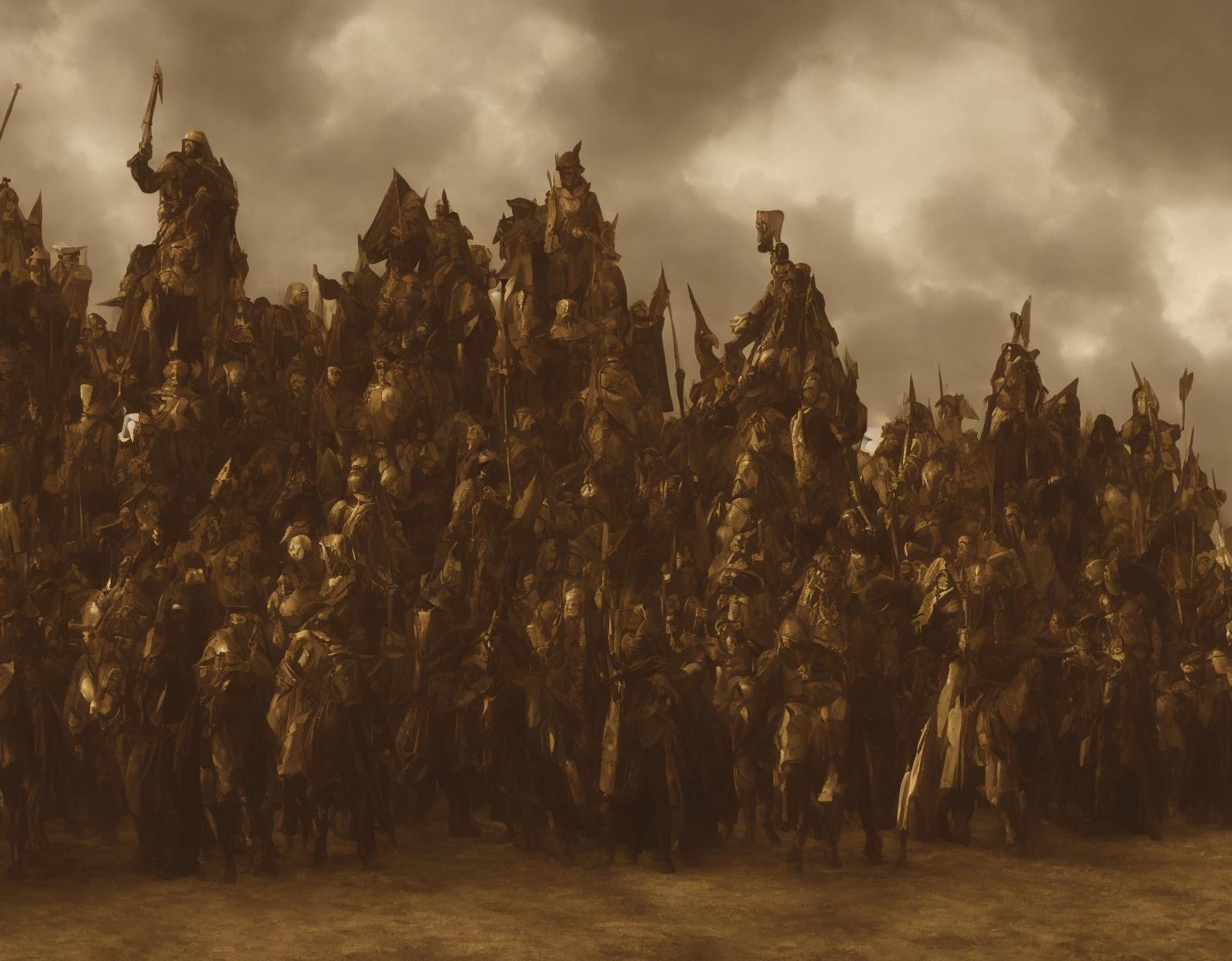
The Knights Hospitaller: Guardians, Healers, and the Secrets of Rhodes and Malta
Intro
The story of the Knights Hospitaller reads like a chronicle stitched from medicine, steel and shadow. Born as a humble refuge for pilgrims in the fraught streets of Jerusalem, the brotherhood that became the Order of Knights of St John quietly transformed into one of medieval Christendom's most formidable military and hospitaller powers. Across centuries they would sustain hospitals, fortify islands, command fleets, and negotiate with emperors and sultans; they kept one foot in piety and the other firmly planted in politics. Their history is attractive to the imagination because it resists a single explanation: were they devoted healers who took up arms out of necessity, or warriors who masked ambition with a halting vow of care? The truth, as it often is in history, was a mixture of both.
From the narrow alleys of Jerusalem to the rocky ramparts of Rhodes and the baroque bastions of Valletta, the Knights left a tangible imprint on the Mediterranean. Their emblem — the eight-pointed Maltese cross — endures in churches, hospitals and civic insignia as a badge of identity and memory. Yet beneath such symbols lie stories of daring sieges, diplomatic maneuvering, technological adaptation and the bold determination of leaders who guided the Order through cataclysmic shifts: the fall of the Crusader states, the rise of Ottoman sea power, and finally the Age of Revolution which expelled them from Malta in 1798.
Did you know? The papal bull Pie Postulatio Voluntatis (1113) granted the Hospitallers independence and the right to receive donations across Christendom, an essential legal foundation for their later sovereignty.
This article traces that long arc. It will follow the Hospitallers from their origins as caregivers in Jerusalem, through their militarization in the twelfth century, their conquest of Rhodes and subsequent centuries as a sovereign maritime order, and their dramatic rebirth in Malta and reinvention after exile. Along the way we will examine their internal structure, medical innovations, and the persistent mystery that surrounds their simultaneous roles as monks, knights and rulers. Expect precise dates and verifiable episodes, but also a narrative tone that invites the reader to feel the creak of ship timbers in a night crossing, the groan of a siege engine against stone, and the hush of a hospital ward where healers walked among the dying.
Origins: The Hospital in Jerusalem and the Making of an Order
The nucleus of the Knights Hospitaller was neither battlefield nor throne but a hospital. In Jerusalem, long before the Order wore the white cross that later became so recognizable, a charitable institution cared for sick and injured pilgrims who arrived in the city that was both a destination for faith and a perilous borderland. The exact origins are anchored to the late eleventh and early twelfth centuries, when pilgrims from Western Europe moved in greater numbers to the Holy Land. A figure traditionally credited with establishing the first organized hospice is Gerard (often called Blessed Gerard or Gerard Tenque), a layman whose work to shelter and treat pilgrims became the seed for a wider corporate identity.
Crucial in the transition from hospice to order was formal recognition. In 1113 Pope Paschal II confirmed the possessions and rights of the hospital with the papal bull Pie Postulatio Voluntatis, giving the community an autonomy that allowed it to collect resources across Christendom and protect its work from local interference. This papal imprimatur did not immediately make the brothers a military force; instead it established legal authority, property rights and a spiritual charter. Over the next century, however, the geopolitical environment of the Latin East — marked by intermittent warfare and the centrality of pilgrimage routes — compelled the Hospitallers to assume defensive responsibilities. They built hospitals that were also fortified refuges, and men whose earliest duty was to care for the sick acquired arms to protect them and the pilgrims they served.
Did you know? The Order was organized into “langues” (tongues) based on regional origin; these divisions helped structure recruitment, finance and cultural identity across Europe.
This gradual shift from pure hospitality to armed guardianship was not an abrupt betrayal of purpose but rather an adaptive strategy. In a region where routes could be raided and hospitals threatened by conflict, the presence of disciplined and armed brothers offered protection to the infirm and to the institution’s economic base. Important administrative reforms under early leaders like Raymond du Puy, who served as Grand Master around the mid-twelfth century, formalized military functions. The Order developed a clear division of labor among its members: knights (professed brothers who took vows of poverty, chastity and obedience and who were trained for combat), chaplains (priests charged with the spiritual life), and sergeants or brothers-in-arms of lower social status who performed menial and military duties. This structure allowed the Hospital to maintain the twin charters of care and defense without sacrificing its original mission.
The Hospitallers kept meticulous records of their possessions and privileges across Europe and the Levant, creating a transnational web of commanderies that funded their work. These European dependencies—houses in Italy, France, Spain, England and beyond—sent revenues to Jerusalem and, later, to Rhodes and Malta. The Order thus became a proto-state with economic reach, administrative sophistication and a moral legitimacy grounded in its medical work. It is worth remembering that the public image of the Hospitallers as purely martial knights is a later emphasis; in their origin story their primary identity was that of caregivers who, under the pressure of circumstance, learned to wield the sword as well as the scalpel.

Becoming a Military Order: Vows, Organization, and the Languages of Power
As the twelfth and thirteenth centuries unfolded, the Hospitallers' evolution into a military order crystallized. Military orders were hybrid institutions: monks or religious knights who combined spiritual life with military discipline. The Hospitallers resembled their better-known cousins, the Knights Templar, in some structural ways but maintained their distinct emphasis on medical care. Military organization was reflected both in battlefield behavior and in the order’s internal governance. The supreme head was the Grand Master, elected for life by the chapter, who combined spiritual authority with executive power. Beneath him the Council of the Order oversaw justice, finance, military operations and diplomatic relations. The Order was divided into “langues” or tongues—geographic-linguistic divisions such as Provence, France, Italy, England, Aragon, Germany, and Auvergne—which collected revenue and recruited members in their territories and sent knights to the central command.
Did you know? After the 1522 siege, the Hospitallers were allowed by the Ottomans to evacuate Rhodes with their arms—a rare negotiated exit that preserved the Order’s continuity.
Knighthood in the Hospitallers involved vows similar to those of monastic life: poverty, chastity and obedience. Yet the knights were also trained for combat, mounted warfare, and long naval engagements. The Order’s adaptation to naval warfare would be decisive for its survival after the fall of mainland Crusader states. The Hospitallers operated galleys, engaged in privateering and convoy protection, and fought in fleet actions across the eastern Mediterranean. Their maritime presence was not solely martial; it protected the lifelines of pilgrims and the movement of trade. The Order's strategic flexibility—moving between hospital administration, castle defense and naval raiding—made it a resilient actor in a volatile region.
Financially, the Hospitallers succeeded by creating an efficient system of commanderies across Europe. These local houses functioned as recruitment centers, treasuries and political nodes. They contributed taxes and recruits and provided political cover in their homelands. The economic base enabled significant architectural programs: hospitals, churches, fortifications, and arsenals. The Order developed its own iconography and administrative paraphernalia—seals, banners and legal documents—that reinforced cohesion and projected sovereignty.
But the nature of their power was ambiguous: were they servants of Christendom or princely rulers in their own right? As the Hospitallers accrued territory, particularly after their conquest of Rhodes and later governance of Malta, they exercised taxation, diplomatic negotiation and warfare in ways indistinguishable from secular lords. Yet they retained a religious ethos that legitimized their rule in the eyes of many of their contemporaries. This tension—between monastic humility and princely authority—remains one of the Order's enduring paradoxes.
Did you know? Jean Parisot de Valette, who led the defense during the Great Siege of 1565, later lent his name to Valletta, the fortified city founded as the Order’s new capital.

Rhodes: Conquest, Statecraft, and the Art of Siegecraft
The conquest of Rhodes and the island period that followed (roughly 1309/1310–1522) represent the most audacious chapter of Hospitaller statecraft. Driven from the Levant by the collapse of Crusader principalities and ever-encroaching Muslim powers, the Hospitallers sought a territorial base from which to continue their mission. Rhodes, strategically located at the crossroads of eastern Mediterranean shipping lanes, provided both a defensible position and a platform for naval operations.
The campaign to take Rhodes began in 1306, and by 1310 the knights had established firm control over the island, ejecting local Byzantine authorities and creating a capital at the city of Rhodes. Over two centuries the Order transformed Rhodes into a fortified maritime state with concentric walls, bastions, harbors and a thriving economy based on trade, shipbuilding and the revenues sent from European commanderies. The Hospitallers invested deeply in military architecture. They modernized fortifications, anticipating artillery and gunpowder developments, and maintained a permanent garrison of knights, sergeants and mercenaries. The urban fabric of Rhodes reflected a mélange of medieval, Byzantine and Western influences; churches, hospitals and palatial residences testified to the Order's dual role as both ruler and patron.
Rhodes’ strategic position also made it a target. In 1480 Ottoman forces under Mehmed II’s successors attempted to take Rhodes but failed. More consequential was the massive campaign of 1522 launched by Suleiman the Magnificent. The siege of Rhodes in 1522 tested the limits of the island’s defenses and the resilience of the Hospitallers. The Grand Master at the time, Philippe Villiers de L'Isle-Adam, directed a defense characterized by tenacity and tactical skill but ultimately faced an overwhelming and relentless Ottoman war machine. After months of brutal fighting, superior Ottoman numbers and resources compelled negotiations. The Hospitallers negotiated terms that permitted an honorable evacuation; they were allowed to withdraw with their arms and personal property and to resettle elsewhere—an outcome that preserved the Order’s corporate identity despite the loss of their island state.
Did you know? Napoleon’s 1798 capture of Malta prompted the expulsion of the Knights from their sovereign base; many of the Order’s treasures were taken by the French expedition.
The fall of Rhodes in 1522 was less an annihilation than a forced migration. The knights carried with them both the experience of state administration and an appetite for a new territorial base. Their subsequent acquisition of Malta and other islands in 1530 underlines how the Hospitallers used diplomacy—particularly with Charles V and the Spanish crown—to secure a new home in exchange for promises of naval service against the Ottomans. Rhodes left an architectural and cultural legacy of its own; the medieval city, with its walls and the Street of the Knights, remains a powerful reminder of the Order’s capacity to reshape a landscape according to its needs and ideals.

Malta: The Great Siege, Naval Power, and the Making of Valletta
The Hospitallers’ tenure in Malta (1530–1798) is often the period most vividly associated with the Knights. Granted the islands of Malta and Gozo and the North African port of Tripoli by Emperor Charles V as a fief in 1530, the Order transformed the archipelago into a fortified base from which to contest Ottoman naval expansion. Malta’s significance was not simply geographic; it became the crucible in which the Hospitallers’ maritime strategy, architectural ambition and symbolic identity coalesced.
Central to this era is the Great Siege of Malta in 1565. Ottoman forces launched a determined effort to take the islands, believing that Malta’s capture would provide a new launching ground for incursions into the Western Mediterranean. The defense, led by Grand Master Jean Parisot de Valette, became legendary. With a comparatively small force of knights, soldiers and Maltese militia, the defenders resisted an overwhelming Ottoman army for months. Key aspects of the defense included the staunch defense of Fort St. Elmo, the utilization of coastal fortresses, and the mobilization of local resources. The siege’s attrition and the timely arrival of a relief force from Spain and Sicily turned the tide. The victory reverberated across Europe as proof that a determined, well-fortified island could resist imperial pressure.
Did you know? The Maltese cross’s eight points have been interpreted in multiple ways, including as representing the eight beatitudes or the eight tongues of the Order.
Valette’s triumph had practical and symbolic consequences. The Order embarked on an ambitious program of fortification and urban planning, founding the city of Valletta on the peninsula across the Grand Harbour and building harbors, hospitals and fortresses to modern standards. Valletta, with its grid layout and massive bastions, became both a living symbol of the Order's resilience and a functioning maritime and military hub. The Hospitallers continued to develop their navy, maintaining galleys and later adopting ships of the line and smaller frigates to patrol Mediterranean waters, intercept corsairs, and escort convoys.
Culturally, Malta under the Order became a melting pot of European artistic and architectural currents. The headquarters of the Order were endowed with churches, auberges (lodgings for knights of different langues), hospitals and charitable institutions. Baroque art and architecture flourished under the Order’s patronage. The Order’s administrative apparatus also matured: the Grand Master effectively ruled as a prince, issuing laws, levying taxes and conducting foreign policy. Yet the Order retained its hospitaller roots, maintaining medical institutions that treated soldiers and civilians alike, reflecting the dual identity of healer and warrior.

Decline, Capture by Napoleon, and the Reinvention of Sovereignty
The long centuries on Malta did not render the Hospitallers immune to the tectonic shifts of early modern politics. By the late eighteenth century the Order’s military edge had dulled: changing naval technologies, the professionalization of European navies and the shifting strategic priorities of patron monarchs meant that the Order’s fleet and revenue streams were less decisive than they had been. Internal weaknesses—financial pressures, disputes among the langues, and an aging aristocratic membership—further eroded effectiveness.
Did you know? After being expelled from Malta, the Knights preserved their institutional identity and later re-emerged as a diplomatic and humanitarian body recognized by modern states.
The decisive blow came from an unexpected quarter: the French Revolution and the military genius of Napoleon Bonaparte. In 1798, en route to Egypt, Napoleon sought a friendly base in the central Mediterranean and coerced the Hospitaller Grand Master Ferdinand von Hompesch into surrender. The French occupation was brief but consequential: Napoleon's forces expelled the knights from Malta, seizing their treasury and valuable collections. The loss of Malta severed the Order from its territorial base and sent its members into exile.
Yet the story did not end in ignominy. Surviving members maintained the Order’s institutional memory. In the nineteenth century, under pressure from European governments and monarchs, the Order reconstituted itself in a different form. It retained a Grand Master and corporate structures but concentrated more on humanitarian works than on territorial rule. The modern Sovereign Military Hospitaller Order of St John of Jerusalem of Rhodes and of Malta (commonly the Sovereign Military Order of Malta, SMOM) established a headquarters and diplomatic presence in Rome and obtained extraterritorial properties. The SMOM today is recognized as a sovereign subject of international law in a limited sense: it issues passports, maintains diplomatic relations with many countries, and holds permanent observer status at the United Nations, while focusing on medical and humanitarian relief worldwide.
This reinvention turned a displaced medieval order into a modern humanitarian actor. The continuity is real but transformed: the ancient vows and ceremonial pageantry remain for many members, but the practical focus is global health care, disaster relief and the operation of medical institutions. The Order’s archives, museums and remaining properties preserve a material record of a long and complicated history that spans crusading piety, naval warfare and diplomatic reinvention.

Enduring Legacy: Medicine, Symbols, and the Mysteries That Linger
What endures of the Knights Hospitaller is a layered legacy. On the one hand, there is a clear lineage of medical practice: the early hospitals in Jerusalem and later institutions in Rhodes and Malta were advanced for their day. They implemented organizational methods for patient care, surgical techniques and record-keeping that influenced the broader history of medicine. The Order’s concern with the sick and wounded seeded institutions that survive in spirit to the present day—connected variously to the Order of St John and St John Ambulance organizations that arose in the nineteenth century, as well as to modern hospital foundations and charitable initiatives linked to the SMOM.
On the other hand, the Hospitallers shaped the built environment. Fortifications on Rhodes and Malta remain among the best-preserved examples of late medieval and early modern military architecture. Valletta’s city plan, bastions and churches embody an urbanism that is both defensive and civic, a testament to the Order’s ability to blend martial necessity with cultural patronage. The Order’s patronage of the arts produced architectural masterpieces, paintings and liturgical objects that survive in museums across Europe.
Symbolically, the Maltese cross has entered the visual language of heroism, medical care and chivalry. Its eight points have been variously interpreted—the eight beatitudes, the eight obligations of the knights, or the eight tongues of the Order—yet whatever the explanation, the emblem’s persistence testifies to the Order’s deep cultural imprint.
Finally, the Hospitallers remain an object of historical fascination and speculative imagination. Their archives offer serious scholars rich sources for study, but legends—hidden treasures, secret courts, and whispered rivalries—persist in popular imagination. Part of the reason is the duality at the Order’s heart: they were monastics and warriors, caregivers and rulers, sovereigns without a nation and international actors before the word existed. That combination invites both rigorous analysis and romantic conjecture.

The Knights Hospitaller endured because they were adaptable. From a hospital in Jerusalem to a maritime power on Rhodes and a fortified kingdom on Malta, they navigated epochs of religious fervor, imperial rivalry and revolutionary upheaval. Their transformation from caregivers into warrior-administrators—and later into a global humanitarian order—illustrates how institutions can survive by reshaping their identity in response to changing political and technological realities. Their history also complicates modern binaries: the Hospitallers were neither purely saintly nor wholly secular; they were a religious order that embraced statecraft, a military power that sustained hospitals.
Their material legacy—walls, churches, hospitals, archives and emblems—continues to speak. Visiting the medieval streets of Rhodes or the bastions of Valletta confronts one with a past that was practical, pious and at times brutal. The Order’s modern incarnation, active in disaster relief and medical care, shows how ancient institutions can find new purposes when stripped of territorial sovereignty. Yet even as the SMOM operates ambulances and clinics, the ghost of the medieval knight lingers: in the cross, in the ceremonial robes, in the names and titles that connect present to past.
History often prefers tidy categories, but the Hospitallers refuse neat encapsulation. Their story is a narrative of paradox: monk and soldier, healer and ruler, exile and survivor. That paradox is their mystery and their appeal. To study the Hospitallers is to stand at the crossroads of faith and force, where compassion sometimes required the sword and order often arose from the brink of chaos. It is a reminder that institutions can embody conflicting aims and still endure—provided they are willing to be remade by the demands of their age.
How we verify this article
By the History Unlocked editorial team
This text is built on historical facts stored in our database and drafted with AI assistance. No signed human review is recorded for this article. Report any inaccuracy: we correct it and update the modified date.
Updated on
AI-assisted drafting.
Read our editorial standardsEnjoyed this? Discover more articles in the category Knights Templar