
When Paris Took Versailles: The Women's March of 1789
The October air in 1789 carried a weight that had nothing to do with weather: it was the heavy pressure of hunger, rumor, and a public will that had been building for months. Bread, the staple of everyday life for most Parisians, had become the index of political stability. When loaves grew scarce and the price of flour soared, what had begun as fiscal crisis and political paralysis at Versailles turned into a crowd with a mission. The March on Versailles — often called the Women's March — has been retold as both a spontaneous seizure of power by market women and as a momentary, chaotic episode that reshaped the monarchy. Each telling carries part of the truth. The reality of October 5–6, 1789 is both more mundane and more mysterious: an event forged in routine grievances and sudden rumor, propelled by a unique coalition of women, revolutionaries, and armed citizens, and sealed by the reluctant consent of a king who would never again rule from the heights of Versailles.
This introduction is not a dry summary but a call to walk the crooked passageways of the story: the markets where women organized their grievances, the road to Versailles where a crowd hardened into force, the palace where doors that had always been closed to commoners were yanked open. We'll trace the trajectory from hunger to politics, examine the fog of false stories — most famously the apocryphal "Let them eat cake" — and probe how the march changed both immediate policy and the symbolic geography of French monarchy. We will also look at the human actors whose names we remember and those who remain anonymous: the mayor who negotiated, the general who escorted, and the thousands of women whose everyday chores became a political act.
The narrative that follows aims to keep one tension at its center: this was an act lodged between desperation and design. Some participants arrived with pikes and pistols; others with baskets and children. Some sought bread; others sought the king. Together they entered a palace that had long seemed unreachable. The consequences were immediate: the royal family returned to Paris, the Assembly relocated under pressure, and the monarchy suffered an irreversible shift in status. The March on Versailles, therefore, stands as a moment where the private life of hunger collided with the public life of politics, creating a new order that was in many ways both theatrical and irrevocable.
Did you know? Several contemporary accounts insist that the phrase "Let them eat cake" was already circulating in pamphlets and rumor before it was ever attached to Marie-Antoinette.
Setting the Stage: Hunger, Finance, and the Fractured Ancien Régime
By the autumn of 1789 France had endured a year of extraordinary strain. The calling of the Estates-General in May had promised renewal but produced instead a dizzying transfer of legitimacy to the National Assembly, along with the Great Fear that surged through the countryside in July and August. Networks of rumor and panic had already shown how quickly local crises could become national convulsions. Against this turbulent background, the most immediate, concrete pressure on Parisian life was bread. Years of poor harvests contributed to rising grain prices, while a complicated system of taxation and hoarded supplies left markets fragile. Parisians kept track of weight and price: when bread became unaffordable, politics stopped being an abstract debate and became daily survival.
Food scarcity cannot fully explain why the march hit when it did. Political theatre and information flows mattered enormously. The revolution had produced new public spaces: assemblies in the churches, expanded pamphlet and newspaper circulations, and the now-familiar tactic of petitions and public meetings. Urban militancy had also grown: the storming of the Bastille in July 1789 had both inspired and changed the vocabulary of popular action. The creation of the National Guard and the ascent of figures like Jean-Sylvain Bailly in Parisian municipal life meant that popular protest now had a potential interface with institutions that did not exist before the summer.
Rumor played an outsized role in October. Stories spread that aristocratic hoarders had conspired to starve Paris and that the queen — Marie-Antoinette — personally mocked the poor. The famous phrase popularly attributed to her, "Let them eat cake," has no contemporary source linking it to her and was almost certainly a later invention or misattribution. Yet rumors, whether true or false, were often as effective as reality in moving crowds. The Paris markets, especially Les Halles and the dense neighborhoods of the Faubourg Saint-Antoine, were hotbeds of conversation and complaint. Women, who managed food procurement for households, were uniquely situated to sense the severity of shortages and act. When obdurate court politics at Versailles failed to address these grievances, the path from market to palace suddenly seemed less improbable.
Did you know? Contemporary registers list reinforcements from Paris neighborhoods; among the groups were employees of the municipal bakeries who brought evidence of misdistribution of grain to Versailles.
Economic hardship, then, was compressed into a political moment by rumor and by infrastructural change: printed news, municipal authority, and an armed citizenry. The march that began in early October 1789 must be seen not as an eruption in a vacuum but as the product of these converging forces. A mood of indignation had acquired channels and instruments; the question was whether it would stay within the city or force its way to the royal door.
From Markets to March: How the Crowd Assembled and Moved
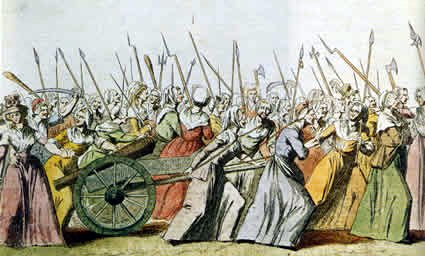
On the morning of October 5, 1789, the march did not begin as a single, rehearsed column but rather as a constellation of groups fastened together by a common objective. Women from the markets of Paris — Les Halles, the boulevards, and neighborhoods like the Faubourg Poissonnière and Faubourg Saint-Antoine — organized spontaneously and through pre-existing networks of domestic labor. They conversed in the marketplaces, where bread, flour, and information changed hands in equal measure. Estimates of how many set out for Versailles vary: contemporary observers and later historians put numbers anywhere from a few thousand to perhaps six or seven thousand. Exact counting is impossible, but what matters historically is the composition and intensity of the crowd: mainly market women, but also a significant number of men, artisans, National Guardsmen, and political militants who joined along the route.
The decision to march was shaped by immediate logistics and by dramatic rumors. Some of the marchers believed that the king had refused to sanction grain distributions. Others had heard that soldiers stationed near Versailles were preparing to fire on Paris. There was a political urgency as well: many demonstrators wanted to bring the king and the National Assembly into the same public theater where they could be held accountable. In short, bringing Louis XVI to Paris was both a practical demand (to secure grain) and a symbolic demand (to end the separation between an aloof monarchy and a politicized populace).
Did you know? Reports from contemporaries recorded that some women forcibly entered the apartments of the royal household and demanded access to royal food stores; at least some flour and grain were seized.
The route from Paris to Versailles is not long — about 12 kilometers — but the marcher's journey took on an epic quality. Along the road they gathered sympathy, supplies, and reinforcement. Pamphleteers and orators urged them on; local municipal officials in Paris watched and tried to coordinate the response. One of the most important emergent roles was played by the Parisian National Guard, whose presence could lend legitimacy and control. Jean-Sylvain Bailly, the mayor of Paris, and the Marquis de Lafayette, who had become commander of the National Guard, were key figures in the unfolding day: bailly represented municipal negotiation while Lafayette, a veteran of the American Revolution, embodied the new armed citizenry's capacity to act.
Violence flared at certain points. The crowd encountered royal hunting lodges and gates, and there were confrontations with cavalry detachments. At the entrance to Versailles, resistance from the royal bodyguard and certain cavalry units produced casualties. Contemporary testimony speaks of confusion and sporadic bloodshed: some guard officers and a few demonstrators were killed. The mood inside the caravan of protesters shifted from focused complaint to a sense of purpose and, at times, vengeance. Notably, many women insisted on entering spaces of the palace that had long been closed to commoners: kitchens, storerooms, and even the Queen's apartments. Their search was not merely curiosity but a practical attempt to find bread and to make the royal household confront the suffering beyond the palace walls.

Confrontation at Versailles: Chaos, Theatricality, and Real Consequences
Versailles, for the marchers, was a theatrical stage framed by chandeliers and gilt. The palace had been built for absolutism's grandeur, but on October 5 it became a site of popular intrusion. The halls that had once hosted courtly life were flooded by people whose daily concerns were the price and availability of bread. Entry into the palace was not uniformly violent; it combined forceful entries with negotiation. Yet the presence of armed and angry crowds transformed what might have been a petition into an occupation.
Did you know? The king’s move to the Tuileries placed him closer to the National Assembly and to Parisian public life, but did not mean immediate submission; Louis XVI continued to resist policies that curtailed traditional royal prerogatives.
Inside Versailles, the National Assembly — which had been meeting in the vast salons and halls — faced a crisis. Deputies, some alarmed and others sympathetic, found themselves in the presence of an agitated public determined to be heard. The king, Louis XVI, initially resisted the idea of leaving his palace. Reports from those days emphasize both his bewilderment and his tactical caution: he recognized that absolute refusal to respond to the crowd could spark wider rebellion, but capitulation would signify a profound loss of status.
One particular sequence of events became emblematic of the march's drama: a detachment of the royal bodyguard was attacked, a few were killed, and some of their heads were displayed on pikes as a warning. While such images are often amplified in later retellings, there is no question that the crowd's violence made the presence of the king in Versailles untenable. The queen, Marie-Antoinette, confronted the crowd and later became the principal scapegoat for aristocratic intransigence. Whether she uttered contemptuous words about the poor, she definitely represented for many a symbol of royal detachment and extravagance.
In the immediate aftermath of the confrontation, two practical outcomes unfolded. First, the king, persuaded or forced, agreed to return to Paris. His decision to move his residence from Versailles to the Tuileries Palace in Paris on October 6 was a seismic change: the king's person would now be under the gaze of a politicized urban populace. Second, the National Assembly also relocated, coming to sit in Paris alongside the king, a close proximity that transformed the dynamics of legislative power. These changes were not merely spatial; they reconfigured political relationships and diminished the mystique of a monarchy that had once seemed unassailable.
Did you know? Later 19th-century painters and lithographers often dramatized the scene of women in the Queen's chamber, but many of these scenes were recreations influenced by political agendas rather than eyewitness accuracy.
The King's Move to Paris and the Political Reverberations
When Louis XVI left Versailles and entered Paris on October 6, 1789, he did not return to a palace of untroubled authority. The journey back to the capital was a staged escort, with the king flanked by the National Guard and watched by the crowds that had brought him back. The move had immediate political consequences: by resettling the royal family in the Tuileries Palace, the monarch was transformed from a distant sovereign into a quasi-prisoner of public opinion. He remained the head of state in form, but his freedom of action contracted drastically under the ever-watchful eyes of Parisians.
Practical governance was affected quickly. The presence of the king in Paris made it possible for the National Assembly's measures to be supervised more closely; ministers and courtiers who preferred distance found themselves confronted with daily public scrutiny. Politically, the move catalyzed factions: moderates who had supported constitutional monarchy now had to accept that the king could be publicly humiliated; radicals saw the new proximity as an opportunity to push for deeper changes. Internationally, the spectacle of a sovereign escorted by a crowd made European courts uneasy and foreshadowed diplomatic consequences that would come as revolutionary France challenged the old order.
The march's legal and administrative aftershocks included a strengthened municipal role for Paris and a more assertive National Guard. Governance at a local level gained new legitimacy as Parisian officials and soldiers demonstrated their capacity to organize large-scale actions. Lafayette's role, in particular, became complicated: once a hero of reform and of the American War of Independence, his task in October 1789 was to mediate between an enraged populace and an endangered monarchy. He helped to secure the king's safety on the road to Paris, but his balancing act would later put him at odds with more radical elements.
Did you know? Some contemporaries recorded that ordinary household objects — wooden spoons, kitchen knives — became tools and symbols of the women's practical power during the march.
In a deeper sense, the March on Versailles demonstrated that the locus of political legitimacy had shifted. The king's distance from Paris had been a central pillar of the ancien régime; by drawing him into the capital, the demonstrators and their allies made political life less ceremonial and more confrontational. Future episodes — from the radical phases of 1792–1793 to the Reign of Terror — would build on the precedent that public pressure could decisively alter royal policy.
Women, Myth, and Memory: How the March Has Been Told and Retold
The Women’s March on Versailles occupies a peculiar place in memory because it sits at the intersection of gender, politics, and myth. Women were at the center of the action, and their participation challenged conventional ideas about public political roles. That said, it is important to avoid simplified portraits: the march included women who acted independently and women who operated alongside men; it featured both the exercise of maternal responsibility — securing bread for children and households — and a political assertiveness that reshaped the course of the revolution.
In subsequent decades, the story of the march has been reinterpreted and repurposed by different political actors. Early revolutionary leaders sometimes lionized the market women as models of civic virtue; later historians, particularly in the 19th century, dramatized the event in romantic and nationalist terms. The trope of the hungry woman becoming a political actor fed into broader narratives about the Revolution's social base and moral character. Artistic representations — engravings, sketches, and painted scenes created after the fact — often emphasize dramatic moments: the display of pikes, women in the Queen's apartment, or the king's humbled return. These images, useful for political theater, sometimes simplified the complicated motives of participants.
Did you know? After October 1789, the royal family’s life at the Tuileries was heavily monitored; the move signaled an end to the court's isolation and foreshadowed future legal constraints on monarchy.
Modern historiography has worked to disentangle myth from evidence. Scholars have scrutinized sources, compared municipal rolls, and examined newspaper reports to reconstruct plausible sequences of events. This work has tended to highlight two things: first, that women’s sustained involvement in political action during 1789 was real and significant; second, that the march’s tactical success owed as much to a confluence of political actors — municipal officials, parts of the National Guard, and revolutionary militants — as it did to market women alone. In other words, the march was both a feminine assertiveness and a broader popular-insurgent coalition.
The myth-making around the march also reveals much about subsequent politics. During the 19th century, as regimes and ideologies shifted from monarchy to republic and back again, memory of the march was invoked to endorse very different political programs. Republics praised its popular legitimacy; conservatives denounced what they saw as mob rule. Feminist historians in the 20th and 21st centuries have reclaimed the march as evidence of women's political agency and as a precursor to later forms of organized female activism.

Conclusion: The Long Shadow of October 1789
The March on Versailles remains a story with many faces: a desperate search for bread, a political act that reshaped the geography of power, a scene of violence, and a crucible for future memory. In one dramatic weekend — October 5–6, 1789 — a crowd moved the monarchy out of its symbolic citadel and into the arena of daily Parisian life. That relocation did not end monarchy overnight, nor did it create a stable new order; rather, it set into motion a series of transformations that made politics more immediate, public, and, at times, perilous.
Did you know? The National Guard's involvement under Lafayette complicated his political standing: he was hailed for protecting the king yet later mistrusted by radicals who sought bolder measures.
The march's lasting importance lies in its demonstration that ordinary people's choices — especially those of women who managed households and markets — could force national institutions to respond. For the royal family, October 1789 marked the beginning of a new reality: proximity to a politicized populace, constrained mobility, and a diminishing aura of unassailability. For the revolution, the event signaled that political power would not only be contested in halls of legislation but also on the streets and in the marketplaces.
Historians will continue to debate the balance of contingency and design in the march. Was it a spontaneous surge rooted in hunger or a calculated move by revolutionary organizers? The best answer is that it was both: rooted in real and immediate grievances, composed of diverse actors and motives, and guided at moments by political calculation. Its drama — the image of commoners invading a palace — tells us something essential about the Revolution: that it was at once theatrical and terrifying, a clash of interests performed on monumental stages.
In remembering the Women's March on Versailles we must keep hold of its complexity. We should honor the courage of those who dared to approach the gates of power and recognize that their action emerged from the textured realities of daily life. The march is both a cautionary tale about the dangers of ignoring subsistence concerns and a testament to the transformative power of collective action. As long as hunger, rumor, and political asymmetry coexist, the kind of upheaval that sent Parisian crowds to Versailles will remain a vivid reminder that politics can be forced to the doorstep of the powerful — and that when it is, the world often changes irreversibly.
Did you know? Municipal records from Paris neighborhoods show that women who participated in October 1789 later remained active in political clubs and neighborhood administration.

How we verify this article
By the History Unlocked editorial team
This text is built on historical facts stored in our database and drafted with AI assistance. No signed human review is recorded for this article. Report any inaccuracy: we correct it and update the modified date.
Updated on
AI-assisted drafting.
Read our editorial standardsEnjoyed this? Discover more articles in the category Great Revolutions