The Fall of Constantinople: Siege, Gunpowder and the End of Byzantium
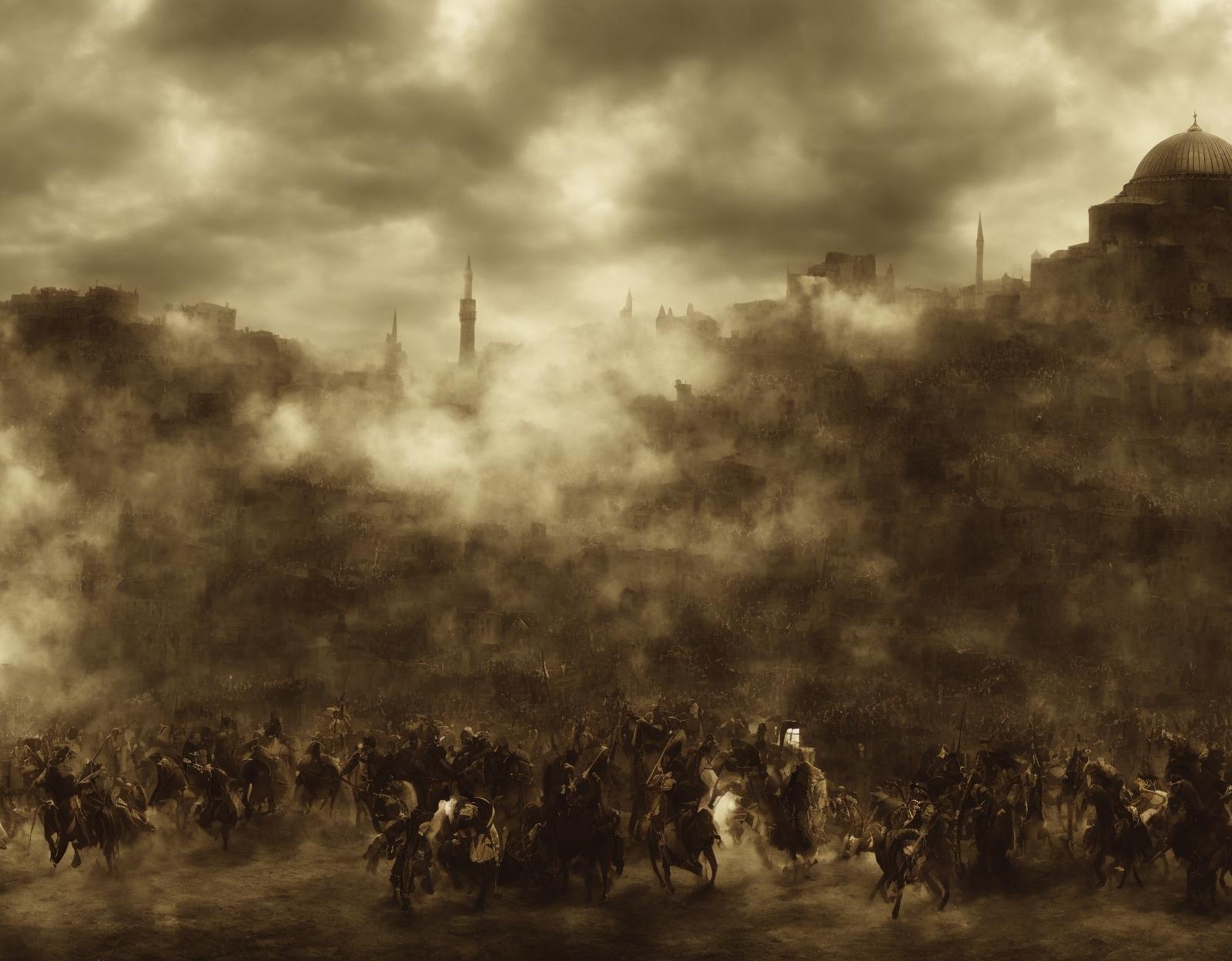
The sun rose over a city that had outlived empires, stood at the crossroads of continents and histories, and bore the scars of siege and salvation for more than a thousand years. By April 1453, Constantinople was a city of ancient memory and precarious survival. Its battered Theodosian Walls still proclaimed the architectural genius of late antiquity; its harbor, the Golden Horn, remained a jewel of strategic and mercantile value. Yet the winding lanes and domes of Hagia Sophia now observed a world that had changed: gunpowder, centralized states, and an ambitious Anatolian prince had combined to threaten what remained of the Roman imperial idea in the east.
Narrative history often hinges on moments that feel inevitable in hindsight. The Fall of Constantinople carries that sense of finality: the end of the Byzantine Empire, a bridge between the medieval Mediterranean and the ascendant Ottomans, and an event that reshaped European consciousness. But the story is not merely a list of dates. It is a study in logistics, diplomacy, technology and human drama. It is about a twenty-one-year-old sultan named Mehmed who had prepared for years; about a handful of defenders, foreign mercenaries and local citizens determined to hold an ancient city against overwhelming force; about machines of iron and the slow, thunderous barrage of cannons; and about choices — some forged in desperation — that would echo for centuries.
From the battering of massive bombards to the sudden audacity of moving ships across hills to enter a protected harbor, the siege of 1453 displayed both continuity and rupture. The Byzantine defenders relied upon venerable fortifications and the courage of leaders like Constantine XI Palaiologos and the Genoese captain Giovanni Giustiniani Longo. The Ottomans, under Mehmed II, marshalled not only numbers but administrative capacity, engineering skill, and a willingness to employ new technologies and tactics. The interplay of these elements produced a siege of almost six weeks, a final assault on the dawn of May 29, and a transformation whose aftershocks extended across Europe and into the intellectual life of the Renaissance.
Did you know? The iron chain across the Golden Horn had been used repeatedly in earlier sieges and was a famous symbol of the city's maritime defense.
This article examines the city and its walls, the Ottoman preparations, the course of the siege, the dramatic last assault, and the far-reaching consequences that followed. It also weighs the myths and memories that have clung to the fall — the ‘Marble Emperor’ legend, contested numbers and claims, and the ways later generations have interpreted this closing of an imperial chapter. Throughout, we will return to primary anchors of fact: contemporary chronicles, diplomatic reports, and later historiography. The result is not only a chronology but an effort to trace the texture of events, the experiences of people trapped between empires, and the broader currents that made 1453 such an echoing hinge in history.
The City and Its Walls
Constantinople had been fortified and refortified since Constantine the Great refounded Byzantium in 330. Yet the defensive system that dominated the medieval imagination and made the city so difficult to conquer was the Theodosian Walls, constructed in the fifth century under Emperor Theodosius II. This multilayered defense consisted of a double line of formidable stone walls some 6.5 kilometers long on the landward side, punctuated by towers, ditches and outworks designed to absorb and repel attackers. On the seaward side, the city enjoyed the natural protection of the Bosphorus and the Golden Horn, its deep harbor where fleets could moor behind a massive iron chain strung across the mouth to deny enemy ships entry.
By 1453 the Theodosian fortifications were still impressive, though maintenance had been difficult for a state in demographic and economic decline. Narrow streets crowded with inhabitants, churches and markets lay within those walls, but the available garrison was a fraction of what the defenses might have required. Byzantium’s imperial reach had shrunk to the city itself and scattered outposts, and the treasury was meager. Still, a well-built wall is an economical and effective weapon when held by determined defenders, and the walls had proven resilient for centuries against sieges. They were not invulnerable: sustained artillery fire, undermining, and concerted assaults could exploit weaknesses in manpower and supplies.
Did you know? Mehmed II was only 21 years old at the time of Constantinople’s fall, yet had prepared for the siege with years of planning and state mobilization.
The Golden Horn’s chain, anchored at the massive sea walls, was a key element of the city’s maritime defense. It prevented Ottoman galleys from easily entering and attacking the harbor; the chain’s presence forced an attacker to attempt risky circumnavigations or find inventive solutions. The defenders complemented these static measures with active measures — sorties, naval raids from the Venetian and Genoese ships present, and skilled gunners and engineers who repaired breaches and maintained morale. One figure who personified this fragile balance was Giovanni Giustiniani Longo, a Genoese captain who arrived with a group of mercenaries and took command of the critical landward defenses. Giustiniani’s leadership and personal courage during the siege were repeatedly praised in contemporary accounts; his presence allowed the defenders to concentrate forces and respond quickly to Ottoman attacks along the walls.
Yet the walls’ very strength concealed structural weaknesses: the city's reduced population limited the pool of defenders, stores of ammunition and provisions were dwindling, and the Byzantine political apparatus could not summon the reinforcements that earlier centuries might have provided. Moreover, blockading the city and reducing it by bombardment became a more plausible strategy with the emergence of large siege cannons. The psychological effect of sustained, thunderous bombardment on both soldiers and civilians must be emphasized; it undermined the sense of impunity the walls had historically provided. Beginning in the mid-fifteenth century, the ability to subject stone fortifications to prolonged, heavy artillery fire began to alter siegecraft, and Constantinople — for all its antiquity — was not immune to this technological reality.

Mehmed II and Ottoman Preparations
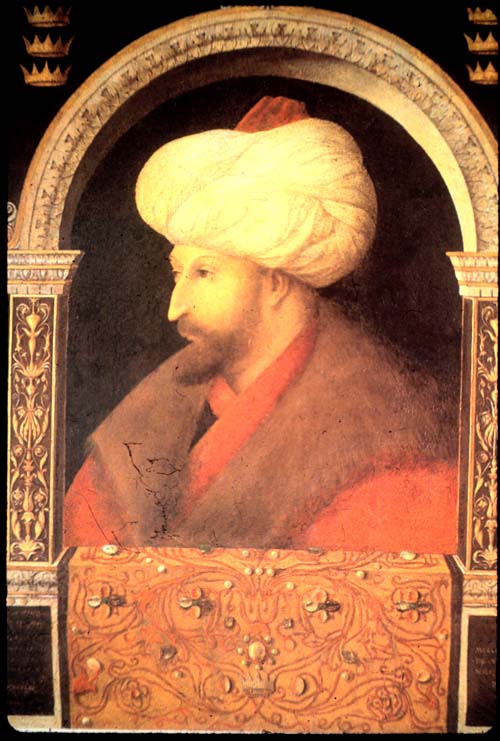
When Mehmed II ascended the Ottoman throne as a young man, he inherited a state that had steadily expanded into the Balkans and Anatolia. His first reign beginning in 1444 had been interrupted, but when he returned to the throne in 1451 he set his sights on completing what earlier Ottoman rulers had not: the capture of Constantinople. To Mehmed, the city was more than a prize; it represented legitimacy, strategic depth, and a symbolic center for a new imperial vision. He prepared for what would be a major undertaking with attention to logistics, diplomacy and technology.
Did you know? Ottoman forces famously hauled ships across the Galata hills into the Golden Horn on greased logs during the night operation of April 22–23, 1453.
Mehmed's preparations were thorough. He levied troops from across his domains, mobilized artillery and siege engineers, and accumulated supplies for a campaign that would involve not just the assault on walls but sustained operations around the city. Contemporary Ottoman chroniclers and later historians note that Mehmed employed both traditional siegecraft and novel approaches. He encouraged the casting of enormous bombards to batter the walls and recruited skilled cannon founders and engineers. One of the most famous artisans associated with Ottoman artillery was an engineer known in sources as Orban (sometimes Urban). Orban had previously offered his services to the Byzantines but found their offers inadequate; he ultimately constructed bombards for the Ottomans. These guns, while not decisive by themselves, were psychologically and materially important: they could deliver powerful blows against masonry and served as a focal point of the Ottoman siege.
The logistical feat of assembling tens of thousands of soldiers, artillery pieces, supply trains and a capable navy was enormous. The Ottoman fleet, commanded by admirals such as Baltoghlu, blockaded the Golden Horn and patrolled the Bosphorus to cut off supplies and reinforcements. Mehmed also engineered specialized equipment: mobile towers, sappers to dig towards the walls, scaling ladders, and a plan to transport ships overland in a daring operation that would neutralize the protection of the Golden Horn. Diplomatic maneuvers accompanied the military preparations; Mehmed sent emissaries to dissuade potential Christian allies and to safeguard Ottoman trade interests, mindful of Venice and Genoa's naval power and of European political divisions that might prevent a united response.
Mehmed’s youth is often remarked upon — he was only 21 when the city fell — but that fact belies the depth of his planning and the centralized apparatus he commanded. His willingness to exploit gunpowder technology and to coordinate a combined land-and-sea operation reflected both ambition and a modernizing instinct in the Ottoman state. The result was a painstakingly prepared siege force, ready to test the ancient ramparts of a city whose legend would now meet the calculus of late medieval warfare.
Did you know? Contemporary observers report that Constantine XI stripped off his imperial robes and fought as a soldier in the last hours before dying in combat, and his body was never conclusively identified.
The Siege Begins: April to May 1453
On April 6, 1453, the Ottomans began their formal operations against Constantinople. The early days of the siege involved artillery bombardment, construction of siege works, and probing attacks aimed at probing the defenders' dispositions. Ottoman artillery, including the large bombards cast with Orban’s expertise, commenced a relentless campaign against the walls. The effect was not immediate collapse; the Theodosian Walls resisted for weeks. Cannons might create breaches in masonry, but defenders could repair or reroute, and the stamina of the garrison mattered as much as the size of the guns.
Naval operations accompanied the bombardment. The sea blockade aimed to isolate the city, cut off supply lines and prevent reinforcements. Venetian and Genoese ships in the harbor did what they could to sally and harass Ottoman vessels, but they were outnumbered. The Golden Horn remained protected by the famous chain, and for weeks the defenders managed to keep Ottoman galleys at bay. The Ottoman command, however, was not content with prolonged stalemate.
Two major episodes punctuated the siege and revealed Ottoman ingenuity. The first was the sustained artillery campaign that, while not instantly decisive, wore down sections of the walls and consumed the defenders’ stores of stone, mortar and resolve. The second and more dramatic episode was the overland transport of ships. On the night of April 22–23, Ottoman forces hauled lightweight galleys across greased logs over the Galata hills and launched them into the Golden Horn. This astonishing operation bypassed the chain barrier and allowed Ottoman vessels to threaten the city’s harbor directly. Though small in number compared to the grand Ottoman fleet, these ships signaled that the defenders’ maritime safety was vulnerable and that Ottoman operational creativity could outflank static defenses.
Did you know? Many Greek scholars and manuscripts fled to Italy after 1453, contributing to the revival of Greek studies and Renaissance humanism in the West.
Among the defenders, morale depended heavily on leadership and cohesion. Giovanni Giustiniani Longo, the Genoese commander who had taken charge of the land walls, was crucial in organizing counterattacks and consolidating weakened sectors. He was wounded on April 22 or 23 (accounts vary) during heavy fighting and had to be evacuated; his removal from the field produced a blow to coordination that contemporary chroniclers emphasize as significant in the eventual collapse. The Emperor Constantine XI maintained a visible presence on the ramparts, rallying troops and sharing the defenders’ fate. Despite appeals to the West and various pleas for help, little arrived in time to alter the siege’s dynamic.
The psychological element was intense. Civilians sheltered in churches and cisterns; the continual roar of cannons and the fear of breaches transformed daily life into a tense vigil. The defenders executed sorties to destroy Ottoman siege engines, repair breaches and keep assault troops off balance. Ottoman sappers probed foundations, undermined weaker sections, and tested where the gates or towers might yield. The siege was a concatenation of engineering, artillery, naval action and human endurance that would culminate in a decisive final assault at the end of May.
The Final Assault and Fall on May 29, 1453
The last days of May saw the concentrated actions that would decide the city's fate. After weeks of bombardment, the Ottomans intensified their preparations for a general assault. They gathered men and materials for multiple simultaneous operations: scaling the walls, storming breaches, attacking gates, and employing naval forces to exert pressure from the Golden Horn and the sea. Mehmed II’s strategy relied on using massed infantry and elite Janissaries in concert with engines of war, seeking to overwhelm the defenders at their most vulnerable points and to break the will of the garrison.
Did you know? The ‘Marble Emperor’ legend held that Constantine XI would someday return; it reflects how myths can preserve hope when political reality has been shattered.
On the morning of May 29, Ottoman forces launched their final attack. Contemporary chronicles describe a ferocious, multi-front assault. Troops poured against the land walls and attempted to exploit any breach created by cannon fire. The Janissaries led repeated penetrations, and the cumulative effect of cannon damage, fatigue, and shortages among the defenders made resistance ever more difficult. At a critical moment, defenders who had been exhausted by weeks of siege — and who had suffered the loss of key leaders like Giustiniani — could not hold every point. Once a breach was effectively exploited in one sector, attackers could funnel through and threaten adjacent defenses, and the cohesion of the defense began to unravel.
Emperor Constantine XI is said to have removed his imperial regalia, donned simple armor, and fought on the walls with the last of his men. Contemporary accounts attest that he died in the fighting, leading the final resistance. His body was never definitively identified, and his death became part of the tragic aura surrounding the end of Byzantium. The city fell and the urban populace — soldiers, civilians, merchants and prisoners — were exposed to the customary but terrifying consequences of conquest. Accounts tell of several days of looting and disorder as soldiers sought plunder; credible sources indicate Mehmed eventually restored order, forbade wanton destruction of certain religious structures, and began measures to repopulate and administer the conquest.
Hagia Sophia, the great cathedral that had been the spiritual center of Orthodox Christianity for centuries, was entered by the conquerors. Mehmed II arranged for its conversion into a mosque, a symbolic act that signaled not only military victory but also the ideological and administrative transformation of the city. Soon after the conquest, Mehmed initiated policies to repopulate the city, settle diverse peoples, re-establish markets and secure Constantinople — soon to be called Istanbul — as a new imperial capital. The fall of May 29 was brutal and transformative; it ended the Byzantine imperial line, elevated a new Ottoman center and reconfigured the strategic map of southeastern Europe and western Asia.
Did you know? The sack of the city reportedly lasted several days before Mehmed ordered discipline and measures to stabilize and repopulate Constantinople, illustrating early Ottoman administrative control after conquest.

Aftermath and Wider Consequences
The immediate aftermath of the fall was chaotic but decisively consequential. Ottoman rule replaced Byzantine institutions; however, Mehmed's approach combined conquest with administrative pragmatism. He sought to make the city habitable and economically viable again by inviting artisans, merchants and migrants from across the empire and beyond. Land grants and tax arrangements were used to reconstitute civic life; mosques, public baths and markets were established or adapted. For the Orthodox Christian population, Mehmed recognized the Ecumenical Patriarch and allowed a measure of religious autonomy under Ottoman millet governance — a pragmatic arrangement that integrated the conquered population into the imperial order while preserving certain community structures.
On the European side, the fall was a psychological shock. Although some contemporaries had long seen Ottoman expansion as a pressing threat, Constantinople’s fall intensified fears and produced calls for crusade that failed to materialize in meaningful military terms. Trade routes oriented through Constantinople were affected, and the new Ottoman control of key eastern Mediterranean passages contributed to the longer-term search for alternative routes to Asia. This disruption was one of several factors — including Portuguese maritime advances — that propelled the Age of Discovery and the maritime explorations of the late fifteenth century.
Intellectually, the fall prompted many Greek scholars, clerics and literati to flee westward, particularly to Italian city-states where their knowledge of ancient Greek texts, commentaries and Byzantine learning invigorated Renaissance humanism. The migration of manuscripts and scholars is often cited as a critical catalyst for the revival of classical learning in the West, even if that process was complex, multi-causal and already underway by the mid-fifteenth century.
In diplomatic and military terms, the conquest strengthened the Ottomans in the Balkans and Anatolia, enabling subsequent expansion and consolidation that would culminate over the next centuries in a sprawling empire. For the Orthodox world, the fall of Constantinople created trauma and also a center of pilgrimage and memory; the event shaped identity and politics in the Balkans and among Orthodox communities. For historians, the fall of 1453 became a pivot: both an end and a beginning — the end of Byzantium and the beginning of a new Ottoman epoch with implications for European geopolitics, commerce and culture.
Memory, Myths, and Historiography
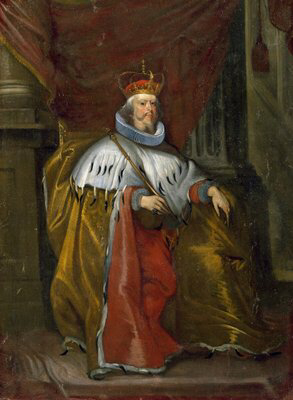
The Fall of Constantinople has been encased in legend as much as it has in documented fact. One enduring myth is the tale of the ‘Marble Emperor’ — a prophecy that Constantine XI did not die but was turned into marble and would return to restore the empire at its hour of greatest need. Such legends reflect the deep cultural wound the fall inflicted upon Byzantine identity and the ways communities seek continuity after catastrophe. Similarly, Western narratives sometimes framed the event as the ‘fall of Rome’ — a shorthand that flattened Byzantine distinctiveness but captured the sense of a profound civilizational rupture.
Historiographically, scholars have debated the relative importance of different factors in the siege: Was it gunpowder that made the difference? Were Ottoman numbers decisive? Did diplomatic isolation doom the Byzantines? Modern consensus tends to emphasize a combination of causes. The introduction and deployment of heavy artillery mattered materially, but the Ottomans’ administrative capacity to mobilize resources, their strategic integration of land and sea operations, the attritional effects of a long siege and the lack of effective Western intervention all combined to produce the outcome. The myth of a single cause reduces a complex interplay into a simple moral lesson, but that simplification is common in later retellings.
Contemporary sources — Western, Byzantine and Ottoman — provide varying perspectives, emphasizing different actors and motives. Ottoman chronicles celebrate Mehmed’s piety, resolve and ingenuity. Byzantine accounts dwell on heroism and martyrdom; Western observers sometimes saw the event through the prism of papal diplomacy or the failure of Christendom to unite. Revisionist interpretations in the twentieth and twenty-first centuries have stressed socioeconomic dynamics, demographic decline, and the structural weakness of a state that had already been reduced to a city-state by the fifteenth century. Whatever the interpretive lens, the Fall of Constantinople remains a subject where primary evidence and narrative flourish together.
Conclusion: The Long Shadow of 1453
The Fall of Constantinople on May 29, 1453 was both an ending and a commencement. It ended the line of Roman emperors who had persisted in Constantinople for a millennium, but it also inaugurated the city’s second life as the Ottoman imperial capital, a hub of commerce, culture and strategic power. The siege showcased how technological innovation — gunpowder and cannon — intersected with administrative capacity, human leadership, and sheer determination. Mehmed II’s victory was neither inevitable nor reducible to a single factor; it reflected planning, statecraft, and a readiness to use every tool at hand.
For the people of the city, the event was catastrophic: lives were lost, institutions transformed and a familiar order overturned. For Europe, the fall reshaped perceptions, accelerated intellectual movements, and helped redirect the trajectories of trade and exploration. For historians, the siege remains a rich case study in the transition from medieval to early modern warfare, diplomacy and cultural exchange.
Reading the fall today invites careful attention to sources and an appreciation for nuance. Legends and romances about Constantine, Mehmed’s proclamations of religious tolerance or conquest, and stories about lost treasures all have their place in the cultural memory of 1453. But beneath myth lies real human experience: the exhausted defenders on the ramparts, the engineers hauling guns and ships through mud and night, the citizens who fled or were resettled, and the ruler who sought to make a city his capital.
Ultimately, the significance of Constantinople’s fall lies less in the drama of a single day and more in the web of continuities and ruptures that followed. It is a story of empires’ ends and new orders’ beginnings, a reminder of how technology and statecraft can combine to transform long-standing arrangements. Viewed across centuries, 1453 is a fulcrum that invites us to consider the fragility of political orders and the ways human ingenuity — for defense and attack — shapes the fate of cities and civilizations.
How we verify this article
By the History Unlocked editorial team
This text is built on historical facts stored in our database and drafted with AI assistance. No signed human review is recorded for this article. Report any inaccuracy: we correct it and update the modified date.
Updated on
AI-assisted drafting.
Read our editorial standardsEnjoyed this? Discover more articles in the category Middle Ages