Pearl Harbor: The Full Story Behind the Day That Will Live in Infamy
At 7:55 AM on Sunday, December 7, 1941, the tranquil Pacific dawn over Oʻahu, Hawaii, was shattered by the roar of airplane engines and the thunder of exploding bombs. For the American sailors, soldiers, and airmen stationed at Pearl Harbor and surrounding military installations, the day began as a peaceful weekend morning, a brief respite from the rigors of training. Few had any inkling of the meticulously planned cataclysm about to be unleashed upon them. The attack on Pearl Harbor was not an isolated act of aggression but the explosive culmination of a decade of simmering tensions, diplomatic failures, and strategic miscalculations. It was a gamble of epic proportions by the Empire of Japan, an attempt to land a knockout blow on the U.S. Pacific Fleet to secure its own imperial ambitions in Southeast Asia. This single event would irrevocably alter the course of the 20th century, catapulting a reluctant, isolationist America into the heart of the Second World War and setting the stage for a brutal conflict across the vast expanse of the Pacific. The story of Pearl Harbor is more than just the tale of a surprise attack; it is a complex narrative of political maneuvering, espionage, technological innovation, tragic human error, and incredible heroism. Why did Japan risk war with a nation it knew was an industrial behemoth? What were the critical intelligence failures that left the United States so vulnerable? And how did the "day of infamy," as President Franklin D. Roosevelt would call it, transform from a staggering defeat into the rallying cry that would awaken a "sleeping giant" and ultimately lead to the downfall of the very empire that conceived it? The answers lie buried in the political intrigues of Tokyo and Washington, the secret preparations of the Japanese fleet, and the fateful decisions made in the hours and minutes leading up to the assault. This is the complete story of Pearl Harbor.
The Unwinding Road to War
The path to Pearl Harbor was paved not with sudden malice, but with years of escalating friction between an expansionist Japanese Empire and an increasingly wary United States. In the 1930s, Japan, driven by a desire for resources, a belief in its manifest destiny to lead Asia, and the growing power of its military faction, embarked on a campaign of aggressive expansion. The invasion of Manchuria in 1931 and the full-scale Second Sino-Japanese War beginning in 1937 were seen by the U.S. as blatant violations of international law and a threat to its own interests in the region. The American response was initially diplomatic, issuing protests and condemnations that did little to deter Tokyo. However, as Japanese aggression continued, particularly with the occupation of French Indochina in 1940, Washington’s stance hardened significantly. The Roosevelt administration implemented a series of escalating economic sanctions, targeting key Japanese imports like scrap metal and aviation gasoline. The final, and most critical, blow came in the summer of 1941. In response to Japan’s move into southern Indochina, the United States, along with Great Britain and the Netherlands, imposed a crippling oil embargo. For Japan, a nation that imported over 80 percent of its oil, this was an existential threat. The embargo threatened to grind its war machine and its entire economy to a halt within two years. From the perspective of the hardliners in the Japanese government, this was tantamount to an act of war. Diplomatic channels remained open, but they were fraught with misunderstanding and intransigence. In Washington, Japanese Ambassador Kichisaburō Nomura and special envoy Saburō Kurusu engaged in tense negotiations with U.S. Secretary of State Cordell Hull. Yet, the two sides were fundamentally at odds. Japan demanded a free hand in China and the lifting of the embargo, while the U.S. demanded a complete withdrawal of Japanese forces from China and Indochina. Neither side was willing to concede its core demands. The final American proposal, the "Hull Note" of November 26, 1941, was viewed by Tokyo not as a basis for further negotiation, but as an ultimatum. It solidified the military’s argument that a diplomatic solution was impossible and that war was the only path forward to secure the empire’s future. The time for talk was over; the time for action had arrived.
"Tora! Tora! Tora!": A Flawless, Daring Plan
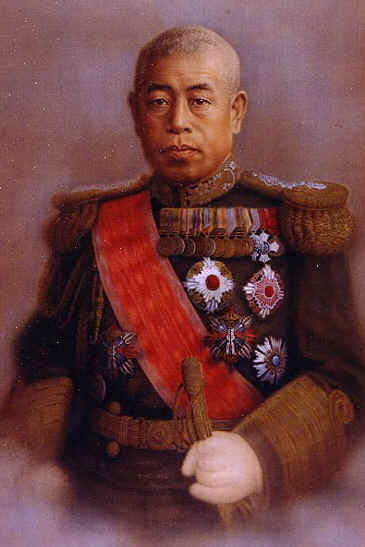
The architect of the Pearl Harbor attack was Admiral Isoroku Yamamoto, the brilliant and complex Commander-in-Chief of Japan’s Combined Fleet. Yamamoto was a strategic visionary, but also a pragmatist. Having served as a naval attaché in Washington and studied at Harvard, he possessed a keen understanding of American industrial might and the spirit of its people. He famously warned his government that he could "run wild for six months or a year," but after that, he had "utterly no confidence" in Japan’s ability to win a prolonged war against the United States. Therefore, his plan was not one of conquest, but of calculated destruction. The goal was to deliver a single, devastating blow to the U.S. Pacific Fleet, sinking its battleships and crippling its naval power. This would, he theorized, shatter American morale and create an undefended window of time—at least six months—for Japan to conquer Southeast Asia and the Pacific islands, seizing vital resources (especially oil) and creating a heavily fortified defensive perimeter. By the time America recovered, he hoped, Japan’s position would be so strong that the U.S. would be forced to negotiate a peace that recognized Japanese dominance in the Western Pacific.
Did you know? U.S. codebreakers had successfully cracked Japan's diplomatic cipher, codenamed "Purple." This intelligence, known as "Magic," gave Washington significant insight into Japanese policy and the growing belief in Tokyo that war was imminent. However, it revealed *that* Japan was preparing for war, not precisely *where* or *when* the first blow would fall.
The plan, codenamed Operation Z, was breathtaking in its audacity and scope. It required the utmost secrecy and meticulous planning. A powerful carrier strike force, the Kido Butai, comprising six aircraft carriers—Akagi, Kaga, Soryu, Hiryu, Shokaku, and Zuikaku—was assembled in total secrecy in the remote Hitokappu Bay in the Kuril Islands. On November 26, this formidable armada, accompanied by battleships, cruisers, and destroyers, slipped out of port and began a long, perilous journey across the turbulent North Pacific, maintaining strict radio silence to avoid detection. The Japanese had also engineered technological solutions for the specific challenges of Pearl Harbor. The harbor was shallow, only about 40 feet deep, which would normally cause aerial torpedoes to lodge in the mud. Japanese technicians ingeniously fitted wooden fins to their Type 91 torpedoes, allowing them to run true in the shallow waters. Furthermore, they converted 16-inch naval artillery shells into devastating armor-piercing bombs capable of punching through the thick deck armor of American battleships. Leading the first wave of the attack was Commander Mitsuo Fuchida. His role was not only to lead the assault but also to report on its success. He was to fire one signal flare to indicate that his pilots should attack. If complete surprise was achieved, he was to fire a second flare. The radio code for this critical message was "Tora! Tora! Tora!" (Tiger! Tiger! Tiger!). As his plane soared over Oʻahu in the pristine morning sky, seeing the American fleet peacefully at anchor, he knew Yamamoto’s audacious gamble had paid off. The tiger was upon its unsuspecting prey.
A Sunday Morning in Hell
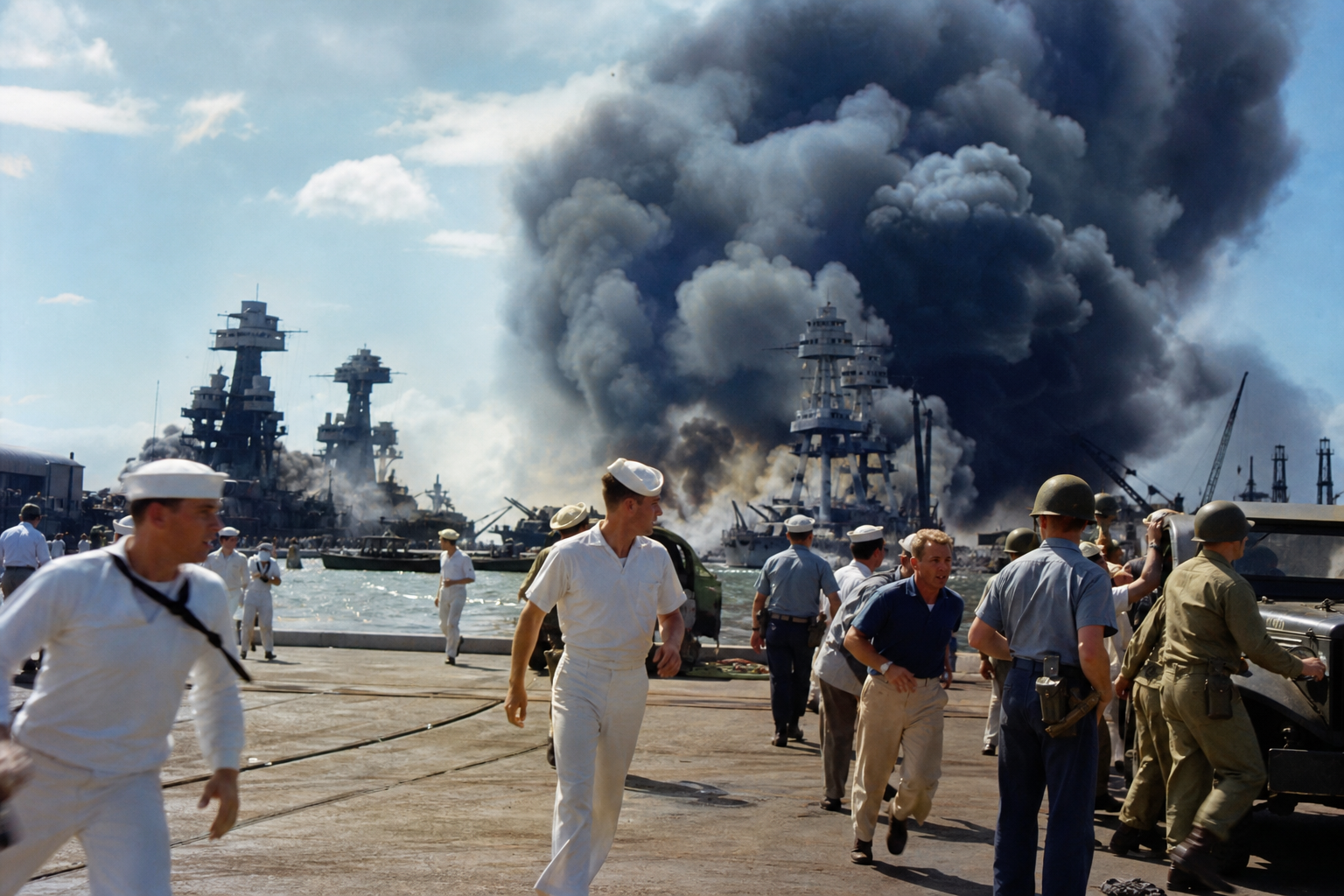
Even before Fuchida’s planes arrived, there were warning signs. Just after 6:45 AM, the destroyer USS Ward, on patrol at the entrance to Pearl Harbor, spotted and attacked a Japanese midget submarine attempting to infiltrate the base. The Ward reported the contact, but the message was delayed and downplayed as it slowly made its way up the chain of command. A half-hour later, at a remote radar station at Opana Point on Oʻahu’s northern tip, two young privates, Joseph Lockard and George Elliott, saw an enormous blip on their screen—larger than anything they had ever seen before. They calculated it was a flight of over 50 planes approaching from the north. They reported their find to the information center at Fort Shafter. Tragically, the inexperienced officer on duty, Lieutenant Kermit Tyler, dismissed the warning, assuming it was a flight of B-17 bombers expected from the U.S. mainland. He told the radar operators, "Don't worry about it." This dismissal would become one of the most fateful errors of the day. At 7:55 AM, the first wave of 183 Japanese aircraft—torpedo bombers, high-level bombers, dive bombers, and fighters—swooped in from all directions. The primary targets were the seven U.S. battleships moored along "Battleship Row," on the southeast side of Ford Island, and the airfields at Hickam, Wheeler, and Bellows Field, to eliminate any aerial opposition. The surprise was absolute. On the decks of the ships, sailors were preparing for morning colors and church services. The horrifying wail of diving planes was the first indication that this was no drill. Torpedoes slammed into the vulnerable hulls of the USS Oklahoma, West Virginia, and California. The Oklahoma capsized in minutes, trapping hundreds of men inside its hull. The most catastrophic moment came at approximately 8:10 AM, when a 1,760-pound armor-piercing bomb, dropped from a high-level bomber, penetrated the forward deck of the USS Arizona near its No. 2 turret. The bomb detonated the ship’s forward ammunition magazine, igniting a cataclysmic explosion that lifted the 33,000-ton battleship out of the water. The Arizona sank in less than nine minutes, taking 1,177 of its crew with it—nearly half of the total American deaths that day. A second wave of 171 Japanese planes struck about an hour later, focusing on finishing off damaged ships and hitting secondary targets like the Navy Yard’s repair facilities. Amidst the chaos and destruction, acts of incredible heroism unfolded. Sailors manned anti-aircraft guns, many firing back with nothing more than rifles. The battleship USS Nevada, despite being hit by a torpedo, managed to get underway, its band having just finished playing the national anthem as the attack began. It became a prime target for Japanese bombers as it attempted to escape the harbor, and its captain, fearing it would sink and block the channel, beached it at Hospital Point. By the time the last Japanese plane departed around 9:45 AM, the devastation was complete.

"A Date Which Will Live in Infamy"
The aftermath of the attack was a scene of utter carnage. In less than two hours, the pride of the U.S. Pacific Fleet had been transformed into a graveyard of twisted, burning steel. The final toll was staggering: 2,403 Americans were killed and 1,178 were wounded. The dead included 2,335 military personnel and 68 civilians. Eighteen ships were sunk or seriously damaged, including all eight battleships of the Pacific Fleet present that day. More than 180 aircraft were destroyed on the ground, and another 150 were damaged, crippling America's airpower in the Pacific before it could even get off the drawing board. News of the attack spread across the United States, sending waves of shock, disbelief, and ultimately, white-hot anger through the populace. The pre-war debate between isolationists and interventionists vanished overnight. The attack on American soil had unified the nation with a singular purpose. The following day, December 8, 1941, President Franklin D. Roosevelt addressed a joint session of Congress and the nation. His powerful and resolute voice reached every corner of the country as he began his speech with the immortal words: "Yesterday, December 7, 1941—a date which will live in infamy—the United States of America was suddenly and deliberately attacked by naval and air forces of the Empire of Japan." He asked Congress for a declaration of war, and the vote was nearly unanimous. In the House, the vote was 388 to 1, and in the Senate, 82 to 0. The sole dissenter was Representative Jeannette Rankin of Montana, a committed pacifist who had also voted against America’s entry into World War I. Three days later, Germany and Italy, honoring their alliance with Japan, declared war on the United States, officially plunging the nation into the global conflagration. The slogan "Remember Pearl Harbor!" became the nation's galvanizing rally cry, fueling recruitment drives and steeling the public for the long and bloody war ahead. It was a call to arms, a promise of vengeance, and a symbol of American resolve in the face of treachery. The attack, designed to demoralize and paralyze the United States, had instead awakened a "sleeping giant" and filled it with a "terrible resolve," just as Admiral Yamamoto had feared.
Did you know? The USS Oklahoma capsized so quickly that many sailors were trapped in airtight compartments. For days after the attack, rescue crews could hear banging from inside the hull, and they worked feverishly to cut holes and save the men. They managed to rescue 32 survivors from the overturned ship.
A Tactical Victory, A Strategic Catastrophe
From a purely tactical military perspective, the attack on Pearl Harbor was one of the most successful operations in naval history. Japan achieved complete surprise and inflicted devastating losses on the U.S. Pacific Fleet at a remarkably low cost to itself—only 29 aircraft, five midget submarines, and 64 servicemen. However, this stunning tactical victory concealed a catastrophic strategic failure that would ultimately seal Japan's fate. The first and most critical blunder was the failure to locate and destroy America's aircraft carriers. By a stroke of luck, the three carriers of the Pacific Fleet—the USS Enterprise, USS Lexington, and USS Saratoga—were not in port on December 7. The Enterprise and Lexington were at sea delivering aircraft to Midway and Wake Islands, while the Saratoga was on the West Coast undergoing repairs. This oversight would come back to haunt the Japanese Navy just six months later at the Battle of Midway, where these very carriers would play the central role in sinking four of the six Japanese carriers that had attacked Pearl Harbor. The attack on Pearl Harbor proved, ironically, that the age of the battleship was over and the age of the aircraft carrier had begun. By sinking the U.S. battleships, Japan inadvertently forced the U.S. Navy to adopt carrier-centric tactics, the very form of warfare at which Japan had just proven so adept.
The second major Japanese error was the decision by Vice Admiral Chūichi Nagumo, commander of the Kido Butai, to call off a planned third wave of attacks. Commander Fuchida and other senior pilots urged Nagumo to launch another strike to destroy the naval base’s critical infrastructure: the oil storage tanks, the submarine base, and the repair and maintenance facilities. Had they done so, the Pacific Fleet would have been forced to withdraw to the U.S. West Coast, crippling its operations for a year or more. The fuel depots alone contained some 4.5 million barrels of oil, a supply that would prove indispensable in the months to come. Nagumo, however, was cautious. He worried about the location of the American carriers and the increasing anti-aircraft fire, and he wanted to preserve his force for future operations. His decision to withdraw allowed Pearl Harbor to remain a functional forward base, enabling the U.S. Navy to mount a surprisingly rapid recovery and begin its counteroffensive far sooner than the Japanese had ever anticipated. But Japan's greatest strategic blunder was psychological and political. The "sneak attack" before a formal declaration of war was delivered enraged the American public and obliterated any anti-war sentiment. Instead of breaking the American will to fight, it created a unified, determined, and vengeful nation with a vast industrial capacity that was now fully mobilized for total war. The attack turned what might have been a limited regional conflict into a fight to the death.
The Enduring Legacy of Pearl Harbor
The attack on Pearl Harbor stands as a pivotal moment in American and world history. Its legacy is complex and multi-layered, resonating through military doctrine, international relations, and cultural memory to this day. The most immediate consequence was the end of American isolationism. The belief that the U.S. could remain insulated from the conflicts raging in Europe and Asia was shattered in an instant, leading to a new era of American global engagement and leadership that would define the post-war world. Militarily, Pearl Harbor was a brutal but effective lesson. It demonstrated the vulnerability of static defenses and revolutionized naval warfare, cementing the aircraft carrier—not the battleship—as the new queen of the seas. The "failure of intelligence" at Pearl Harbor became a case study that spurred the complete overhaul of the American intelligence community, eventually leading to the creation of the Central Intelligence Agency (CIA) and the National Security Agency (NSA). The event also left a dark stain on American civil liberties. Fueled by war hysteria and long-standing racial prejudice, the attack provided the justification for Executive Order 9066, which authorized the forced relocation and internment of over 120,000 people of Japanese ancestry, the majority of whom were American citizens. It remains one of the most troubling chapters in modern American history, a stark reminder of how fear can undermine the nation's most cherished principles. Today, Pearl Harbor is a place of solemn remembrance. The stark white USS Arizona Memorial floats silently above the sunken hull of the battleship, a tomb for the more than a thousand men still entombed within. The nearby USS Missouri, the battleship upon which Japan formally surrendered in 1945, now stands as a museum ship, its guns pointed towards the Arizona in a symbolic gesture of peace and reconciliation. Together, they bookend America’s involvement in World War II, a journey that began in fire and ended in victory. Pearl Harbor was a national trauma, but also a crucible that forged a new America. It was a day of infamy and defeat, but also the beginning of a story of resilience, resolve, and ultimate triumph that changed the world forever.
Did you know? In the frantic hours after the attack, rumors of an imminent Japanese invasion of Hawaii spread like wildfire. This led to a "Battle of Niihau," where a Japanese pilot who had crash-landed on the small island of Niʻihau terrorized the locals for several days before being killed. This incident stoked fears and contributed to the subsequent internment of Japanese Americans on the mainland.
How we verify this article
By the History Unlocked editorial team
This text is built on historical facts stored in our database and drafted with AI assistance. No signed human review is recorded for this article. Report any inaccuracy: we correct it and update the modified date.
Updated on
AI-assisted drafting.
Read our editorial standardsEnjoyed this? Discover more articles in the category World War II