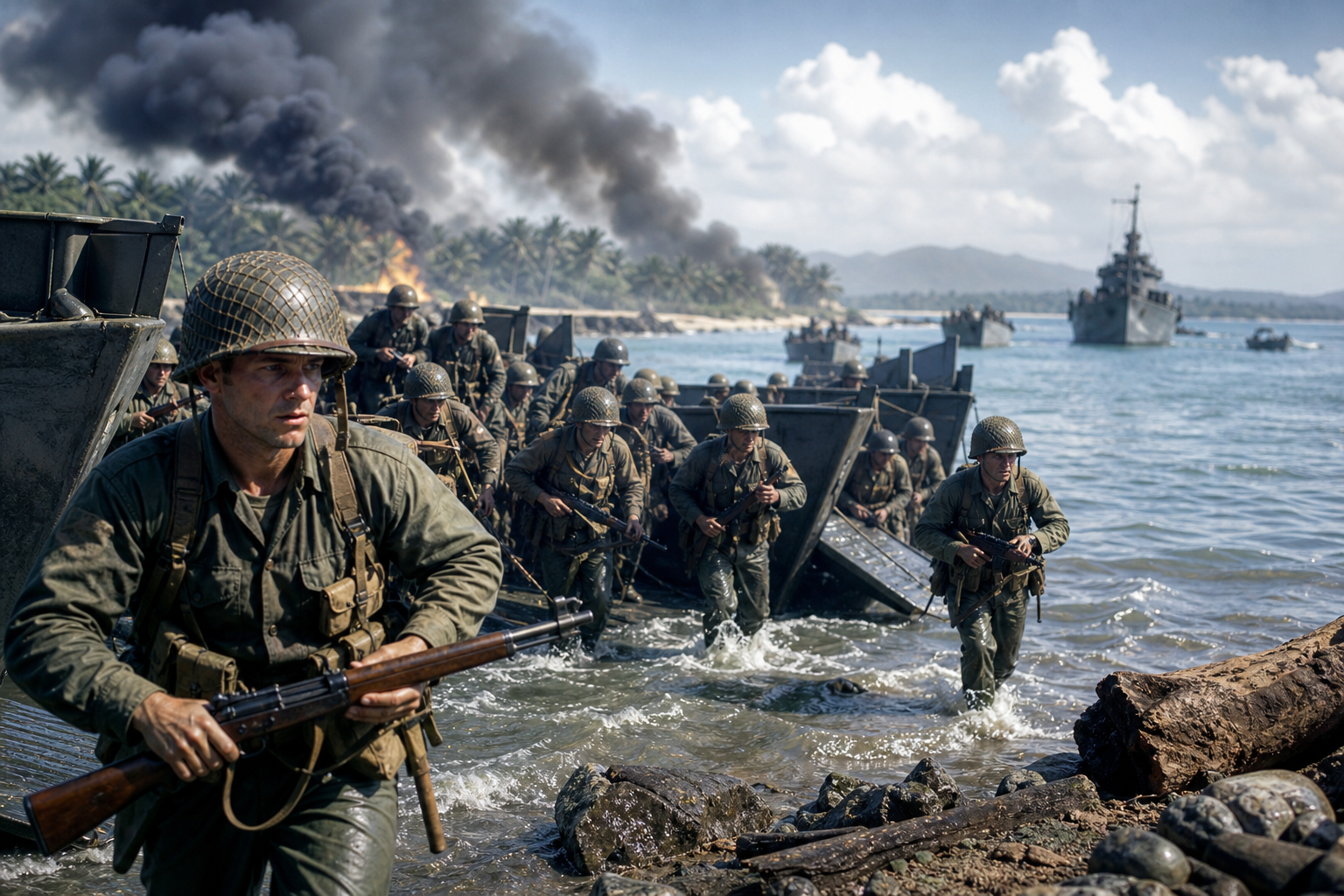
Shadows Over the Pacific: The War That Reshaped the World
The Pacific in flames was not merely a theater of battles; it was a crucible that melted empires, technologies and human lives into new shapes. From the early shock of Pearl Harbor to the silence after the formal surrender aboard USS Missouri on September 2, 1945, the war in the Pacific stretched across thousands of miles of ocean, coral atolls, volcanic islands, and urban infernos. Its narrative is a tapestry of bold gambits, bitter grinding campaigns, and moments of sudden, dramatic reversal—Doolittle’s raid, Midway’s intelligence victory, the grinding attrition of Guadalcanal, the volcanic fortresses of Iwo Jima and Okinawa, and the cataclysmic finale of Hiroshima and Nagasaki.
Yet beneath the headlines of fleets and carriers there are threads of mystery: how a handful of cryptanalysts in Hawaii turned the tide by reading the Japanese navy’s secret messages; how logistic constraints and the tyranny of distance shaped strategy; how decisions made in Washington, London, Tokyo, and Canberra echoed on beaches and in jungles. The Pacific War is paradoxically both modern—aircraft carriers, radar, cryptanalysis—and archaic: hand-to-hand combat in caves, sieges of tiny islands, and the worship of honor that fed kamikaze attacks. This article traces those threads with a narrative eye, balancing operational detail with the human stories and moral dilemmas that made the campaign unforgettable.
It is a story of choices under constraint. The Allies operated with separate, sometimes competing chains of command—General Douglas MacArthur’s southwestern Pacific command and Admiral Chester Nimitz’s Pacific Fleet pursuing operations across the central Pacific—each pursuing strategies that would later converge. Japan, wounded by resource shortages and strategic overreach, alternated between bold offensives and desperate measures. The result was a war in which intelligence, industrial capacity, and sheer endurance mattered as much as heroism. In the following sections we will examine geography and logistics, the decisive battles that turned the tide, the island-hopping doctrine and its cost, the interplay of technology and intelligence, the lived experience of combatants and civilians, and finally the harrowing path to surrender.
Did you know? The attack on Pearl Harbor destroyed eight U.S. battleships, but all were ultimately repaired or salvaged except for the USS Arizona and USS Oklahoma.
This narrative seeks to hold both the grand sweep of events and the sharpness of singular moments. It moves from cliff-edge decisions—like Admiral Yamamoto’s gamble at Midway—to the slow attrition of men and material on beaches caked with volcanic ash. As you read, imagine the map not as static lines but as a living, breathing theater where weather, supply, and codebooks often mattered more than numerical superiority. The Pacific War’s legacy is not only the redrawing of political boundaries; it is the imprint of human choices made under the pressure of fire.
The Strategic Canvas: Geography, Logistics, and Early Moves
The Pacific theater was defined first by space. Stretching from the Aleutians in the north to the Solomon Islands and New Guinea in the south, and from the Philippines to the central Pacific atolls, the distances involved were immense. Logistics, therefore, was the sinew upon which strategy rested. Ships could cross oceans, but fuel, ammunition, food, and spare parts could not. Airfields, not borders, became the stepping stones of empire; whoever controlled an airstrip could project power across hundreds of miles and deny it to an enemy. From a strategic standpoint, Japan’s early successes in 1941–42—seizing the Philippines, Malaya, Singapore, the Dutch East Indies, and parts of New Guinea—were rooted in a well-executed initial offensive that capitalized on surprise, superior carrier tactics at that time, and the temporary paralysis of Allied naval forces.
Pearl Harbor on December 7, 1941, remains the emblematic opening blow: a forceful, well-planned strike that destroyed battleships and shocked the American public into total war. Yet the raid did not eliminate American carriers—crucially absent at Pearl Harbor—or the U.S. Pacific industrial potential. Within months the United States mobilized shipyards, aircraft factories, and training centers at a scale that Japan, constrained by limited raw materials and blocked shipping lanes, could not match. The geography that gave Japan room to advance—distant islands and stretched supply lines—also exposed it to a war of attrition. The Allied response, especially after late 1942, increasingly emphasized cutting Japanese supply lines, retaking key positions (Philippines, New Guinea), and securing airfields.
Did you know? Cryptanalysts at Station Hypo deliberately spread a false story about a water shortage on Midway to prompt the Japanese to identify 'AF' as Midway in intercepted messages.
Strategic control of sea lanes mattered. Oil from Borneo and the Dutch East Indies powered Japan’s fleet; Allied submarine campaigns and air strikes gradually choked those lifelines. Supply constraints forced the Japanese Navy to operate at reduced tempo, and many Japanese garrisons would eventually be bypassed and isolated rather than assaulted directly. The U.S. embraced a dual-pronged strategy: General Douglas MacArthur would advance through New Guinea and the Philippines toward Japan from the southwest, while Admiral Chester Nimitz would leapfrog across the central Pacific—Gilberts, Marshalls, Marianas—toward a strategic posture that could support carrier and bomber operations against the Japanese home islands. These parallel thrusts recognized the tyranny of distance and the need to seize forward bases for air power projection.
The operational consequences of geography also made intelligence and reconnaissance disproportionately valuable. Spotting enemy movements, reading intercepted signals, and timing carrier strikes with precision could decide battles without direct confrontation. In the opening phases the Japanese enjoyed the initiative, but their extended perimeter created vulnerabilities. Islands that seemed remote and insignificant, like Midway or Guadalcanal, suddenly acquired strategic importance because they offered airfields and staging areas that could change the operational balance. The war in the Pacific was thus a contest to control the few nodes—harbors, atolls, airstrips—within a vast, watery expanse.

The Turning Point: Midway and Coral Sea
The spring of 1942 presented a curious contrast: within weeks the Japanese Navy, having seemed invincible, met the hard arithmetic of modern naval warfare. Two clashes—one fought principally by aircraft from carriers, the Battle of the Coral Sea (May 4–8, 1942), and the other a decisive intelligence-aided clash at Midway (June 4–7, 1942)—show how the balance shifted. At Coral Sea, American and Australian forces halted a Japanese attempt to isolate Australia by seizing Port Moresby, but the battle was tactically inconclusive. Its strategic value lay in checking Japanese southern expansion and, importantly, in foreshadowing their vulnerability: ships were struck by planes located hundreds of miles away, a paradigm that made battleship supremacy less decisive than carrier air power.
Did you know? On Saipan in June–July 1944, civilian casualties were catastrophic; thousands of Japanese civilians died in mass suicides after being misled into believing American troops would commit atrocities.
Midway cemented the turning point. The U.S. Navy, famously aided by broken Japanese codes, lured and destroyed a portion of the Japanese carrier force. Station Hypo, a modest but brilliant cryptanalytic operation led by Commander Joseph Rochefort at Pearl Harbor, had partially reconstructed the Japanese naval code JN-25. By confirming that the Japanese planned to attack an objective designated “AF” (Midway), and by conducting a deception to provoke a clarifying radio response, U.S. intelligence could forecast the time, place, and approximate composition of the Japanese strike. Admiral Chester Nimitz, trusting this intelligence, arranged an ambush. Over the course of the battle four Japanese fleet carriers—Akagi, Kaga, Soryu, and Hiryu—were sunk, along with scores of aircraft and veteran aircrews. The U.S. lost the carrier USS Yorktown, but the strategic loss to Japan was irreparable; it had lost seasoned aviators and carriers it could ill afford to replace.
Midway’s victory was not only technical but psychological. It marked the end of Japanese momentum and the assertion that industrial production and intelligence could trump the tactical daring of early 1942. Yet Midway was not a pansy—Japanese naval aviation remained lethal, and the U.S. still faced formidable Japanese land-based air power and garrisons. The lessons of Coral Sea and Midway reshaped Allied operational planning: carriers and airfields became decisive, and the emphasis shifted toward attrition of ships, aircraft, and trained personnel rather than mere territorial seizure.

Island Hopping: Strategy, Battles, and Costs
Island hopping—often credited to Admiral Nimitz and General MacArthur in different corridors—was not a single doctrine but a suite of operational choices driven by logistics, firepower, and political aims. The idea was simple in thought but brutal in execution: bypass heavily fortified Japanese positions, isolate them by cutting supply lines, and seize nearby islands with airfields to serve as stepping stones toward Japan. In practice it required amphibious mastery, naval gunfire support, close air support, and an industrial base capable of replacing ships and planes lost to kamikaze attacks and natural attrition. Campaigns like Guadalcanal (August 1942–February 1943), Tarawa (November 1943), the Marshalls and Gilberts (late 1943–1944), and the Marianas (Saipan, Tinian, July 1944) were all cogs in this operation.
Did you know? The U.S. Navy’s submarine campaign sank more Japanese merchant shipping than any other Allied service, crippling Japan’s ability to import vital resources.
Guadalcanal’s campaign is instructive: initially a bid to deny Japan an airbase over the approaches to Australia, it turned into a grinding test of sustainment and will. Both sides suffered from supply shortages, disease, and fatigue. The Americans eventually prevailed, but at significant cost. Tarawa, in November 1943, showed how even a small coral atoll could inflict heavy casualties on attackers facing well-sited defenses. Lessons in amphibious assault—timing, pre-landing bombardment, coordination between marines, navy, and air units—were sometimes learned the hard way.
The Marianas campaign, culminating in the capture of Saipan and Tinian in June–July 1944, had strategic consequences beyond the islands themselves. Seizing these bases allowed the U.S. Army Air Forces to base B-29 Superfortress bombers within range of the Japanese home islands—transforming the war into a strategic bombing campaign with devastating consequence. Moreover, the fall of Saipan precipitated political turmoil in Japan and contributed to the resignation of Prime Minister Hideki Tojo in July 1944; when the stakes became existential, the Japanese leadership altered tactics, increasingly resorting to kamikaze attacks and desperate counterattacks.
Island hopping was also morally complex. Many isolated Japanese garrisons—cut off from supplies and hope—faced starvation and eventual annihilation. Civilians on islands such as Saipan and Okinawa were caught in the crossfire; tens of thousands of Okinawan civilians died during the battle there, and many on Saipan perished or committed suicide under duress and misinformation. Moreover, the cost of capturing small islands was sometimes colossal in blood and material, prompting debate among Allied planners about when to bypass and when to invest the resources to capture.
Did you know? The Bataan Death March resulted in the deaths of an estimated 5,000–10,000 Filipino and American POWs during the forced transfer in April 1942.

Naval and Air Power: Technology, Tactics, and Intelligence
The Pacific War was a laboratory for naval and air innovation. The aircraft carrier matured into the principal capital ship, supplanting battleships as the platforms that decided fleet actions. Advances in radar and radar-directed fighter control improved night detection and interception, while carrier-based fighters and torpedo bombers evolved tactics to cope with increasingly sophisticated anti-aircraft defenses. Submarines—initially underused by the U.S. Navy—later played a decisive role in strangling Japanese logistics, sinking merchant tonnage and oil tankers that Japanese war industry desperately needed.
Intelligence shaping operations was perhaps the most consequential technological shift. Breaking the Japanese naval code JN-25 allowed Allied commanders to anticipate movements and plan force concentrations. Station Hypo’s work alongside other codebreaking units contributed to a mosaic of intelligence that included intercepted radio traffic (often referred to in U.S. parlance as 'Magic') and aerial reconnaissance. The synergy between decrypted signals, human intelligence, and on-the-scene reconnaissance often enabled smaller forces to punch above their weight.
Aircraft technology also evolved rapidly. The B-29 Superfortress represented a leap in strategic reach—pressing the bombing campaign against Japan from newly captured forward bases. Carrier aircraft also improved; the Grumman F6F Hellcat and the Vought F4U Corsair were potent fighters that gained air superiority over Japanese opponents. However, technical advances did not eliminate human factors: pilot training, experience, and attrition mattered. Japan’s pool of veteran pilots, trained over years and honed in early-war combat, dwindled; replacement pilots often received far less training due to fuel shortages and compressed programs.
Did you know? The raised U.S. flag on Iwo Jima’s Mount Suribachi was staged for a clearer photograph; the image nevertheless symbolized the brutal and costly island campaign.
Sea power’s application had moral and strategic dimensions. Submarine warfare, while effective at destroying Japanese shipping, also meant that many isolated garrisons and civilian populations suffered severe shortages of food and medicine. Strategic bombing—both incendiary raids on Japanese cities and the eventual atomic strikes—raised questions about proportionality, civilian suffering, and the limits of total war. While military planners argued the necessity of compelling Japan to surrender and shortening the war, the human toll was immense.

Life on the Frontlines: Soldiers, Sailors, and Civilians
The human experience of the Pacific War was diverse and often brutal. Marines on Guadalcanal dealt with jungle fever, short rations, and nights of close-range combat. Sailors on wooden-deck carriers watched planes take off and sometimes never return; they faced kamikaze strikes that turned the air above their decks into whirling death. Japanese soldiers, often isolated on islands without hope of resupply, fought tenaciously in caves and bunkers. Many fought to the last man rather than surrender, a cultural context shaped by the Japanese military code of honor and the fear of dishonor.
Civilians bore an appalling burden. In the Philippines, the Bataan Death March of April 1942 remains a searing symbol of brutality: tens of thousands of Filipino and American prisoners of war were forced to march under brutal conditions, with thousands dying along the way. The Japanese occupation of territories often involved forced labor, reprisals, and civilian suffering. Conversely, Japanese civilians on the home islands faced the terror of incendiary bombing raids; Tokyo’s firebombing on March 9–10, 1945 (Operation Meetinghouse) killed an estimated 100,000 people and razed large sections of the city. The scale of civilian death in the Pacific challenges any simple moral calculus of wartime necessity.
Did you know? The formal surrender of Japan was signed aboard USS Missouri on September 2, 1945, marking the official end of World War II.
The end-of-war choices also created moral dilemmas for Allied planners. The prospect of an invasion of the Japanese home islands—Operation Downfall—was expected to produce enormous casualties on both sides. Estimates varied, but many planners predicted hundreds of thousands of Allied casualties and millions of Japanese military and civilian deaths should a mainland invasion proceed. This calculus influenced the decision to use atomic weapons, a choice still debated by historians and ethicists.
Amid these grim statistics there were moments of humanity: sailors helping shipwrecked survivors, medics risking exposure to save wounded comrades, and instances of Japanese soldiers surrendering after long isolation when they learned the war had ended. The Pacific War left deep scars—societal, demographic, and psychological—that reverberated through generations.
From Firebombing to Surrender: Iwo Jima, Okinawa, and the Atomic Endings
By 1945 the Allies had closed a ring around Japan’s home islands. The assaults on Iwo Jima (February–March 1945) and Okinawa (April–June 1945) were among the bloodiest Pacific battles and provided a grim preview of what an invasion of Japan might entail. Iwo Jima, a tiny volcanic island just 750 miles from Tokyo, produced ferocious fighting in a network of caves and positions carefully constructed by Japanese defenders. U.S. forces suffered nearly 7,000 killed, while Japanese military casualties were overwhelmingly high—over 20,000 killed—reflecting a defense that intended to make any invasion costly to the last man. The iconic photograph of U.S. Marines raising the flag atop Mount Suribachi captured the bitter cost of the operation and became one of the most enduring images of the war.
Okinawa’s campaign was larger and even more devastating. The island’s capture was essential for staging operations and providing bases for air attacks. The battle was also notable for the widespread use of kamikaze aircraft, which inflicted heavy losses on Allied ships. American casualties numbered over 49,000 (including roughly 12,520 killed), while Japanese military deaths were markedly higher, and civilian casualties were catastrophic—estimates of Okinawan civilian deaths range widely, but are commonly cited at over 40,000. The ferocity of Okinawa convinced many in Allied leadership that an invasion of Japan would be extraordinarily costly.
The atomic bombings became the final, contested instrument. On August 6, 1945, a B-29 dropped a uranium bomb on Hiroshima; on August 9 a plutonium bomb struck Nagasaki. The immediate death tolls were enormous—estimates often cite 70,000–80,000 dead in Hiroshima immediately and tens of thousands dead in Nagasaki—though the long-term deaths from radiation and injury continued to mount. The Japanese government announced its intention to surrender on August 15, 1945, following Emperor Hirohito’s radio address (the Jewel Voice Broadcast). The formal surrender was signed on September 2, 1945, aboard the U.S.S. Missouri in Tokyo Bay, ending hostilities in the Pacific.
Historians continue to debate the relative weight of factors that produced surrender: the shock of atomic destruction, the Soviet Union’s declaration of war against Japan on August 8 and rapid invasion of Manchuria, the ongoing conventional bombing and blockade, and the deteriorated state of Japan’s logistics and leadership. What is indisputable is the human cost and the geopolitical reshaping that followed: the occupation of Japan, laid plans for decolonization across Asia, and an American strategic presence in the Pacific that would shape the Cold War.
The war in the Pacific was not a single story but a conglomeration of dramas—strategic gambles, technological leaps, and human endurance. It forced policymakers and soldiers alike to confront the limits of honorable war and the necessities of total war. Geography dictated tactics; logistics decided battles; intelligence often turned the tide; and the human cost of taking islands, sinking ships, and bombing cities remains a stark reminder of war’s devastation. The legacy of the Pacific War is complex: a triumph over militarism and imperial expansion, coupled with ethical questions about means and ends that persist in memory and scholarship.
For contemporary readers the Pacific War offers enduring lessons. The primacy of intelligence and information; the interplay between industrial capacity and frontline success; and the moral burden of decisions that target civilian populations are threads that connect 1940s campaigns to modern conflict. The islands and atolls that were once battlegrounds now harbor quiet memorials, cemeteries, and museums—places where the ghosts of that conflict can still be felt. As we walk those shores and study those campaigns, we must not only recount maneuvers and dates but listen to the stories of those who lived through them: veterans, civilians, and survivors whose testimonies turn abstract statistics into lived histories.
The Pacific War reshaped nations and lives. It remade Japan, accelerated decolonization in Asia, and anchored the United States as a Pacific power. But most poignantly, it left behind a human ledger of sacrifice that resists neat summation. Reading that ledger with care—recognizing both strategic necessity and human cost—is the historian’s duty. In doing so, we not only honor the past but also gain perspective on decisions that might avoid repeating its gravest mistakes.
How we verify this article
By the History Unlocked editorial team
This text is built on historical facts stored in our database and drafted with AI assistance. No signed human review is recorded for this article. Report any inaccuracy: we correct it and update the modified date.
Updated on
AI-assisted drafting.
Read our editorial standardsEnjoyed this? Discover more articles in the category World War II