The Longest Day: Secrets of the D-Day Deception That Fooled Hitler
The air over the English Channel on the eve of June 5, 1944, was thick not just with moisture, but with a palpable tension that seemed to vibrate in the very bones of the 160,000 men waiting to embark. For four long years, the shadow of the Swastika had stretched across mainland Europe, an oppressive darkness that had extinguished the lights of Paris and silenced the bells of Warsaw. From the occupied coast of France, the formidable Atlantic Wall, a chain of concrete, steel, and firepower, stared back at Britain, a defiant bulwark of Hitler’s Fortress Europe. The free world held its breath, praying for a dawn that seemed perpetually delayed. This was more than a battle; it was a crusade, the long-awaited, terrifyingly uncertain effort to reclaim a continent from tyranny. The plan, codenamed Operation Overlord, was the most complex and audacious amphibious invasion in human history. Its success hinged not only on brute force but on a dizzying array of factors: the unpredictable weather of the English Channel, the courage of individual soldiers, and, most critically, a campaign of deception so elaborate it bordered on the fantastical. The German High Command knew an invasion was coming. The question was not if, but where and when. Their eyes were fixed on the Pas-de-Calais, the shortest and most logical crossing point. For the Allies, ensuring the Germans kept looking there, away from the wide, sandy beaches of Normandy, was the key that could unlock victory or lock in a catastrophic defeat. As the vast armada prepared to sail, a secret war of phantom armies, double agents, and ghost signals reached its crescendo, a symphony of lies designed to orchestrate the liberation of millions. The fate of the 20th century rested on the shoulders of young men, many of whom had never seen combat, sailing toward a coastline bristling with an enemy who had spent years preparing for this very day. The dawn of June 6th would not just break the night; it would attempt to break the iron grip of the Third Reich itself. The longest day was about to begin.
The Great Deception: Operation Fortitude
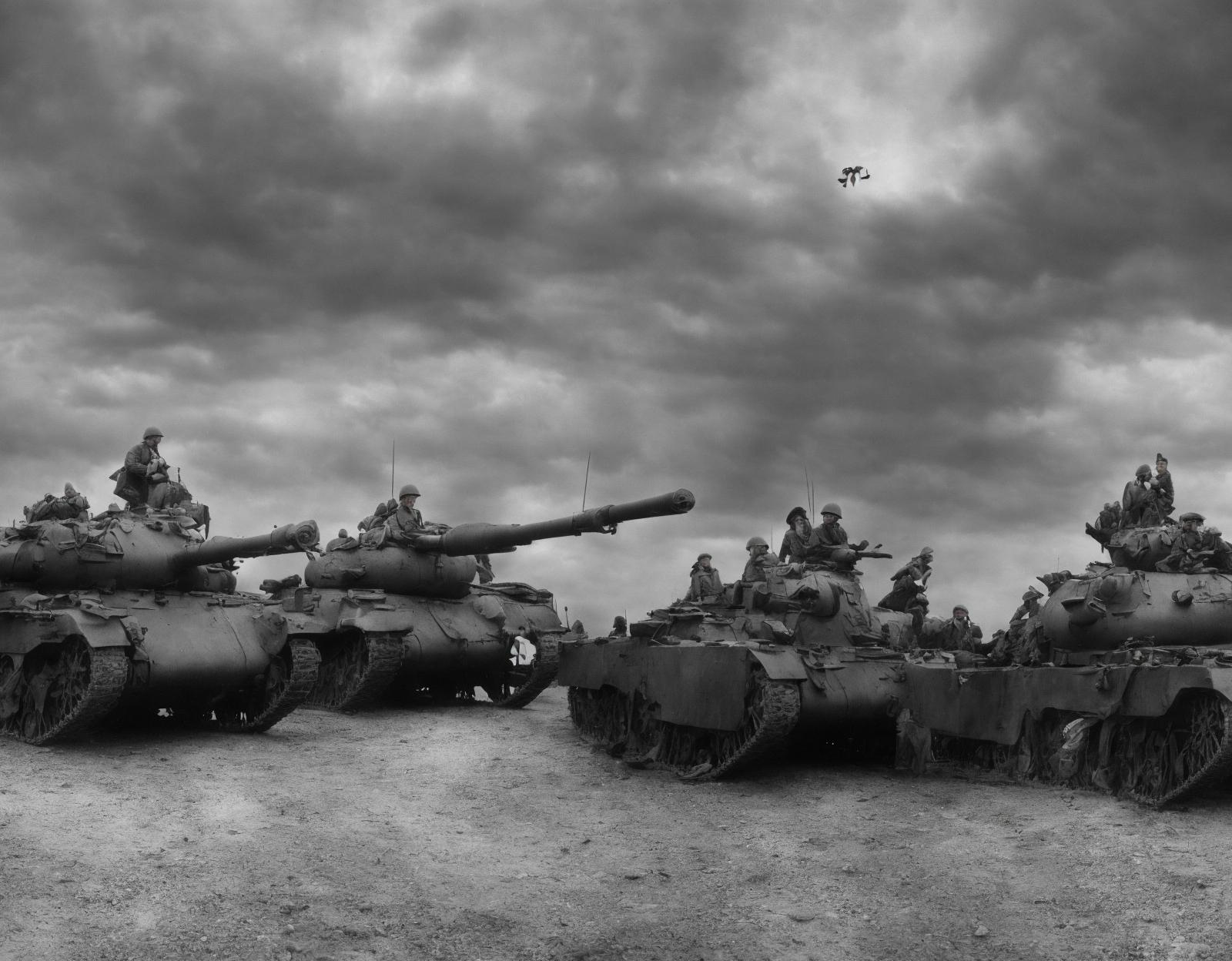
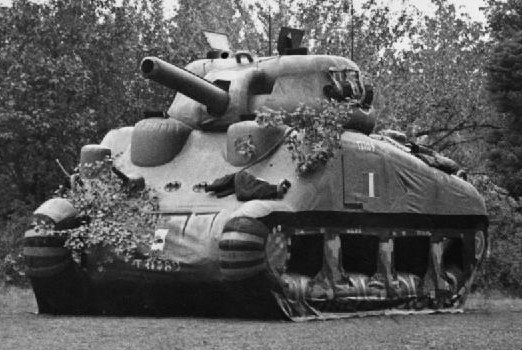
The success of D-Day was born from a lie—a lie of unprecedented scale and breathtaking ingenuity. Operation Fortitude was the masterstroke of strategic deception that convinced the German High Command that the main Allied invasion of Europe would strike at the Pas-de-Calais, not the beaches of Normandy. This was not merely a diversion but a fully orchestrated fiction, a phantom invasion force so convincing that it held powerful German divisions in a state of paralysis, waiting for an attack that would never come. At the heart of this grand illusion was the First U.S. Army Group (FUSAG), an entirely spectral army. To give it credibility, the Allies assigned its command to one of their most famous and feared generals: George S. Patton. The Germans respected—and dreaded—Patton, believing him to be the Allies' best commander. They could not imagine such a figure would be entrusted with anything less than the main invasion force. FUSAG was headquartered in Kent, directly opposite Calais, and the Allies went to extraordinary lengths to make it appear real. An army of artists, set designers, and engineers created a sprawling tableau of war preparation. In the fields of East Anglia, they deployed hundreds of inflatable rubber Sherman tanks, dummy landing craft assembled from canvas and wood, and plywood aircraft. From the air, these decoys were indistinguishable from the real thing. They even created fake railway lines and supply depots to suggest a massive logistical buildup. The illusion was maintained through a constant stream of fabricated radio traffic, mimicking the chatter of a vast army preparing for battle. Special units transmitted signals simulating the communications of divisions, corps, and a full army headquarters, all carefully designed to be intercepted by the Germans. This "ghost army" had a complete order of battle, and its fake soldiers were given leave in London to spread rumors about the upcoming "Calais invasion." The deception was further solidified by a network of double agents, the crown jewel of which was Juan Pujol García, a Spanish national codenamed "Garbo" by the British. Garbo was a master of disinformation who had so thoroughly earned the trust of his German handlers that they awarded him the Iron Cross. He fed them a steady diet of "intelligence" from his fictitious network of sub-agents, confirming the FUSAG buildup and reinforcing the idea that Normandy was merely a diversionary tactic. Even after the landings on June 6th began, Garbo sent urgent messages to the Abwehr claiming that the Normandy assault was a feint designed to draw German reserves away from Calais, where the "real," larger invasion was imminent. The German 15th Army, a powerful force of nearly twenty divisions, remained stationed in the Pas-de-Calais for weeks after D-Day, waiting for Patton's phantom legions. This crucial delay prevented them from reinforcing the beleaguered German units in Normandy, giving the Allies the precious time they needed to establish and consolidate their fragile beachhead. Operation Fortitude was a war won by imagination, a testament to the idea that in conflict, the greatest weapon can be the enemy’s own mind.
The Airborne Assault: Sentinels in the Dark
Long before the first landing craft grated against the sands of Normandy, the invasion began in the darkness of the night sky. Operation Overlord’s crucial first act was delivered by over 13,000 elite paratroopers of the U.S. 82nd and 101st Airborne Divisions and 6,000 men of the British 6th Airborne Division. Their mission was perilous and chaotic: to drop behind enemy lines hours before the seaborne assault, sow confusion, and seize vital strategic objectives to protect the flanks of the invasion beaches. They were the sentinels in the dark, tasked with paving the way for the main force. The flight across the English Channel was a terrifying ordeal. C-47 transport planes flew in tight formation through thick clouds and withering anti-aircraft fire. Inside, the paratroopers, weighed down by over 100 pounds of equipment, were thrown about as their pilots dodged flak. Many planes were hit, and many men never reached their destination. Due to poor visibility and intense ground fire, the drops were scattered and inaccurate. Men were dropped miles from their designated zones, alone or in small, isolated groups. The meticulously crafted plans dissolved into a desperate struggle for survival and improvisation. Despite the chaos, these elite soldiers proved their mettle. The British 6th Airborne had two spectacular successes on the eastern flank. In a daring glider assault, a small contingent led by Major John Howard crash-landed just yards from their targets and, in a swift ten-minute battle, captured the crucial bridges over the Caen Canal and Orne River, later famously renamed Pegasus and Horsa Bridge. This prevented German armor from counter-attacking the easternmost Sword Beach. Simultaneously, another battalion assaulted the formidable Merville Gun Battery, whose heavy guns threatened the landings. After a brutal fight, they disabled the cannons. On the western flank, the American paratroopers of the 82nd and 101st were scattered across the Cotentin Peninsula. Their primary goal was to secure causeways leading inland from Utah Beach and capture key towns like Sainte-Mère-Église. The 101st fought their way into Sainte-Mère-Église, making it the first town in France to be liberated by the Allies. The battle produced one of D-Day’s most enduring images: paratrooper John Steele, whose parachute snagged on the town’s church spire, was forced to hang limply, pretending to be dead for two hours as the battle raged below him. Scattered groups of paratroopers ambushed German patrols, cut communication lines, and created such widespread havoc that the German command was unable to form a clear picture of the invasion. They received reports of landings all over Normandy, leading them to believe this was the work of a far larger force. Though their casualties were high—the airborne divisions suffered more than any other on D-Day, proportionally—their sacrifice was not in vain. By disrupting the German response and securing key routes, they ensured that the troops landing at dawn would not be trapped and annihilated on the beaches.
Did you know? To add another layer of realism to the deception, the Allies dropped hundreds of dummy paratroopers, nicknamed "Ruperts," over different regions of France. These small, man-shaped burlap figures exploded on impact or played recordings of gunfire and battle sounds to sow confusion and divert German troops.
The Five Beaches: A Coastline Redefined by Fire
The centerpiece of Operation Overlord was the simultaneous amphibious assault on five designated beaches along a 50-mile stretch of the Normandy coast. Each beach was given a codename, and each would develop its own unique, brutal character on June 6, 1944. From west to east, they were Utah, Omaha, Gold, Juno, and Sword. Utah Beach, on the western flank, was assigned to the U.S. 4th Infantry Division. Thanks to the disruptive work of the 82nd and 101st Airborne inland and a devastatingly effective pre-invasion naval bombardment, the landings at Utah were the most successful of the day. A strong current even worked in the Americans' favor, pushing their landing craft more than a mile south of their intended target to a less-defended section of the beach. Brigadier General Theodore Roosevelt Jr., the 56-year-old son of the former president, famously declared, "We’ll start the war from right here!" upon realizing the error. Casualties were comparatively light, and by the end of the day, the troops had linked up with the paratroopers and pushed several miles inland. To the east lay Omaha Beach. Omaha was a deathtrap. Assigned to the U.S. 1st and 29th Infantry Divisions, the beach was a deep crescent of sand overlooked by high, steep bluffs. It was defended by the veteran German 352nd Infantry Division, a unit Allied intelligence had failed to locate. The pre-invasion aerial and naval bombardments were tragically ineffective, leaving the German bunkers, machine-gun nests, and artillery positions largely untouched. As the first wave of landing craft lowered their ramps, they were met with a storm of machine-gun, mortar, and artillery fire. Men were cut down in the surf, and the beach quickly became a chaotic killing field littered with the dead and dying. Tanks meant to provide cover were launched too far out and sank. For hours, the invasion teetered on the brink of catastrophic failure. Pinned down at the water's edge, with no cover and mounting casualties, it was the initiative of junior officers and NCOs that turned the tide. Small groups of survivors, like those led by Colonel George Taylor, who urged his men "Two kinds of people are staying on this beach: the dead and those who are going to die. Now let’s get the hell out of here!", began to slowly and painfully infiltrate the bluffs, blasting their way through with Bangalore torpedoes and grenades. By nightfall, the Americans had secured a tenuous foothold, but it came at a staggering cost of over 2,400 casualties, earning Omaha the grim moniker "Bloody Omaha." Further east were the British and Canadian sectors. At Gold Beach, the British 50th (Northumbrian) Infantry Division landed and overcame strong resistance to push inland, advancing towards their objective of capturing the town of Bayeux. The fighting was tough, but the British succeeded in linking up with the Canadians from Juno. The Canadians of the 3rd Infantry Division landed at Juno Beach. They faced treacherous reefs, obstacles, and a determined German defense. The naval bombardment had also been less effective here, and the first wave of Canadian troops suffered casualties on a scale second only to Omaha. Despite the brutal start, the Canadians fought their way off the beach with incredible tenacity and pushed further inland than any other Allied unit on D-Day, though they were just short of their ambitious objective of Caen. Finally, at the easternmost flank lay Sword Beach, assaulted by the British 3rd Infantry Division. Their primary task was to capture the city of Caen and link up with the 6th Airborne at Pegasus Bridge. While they faced initial heavy fighting, they quickly moved inland. Lord Lovat, the commander of the 1st Special Service Brigade, famously ordered his personal piper, Bill Millin, to play his bagpipes as the commandos waded ashore, a defiant and surreal sound amidst the cacophony of battle.

The Engineering Marvels: Mulberry Harbours and Pluto
Victory in Normandy depended not just on winning the initial battle for the beaches, but on sustaining a massive army in a prolonged and brutal campaign. The Allies needed to pour hundreds of thousands of men, millions of tons of supplies, and thousands of vehicles into France. To do this, they required a deep-water port. However, the major ports of Cherbourg and Le Havre were heavily fortified and would take weeks, if not months, to capture and clear. The ingenious solution was one of the most audacious engineering feats of the war: if the Allies couldn't capture a port, they would bring their own. This was the genesis of the Mulberry Harbours, enormous prefabricated artificial ports to be towed across the English Channel and assembled off the coast of Normandy. Two harbours were planned: Mulberry ‘A’ for the Americans at Omaha Beach and Mulberry ‘B’ for the British at Arromanches-les-Bains on Gold Beach. It was a project of staggering complexity. The outer breakwater of each harbour was formed by sinking a line of old ships (codenamed "Gooseberries") and massive, hollow concrete caissons known as "Phoenixes." These Phoenixes, some as tall as a six-story building, were towed across the Channel and then flooded and sunk into position. Inside this protective ring, floating roadways, codenamed "Whales," connected a series of pier heads, or "Spuds," which were anchored to the seabed but could rise and fall with the tide. This created a system of floating docks where large supply ships could unload their cargo directly onto trucks, which would then drive to shore. The construction of these components in secrecy across Britain was a monumental undertaking, involving thousands of workers. The successful installation of these harbours in the days following June 6th was a logistical triumph. However, on June 19th, a violent storm, the worst to hit the Channel in 40 years, struck the coast. For three days, it battered the allied installations. The more exposed American Mulberry at Omaha was utterly destroyed, a devastating blow to their supply line. The British Mulberry at Arromanches, however, survived. It became the lifeline of the Allied invasion force for the next ten months, landing over 2.5 million men, 500,000 vehicles, and 4 million tons of supplies. It was a war-winning marvel. Alongside the Mulberrys was another, equally brilliant, and even more secretive engineering solution: PLUTO, an acronym for Pipe-Line Under The Ocean. To fuel the thousands of tanks, trucks, and aircraft of the Allied armies, an immense quantity of petroleum was needed. Transporting it by sea in vulnerable tankers was inefficient and dangerous. PLUTO was the answer: a series of flexible, 3-inch diameter pipelines laid on the seabed of the English Channel, designed to pump fuel directly from pumping stations in England to France. The first line became operational in August 1944, and eventually, this underwater pipeline network delivered over 172 million gallons of fuel, a critical and unsung contributor to the Allied advance across Europe.
The German Response: Confusion and Delay
While the Allies executed the most complex amphibious assault in history, the German response was a study in confusion, delay, and strategic paralysis. The High Command was caught completely off guard, not by the fact of the invasion, but by its location. The masterful deception of Operation Fortitude had worked perfectly. They were convinced Normandy was a feint and that the main blow was yet to fall on the Pas-de-Calais. When the first reports of airborne and seaborne landings arrived in the early morning hours of June 6th, they were fragmentary and contradictory. German commanders on the ground were unsure if they were facing a full-scale invasion or a series of large-scale commando raids. One of the most critical figures, Field Marshal Erwin Rommel, commander of Army Group B and responsible for defending the French coast, was not even in France. Believing the stormy weather made an invasion impossible, he had taken the opportunity to travel back to Germany to celebrate his wife’s birthday. When he was finally informed of the landings, he began a frantic journey back to his headquarters, but the crucial opening hours were lost. The command structure itself was a major weakness. Rommel controlled the infantry divisions on the coast, but the powerful Panzer divisions—the armored reserves crucial for throwing any invasion back into the sea—were under the control of a separate command, and their release required Hitler’s personal authorization. When Rommel’s chief of staff, General Hans Speidel, and Field Marshal Gerd von Rundstedt, the overall Commander-in-Chief West, requested the release of the Panzer reserves to counter-attack the Normandy beachheads, their request was denied. At his headquarters in Berchtesgaden, Hitler was asleep. His aides were too afraid to wake him. When he finally awoke late in the morning and was briefed, he remained convinced that Normandy was a distraction. He confidently asserted that the "real" invasion would come at Calais and ordered the bulk of the Panzer reserves to remain there. He only released the 21st Panzer Division for an immediate counter-attack. This division, located near Caen, launched an attack in the afternoon between Juno and Sword beaches. For a brief, terrifying moment, they broke through to the coast, but without support and harassed by Allied fighter-bombers, they were forced to pull back. It was the only significant German armored counter-attack on D-Day. All day, the German command was plagued by Allied air supremacy, which destroyed bridges and strafed any movement on the roads, and by sabotage from the French Resistance, which cut communication lines. As the day wore on and the scale of the Allied landings became terrifyingly clear, disbelief turned to panic. But by then, it was too late. The Allies, despite heavy losses, had clawed their way ashore and established a foothold. The critical window for the Germans to annihilate them on the beaches, as Rommel had planned, had closed, thanks to a combination of Allied deception, Hitler’s flawed intuition, and a fatally disjointed German command.
Did you know? To identify friend from foe in the pitch black of the Normandy countryside, American paratroopers were issued a simple child's toy: a metal "cricket" clicker. A single "click-clack" was to be answered by two "click-clacks." This simple sound became a lifeline in the confusion of the night.
In conclusion, D-Day stands as a monumental turning point in modern history, a day of extraordinary bravery and unparalleled strategic complexity. The successful landings on June 6, 1944, were the result of years of meticulous planning, industrial mobilization, and a campaign of deception so effective it has become legendary. From the phantom army of Operation Fortitude that mesmerized the German High Command to the engineering genius of the Mulberry Harbours that sustained the invasion, Operation Overlord was a testament to Allied ingenuity and resolve. Yet, the triumph of strategy on the grand scale was ultimately secured by the raw courage of individual soldiers on the ground. It was the paratroopers who jumped into a chaotic darkness, the rangers who scaled the cliffs of Pointe du Hoc, the Canadians who fought their way through the inferno at Juno, and the American infantry who, against all odds, overcame the deathtrap of Omaha Beach. However, the victory of June 6th was not an end but a beginning. The foothold gained on the "longest day" was fragile and came at a terrible price. D-Day opened the door to the brutal, grinding attrition of the Battle of Normandy, a two-month slog through the hedgerows and fields of northern France that would cost hundreds of thousands of lives on both sides. The campaign for Normandy would be as bloody as any on the Eastern Front. The legacy of D-Day is therefore twofold. It is a story of a brilliant military victory that heralded the beginning of the end for Hitler’s "Thousand-Year Reich." But it is also a somber reminder of the immense human cost of that victory. It is etched in the rows of white crosses and Stars of David in the American cemetery overlooking Omaha Beach, a silent, powerful testament to the sacrifice required to restore freedom to a subjugated continent. D-Day was the moment when the tide of the war in Western Europe turned decisively, a day of blood, fire, and heroism that reshaped the world and continues to command our respect and remembrance. It was, in every sense of the word, a day that made history.
How we verify this article
By the History Unlocked editorial team
This text is built on historical facts stored in our database and drafted with AI assistance. No signed human review is recorded for this article. Report any inaccuracy: we correct it and update the modified date.
Updated on
AI-assisted drafting.
Read our editorial standardsEnjoyed this? Discover more articles in the category World War II