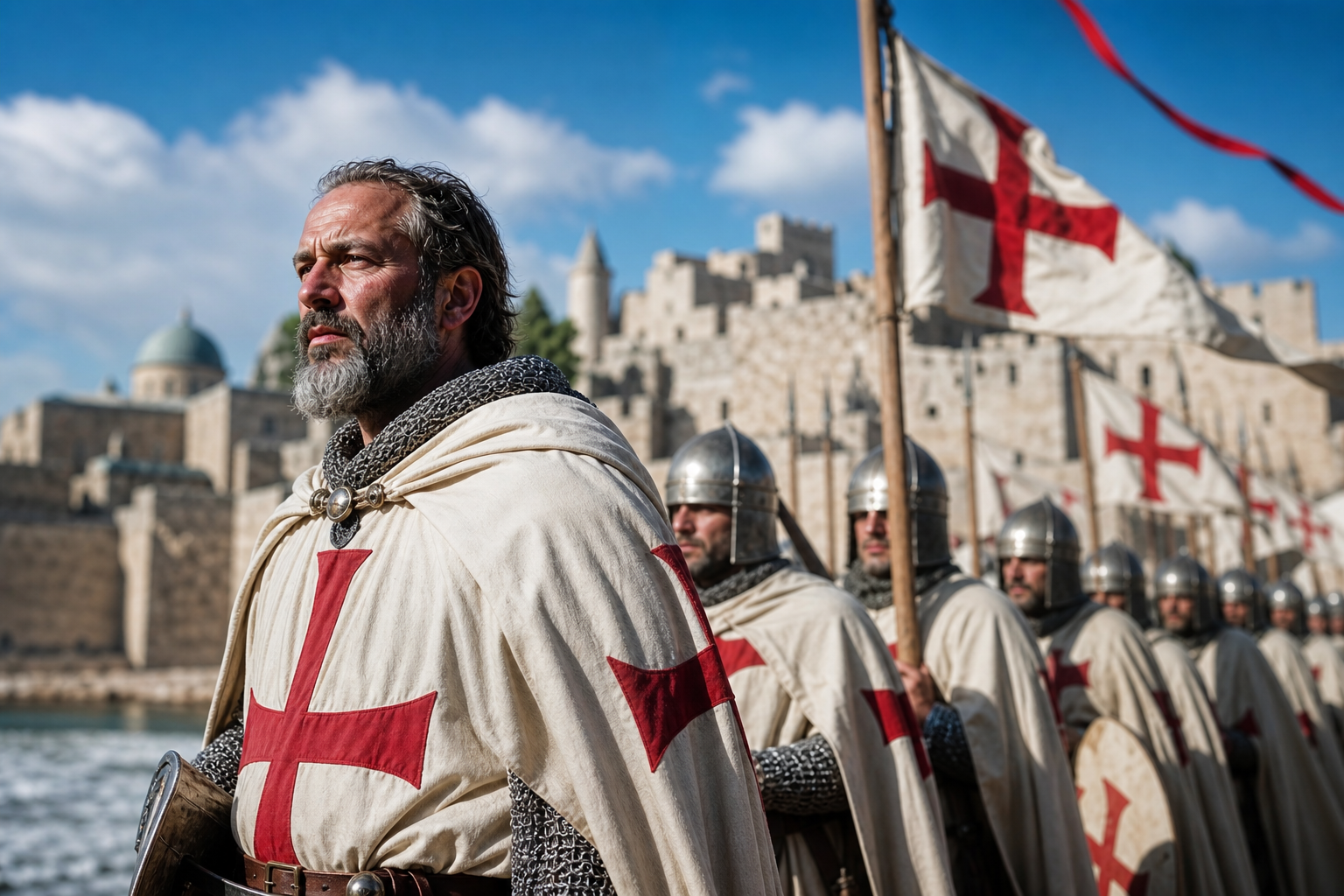
Siege of Acre: The Turning Point of the Third Crusade
The salty air of the eastern Mediterranean mingled with smoke and the iron tang of blood. For nearly two years the port city of Acre would be at the fulcrum of a clash between two worlds: the Latin West determined to reclaim what had been lost at Hattin and the Muslim Near East under the leadership of Saladin who sought to hold the new order. The Siege of Acre (1189–1191) is remembered as one of the longest, cruelest, and most consequential sieges of the medieval Levant. It was less a single, clean battle than a grinding campaign of starvation, engineering, diplomacy, and negotiation in which knights, merchants, mariners, and religious warriors shaped history.
Acre stood as the key to the coast—the gateway through which supplies, reinforcements, and trade flowed. After the catastrophic defeat of the Crusader field armies at Hattin in 1187 and Saladin’s subsequent capture of Jerusalem, the remaining Latin strongholds clung to the coast. The siege that began in August 1189 was not merely a military action; it was a statement of intent, a test of endurance, and an act of retribution. Pilgrims and soldiers alike poured into the Levant, some with vows of piety and others with ambitions of glory, plunder, or political advancement. The scene that unfolded at Acre would bring together an astonishing array of personalities—the desperate defenders within the walls, the Templar and Hospitaller brothers who manned the assaults, and later, the crowned heads of Europe—Philip II of France and Richard I of England—whose arrival would change the character and stakes of the siege.
In the shadow of towers and catapults, the human cost was immense: disease, hunger, and the brutality of medieval warfare. Chroniclers on both sides left records that are often partial and passionate, and their narratives still shape our perception centuries later. Yet beneath the rhetoric of holy war were very human stories of rivalry, negotiation, and the collapse and remaking of political legitimacy in the Crusader states. The fall of Acre on 12 July 1191 would be a turning point in the Third Crusade, an event that re-opened the possibility of a Latin presence in the Holy Land even as it revealed deep fissures between allies.
Did you know? The fall of Jerusalem in 1187 spurred not only knights but also hundreds of merchants and sailors from Italian city-states, whose financial interest in the Levant made them eager participants in the siege.

Prelude: From Hattin to the Shores of Acre
The disaster at Hattin (4 July 1187) is the necessary prologue to the Siege of Acre. When Saladin decisively defeated the army of King Guy of Lusignan, the moral and military foundations of the Kingdom of Jerusalem crumbled. The loss of the True Cross and the capture of most of the nobility left the coastal cities isolated. Saladin swept through the hinterlands, taking Jerusalem in October 1187 and forcing the remaining Latin enclaves to retrench to the sea. Acre, with its strong walls, harbor, and mercantile wealth, became the focal point of the remaining Latin resistance.
The response from Europe was not immediate but it was decisive. The fall of Jerusalem triggered a wave of crusading fervor across Christendom; calls for a new expedition reached the courts of kings and the pulpits of bishops. Preachers like Bernard of Clairvaux had earlier galvanized support for crusading causes, and in the years after 1187 the papacy and secular rulers issued motivators and indulgences that drew warriors from all classes. The movement that gathered for Acre was not a single, centrally organized army but a mosaic of contingents—nobles with retinues, bands of volunteers, merchants from Italian maritime republics, and contingents from smaller principalities.
The geography of Acre made it vital. Its deep natural harbor permitted fleets to support a protracted siege, and its citadel and inner towers offered a formidable defense. In strategic terms, whoever held Acre controlled the lifeline that connected the Crusader states to Europe. For Saladin, taking Acre had been a strategic objective to deny the Franks a staging ground for renewed campaigns. For the Crusaders, reclaiming Acre would restore a bastion, allow the arrival of reinforcements, and re-establish trade ties that underpinned the financial capacity to wage war.
Did you know? The maritime republics did not fight purely for faith—Genoa and Pisa saw Acre as crucial to Mediterranean commerce, lending their ships in hope of regaining or enhancing trade privileges and warehouses in the city.
The early months were characterized by improvisation. Lacking a unified command and the resources for a rapid assault, the besiegers established camps, constructed siege works, and attempted blockades by sea. Disease and supply were immediate concerns: the besiegers faced the hot Levantine summers and the same logistical constraints that tested any medieval army on campaign. Reinforcements and guns would come only through time and the intervention of maritime powers whose commercial interests made them stakeholders in the struggle.
The First Years: Trench, Tower, and Sea (1189–1190)
From August 1189 a ragged but determined crusading force established the investment of Acre. The early siege relied less on grand royal banners than on the discipline and experience of the military orders and the engineering skills of the Italian maritime republics. The Pisans, Genoese, and later the Venetians provided ships, siege engines, and crews to maintain a blockade. The naval element transformed Acre from a city that could be provisioned by sea into a target increasingly cut off from Saladin’s support, as fleets patrolled and intercepted supply ships.
Siegecraft in the late 12th century combined brute force and emerging technical sophistication. Mangonels threw stones to batter walls; trebuchets—counterweight or traction engines depending on local technology—delivered heavier missiles; siege towers allowed attackers to match height with the city's ramparts; and undermining (mining) tried to collapse foundations. Each technique required logistics: timber to build frames and engines, ropes and canvas, skilled carpenters, and engineers versed in the art of medieval warcraft. Italian shipwrights and smiths contributed crucial know-how, while the crusading knights and infantry attempted repeated assaults on the outer works.
Did you know? The alleged mass execution of prisoners after Acre’s fall is reported by several contemporary sources, and while the number “2,700” is commonly cited, medieval chroniclers varied widely; the episode remains one of the most debated moral flashpoints of the Third Crusade.
Inside Acre, defenders repaired and improvised. Saladin had left garrisons that were determined and well-provisioned early on, and the inner fortifications and towers presented daunting obstacles. The contested towers—names given by chroniclers like the “Tower of Flies” and others—became focal points of attack and defense. Taking a single tower could change the local topography of the siege warfare, enabling attackers to control stretches of the wall and the adjacent wards. The fighting around towers was episodic, brutal, and often personal: arrows, crossbow bolts, and hand-to-hand clashes atop wooden platforms and stone crenellations defined the rhythm of the campaign.
Disease and starvation did not discriminate. Crusader camps were riddled with fever and dysentery; supply lines stretched thin. The besiegers sometimes negotiated ransom for prisoners, and at other moments accepted alliances and truces. Diplomacy and espionage were constant—spies and deserters crossed lines to carry news and offers. The protracted nature of the siege forced new arrivals from Europe to import fresh wills, vows, and hopes: men who had set off for pilgrimage now found themselves in a grinding war of material attrition.
Kings and Crowns: The Arrival of Richard and Philip (1190–1191)
The siege took a decisive turn with the arrival of royal resources. The French King Philip II Augustus and the English King Richard I (the Lionheart) came separately to the Levant with substantial forces, both drawn by a mixture of piety, politics, and the lure of crusader glory. Philip reached the eastern Mediterranean in 1191 after taking a circuitous route; Richard’s voyage, delayed by shipwreck and the death of his sister’s husband, culminated in a dramatic maritime entrance that altered the calculus of the siege.
Did you know? Many of the military orders’ logistical skills—especially in provisioning, accounting, and fortification—were learned from interactions with Italian merchants and Byzantine engineers, showing a cross-cultural exchange amid conflict.
When Richard arrived in June 1191, he brought not only a reputation for martial prowess but significant military machines, siege engineers, cavalry, and a sizeable English contingent. His willingness to throw resources at Acre accelerated operations: massive trebuchets began to crash into walls, and coordinated assaults intensified. The cooperation between Philip and Richard was uneasy and fraught with mutual suspicion. Matters of precedence, control of spoils, and political claims over the future of the Kingdom of Jerusalem complicated the military campaigns. Yet their combined pressure—and the arrival of fresh crusading contingents from Europe—gave the besiegers a numerical and material advantage over the city's defenders.
The fall of Acre in July 1191 came after a series of assaults that overran the outer wards and captured major towers. The city’s walls were breached and the garrison exhausted. The surrender negotiations were bitter. One of the most infamous episodes during and immediately after the fall was the execution of Muslim prisoners. Contemporary chroniclers report that approximately 2,700 prisoners—numbers vary in sources—were beheaded or otherwise killed after the city fell. Richard’s decision shocked contemporaries and later historians; some saw it as military necessity to deter further resistance and to keep the men from rejoining Saladin’s armies, while others described it as a grim act of vengeance.
The capture of Acre also produced contentious political outcomes. Guy of Lusignan, the embattled king of Jerusalem whose claim had been severely questioned since Hattin, expected to be reinstated. Meanwhile Conrad of Montferrat—an accomplished and resourceful Tyrian noble—had risen as a rival claimant and had significant support among the nobility of the kingdom. Richard’s intervention in Acre and the negotiations that followed set the stage for political turmoil that would outlast the siege itself, sowing rivalries that would culminate in further violence and intrigue.
Did you know? The murder of Conrad of Montferrat in 1192 occurred under a cloak of secrecy; two assassins entered his chamber and killed him, and while they were captured, they declared they acted for motives that remain opaque, fueling conspiracy theories among contemporaries.

The Military Orders: Templars, Hospitallers, and the Architecture of War
The military orders were among the most disciplined and politically influential forces at Acre. Both the Knights Templar and the Knights Hospitaller had been shaped by the losses of 1187 and had become central instruments in any major campaign. Their role at Acre was not simply auxiliary; they were often in the vanguard of assaults, managed key fortified positions, and were entrusted with important responsibilities by the secular commanders. The orders combined martial skill with administrative capacity: they could levy men, maintain stores, and manage the complex logistics of a protracted siege.
Unlike feudal levies that dispersed after a campaign season, the orders stood as enduring institutions. Their fortified houses (preceptories) and castles provided staging points and repositories of wealth. At Acre the Templars and Hospitallers held towers and wards that were critical to the final operations. Their brothers—clad in distinctive mantles—led breach assaults, repelled sallies, and often became focal points for morale. The military orders also had political agendas. They were not merely soldiers of Christendom but corporations with assets and diplomatic reach: the Templars had banking connections across Europe, and the Hospitallers were increasingly a sovereign actor in their own right, caring for the sick while fighting to defend the sickbeds of the Latins.
The presence of the orders complicated royal ambitions. Kings relied on them for military support but sometimes feared their autonomy. At Acre their influence was visible in both the fighting and in negotiations: the orders had to be placated with rights, lands, and privileges if broader unity were to be maintained. Their actions were sometimes controversial—accusations of heavy-handedness, rivalry between the two orders, and differing relations with local nobility colored diplomatic outcomes. Yet their contribution to the eventual success at Acre is undeniable. Their members’ willingness to hold forward positions, rebuild shattered works, and coordinate counter-attacks under enormous pressure determined many of the micro-outcomes that accumulated into victory.
Did you know? Modern archaeological excavations at Acre have uncovered Crusader-era warehouses and harbor structures that confirm chroniclers’ claims about the city’s importance as a commercial hub.
Despite their martial prowess, the orders suffered grievous losses. The protracted fighting and the diseases of camp life eroded numbers and morale. The reputation they acquired—both fearsome and revered—became part of the legacy of Acre, informing later narratives that cast the military orders as either heroic defenders of Christendom or as self-interested institutions whose power complicated the crusading enterprise.
Political Consequences and the Struggle for Legitimacy
The fall of Acre did more than grant a strategic port to the crusaders; it precipitated a crisis of legitimacy that would define the remainder of the Third Crusade. With the city in Christian hands, the question of who would rule the Kingdom of Jerusalem became urgent. Guy of Lusignan asserted his kingship by right of coronation and loyalty, but his failures at Hattin left many noblemen questioning his fitness. Conrad of Montferrat, newly arrived and seasoned in Levantine politics, represented a rallying alternative: he had defended Tyre against Saladin and had the support of important factions.
Richard I’s priorities were complex. He sought to re-establish a defensible Christian realm on the coast and to secure a vassal ruler who would protect English and allied interests. He was also calculating the optics of power: a strong and pliant ruler in Jerusalem might ensure a long-term Western presence, but interfering overtly in the kingdom’s succession could damage his prestige. Philip II, meanwhile, had his own ambitions and rivalries, and his quarrels with Richard over precedence and spoils of war led to diplomatic strain that would see him depart for France early in the campaign.
Did you know? The medieval chroniclers’ varying accounts of Acre’s fall—differing in tone, detail, and casualty numbers—reflect the fractured and partisan nature of contemporary information.
The rival claims and the politics of appeal culminated in fraught negotiations. Richard initially supported Guy’s continued rule, partly because Guy’s claim was tenuous and his removal could open space for a ruler more favorable to Richard. The murder of Conrad in April 1192—by assassins whose identity remains debated—shocked contemporaries and further destabilized the already precarious politics of the kingdom. Eventually, Isabella of Jerusalem, the legitimate heiress, was married to Conrad and, after his assassination, to other nobles ensuring that dynastic claims remained contested. The instability created by these disputes weakened the long-term gains of the siege, even as the military success at Acre re-opened supply lines and allowed further campaigning.
Beyond dynastic struggle, the siege had diplomatic consequences with Muslim polities as well. Saladin, though humiliated, remained a formidable opponent. His attempts to gather forces and cut supply lines would continue; he relied on sway among Syrian and Egyptian emirs to maintain cohesion. The contested moral memory of Acre—especially the massacre of prisoners—stiffened resolve on both sides and added bitterness to subsequent engagements.

Siegecraft, Memory, and Legacy
The Siege of Acre stands as a case study in medieval siegecraft and the limits of crusader power. From a technological perspective, Acre saw the application of heavy artillery for its age, relentless mining, and the co-ordination of sea and land forces. The logistical demands—timber, iron, rope, food, and fresh horses—required an entire maritime-industrial complex that only the Italian city-states could partially supply. These interdependencies illustrate the hybrid nature of the Crusades: a religious war that relied heavily on commerce, technical know-how, and political bargaining.
From the human perspective, the siege illustrates how warfare in the Middle Ages blended ideology and survival. Chroniclers like Ambroise, Richard of Devizes, and Arab historians such as Ibn al-Athir and Baha ad-Din ibn Shaddad left vivid, sometimes contradictory accounts that historians must read against the grain. The moral questions posed by events such as the execution of prisoners and the sacking of the city resurface in every generation’s retelling. For contemporaries, the siege could be portrayed as divine justice, strategic necessity, or brutal excess; for modern historians it is a prism through which to view the violent contact of cultures and the ambiguities of medieval politics.
The physical legacy of Acre is also telling. Layers of occupation, fortification, and rebuilding created a palimpsest in stone. Archaeology in the modern city of Acre (Akko) reveals Crusader walls, towers, harborworks, and remnants of Christian and Muslim neighborhoods that attest to the contested history. The orders left architectural imprints—chapels, halls, and fortresses—that would be adapted and reused by subsequent rulers. The city’s status as a UNESCO World Heritage site today emphasizes its layered past and the long shadow of events like the siege.
In the broad sweep of the Third Crusade, Acre stands as both triumph and caution. It reopened the door to Latin presence on the Levantine coast, yet it exposed the fragility of that presence when diplomacy, dynastic disputes, and regional power politics intruded. The personalities who converged on Acre—kings, knights, merchants, and sheikhs—shaped an event that still intrigues because it blends military drama with human frailty.

Conclusion: Acre as a Mirror of Crusading Ambition
The Siege of Acre was a crucible that distilled the strengths and weaknesses of the crusading movement. It showcased extraordinary endurance, the mobilization of trans-Mediterranean resources, and the military prowess of forces that converged in the Levant. At the same time, it exposed political rivalries, moral controversies, and logistic limits that tempered the victories of the West. The capture of Acre in 1191 reopened strategic possibilities—it provided a port, a foothold, and a psychological boost. But the fragile political settlements that followed, the contentious claims to kingship, and the continuing military pressure from Saladin’s coalition ensured that the victory would not be an end but a prelude.
In memory and myth, Acre became emblematic: for Western chroniclers it could be celebrated as redemption after Hattin; for Muslim writers it stood as a site of suffering and a spur to renewed resistance. For modern readers, the siege offers dense layers of study—military, political, economic, and cultural. It invites us to see the Crusades not as single-minded holy wars but as messy, contingent episodes of history where commerce and piety, rival ambition and collective effort, came together in a violent theater.
More than eight centuries later, travelers to Akko can walk among stones that once rang with the clang of armor and the cries of siege. The city’s archaeology and the surviving chronicles allow us to reconstruct the outlines of a story that remains human and complex. The Siege of Acre is, therefore, a mirror: of medieval strategic thinking, of the entanglement of faith and interest, and of the unpredictable consequences of war.

How we verify this article
By the History Unlocked editorial team
This text is built on historical facts stored in our database and drafted with AI assistance. No signed human review is recorded for this article. Report any inaccuracy: we correct it and update the modified date.
Updated on
AI-assisted drafting.
Read our editorial standardsEnjoyed this? Discover more articles in the category Knights Templar