The Fall of Berlin: Last Battle for Europe
Intro
The city of Berlin in the spring of 1945 was a landscape of smoke and rumor, of promises broken and destinies closing in. For nearly a decade Europe had been remade by war, and by April the cradle of Nazi power had become its final stage. The Fall of Berlin was not a single event but a sequence of converging tragedies: a strategic race between Allied commanders, a last-stand defense by a fractured German command, and an urban inferno in which soldiers and civilians were consumed alike. In that crucible, monumental decisions were made in subterranean rooms and on shattered boulevards, and the symbolism of victory would be as decisive as the lines drawn on any map.
This account aims to blend the tactical and the human — to show how the vast Soviet offensive that began in mid-April 1945 became a brutal house-to-house contest, how the Führerbunker became the epicenter of a dying regime, and how the raising of a flag on the Reichstag would echo across continents. It avoids myth-making while leaning into the drama: the Soviet push was propelled by operational mastery and staggering resources; German resistance was characterized by improvisation, ideological loyalty, and despair. Civilians, often the silent majority of this story, endured bombardment, starvation, and mass displacement.
Did you know? The Yalta Conference (Feb 1945) set occupation zones, but Stalin still insisted the Red Army take Berlin before further talks concluded.
The Fall of Berlin marked the end of the Third Reich, but it also planted the seeds of a divided Europe. The military triumph of Soviet arms would translate quickly into political occupation, occupation zones, and the early outlines of the Cold War. Yet the notes of human agency — individual acts of courage, cruelty, stubbornness, or mercy — stitched themselves into the larger tapestry. The following sections trace the battle from its strategic prelude through the final surrender, shedding light on lesser-known episodes as well as the decisive, well-documented moments. Expect detail, pauses for reflection, and occasional revelations that complicate the tidy narratives of victory and defeat.
Prelude: The Strategic Stakes and the Race to Berlin
By the spring of 1945, the military calculus of the European war had been settled for months: Germany was collapsing on multiple fronts, its armies in retreat, its cities burning. Yet Berlin itself remained not only the political heart of the Nazi state but also a symbol whose capture carried enormous strategic and diplomatic significance. Joseph Stalin, with the memory of German invasions of Russia and with an eye on postwar influence, demanded that Soviet forces take the German capital. Western Allied commanders, advancing from the west, were more cautious politically and operationally; Eisenhower had notably preferred a broad encirclement that would conserve forces and avoid pointless slaughter for symbolic prizes. The result was an implicit, tense competition: to whom would Berlin belong at the moment the Reich finally crumbled?
The strategic picture was stark. The Red Army had crushed German forces on the Eastern Front through a series of offensives during 1944 and early 1945, culminating in massive operational concentrations in Poland and eastern Germany. Stavka (the Soviet high command) allocated enormous resources to the Berlin operation: three Soviet Fronts — the 1st Belorussian (under Georgy Zhukov), the 1st Ukrainian (under Ivan Konev), and the 2nd Belorussian (under Konstantin Rokossovsky) — would spearhead the assault. Collectively these formations assembled hundreds of thousands of men, thousands of tanks and artillery pieces, and wide aerial support. The sheer magnitude was designed not only to destroy German formations but to overwhelm the German state apparatusal and seize the capital as a fait accompli.
Did you know? The encirclement that trapped Berlin was effectively completed between April 23 and April 25, 1945, when Soviet fronts linked north and south.
Allied politics complicated military choices. At the Yalta Conference in February 1945, American, British, and Soviet leaders had discussed postwar occupation zones and endorsed the eventual division of Germany into sectors. Yet the lines on the map were still to be negotiated, and Stalin’s insistence on capturing Berlin before further negotiations could constrain outcomes gave the Soviet offensive a political urgency. Winston Churchill and Franklin D. Roosevelt (and later Harry S. Truman) recognized the moral and emotional appeal of capturing the enemy’s capital, but they also feared that a ruinous battle for Berlin would cost tens of thousands of lives and leave the city in such a condition that any political value would be diminished.
On the German side, Adolf Hitler had rejected any notion of strategic withdrawal. The Führer’s belief in “Fortress Berlin” and the obstinate orders to hold the capital at all costs turned an already desperate defense into a symbolism-laden last stand. The city’s defenders were a patchwork of remnants: regular Wehrmacht units, SS formations, police units, and the hastily raised Volkssturm (people’s militia, often elderly men or boys). Supplies were erratic; command and control had already fractured. Still, the geography of Berlin — dense urban centers, parks, and rivers — offered defenders the potential to delay attackers in costly street fighting.
The stage was set for a battle that would combine massive operational planning with the intimate brutality of urban combat. As Soviet troops massed beyond the Oder and in Silesia, and as Allied columns pushed eastward across the Rhine and into central Germany, Berlin became the prize whose capture would shape not only the final days of the war but also the immediate postwar order. Every decision — to press on, to hold, to negotiate — had consequences beyond the battlefield. The next section recounts how that strategic intent became the violent reality of encirclement and street-to-street warfare.
Did you know? Hitler married Eva Braun inside the Führerbunker on April 29, 1945, less than 24 hours before their joint suicide.
The Soviet Offensive: Encirclement and Urban Warfare
The Red Army launched the Berlin Operation on April 16, 1945. Zhukov’s 1st Belorussian Front attacked from the east and northeast, Konev’s 1st Ukrainian Front struck from the south, and Rokossovsky’s 2nd Belorussian Front operated to the north to complete the encirclement. The offensive was a classic application of Soviet operational art: deep armored thrusts aimed at rendering German strategic reserves impotent, followed by envelopments and repeated strongpoints to degrade German defensive cohesion. Within days Soviet forces had pierced German lines and driven toward the German capital, closing the ring tighter as units advanced at astonishing speed given the scale of resistance.
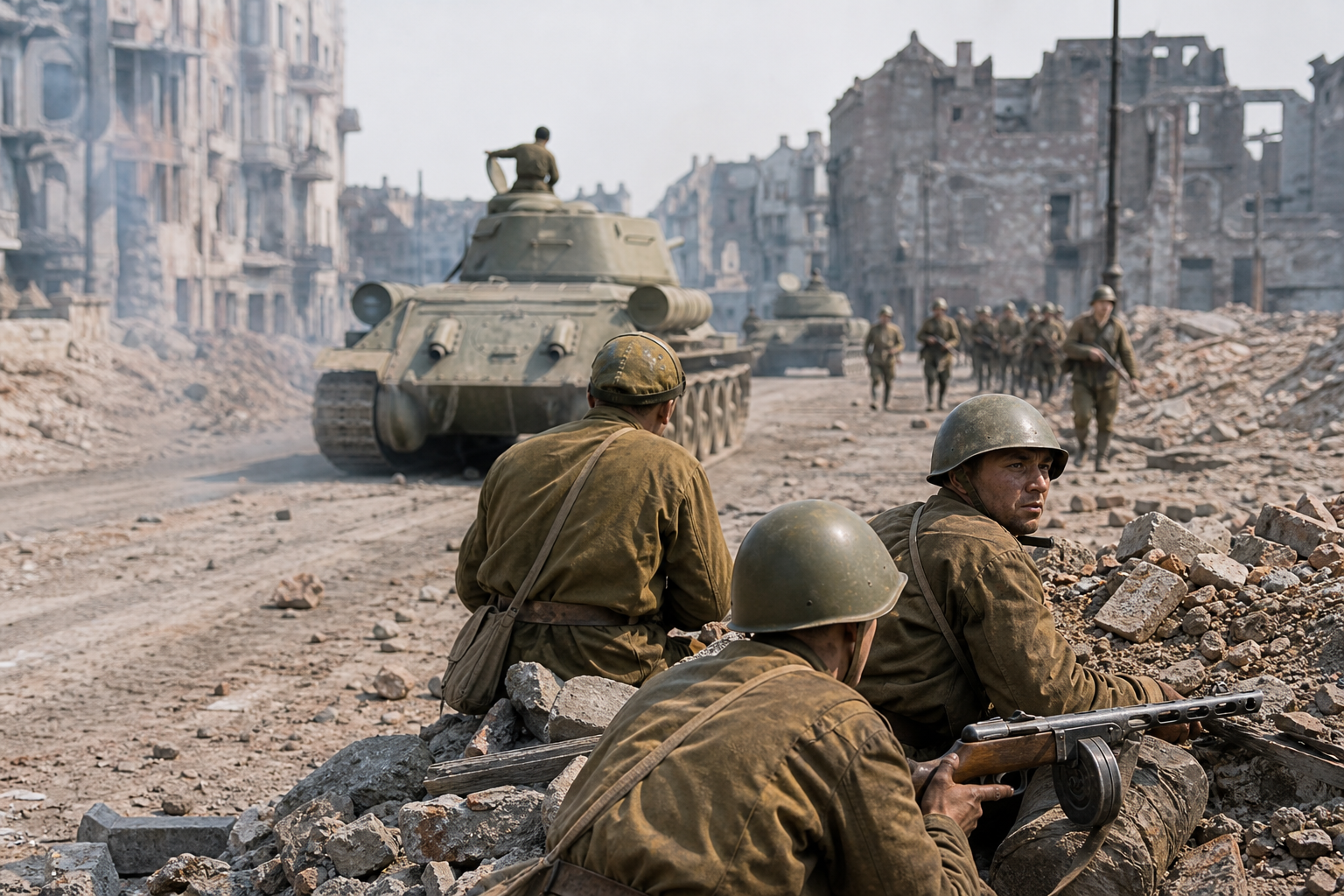
The encirclement phase (April 21–25) is notable for both its operational decisiveness and the human cost. Soviet troops, sometimes advancing in echeloned formations supported by massed artillery barrages and air strikes, exploited gaps between German corps. By April 25 the Soviet fronts met in the northwest and south of the city, effectively sealing Berlin. At that moment, the battle transformed. The larger maneuver war — with its sweeping breakthroughs and operational envelopment — gave way to grinding urban combat where artillery and armor could not simply roll over narrow streets and fortified buildings. Urban warfare negated numerical superiority in many ways and required painstaking clearing operations block by block.
Inside Berlin, the German defenders attempted to assemble a coherent defense under General Helmuth Weidling, who had been appointed commander of the Berlin Defense Area in mid-April. Weidling faced impossible odds: his forces were a mosaic of depleted infantry units, SS detachments, police battalions, Hitler Youth, and Volkssturm. Ammunition was limited, supply lines were severed, and morale was fractured by the realization that relief was unlikely. Yet in some districts, German defenders leveraged the built environment to create killing zones — barricaded streets, booby-trapped buildings, and interlocking fields of fire. For the Soviets, this meant costly, close-quarters fighting.
Did you know? The iconic Reichstag flag photograph by Yevgeny Khaldei was staged after the building’s capture and drew inspiration from earlier famous war images.
Soviet assault groups adapted techniques learned elsewhere but scaled to unprecedented proportions. Artillery concentrations were used to level heavily defended blocks, clearing the way for infantry and engineers. Tanks were used in integrative roles, sometimes forced to enter buildings or cover advancing infantry in narrow streets. Flamethrower teams, sappers, and grenadiers became essential. The result was horrific: entire neighborhoods became cratered shells where the front line could move only a few dozen meters a day, sometimes less. The casualty rates among assault units soared accordingly.
The civilian population was caught in the crossfire. Evacuation routes were largely closed or too dangerous; many civilians sought shelter in basements and underground rail stations. Shortages of food, water, and medical care compounded the physical dangers of bombardment. Soviet commanders issued directives meant to preserve momentum, but the reality of street fighting made control of forces difficult, and instances of indiscipline occurred. The deterioration of order in the city — the breakdown of civil services, the collapse of policing structures — contributed to a chaotic and often lawless environment.
Emblematic engagements included fighting around central transportation hubs, government buildings, and key bridges across the Spree and Havel rivers. Both sides improvised: Germans placed tanks in buildings for surprise flanking, while Soviets turned to night attacks to exploit weaknesses. The smell of cordite, fire, and sewage mingled with the constant drone of artillery; the urban setting magnified the psychological strain on soldiers and residents alike. Reports from the front detail frantic street brawls, sniper duels from ruined attics, and desperate counterattacks that briefly reclaimed small blocks only to be repelled by superior Soviet numbers.
Did you know? Contemporary estimates suggest tens of thousands of civilian deaths in Berlin during the battle, though precise numbers remain debated among historians.

The Führerbunker and Hitler's Last Days
Beneath the New Reich Chancellery, the Führerbunker became a claustrophobic theatre of collapse. From early 1945, as Allied bombs reduced Berlin to rubble and hope to ash, Adolf Hitler had retreated into this subterranean compound where he would spend his final days. The bunker, designed for protection against air raids, was a confined space where the Führer, his entourage, secretaries, and the last loyalists gathered to witness the disintegration of a regime they had once believed unassailable.
Hitler’s last days were marked by delusion, rigid ideology, and fatalism. Despite the tactical situation collapsing, he continued to issue impossible orders: counterattacks that could not be mounted and defenses that could not be sustained. The famous refusal to authorize breakout attempts from the city or allow commanders to retreat when it might have preserved forces was emblematic of a leader disconnected from reality. On April 29, he married Eva Braun in a brief ceremony in the bunker and dictated the political testament that would attempt to place responsibility and succession on paper, naming Karl Dönitz as his successor.
On April 30, 1945, Hitler committed suicide alongside Eva Braun. Their bodies were carried to the Chancellery garden, doused in petrol, and set alight according to Hitler’s instructions. The act was as much a finale to an ideology as to a man. In the hours that followed, the German command in Berlin unraveled rapidly. Joseph Goebbels, the propagandist who had been Hitler’s loyal lieutenant, assumed the position of Chancellor but only briefly; on May 1 he and his wife Magda poisoned their six children before taking their own lives. The moral abyss of those final days — simultaneous acts of self-delusion, cruelty, and surrender — left a city with a leadership vacuum just when it needed coherent negotiation.
Did you know? General Helmuth Weidling surrendered Berlin on May 2, 1945; Germany’s unconditional surrender followed days later and is commemorated as VE Day on May 8.
With Hitler gone, General Helmuth Weidling sought to negotiate surrender to minimize further civilian casualties. Weidling’s decision was daring and pragmatic, aimed at averting needless bloodshed in a dead city. But the situation was complicated by the multiplicity of German commanders, the ideological fragmentation among die-hard Nazi units, and the chain of command that had been decapitated by Hitler’s death. Some units continued to fight out of conviction, others from lack of awareness, and some from sheer survival instinct.
The bunker itself, once a place of administrative command and centralized decision-making, became a symbol of the regime’s failure — a cramped tomb of fanaticism and fatal choices. The surrealities of those final conversations — orders given with no possible meaning, attempts to rationalize collapse, triumphant one-liners to bequeath leadership — have been recounted by survivors and chroniclers, but they cannot fully capture the mixture of delusion and terror that characterized the bunker’s atmosphere.

The Fall of the Reichstag and Symbolic Victory
Few images of the Second World War are as resonant as the photograph of the Soviet flag being raised over the Reichstag. That photograph, taken amid smoke and ruin, crystallized the Soviet victory and became a global symbol of the end of Nazi power. But the capture of the Reichstag was less a single heroic climax and more the culmination of ferocious, protracted combat that reduced the building and its surroundings to a battlefield.
Did you know? The photo of the Soviet flag over the Reichstag became one of the most reproduced images of WWII and helped shape Soviet victory mythology.
The Reichstag had been chosen by both sides as a symbolic objective. For the Soviets, raising a flag over the house of parliament would represent not only military success but the moral and political defeat of Nazism. For the Germans, the building was a last-ditch defensive landmark; it was heavily fortified and fought over fiercely. Soviet units assigned to take the Reichstag engaged in repeated assaults, often under murderous fire. The capital’s dense layout meant that approaches were clogged with rubble and that attackers faced interlocking defensive positions. Engineers and assault detachments were tasked with clearing floors, breaking through walls, and dealing with stubborn snipers.
On April 30, as the siege tightened and Hitler’s suicide reverberated through the city, assault groups penetrated the Reichstag. The famous photograph of the hoisted flag was taken on May 2 in the aftermath of the final German surrender in Berlin. There is controversy and nuance around details: several Soviet soldiers claimed to have been the first to raise a banner; multiple photos and staged representations exist; and the exact identity of the soldier in the iconic picture (often misattributed) has been debated. Yevgeny Khaldei’s famous photograph, inspired by images such as Joe Rosenthal’s Iwo Jima raising, was a constructed moment intended to capture the essence of victory rather than the literal single initial act.
Beyond symbolism, the fall of the Reichstag had practical implications. It signaled the breakdown of organized government authority and made it clear that the heart of political power was in Soviet hands. German military units, seeing the papery remnants of centralized governance disappear, became more willing to surrender or simply cease coordinated resistance. The emotional release that accompanied the Reichstag’s capture was profound: for Soviet soldiers it validated immense sacrifice; for Germans, it underscored the irreversible end of the regime.
Yet the photograph and the theatricality of the moment can obscure the blood cost and the messy human reality. Troops who raised flags were exhausted, often wounded, and their victories were scored against a backdrop of civilian suffering and ruin. The Soviet command recognized the propaganda value of the Reichstag image and circulated it widely. In doing so, it crafted a narrative of liberation and heroism that also served Soviet political ends — portraying the Red Army as the decisive liberator of Europe while simultaneously cementing Soviet presence in central Germany.

Civilian Suffering, Looting, and the Human Cost
While military narratives focus on maneuvers and command decisions, the story of Berlin’s fall is inseparable from the suffering endured by its civilian population. From the opening salvos of the Soviet offensive to the chaotic days of surrender, ordinary inhabitants endured bombardment, disease, hunger, and the collapse of public order. The scale of civilian suffering is difficult to quantify precisely: estimates of civilian deaths in Berlin during April–May 1945 vary widely, but tens of thousands are generally accepted. Many perished in the aerial bombardments and artillery strikes, while others died amid the breakdown of infrastructure and medical services.
One of the most contested and tragic aspects of the battle was the widespread sexual violence and looting that accompanied the Soviet advance. Historical accounts and survivor testimonies document mass rape perpetrated by some Soviet soldiers; historians estimate that tens of thousands of German women were assaulted in Berlin and the surrounding regions in 1945. Soviet political directives and the chaos of urban fighting contributed to uneven discipline, and while Soviet leadership later condemned such acts and prosecuted some offenders, the scale of suffering was enormous and left deep scars in German society.
Looting and the appropriation of property was another facet of the collapse. Soldiers, refugees, and opportunists entered abandoned apartments and homes, taking valuables and food. Cemetery of possessions that had belonged to Jewish Berliners — many of whom had already been deported or killed — were plundered. The moral geography of a defeated city had shifted: possessions that had once been markers of identity became resources for survival, and the lines between pillage, retribution, and necessity often blurred.
The wartime displacements were vast. Refugees who had fled to Berlin from occupied territories earlier in the war found themselves trapped. Shelters and hospitals overflowed, and medical staff worked under impossible conditions. The elderly and infirm were particularly vulnerable as supplies and fuel dwindled. Food shortages were acute: by April 1945 large sections of Berlin faced starvation-level rations. The colder spring nights, combined with the destruction of heating systems, added to the misery.
The occupation itself became the next chapter of hardship. Soviet authorities installed military administrations that prioritized security and reparations. For many Berliners, the transition from Nazi terror to occupation by a triumphant army was bewildering and traumatic. The political consequences — looting by troops, forced expulsions in following months, and eventual deportations — created legacy grievances that would feed into Cold War narratives.

Aftermath: Surrender, Occupation, and the Birth of a Divided City
On May 2, 1945, General Helmuth Weidling formally surrendered the Berlin garrison to Soviet forces, effectively ending organized German resistance in the city. The surrender marked a transition from active combat to occupation and the slow, wrenching process of mapping out a postwar order. Yet the fall of Berlin did not mean instant peace for Europe; pockets of fighting continued elsewhere for days, and formalities had to be observed. Germany’s overall military surrender would be signed on May 7 in Reims and ratified on May 8 in Karlshorst — dates that Western Europe and many Allied nations commemorate as Victory in Europe Day (VE Day).
Politically, the capture of Berlin empowered the Soviet Union in immediate and tangible ways. The Soviet military presence allowed Moscow to secure key infrastructure, to detain political opponents, and to establish administrative control in its occupation zone. At the same time, Allied occupation plans shaped by Yalta and subsequent agreements led to the division of Berlin into four occupation sectors: American, British, French, and Soviet. This partition was a practical administrative solution but also the seedbed for the future Cold War: a capitalist West Berlin surrounded by Soviet-controlled East Germany would become a focal point of ideological confrontation in the decades to come.
The physical reconstruction of the city was slow and arduous. Wartime destruction had obliterated large sections of Berlin’s housing and industrial base. The scale of damage required massive clearing operations, and the city’s population shrank as refugees and displaced persons moved on to other areas or fell victim to the ferocity of the immediate postwar period. Reparations claims and the seizure of German assets fed the early economic tensions between East and West. The Soviet Union shipped industrial equipment and resources out of its zone to rebuild its own war-ravaged territories, feeding resentment and hardship among the local population.
Memory politics also began early. In the Soviet Union, the victory at Berlin became a central pillar of wartime historiography and national identity, celebrated through parades, monuments, and state-sponsored remembrance. In the West, narratives emphasized the Allied coalition’s role in defeating Nazism, even as tensions rose about Soviet actions in Eastern Europe. For Germans, memory was complicated: the shame of Nazi crimes, the trauma of defeat, and the need for reconstruction created a layered relationship to the recent past.
The Fall of Berlin had legal and moral consequences. Many Nazi leaders were captured, some escaped temporarily, and others committed suicide. The Nuremberg Trials later attempted to assign responsibility and adjudicate crimes of war and crimes against humanity. But the immediate postwar months were more about survival and reorganization than about justice. The processes of denazification, displacement, and rebuilding occupied the lives of millions.
In the long view, the battle that ended in Berlin stands as the closing chapter of a cataclysmic European war, and the opening act of a new geopolitical era. The very victory that liberated much of Europe from fascist rule also paved the way for a bipolar world in which Berlin itself would be a divided city, a potent symbol of ideological confrontation and human resilience.
The Fall of Berlin is a story of extremes: of grand strategic planning and intimate human suffering, of triumphal images and the quietness of devastated neighborhoods. It is a study in how the ends of wars are often messy and morally ambiguous. The Soviet army’s operational brilliance and brute force ended the Third Reich, but the cost was measured in lost lives, ruined institutions, and an altered political map. The battle underscores a persistent truth about modern warfare: military victory does not automatically translate into moral clarity or postwar harmony.
Yet the battle’s symbolism refuses to fade. The picture of a flag over a parliamentary ruin acts as shorthand for liberation in many accounts and as a reminder of conquest in others. The narratives that grew from Berlin’s fall — Soviet liberation, Western restraint, Nazi collapse — have been retold and contested because they served postwar politics as much as they recorded historical facts. Understanding the Fall of Berlin requires holding these narratives side by side: honoring the sacrifice of soldiers without ignoring the misconduct, recognizing the strategic necessity of action while acknowledging political motives, and seeing civilians not as passive statistics but as agents of survival and memory.
The legacy reaches beyond geopolitics. The structure of Berlin itself — its streets, monuments, and scars — became a palimpsest on which subsequent generations would write new histories. The city’s division, the building of the Berlin Wall in 1961, and the eventual reunification in 1990 are all chapters that begin with the events of 1945. In public memory, the Fall of Berlin is the fulcrum between catastrophe and renewal: it ended a regime that had wrought unprecedented destruction, but it also launched an era defined by occupation, reconstruction, and ideological struggle.
Finally, the human stories that emerge from those days insist on nuance. Acts of heroism and brutality sat side by side; soldiers who had suffered enormously sometimes committed atrocities, and civilians who had been propagandized against the Soviets found themselves rescued — and violated — by the same forces. These complexities resist simple moral judgments. To study the fall of Berlin is to confront the difficult interplay of military necessity, political ambition, and moral responsibility. The city died and was reborn in rubble and resolution, and its fate continues to teach lessons about the costs of war and the fragile work of peace.


How we verify this article
By the History Unlocked editorial team
This text is built on historical facts stored in our database and drafted with AI assistance. No signed human review is recorded for this article. Report any inaccuracy: we correct it and update the modified date.
Updated on
AI-assisted drafting.
Read our editorial standardsEnjoyed this? Discover more articles in the category World War II