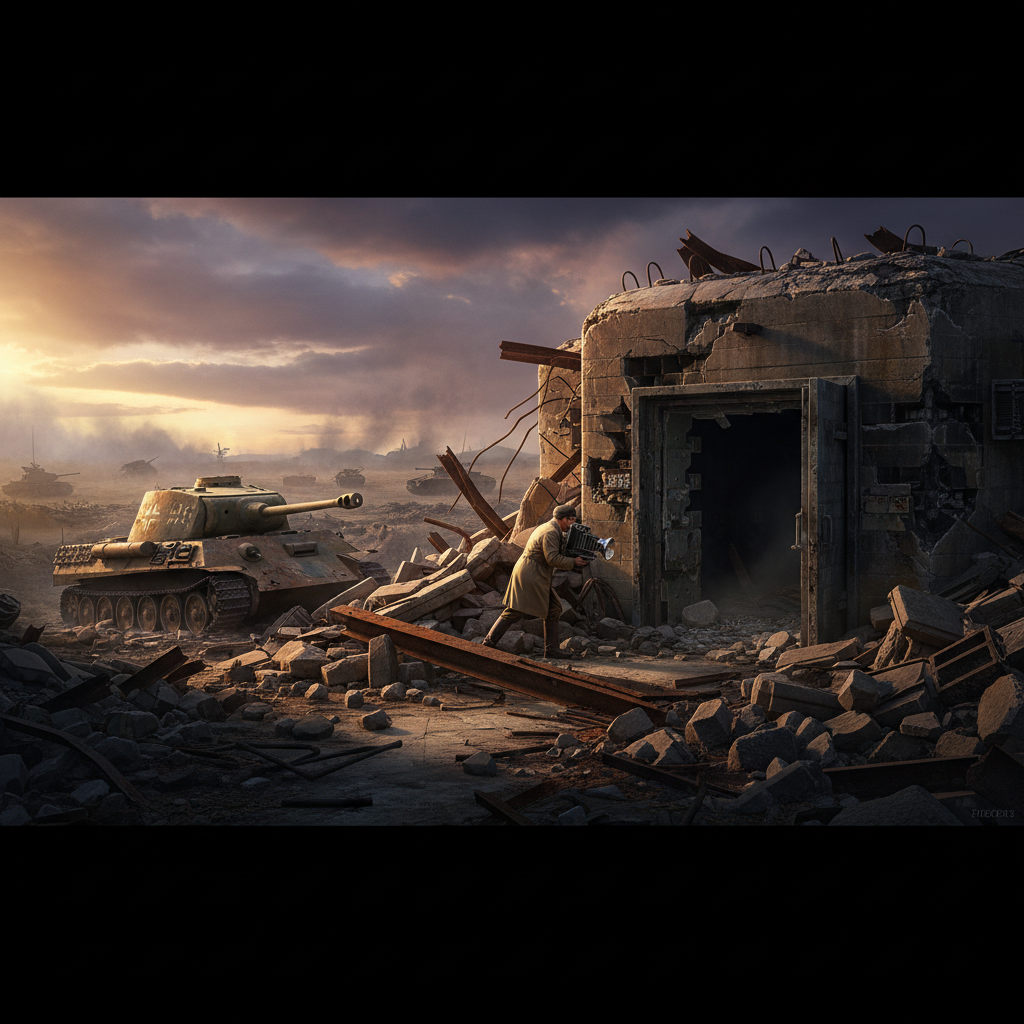
Inside Hitler’s Bunker: The Last Days of the Third Reich
The address is mundane, the surface unremarkable: a quiet corner of central Berlin where parked cars face new apartment blocks and a modest information board stands to one side. Yet beneath this ordinary skin once lay a subterranean nerve-center—the Führerbunker—where Adolf Hitler passed his final months and where, in April 1945, the Third Reich collapsed inward upon itself. The rooms were cramped, the air stale, the walls thick enough to muffle a city’s last convulsions. In those concrete corridors unfolded a drama of denial, loyalty, fear, and fatalism. The pacing of orderlies, the drone of generators, and the scratch of pens on hastily drafted testaments filled the place as the Red Army squeezed Berlin street by street.
To step, imaginatively, into Hitler’s bunker is to descend not only into physical depths but into a shrinking world of illusions. Maps on the walls showed fronts that no longer held. Telegraph keys and telephones rang with dwindling options. The familiar rituals of a dictatorship—briefings, promotions, speeches—continued as hollow ceremony. The bunker was never designed to host a nation’s endgame, yet that is precisely what it became. This article traces the bunker’s origin and architecture, the claustrophobic routines of its inhabitants, the frantic final days, the deaths that followed, and the long afterlife of the site itself: a story pieced together from diaries, testimonies, autopsy reports, and fragments of concrete. Much remains to be debated, but the broad lines are clear and chilling. They instruct us not only about a place but about the psychology of power when reality finally overwhelms ideology.
Beneath the Reich Chancellery: Origins and Architecture of the Führerbunker
The two levels were connected by a staircase and equipped with armored, gas-tight doors. Multiple escape routes were integrated into the design, including passages to the garden of the New Reich Chancellery. Within the lower bunker, small rooms were arranged along narrow corridors: a modest bedroom and study for Hitler, a sitting room and bedroom for Eva Braun, a conference room for military briefings, a communications hub with telephones and teletype, quarters for secretaries and aides, and ancillary spaces for power generation, ventilation, and storage. While the exact number of rooms and their precise measurements vary across plans—the complex evolved during subsequent modifications—contemporary sketches and reconstructions indicate several dozen compartments split between the upper and lower levels.
Did you know? Hitler rarely used the deeper bunker before 1945; during earlier air raids he more often sheltered in the upper Vorbunker or other facilities, descending fully only in the final months.
Practicality governed much of the bunker’s engineering. Ventilation systems with filters attempted to purge foul air; diesel generators kept lights and communications alive when the city’s power failed. Water pumps labored against Berlin’s high groundwater table, which made all subterranean building a challenge. The ceilings were low, the walls sweating with condensation, and the corridors claustrophobic. Despite its fearsome reputation, the bunker was not a palace beneath the earth; its furnishings were functional and plain, more reminiscent of a military shelter than a dictator’s lair. The defensive logic was absolute: survival during bombardment and the continuity of command. What no engineer could design, however, was psychological relief from the pressure that mounted as the war turned decisively against Germany.

Life Underground: Routines, Rooms, and the Claustrophobic Atmosphere
If the bunker’s architecture was functional, the life within it was ritualized. Every day organized itself around situation conferences, where Hitler received updates from army and SS officers. Maps papered the walls; pins and colored pencils tracked formations that, by spring 1945, were often fictional. The staff included secretaries like Traudl Junge and Gerda Christian, adjutants and orderlies such as Heinz Linge and Otto Günsche, and political figures like Joseph Goebbels and Martin Bormann who moved between the bunker and nearby buildings. Medical care rotated among several physicians, including SS doctors Werner Haase and Ludwig Stumpfegger after Hitler’s long-time physician Theodor Morell departed the bunker late in April.
The atmosphere was heavy—literally and figuratively. Diesel generators thrummed; ventilation fans coughed stale air. Smoking had to be managed carefully in confined quarters. Food preparation fell to a small kitchen and to Hitler’s dietitian and cook, Constanze Manziarly, who maintained his vegetarian regimen even as supplies dwindled. Personal routines persisted out of habit and hope: tea, short walks in the garden during artillery lulls, and, for some, moments of conversation to push back the press of despair. Yet sleep was fractured. Air raids, shellbursts, and the relentless drum of news kept most people to odd hours. Those who left the bunker, crossing its thresholds up into the ruins of the Reich Chancellery garden, returned with eyes rimmed in grit and disbelief.
Did you know? Several eyewitnesses, including secretary Traudl Junge, recalled frequent headaches and nausea among bunker staff—likely from diesel fumes, poor ventilation, and stress.
For all the hierarchy at play, the bunker could not blunt the democratizing force of proximity: powerful men and minor clerks shared the same stale air. Witness accounts speak to odors of damp concrete, disinfectant, and machinery oil. Water seeped into corridors, and condensation gathered on pipes. In a place designed to secure command, reality intruded in the most banal ways—as when dogs paced nervously, or when a door banged loudly and drew a momentary silence, everyone listening for the sound that might mean a direct hit. Outside, Berlin’s civilians crowded into their own shelters, and Soviet artillery crept ever closer. Inside, typed communiqués clattered through the teleprinter, bringing news that constricted prospects by the hour. The bunker’s routines, meant to convey control, only underscored how little of it remained.

The Final Days: From Hitler’s Birthday to the Collapse
By April 1945 the front lines raced not at a distance across maps but into Berlin itself. On April 20, Hitler’s fifty-sixth birthday, he emerged briefly to distribute medals to Hitler Youth and Volkssturm defenders in the Chancellery garden—an eerie echo of earlier triumphal rituals amid the whistle of incoming shells. In the following days, Soviet forces under Georgy Zhukov and Ivan Konev closed a vice on the capital. Allied airpower had reduced much of the city to rubble; inside the bunker, the situation briefings grew ever more strained. On April 22, after learning that SS-Obergruppenführer Felix Steiner’s counterattack would not materialize—Steiner lacked the forces—Hitler exploded in anger in a now-notorious tirade, denouncing his generals and declaring his intention to remain in Berlin and die there. It was a psychological pivot: the bunker went from a command post to a mausoleum-in-waiting.
The political edifice cracked in parallel. From his retreat in Berchtesgaden, Hermann Göring—long Hitler’s designated successor—telexed on April 23, asking whether he should assume leadership. Hitler interpreted this as disloyalty; Göring was stripped of his offices. Days later, news reached the bunker that Heinrich Himmler had sought to negotiate surrender through Count Folke Bernadotte of Sweden. Himmler too was denounced and dismissed. In a surreal scene on April 26, test pilot Hanna Reitsch landed in embattled Berlin with General Robert Ritter von Greim, whom Hitler promptly named as the new Luftwaffe chief. Such gestures carried more symbolism than substance; German defenses in and around Berlin, under General Helmuth Weidling, fought desperately but were doomed.
Did you know? Hitler’s marriage to Eva Braun was officiated by a minor city official, Walter Wagner, one of the few civil servants still on hand in the ruins of the capital.
Communications thinned. Telephone lines failed; messengers struggled through streets swept by fire. By April 28–29, the Soviet ring had tightened to the city center. On the night of April 28–29, in the bunker’s confined rooms, Hitler dictated his political testament and a personal will to his secretaries, apportioning blame and naming new leaders: Grand Admiral Karl Dönitz as President (Reichspräsident) to head a successor government, and Joseph Goebbels as Chancellor. The next day, in the early hours of April 29, Hitler married Eva Braun in a brief civil ceremony conducted inside the bunker. Witnesses recalled a small celebration afterward, a last, subdued ritual that tried and failed to mask the inevitability hanging over the rooms.
The final day, April 30, 1945, fell like a curtain. Soviet shells already raked the Chancellery grounds. Orders went out for last-ditch defenses and for the destruction of sensitive documents. Hitler met with a few remaining aides, said farewells, and withdrew with Eva Braun into his private suite. A short time later, a shot sounded. When attendants entered, Hitler was slumped on a sofa, dead by gunshot; Eva had taken cyanide. In keeping with instructions, their bodies were carried up into the shattered garden, placed in a shell crater, doused with petrol, and set alight as Soviet fire continued to fall.

Death in the Garden: Suicides, Burnings, and Soviet Discovery
The aftermath of Hitler’s suicide intensified the bunker’s fatal gravity. Joseph Goebbels, newly named Chancellor in Hitler’s testament, remained in Berlin with his wife, Magda, and their six children. On May 1, after a failed attempt by General Hans Krebs to negotiate terms with the Soviets—terms the Red Army rejected—Magda Goebbels killed her children using cyanide, an act facilitated in part by medical personnel in the bunker after the children had been sedated. Joseph and Magda then committed suicide, their bodies likewise burned outside in the Chancellery garden.
Did you know? Petrol was scarce in the bunker’s last days; witnesses recalled that repeated attempts were needed to keep the bodies of Hitler and Eva Braun burning under shellfire, leading to only partial cremation.
Elsewhere, desperate escape attempts unfolded. A breakout group including Martin Bormann, Dr. Ludwig Stumpfegger, and others tried to fight westward under cover of darkness; many were killed or would soon take their own lives. Bormann’s death remained the subject of rumor for decades until remains discovered near Berlin’s Lehrter Bahnhof in 1972 were identified as his; DNA analysis in the 1990s confirmed this identification. Within the bunker, others met their ends in different ways. Some shot themselves; others swallowed poison. Walther Hewel, a diplomat close to Ribbentrop and a veteran of the Nazi inner circle, took his life on May 2 after capture seemed imminent. A telephone operator and guard, Rochus Misch, survived and later published recollections that, while colored by self-justification, offered detail about the flow of people and messages in those last days.
The Soviets captured the Chancellery complex in early May. Soviet counterintelligence units (SMERSH) scoured the ruins and the bunkers, recovering charred remains from shell holes in the garden and from shallow graves. Their subsequent investigations included autopsies and, crucially, the identification of dental remains said to be Hitler’s. The Soviet leadership cloaked these findings in secrecy, in part for propaganda and security reasons, and accounts of the discoveries filtered westward in fragments. The opacity fed a cottage industry of speculation—escape to Argentina, death elsewhere, doubles—all claims that collided with the stubborn weight of physical evidence and eyewitness testimony.
Secrets, Skulls, and Testaments: What the Documents Reveal
The documentary record from the bunker’s finale is both abundant and agonizing. On April 29, Hitler dictated his last will and political testament, naming Karl Dönitz as head of state and Joseph Goebbels as Chancellor. The documents blamed the war on international Jewry and excoriated his own commanders. Copies were smuggled out by couriers who attempted to cross the front lines; some succeeded and eventually reached the remnants of German command. Dönitz established a rump government at Flensburg near the Danish border, seeking terms that might spare civilians and troops in the east. The Reich, however, was beyond salvaging.
Did you know? Soviet intelligence reportedly reburied and later exhumed Hitler-associated remains multiple times; in 1970 they were finally destroyed and the ashes scattered in a river to prevent a gravesite.
The physical evidence of Hitler’s death rests in part on dentistry—prosaic, precise, and persuasive. Hitler’s dental work was distinctive, and the Soviets located jaw fragments and dental bridges among the remains they exhumed. Soviet pathologists compared these with records from Hitler’s dentist, Hugo Blaschke. The testimony of dental assistant Käthe Heusermann and technician Fritz Echtmann, who had worked on Hitler’s dental apparatus, corroborated the identification. This convergence—eyewitness accounts of the suicide, immediate handling and partial cremation of the bodies, and the match of dental structures—forms the backbone of the historical case against the escape fantasies that proliferated after the war.
Secrecy, however, layered the story in ambiguity. Soviet archives were closed for decades. In the 1990s, Russian institutions revealed that what they had kept included jawbones and, controversially, a skull fragment with a bullet hole. Later analysis of the skull fragment suggested it might belong to a woman, not Hitler, renewing press attention. Yet the jaw remains—compared to radiographs and described by those who knew Hitler’s dental treatment—continue to align with the dictator. Historians caution against reading too much into any single artifact and stress the totality of converging evidence: testimony from officials like Otto Günsche and Heinz Linge; the contemporaneous diaries of Goebbels and others; the forensic record; and the dead end of postwar police investigations into supposed sightings around the world.
From Rubble to Parking Lot: The Postwar Fate of the Site and Memory
The Reich Chancellery complex was a ruin by 1945, and the bunkers beneath it were a headache for the victorious powers. Parts of the aboveground structure were demolished soon after the fighting ended. In the late 1940s, East German authorities undertook further demolition of bunker access points and the remaining Chancellery ruins, attempting to remove apertures that drew the curious. Yet the core of the underground complex proved stubborn; even heavy explosives could not pulverize every reinforced chamber. Over the decades, especially in the 1980s, more extensive construction reshaped the area. During East Berlin’s late socialist period, additional demolition and backfilling buried what remained of many subterranean spaces. By the time of German reunification, the site had been integrated into a new cityscape.
Did you know? The site today is deliberately understated; authorities feared that a dramatic memorial could attract neo-Nazi pilgrims, so they opted for low-key signage and ordinary urban fabric.
Today, the place where the bunker once lay is unassuming by design. The decision to keep it so reflects a careful calculus: to document without glamorizing. In 2006, an information board went up near the site for the World Cup influx of visitors, explaining the bunker’s position relative to the surrounding streets. No stones plead for attention; no dramatic markers invite pilgrimage. It is a car park and a patch of grass amid apartment blocks—a landscape that quietly refuses to monumentalize mass murder. Guides can point to the general location, and historians can map the underground rooms with reasonable fidelity based on Soviet surveys and postwar excavations, but there is no sanctioned descent into the underworld.
Memory, like water, finds its own channels. For Berliners and visitors, the very ordinariness of the spot serves as a lesson: tyrannies end not always in grandiose tombs but in places we pass on our way to somewhere else. Researchers continue to publish new analyses of fragments—concrete cores, archive photographs, engineering notes—that refine our picture of the bunker’s layout and fate. Meanwhile, the city’s museums and memorials direct attention to victims rather than perpetrators. If one feels compelled to look for the bunker, one finds instead a city that has learned, with difficulty and imperfectly, to live with its history without letting that history dictate every block.

To visit Hitler’s bunker in the imagination is to confront how the hard shell of concrete can protect bodies but not beliefs. The story of those rooms begins with engineering—thick walls, air pumps, armored doors—and ends with a portrait of failure that no thickness could stem. In the pressurized atmosphere of spring 1945, the bunker became a crucible that concentrated all the traits of the regime: the ritualization of command, the denial of reality, the insistence on loyalty to the point of annihilation. Within its tight corridors, final orders were barked that reorganized nothing. Marriages were contracted and testaments signed that reclaimed no future. Suicides and killings gave the garden above a grim harvest under the fire of Soviet guns.
Out of this demise rose questions that have preoccupied journalists and historians for decades. Were the autopsies reliable? What exactly was found, lost, or reburied? How do we weigh testimony born under duress against evidence recovered in secrecy? Each new publication or declassification tends to narrow rather than widen the field of plausible scenarios. The weight of material—dental comparisons, overlapping eyewitness accounts, and the lack of credible postwar sightings—anchors the prevailing consensus: Hitler died in the bunker on April 30, 1945, and his remains were partially burned and later identified.
What remains above ground is as telling as what lies below it. By leaving the site unadorned, Berlin resists fetishizing the dictator’s end. The city offers context elsewhere—in museums, memorials, and documentation centers—while declining to excavate a shrine. The bunker has, in effect, been consigned to footnotes and maps, to the steady work of archivists and engineers rather than to spectacle. That choice is a judgment of history: a recognition that some places must be understood but not enshrined, studied but not staged. Beneath an ordinary car park rests the most infamous basement in modern Europe—now sealed, its power spent, a mute witness to the far louder memory of those whom the regime sought to erase.
How we verify this article
By the History Unlocked editorial team
This text is built on historical facts stored in our database and drafted with AI assistance. No signed human review is recorded for this article. Report any inaccuracy: we correct it and update the modified date.
Updated on
AI-assisted drafting.
Read our editorial standardsEnjoyed this? Discover more articles in the category World War II