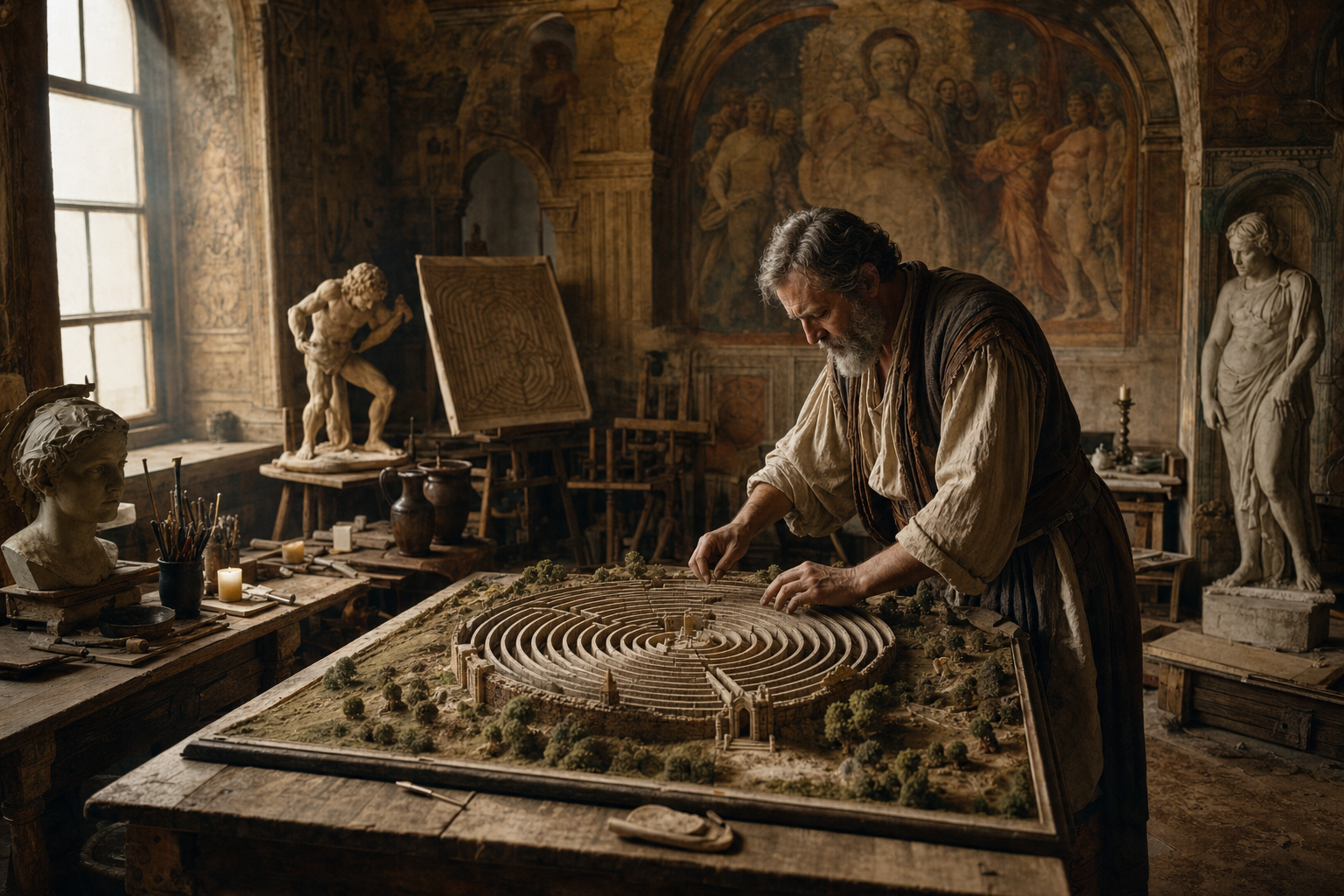
Labyrinth Symbolism: From Minos to Modern Minds
The labyrinth is one of those images that seems to live in the collective shadow of human history, a braided sign that draws us inward and makes us pause. It appears in pottery and palace frescoes, in the floor of cathedrals, in garden hedges and in the metaphors of poets. It is at once a physical structure, a mythic stage, and an interior map. To follow the story of labyrinth symbolism is to move between archaeology and legend, to touch on the ancient stones of Crete and the columns of Egyptian courts, to feel the worn grooves of medieval pavement underfoot and to trace the modern lines of psychology and literature that have rehabilitated the labyrinth as a site of reflection rather than only of entrapment.
This introduction will set the mood: labyrinths are not merely puzzles or quaint garden entertainments. From the Bronze Age palaces that inspired the Minotaur myth to the labyrinthine mosaics of antiquity, their forms have carried meanings about power, initiation, sacred enclosure, and the human desire to order chaos. Across centuries, the symbol has been adapted and readapted — sometimes with continuity, sometimes with deliberate reinvention — and always with a sense of mystery. In this article we will move chronologically and thematically, pairing archaeological and historical evidence with the interpretive lenses that have magnified the labyrinth’s power: myth, ritual, architecture, and psychology.
The narrative that follows is deliberately mystery-driven. It will dwell on vivid scenes — the frescoed courts of Knossos where archaeologists once believed palace corridors mirrored myth; the accounts of Herodotus and later Greek geographers in awe of an Egyptian labyrinth at Hawara; the rhythmic walking of pilgrims across medieval cathedral stone; the clipped hedges of a Baroque maze where courtiers gambolled and whispered. At every stage we will ask: what did contemporaries see in these forms? Which layers of meaning are most directly supported by the evidence, and which belong to later centuries’ projections? And lastly: why does the labyrinth retain such evocative power in the modern imagination, from Borges’s fiction to Jungian therapy rooms?
Did you know? Herodotus described the Egyptian Labyrinth at Hawara as more impressive than the pyramids, a judgment that inspired centuries of curiosity and nineteenth-century excavations by Flinders Petrie.
This article is grounded in verifiable history, archaeology, and scholarship. It cites well-attested facts about excavations, inscriptions, medieval practice, and the documented careers of artists and writers who returned frequently to labyrinthine images. Where interpretation is contested, the text will be explicit about debate and uncertainty. The goal is not merely to catalog labyrinths, but to narrate a long human engagement with a figure that remains both concrete and suggestive: a circuit that is also a story.
Origins and Early Archaeology
The classical genealogy of the labyrinth begins in the ancient Mediterranean, where archaeological remains and ancient texts mingle with myth. The best-known origin story, of course, is the Cretan labyrinth of King Minos, the maze set to contain the Minotaur and finally penetrated by Theseus with the help of Ariadne’s thread. Myth aside, the archaeological reality that arguably generated these tales is the Bronze Age palace complex at Knossos on Crete. Excavated and controversially restored by Sir Arthur Evans beginning in 1900, Knossos is a sprawling complex of rooms, corridors, staircases, storage magazines, and ritual spaces dating to the Minoan civilization (roughly 2000–1400 BCE). Evans saw in the palace’s complexity a physical analog to the labyrinth of myth; he popularized the association between the palace’s plan and the idea of a maze, though modern scholars caution against equating the palace strictly with the mythic labyrinth.
One tangible piece of linguistic and iconographic evidence often invoked in discussions of the “labyrinth” is the labrys, the double-headed axe that appears frequently in Minoan art. Some scholars have proposed that the word labyrinth derives from labrys + -inthos (place or house), suggesting a ‘house of the double axe.’ This etymology is intriguing because machete- or axe-shaped cult objects are prominent at Knossos and elsewhere in Minoan Crete, but linguistic certainty is lacking: the precise origin of the word labyrinth remains debated among philologists. The labrys connection remains an evocative, if not definitive, link between symbol and name.
Did you know? Labyrinth motifs appear on Greek pottery as early as the Geometric period (c.900–700 BCE), and the classical seven-circuit pattern persisted across Roman mosaics and decorative arts.
Far from Mediterranean shores, another monumental structure referred to as a “labyrinth” appears in ancient Egyptian descriptions. Herodotus, writing in the fifth century BCE, and later geographers such as Strabo and Pliny the Elder, described a great labyrinth at Hawara, near the Faiyum region, constructed under the Middle Kingdom pharaoh Amenemhat III (c. 19th–18th centuries BCE). Herodotus praised this Egyptian labyrinth for its scale and complexity, suggesting it outshone even the pyramids. Modern archaeology has confirmed that a massive mortuary and administrative complex did exist at Hawara; excavations led by W. M. Flinders Petrie in the late nineteenth century uncovered foundation walls and architectural fragments that gave substance to the ancient accounts. The Egyptian labyrinth served tomb, temple, and administrative functions and was evidently a highly organized monumental complex rather than a puzzle arranged to confound intruders; yet the Greek writers’ language framed it in terms that resonated with their own cultural categories for complex, enclosed structures.
The archaeological record thus provides twin early anchors for the labyrinthary imagination: the Minoan palatial plan, with ritualized architecture and sacral iconography, and the Egyptian monumental complex, famed in Greek prose for its impressiveness. Both sites fed later imaginings and metaphors. Archaeologists and historians continue to debate the degree to which Bronze Age palaces like Knossos were perceived by contemporaries as maze-like. Excavation reports, pottery assemblages, and Linear B administrative tablets demonstrate that these were sophisticated centers of storage and ritual; the labyrinthic image is therefore as much an interpretive overlay as an archaeological fact.

Classical Patterns: From Pottery to Pavement
A form we could recognize as the “classical labyrinth” appears repeatedly in Greek and Roman decorative arts: as a motif on pottery, as a device in mosaics, and occasionally as architectural ornament. The classical or ‘Cretan’ labyrinth motif — constructed of continuous lines that fold into a pattern of seven circuits terminating in a central point — is more symbolic than functional. It differs from a multicursal maze in that it is unicursal: there is a single continuous path that leads to the center without choices or dead ends. This geometric pattern can be found engraved on amulets, painted on pottery, and set into floors; it constitutes a visual shorthand for the idea of an ordered yet inward-turning journey.
Did you know? The Chartres labyrinth dates to the early thirteenth century and was likely used by medieval worshippers as a symbolic or penitential walk, functioning as a substitute for pilgrimage to Jerusalem.
On Greek pottery and in Geometric period art there are labyrinthine motifs dating back to the late first millennium BCE. Archaeologists catalog such motifs from the Geometric period (c.900–700 BCE) through the Archaic and Classical epochs. The pattern’s persistence suggests that it carried symbolic weight independent of the specific Minoan myth — a sign for enclosure, protection, or sacred space. Roman authors and visual culture inherited and adapted these motifs: labyrinth motifs appear in Roman contexts as well, including mosaics and small-scale decorative architecture. In the Roman imperial period labyrinth motifs could be purely decorative, but they could also signal ritual or mythic associations. Labyrinth designs appear on Roman bath-house pavements, where the ordered repetition of the line could mirror social or cosmological harmonies valued by patrons.
Coins and seals occasionally preserved labyrinthine imagery, and the pattern’s recurrence across mediums indicates its portability as a symbol. In some cases, the labyrinth motif was explicitly associated with protective or apotropaic functions — a design meant to ward evil away from the household or to mark a threshold. The labyrinth’s single, unbranching path made it especially suitable for such symbolic uses: a path that arrives at the center is a controlled path, an ordered descent that can be retraced. In the Mediterranean world, where sacred spaces were frequently bounded by thresholds and doorways of ritual significance, such patterns reinforced the idea of enclosure.
Medieval artists and masons later inherited and misread many of these motifs, reassigning their meanings in the context of Christian cosmology. By the High Middle Ages the labyrinth’s image had been folded into new narratives about pilgrimage and penitential practice. But in the classical period the motif seems to have been polyvalent: protective, decorative, and evocative of mythic narratives without being reducible to any single function.
Did you know? The Hampton Court Maze dates from around 1690 and is one of the oldest surviving hedge mazes in Britain, built as a recreational feature for the royal palace.

Medieval Christianity and the Cathedrals
One of the most poetic and enduring manifestations of labyrinth symbolism appears in the stone floors of Gothic cathedrals. The most famous surviving example is the labyrinth on the nave floor of Chartres Cathedral in France, laid down in the early thirteenth century. Chartres’ labyrinth is unicursal and composed of eleven concentric circuits leading to a central rosette; it is located in the nave rather than the ambulatory or the cloister, which has prompted enormous scholarly discussion about its intended use and symbolic function. Some medieval sources suggest that labyrinths in ecclesiastical contexts represented the pilgrimage to Jerusalem, a symbolic path for those who could not make the long and perilous journey; others emphasize penitential and meditative practices associated with walking the circuit.
Historical records show that cathedral labyrinths were not universal and that some that did exist were later removed; for example, the great medieval labyrinth at Reims (destroyed in the seventeenth century) is known only through ephemeral records and antiquarian drawings. Chartres remains particularly evocative because of its preservation; the floor’s stones still show traces of wear from medieval feet, and the labyrinth’s symbolism can still be read as a physical, communal practice. Pilgrims and penitents, unclear or unable to travel to Jerusalem, might have walked the labyrinth as an enacted metaphor for the long spiritual journey. The cathedral labyrinth thus functioned as a devotional object that combined visual symbolism with embodied ritual.
Scholars debate whether the Chartres labyrinth was used for processional performance, as a pedagogical tool for teaching Christian cosmology, or as a substitute pilgrimage. There are also suggestions that labyrinths encoded cosmological or esoteric knowledge — for instance, symbolic correspondences between the path’s turns and aspects of salvation history — though such readings sometimes venture far from the strictly documentary evidence. Importantly, medieval ecclesiastical use of labyrinth imagery did not imply ignorance of classical associations; monastic and clerical intellectual life commonly drew on classical texts, and symbols migrated across cultural boundaries.
Did you know? The phrase "Ariadne's thread" is used in modern problem solving as a metaphor for a method that guarantees a way through complex problems — a direct linguistic inheritance from the myth.
The medieval period also saw the conflation of labyrinthic imagery with moral and allegorical literature. The language of tangled paths and intricate enclosures turns up in sermons and devotional writing as a way to represent the soul’s trials; labyrinth metaphors thereby became part of the vernacular idiom of spiritual struggle. That usage helped perpetuate the labyrinth motif into later periods, where it found new contexts in gardens and courtly entertainments.
Labyrinths in Renaissance Gardens and Hedge-mazes
By the Renaissance and into the Baroque era, the image of the labyrinth moved from stone to garden. The courtly hedge-maze became a theatrical, recreational incarnation of labyrinthine symbolism. These mazes were multicursal — true puzzles — and they were designed for play, seduction, political display, and the controlled enjoyment of court life. Rather than the singular, meditative path of the cathedral labyrinth, these garden mazes offered choice, confusion, and encounter: a visitor might be lost, might meet companions in the dark of clipped hedges, or might find a central pavilion offering views and caprice.
The Hampton Court Maze, planted around the late seventeenth century at the palace near London, is an exemplary survival of this tradition. Dating to roughly the 1690s and associated with the grounds kept during the reign of William III, Hampton Court’s layout exemplifies the English taste for the living, clipped labyrinth. In France, labyrinths and elaborate parterres were features of the great formal gardens — the Labyrinth at Versailles is well documented in inventories and period descriptions as a series of sculpted fountains and allegorical scenes that accompanied walkways; it was replaced and reworked several times during Louis XIV’s reign to reflect changing tastes.
Did you know? Jorge Luis Borges’ "The Garden of Forking Paths" (1941) uses labyrinthine metaphors to explore narrative multiplicity; his work helped reframe the labyrinth as a central device of modern literature.
Garden labyrinths played multiple roles: they were sites of courtly display and social performance, but they could also be moral or allegorical spaces. Courtly texts and operas staged scenes of confusion and discovery in hedged mazes; sometimes mythic narratives, notably the Theseus-Ariadne story, were enacted or alluded to in garden settings where lovers might stray and be rescued. In the early modern period the labyrinth could be read as a metaphor for political life — winding, risky, and requiring cunning to navigate — or as a test of character and wit.
Architects and gardeners took delight in the optics of the maze. Garden designers used perspective, topiary, and sculptural vignettes to produce staged experiences that announced power and control over nature even while they simulated disorientation. The contrast between the ordered interior path of ancient labyrinths and the playful complexity of modern mazes reveals a cultural shift: where medieval church labyrinths emphasized inwardness and penitence, early modern garden mazes emphasized social drama and aesthetic pleasure.

Symbolism and Interpretation: Myth, Ritual, and Psychology
The journey from myth to modern psychology shows how the labyrinth has been repeatedly reinterpreted to fit evolving cultural needs. In myth, the labyrinth is primarily associated with the Cretan tale: King Minos commissions Daedalus to build a structure so complex that his half-man, half-bull offspring, the Minotaur, could be contained. Theseus volunteers to enter the labyrinth and slays the monster, returning on Ariadne’s thread — a literal line that guarantees a route back. That image — the guiding thread — is itself a potent symbol. Ariadne’s thread became a metaphor across centuries for a guiding principle that helps one find one’s way amid complexity.
Did you know? Modern labyrinth-walking practices, revived in the late twentieth century, draw explicitly on medieval and archaeological precedents to create contemplative experiences in hospitals, cathedrals, and parks.
In ritual and initiation readings, scholars have suggested that labyrinths functioned as symbolic journeys of death and rebirth. Initiatory movements — entering, reaching the center, and returning — parallel rites of passage in many religious and mystery cult contexts. Scholars of religion and anthropology sometimes compare labyrinthal movement to other ritual circuits, such as circumambulation practices seen in Buddhism, Hinduism, and the pilgrimage circuits of Islam and medieval Christianity. The concentricity of the labyrinth suggests a journey toward a sacred center, an axis mundi where the human and divine meet.
Modern psychological readings owe much to Carl Gustav Jung and later psychoanalytic and humanistic writers who treated the labyrinth as an image of the psyche. Jung saw the labyrinth as an archetypal symbol reflecting the inner journey toward individuation — the process by which the conscious self integrates unconscious contents to become whole. For Jungians, the center of the labyrinth might be interpreted as the Self, a point of integration where fragmented aspects cohere. Labyrinth-walking therapies that became popular in the late twentieth century invite participants to treat the act of walking a unicursal labyrinth as a form of contemplative practice, a method to externalize and reflect on one’s internal movement.
The labyrinth also intersects with literature and modern critical thought. Jorge Luis Borges made the labyrinth a central trope in several stories, using its geometry to probe questions about time, choice, and narrative structure. Borges’ labyrinths are often metaphysical: endless libraries, forking paths, and monstrous books evoke the intellectual and existential perplexities of the twentieth century. Similarly, artists like M. C. Escher created visual works that summon labyrinthine dizzying spaces and paradoxes, translating the ancient figure into modern visual paradox.
Modern Revivals and Cultural Afterlives
The twentieth and twenty-first centuries have seen renewed interest in the labyrinth across a range of cultural fields — public art, therapeutic practice, urban design, and popular media. Labyrinth-walking as a consciously meditative act has become popular in wellness communities; contemporary cathedrals and hospitals sometimes include turf or canvas labyrinths for visitors who seek quiet reflection. Designers have also returned to labyrinth motifs for public plazas, mosaics, and corporate landscapes, where the graphic sign conveys both tradition and contemplative aspiration.
In literature and film, labyrinths continue to signal narrative complexity and existential uncertainty. Borges’ influence reverberates through later writers who use labyrinths to stage questions of fate and multiplicity. Films and videogames too make systematic use of labyrinthine environments to produce psychological and aesthetic effects: from classical horror movies that show characters lost in institutional corridors to modern interactive media that simulate maze-like levels, the labyrinth continues to be an engine of narrative tension.
Contemporary scholarship on labyrinths tends to be interdisciplinary, bringing together archaeologists, historians of religion, art historians, and scholars of literature to interpret the multiple lives of the symbol. Debates persist: were Bronze Age palaces ever called labyrinths by their builders, or is the association purely a later interpretive construction? Were medieval cathedral labyrinths used as penitential walks or only as floor ornament? Interdisciplinary research that combines material analysis, documentary records, and anthropological insight yields more nuanced answers than monodisciplinary claims.
Public fascination with labyrinths is not purely antiquarian. Communities build new labyrinths as community projects — turf labyrinths, labyrinth mosaics, or sidewalk inlays — precisely because the image still speaks to contemporary concerns about orientation, memory, and shared ritual. The labyrinth’s adaptability, its ability to accommodate literal walking, sculptural design, and metaphorical use, explains its endurance. In a world where complexity is often linked to anxiety, the labyrinth offers a paradoxical solace: a structure that promises a route inward and eventually out.

Conclusion: The End and the Return
The story of labyrinth symbolism is not a simple tale of descent and conquest but an ongoing conversation between built form, mythic imagination, ritual practice, and psychological reflection. From the stone and plaster of Bronze Age palaces and Egyptian complexes to the mosaic floors of classical antiquity, from medieval church pavements to clipped royal hedges and modern mosaic plazas, the labyrinth has been remade according to changing cultural needs. Its contours have provided societies with a way to think about containment and release, danger and safety, confusion and revelation.
What makes the labyrinth persist as a symbol is its capacity to hold multiple, even contradictory meanings. It can be a prison, as in the Minotaur myth; a path of initiation, as in many ritual interpretations; a playground for courtiers lost in clipped hedges; a quiet walking meditation for a twenty-first-century visitor seeking solace. The archetypal power of the labyrinth is that it stages movement — toward a center, back toward an exit — that mirrors our narrative imaginations. Even when the physical structures are gone, the image endures in text, floor designs, garden plans, and therapeutic rooms.
For historians and archaeologists the labyrinth invites responsible restraint. It tempts with easy analogies and dramatic headlines, yet the historical record often resists tidy stories. Excavations and documents can show us where labyrinth-like motifs were used and how medieval communities used stone circuits, but they rarely hand us a single, definitive meaning. The work of interpretation must take into account context, material evidence, and the shifting interpretive needs of later readers.
For the general reader, however, the labyrinth maintains a compelling invitation. It says: step in, trace a line, and see how the path changes you. That invitation accounts for the labyrinth’s modern revivals in contemplative practice and public art. The ancient motif continues to be a living form because it addresses a perennial human problem — how to navigate complexity, how to find a center amid noise and distraction, and how to return with a thread of meaning.

How we verify this article
By the History Unlocked editorial team
This text is built on historical facts stored in our database and drafted with AI assistance. No signed human review is recorded for this article. Report any inaccuracy: we correct it and update the modified date.
Updated on
AI-assisted drafting.
Read our editorial standardsEnjoyed this? Discover more articles in the category Art & Symbolism