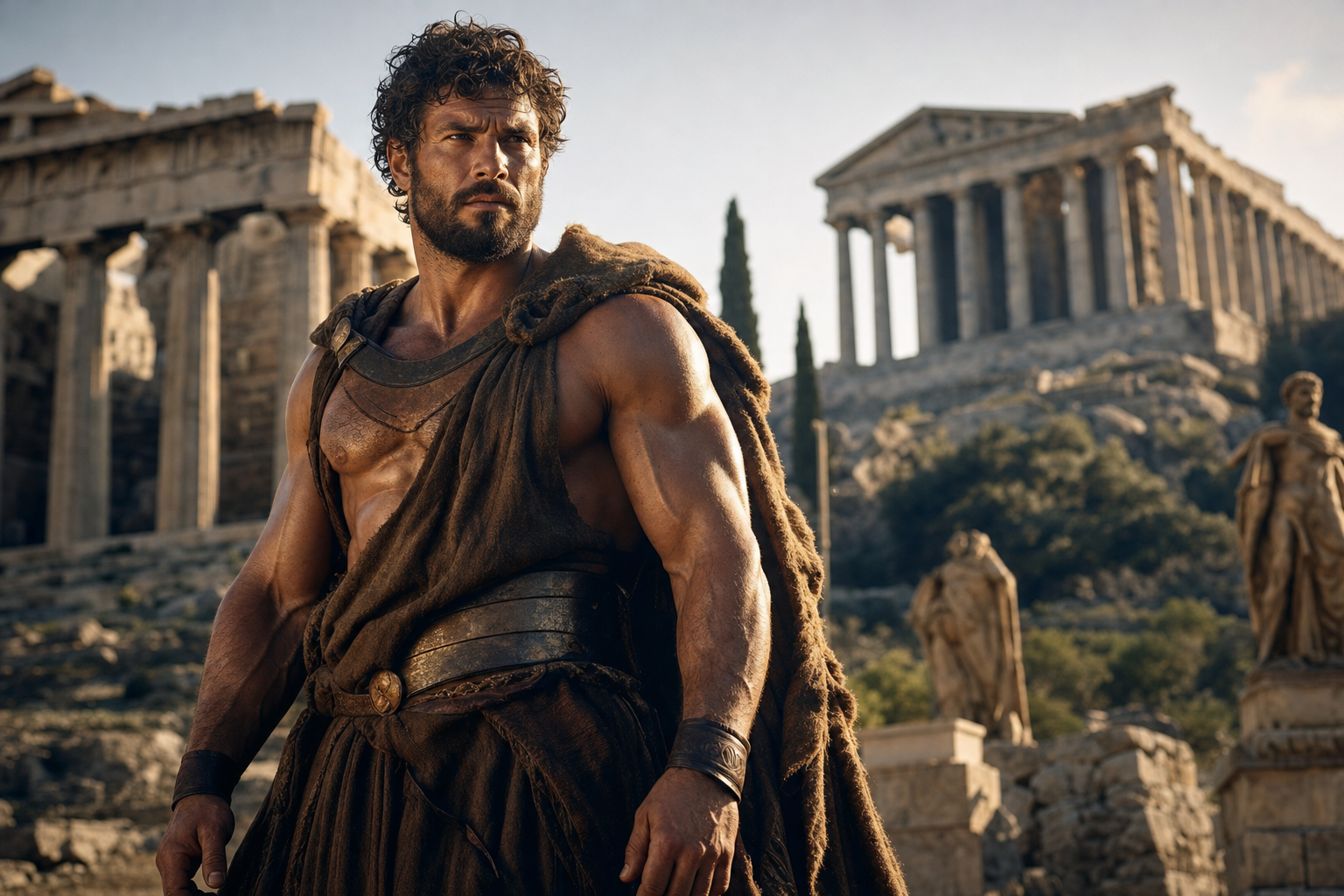
Hercules' 12 Labors: Unraveling the Myth of a Demigod's Redemption
The Birth of a Hero and a Goddess's Wrath
The tale of Hercules, or Heracles as he was known to the ancient Greeks, is not merely a story of superhuman strength but a nuanced exploration of fate, divine jealousy, and the arduous path to redemption. Born from the illicit union of Zeus, king of the gods, and Alcmene, a mortal princess, Hercules' very existence was an affront to Hera, Zeus's notoriously vengeful wife. Even before his birth, the stage was set for a life fraught with trials and tribulations. Hera, consumed by jealousy, attempted to prevent his birth by delaying Alcmene's labor, only to be thwarted by other deities sympathetic to Alcmene. From infancy, Hercules displayed prodigious strength, famously strangling two serpents sent by Hera to his crib, an ominous preview of the struggles that awaited him. This early feat cemented his destiny as a hero, but also marked him as a perpetual target of Hera's wrath, a divine vendetta that would cast a long shadow over his entire life.
His early years were marked by a period of relative peace and traditional heroic training. He was tutored by figures such as the centaur Chiron, renowned for his wisdom and skill in various arts, including archery, wrestling, and music. Hercules excelled in all physical disciplines, his innate strength amplified by rigorous training. However, the shadow of Hera's enmity never truly receded. It was this relentless persecution that would ultimately drive him to commit the most heinous act of his life. In a fit of divinely induced madness, orchestrated by Hera, Hercules tragically murdered his own wife, Megara, and their children. The immediate aftermath was a period of profound despair and self-imposed exile, as the hero wrestled with unimaginable guilt and the horrifying reality of his actions. This tragic event, more than any other, serves as the true catalyst for the legendary Twelve Labors, a monumental penance prescribed by the Oracle of Delphi as the only means of purification and atonement for his grievous sins. The weight of his past would forever be intertwined with his future, propelling him towards an epic quest for forgiveness and ultimately, immortality.

The Oracle's Decree and the Tyranny of Eurystheus
Tormented by his heinous crime, Hercules sought solace and guidance from the Oracle of Delphi, the most revered prophetic voice in the ancient Greek world. The Pythia, the priestess of Apollo, delivered a cryptic and demanding prophecy: Hercules was to serve King Eurystheus of Tiryns for twelve years and perform a series of labors dictated by the king. Only through this grueling servitude and the successful completion of these seemingly impossible tasks could he achieve purification for his past deeds and, more importantly, attain immortality. This divine decree locked Hercules into a destiny of hardship, placing him under the command of a man he despised, a man who harbored a deep-seated fear and jealousy of Hercules' immense power. Eurystheus, a cousin of Hercules, was a timid and conniving ruler, easily manipulated by Hera, who saw in him a perfect instrument to further torment her stepson. The choice of Eurystheus as his taskmaster was not coincidental; it was a deliberate act of cruelty designed to humble the proud hero and push him to his absolute limits, both physically and psychologically.
Did you know? Eurystheus was so terrified of Hercules that he reportedly hid in a bronze jar when the hero returned from some of his labors.
The very nature of the labors was designed to be not only physically demanding but also strategically humiliating. Eurystheus, often advised by Hera, devised tasks that were meant to be impossible for any mortal, tests that would surely lead to Hercules' downfall. These were not merely challenges of strength, but often required cunning, endurance, and an unwavering spirit in the face of overwhelming odds. The king’s fear was palpable; he rarely even allowed Hercules into the city of Mycenae, often receiving him outside the city walls. This constant state of vigilance and suspicion underscored the truly adversarial relationship between the two. Eurystheus's tyranny extended beyond merely assigning tasks; he also took credit for many of Hercules's achievements, attempting to diminish the hero's glory at every turn. Yet, it was precisely this oppressive environment that forged Hercules into an even greater hero. Each completed labor, each triumph over seemingly insurmountable obstacles, chipped away at his guilt and gradually earned him the respect and admiration of both mortals and gods, a testament to his indomitable will and unwavering commitment to his penitent journey. The prophecy of Delphi was thus not just a punishment, but a transformative journey towards self-discovery and ultimate apotheosis.
The First Six Labors: Triumphs in Peloponnese
The first six labors primarily took place within the Peloponnese, establishing Hercules' reputation as a formidable hero. The first task was to slay the Nemean Lion, a beast with impenetrable hide. Hercules' arrows bounced off its skin, forcing him to engage in a brutal hand-to-hand combat. He ultimately choked the monstrous creature to death, a feat that showcased his immense raw strength. He then flayed the lion using its own claws and wore its hide as armor, a symbol of his first great victory and a characteristic attribute in future depictions. This initial triumph not only solidified his physical prowess but also demonstrated his strategic thinking in overcoming an seemingly invulnerable foe.
The second labor involved the Lernaean Hydra, a multi-headed serpent that grew two new heads for every one cut off. This challenge required not just strength but ingenuity. Hercules, aided by his nephew Iolaus, cauterized each severed neck with a burning torch, preventing regeneration. He also had to contend with a giant crab sent by Hera. The hydra's venomous blood, once its immortal head was crushed under a rock, was then used by Hercules to tip his arrows, making them deadly. This victory highlighted his resourcefulness and willingness to accept assistance when necessary, a departure from the purely independent heroism often associated with him. The third labor was the capture of the Ceryneian Hind, a magnificent golden-horned deer sacred to Artemis. This task was unusual, as it required capture rather than killing. Hercules pursued the swift creature for a full year across Greece, finally cornering it and bringing it back wounded, but alive, to Eurystheus, demonstrating incredible endurance and respect for the divine.
Did you know? The Amazons were a recurring motif in Greek mythology, often depicted as formidable adversaries of heroes like Hercules and Theseus, representing a challenge to patriarchal societal norms.
Next came the Erymanthian Boar, a ferocious beast ravaging the farmlands of Arcadia. Hercules, using his immense strength, chased the boar into deep snow and trapped it alive, carrying it back to Eurystheus, who famously cowered in fear at the sight of the live animal. This labor, while seemingly straightforward, further cemented Hercules' reputation for confronting and subduing dangerous creatures. The fifth labor, the cleaning of the Augean Stables, was a deliberately humiliating task. Augeas, king of Elis, owned vast herds of cattle whose stables had not been cleaned in years, resulting in an unimaginable accumulation of filth. Hercules, rather than attempting to shovel the dung, ingeniously diverted the rivers Alpheus and Peneus through the stables, cleansing them in a single day. This masterful display of intellect and engineering proved that Hercules was not just a brute but a cunning strategist. Finally, the Stymphalian Birds, man-eating avian creatures with bronze beaks and metallic feathers, plagued the region of Stymphalia. Athena provided Hercules with a bronze rattle, whose incessant noise flushed the birds from their hiding places, allowing him to shoot them down with his poisoned arrows. These initial labors, though geographically confined, showcased the multifaceted nature of Hercules' heroism: raw strength, cunning, endurance, and divine aid, all contributing to his slowly but surely growing legacy of atonement.

The Later Six Labors: Journeys Beyond the Familiar
The subsequent six labors took Hercules beyond the familiar confines of the Peloponnese, leading him on increasingly perilous journeys to remote lands and the very edge of the known world, and even into the underworld itself. These tasks were not only tests of strength but also of his resolve in the face of the unknown and the supernatural. The seventh labor took him to Crete, where he was to capture the Cretan Bull, a magnificent white bull that Poseidon had sent to King Minos. This bull, the father of the Minotaur, was a formidable beast, but Hercules, employing his renowned strength, wrestled it into submission and brought it back to Eurystheus, who then released it. Its escape would later lead to further heroic exploits by other figures.
Next, Hercules faced the Mares of Diomedes, flesh-eating horses belonging to King Diomedes of Thrace, a son of Ares. These beasts were fed on human flesh, making them exceptionally dangerous. Hercules subdued them by feeding them Diomedes himself, a stark and brutal act that exemplified the harsh realities of his mythological world. He then brought the now docile horses back to Mycenae. The ninth labor was a venture into the realm of the Amazons, a tribe of fierce warrior women ruled by Queen Hippolyta. Hercules was tasked with obtaining Hippolyta's girdle, a symbol of her authority and a gift from Ares. Initially, Hippolyta was willing to surrender the girdle, but Hera, ever present in her malicious intent, disguised herself and spread rumors that Hercules intended to abduct the queen, inciting a battle. Hercules, believing Hippolyta had betrayed him, killed her and took the girdle by force, demonstrating that even good intentions could be corrupted by divine interference.
Did you know? The Golden Apples of the Hesperides are often interpreted as a symbol of immortality or divine knowledge, making their retrieval a quest for ultimate understanding.
The tenth labor plunged Hercules into the far west, to the island of Erytheia, to steal the Cattle of Geryon. Geryon was a fearsome triple-bodied giant who owned a magnificent herd guarded by a two-headed dog, Orthrus, and a herdsman, Eurytion. Hercules sailed to Erytheia in a golden cup borrowed from Helios, slew Orthrus and Eurytion, and then confronted Geryon, whom he killed with a single arrow. The journey back with the cattle was itself a monumental task, fraught with challenges and requiring Hercules to establish landmarks like the Pillars of Hercules at the Strait of Gibraltar. This labor represented a journey to the very edge of the known world, pushing the boundaries of human, or demigod, endurance. These labors increasingly moved beyond simple monster slaying and into grander, more epic narratives of exploration and overcoming supernatural guardians, showcasing the escalating difficulty and profound significance of his quest.

The Eleventh and Twelfth Labors: Confronting Immortality and Death
The final two labors represented the pinnacle of Hercules' heroic journey, tasks that directly challenged the boundaries between the mortal and immortal realms, and even death itself. These were arguably the most dangerous and significant of all, cementing his place in the pantheon of heroes. The eleventh labor was to retrieve the Golden Apples of the Hesperides. These were not ordinary apples, but divine fruits that granted immortality, guarded by the Hesperides nymphs and the hundred-headed dragon Ladon in a sacred garden at the western edge of the world. Hercules' journey to find the garden was arduous, involving encounters with various beings and seeking the advice of others, like Nereus, the Old Man of the Sea, to discover its location.
Upon reaching the garden, Hercules faced a dilemma: how to outwit Ladon. He ultimately employed cunning rather than brute force. He encountered Atlas, the Titan condemned to hold up the heavens, and offered to temporarily relieve him of his burden if Atlas would retrieve the apples, as he was the father of the Hesperides and knew how to obtain them. Atlas, eager for a respite, agreed. However, upon his return with the apples, Atlas, enjoying his freedom, attempted to trick Hercules into permanently taking on the burden of the sky. Hercules, feigning agreement, asked Atlas to hold it for a moment while he adjusted his cloak. Once Atlas took the heavens back, Hercules seized the apples and departed, a testament to his intelligence and ability to outwit even the most ancient of beings. This labor was not merely about strength but about outsmarting gods and Titans, showcasing the growth of Hercules' strategic mind throughout his trials. It also symbolized his confrontation with the concept of immortality, as the apples themselves represented eternal life.
Did you know? Hercules is the only demigod hero in Greek mythology to achieve full apotheosis and become an Olympian god.
The twelfth and final labor was the most daunting of all: to descend into the Underworld and bring back Cerberus, the three-headed hound that guarded its gates. This was a direct challenge to Hades, the lord of the Underworld, and a test of Hercules' courage in the face of death itself. Accompanied by Hermes and guided by Athena, Hercules journeyed through the gloomy realm of the dead, encountering various figures, including the shades of heroes and villains. He even briefly rescued Theseus from the Chair of Forgetfulness. His passage through the Underworld was a significant event, marking him as one of the few mortals to ever venture into that realm and return.
Upon reaching Hades, Hercules respectfully requested permission to take Cerberus. Hades, surprisingly, agreed, but on one condition: Hercules had to subdue the monstrous hound without the use of any weapons, relying solely on his bare hands and immense strength. This was a fitting ultimate challenge, stripping away all external aids and pitting the hero's raw power against a creature born of the underworld. Hercules bravely confronted Cerberus, wrestling the beast into submission. The struggle was epic, a testament to his unparalleled might. He then dragged the struggling, growling Cerberus back to the mortal world, presenting the terrified beast to an utterly petrified Eurystheus. This final labor was the ultimate act of atonement, a literal journey through death and back, signifying his complete purification and proving his worthiness for divine favor. It was a triumph over the ultimate boundary, foreshadowing his eventual apotheosis.
The Apotheosis of Hercules and Enduring Legacy
With the completion of the Twelve Labors, Hercules had paid his penance and earned his freedom from Eurystheus's tyranny. However, his life was far from over. He continued to undertake numerous other heroic exploits, battling monsters, intervening in conflicts, and even participating in the Argonautic expedition, though he left before its completion. His life remained one of constant adventure and challenge, always demonstrating his extraordinary strength and courage. Yet, the shadow of his past and the continued machinations of Hera would pursue him. His relationships with women, particularly Deianira, would prove to be another source of tragic conflict, ultimately leading to his demise. The story of his death is as dramatic and poignant as his life, a testament to the complexities of his character and the enduring power of fate in Greek mythology.
Did you know? Many scholars believe the Twelve Labors were designed to reflect the twelve signs of the zodiac, with each labor corresponding to a particular astrological constellation or season.
His passing, however, was not an end but a transformation. Enraged by the torment inflicted by the poisoned shirt of Nessus, which Deianira unwittingly used to try and secure his love, Hercules built his own funeral pyre on Mount Oeta and ascended it. As the flames consumed his mortal body, a divine transformation occurred. Zeus, recognizing his son's immense suffering and unparalleled heroism, intervened. Hercules' divine essence was separated from his mortal form, and he was taken to Mount Olympus by Athena. There, he was welcomed among the gods, achieving apotheosis and finally finding peace from Hera's wrath. He even reconciled with Hera, who adopted him and gave him her daughter Hebe, the goddess of youth, as his wife, symbolizing his full acceptance into the Olympian pantheon. This ultimate elevation to godhood was the culmination of his arduous journey, a testament to the idea that even the gravest sins could be atoned for through unwavering commitment and heroic deeds.
Hydra fighting Hercules. Heracles and the Mares of Diomedes.
The myth of Hercules and his Twelve Labors transcends a simple narrative of strength. It is a profound exploration of human suffering, divine intervention, redemption, and the tireless pursuit of atonement. Each labor, a microcosm of overcoming immense challenges, offered a moral lesson and contributed to the hero's spiritual and physical growth. From the monstrous beasts of the Peloponnese to the guardians of the Underworld, Hercules faced not only external foes but also his own inner demons. His story has resonated through millennia, inspiring countless works of art, literature, and philosophy. It speaks to the enduring human fascination with strength, courage, and the epic struggle against overwhelming odds. Hercules remains a quintessential hero, a symbol of perseverance and the ultimate triumph of good over evil, however complex and tragic his path may have been. His legacy continues to remind us that even in the face of divine wrath and personal tragedy, the pursuit of virtue and the unwavering commitment to one's destiny can lead to ultimate glory and immortality.
The Enduring Impact and Symbolism of the Labors
The Twelve Labors of Hercules are more than just a sequence of heroic deeds; they form a foundational narrative in Western culture, permeated with rich symbolism and enduring moral lessons. Each labor serves as an allegory for various human struggles, triumphs, and the arduous path toward self-mastery and redemption. The slaying of the Nemean Lion, for instance, symbolizes the conquest of primal, untamed instincts and the overcoming of seemingly impenetrable obstacles through sheer will and unconventional methods. The Lernaean Hydra, with its regenerating heads, represents the perpetual struggle against multifaceted problems that, when one aspect is addressed, another arises, demanding strategic thinking and persistent effort rather than brute force. This highlights the idea that some challenges require more than just strength; they demand foresight and an understanding of the underlying complexities of the problem itself. The capture of the Ceryneian Hind, an animal sacred to Artemis, teaches respect for nature and the divine, and the importance of achieving goals through patience and careful pursuit rather than immediate aggression.
The cleaning of the Augean Stables, a task designed to be both physically repulsive and symbolically demeaning, speaks to the power of ingenuity and unconventional solutions to seemingly insurmountable problems. It showcases that intellect can often triumph where pure strength fails, providing a powerful metaphor for cleansing corruption or reforming entrenched systems. The journey to retrieve the Golden Apples of the Hesperides, guarded by a dragon and demanding a complex interaction with a Titan, delves into themes of ultimate knowledge, immortality, and the necessity of cunning to achieve divine goals. This labor represents the quest for esoteric wisdom and the challenges involved in acquiring truly profound insights. The descent into the Underworld to capture Cerberus, the ultimate test, symbolizes the hero's confrontation with death, the unknown, and his willingness to face his deepest fears to achieve complete purification. This journey to the realm of the dead is a universal motif in mythology, representing transformation, rebirth, and the ultimate triumph over mortality by confronting it directly. Each labor, therefore, transcends its literal narrative, offering layers of meaning that have been interpreted and reinterpreted across generations.
The widespread influence of the Twelve Labors can be seen in countless forms of art, literature, and popular culture throughout history. From ancient Greek pottery and sculptures vividly depicting his struggles, to Roman mosaics and Renaissance paintings celebrating his triumphs, Hercules has remained a powerful visual icon. His story was a favorite subject for playwrights and poets, used to explore themes of fate, free will, divine justice, and the nature of heroism. In later periods, particularly during the Enlightenment, Hercules was often reinterpreted as a symbol of human reason and the triumph of civilization over barbarism. Modern cinema, comics, and video games continue to draw inspiration from his myth, often recontextualizing his challenges for new audiences. This enduring appeal lies in the universality of his struggles: the fight against overwhelming odds, the quest for redemption, the battle against one's inner demons, and the ultimate desire to achieve a lasting legacy. Hercules, through his trials and triumphs, offers a timeless narrative on the human condition, making his story not just a relic of the past, but a living, evolving testament to the power of the heroic journey and its profound impact on the collective human imagination.
His trials also offer a compelling narrative on the development of justice and societal order. Many of the monsters Hercules battles represent chaos and threats to human civilization, and his victories can be seen as allegorical representations of humanity's struggle to establish order and safety in a dangerous world. The transition of his labors from within the Peloponnese to the far reaches of the known world, and even the Underworld, mirrors the expansion of Greek geographical and conceptual understanding. The earlier, more tangible threats gradually give way to more mystical and existential challenges, reflecting a deepening philosophical inquiry into the nature of existence and the boundaries of human achievement. The myth of Hercules is thus not only a tale of individual valor but a reflection of a society grappling with its place in the cosmos, its relationship with the divine, and the eternal quest for meaning and immortality. The narrative arc of his life, from tragic fall to divine ascent, continues to captivate and inspire, a powerful reminder of the transformative power of perseverance and faith in the face of an unforgiving world.
How we verify this article
By the History Unlocked editorial team
This text is built on historical facts stored in our database and drafted with AI assistance. No signed human review is recorded for this article. Report any inaccuracy: we correct it and update the modified date.
Updated on
AI-assisted drafting.
Read our editorial standardsEnjoyed this? Discover more articles in the category Mythology & Ancient Gods