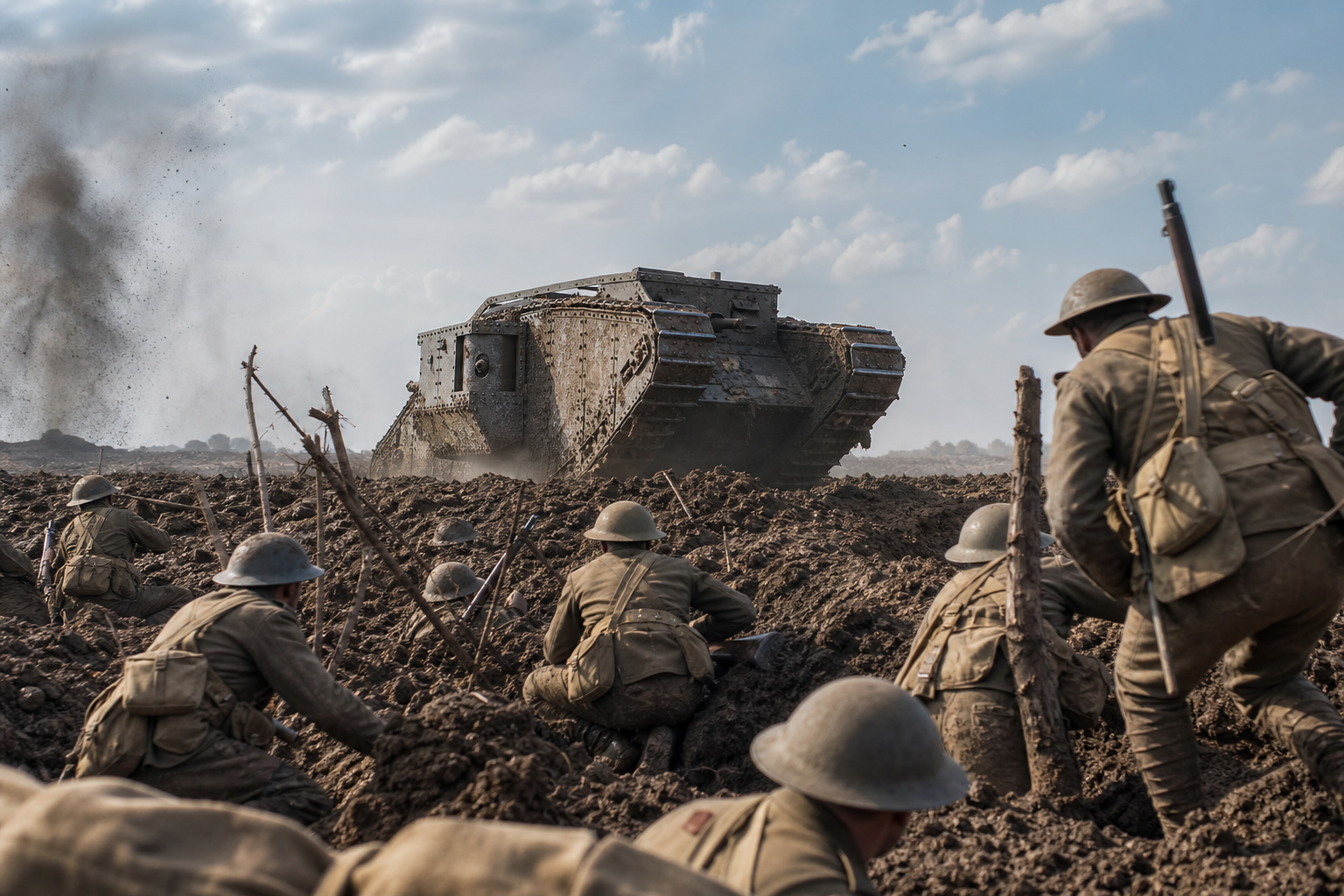
Tanks in the Great War: Iron Beasts that Broke the Trench Deadlock
In the early autumn haze of 1916, a new sound began to thread itself through the gutted landscape of the Western Front: a grinding, clanking, and almost animal sigh that did not belong to man, horse, artillery or weather. For soldiers huddled in the shattered rims of the Somme, the sight that followed that sound was both grotesque and miraculous—armoured iron boxes with relentless treads, moving like monstrous beetles across craters and barbed wire. The first tanks, in their awkward and primitive glory, were not graceful. They were, rather, a mechanical answer to an impossible problem: how to force movement across a landscape deliberately designed to stop movement. The story of those iron beasts is a story of invention born of desperation, of secrecy and spectacle, of tactical failure and strategic promise.
The development of tanks in the Great War is often told as a linear march from prototype to triumph, yet the truth is more complex and human. Inventors and bureaucrats, naval officers and agricultural engineers, young officers with a penchant for machines and cabinet ministers fearful of political fallout—all converged to produce an idea that would reshape warfare. It began with tractors and chassis, with the ungainly experiments of firms that made agricultural equipment. It progressed through dark workshops and government committees where secrecy was absolute, because the British were determined to keep their land-war experiments hidden from German spies. To the public, these machines remained a rumor for many months; to the men who would ride them, they were a hope for breaking the trench deadlock.
This article follows those machines from blueprint to battlefield, from their awkward debut at Flers-Courcelette to the more coordinated and spectacular use at Cambrai. It examines the engineering compromises that made them both revolutionary and fragile, the brutal conditions experienced by their crews, and the varying doctrines that national armies developed around them. But perhaps most importantly, it seeks to understand the psychological effect these machines had—the blend of fear and fascination that they inspired in friend and foe alike. These iron beasts were imperfect, yet their imperfect presence forced generals, engineers, and politicians to imagine a different kind of warfare.
Did you know? The word "tank" was chosen as a deliberate military ruse to disguise the machines as water carriers during development.
What follows is not merely a technical history. It is a narrative exploration—mystery-driven and human—of how the tank was born of mud and urgency, how it fumbled into the world, and how it left an indelible mark on the century that followed. The trenches did not fall instantly upon their arrival. The first tanks were as prone to failure as they were to surprise. Yet each breakdown taught its makers a lesson, and every advance, even when measured in yards, shifted the shape of modern war. We begin at the origins, in workshops and committees, where the problem was first dared and the solutions began to take iron form.
Origins: From Tractors to “Landships” — The Idea Takes Shape
The origin story of the tank is anchored in improvised invention. Trench warfare had transformed the Western Front into a relentless cage: barbed wire entanglements, deep shell-cratered no-man’s-lands, and fields of machine-gun fire. Traditional cavalry and infantry were simply slaughtered when they tried to cross open ground. The idea of an armoured vehicle that could cross trenches and resist small arms fire emerged slowly, often independently, in various corners of Britain, France, and even Germany. In Britain, the institutional birth of the tank is usually associated with the so-called Landships Committee, an ad hoc body formed within the Admiralty in 1915. The committee gathered engineers, naval officers, and industrialists to explore vehicles that could operate on land with naval robustness. The Admiralty’s involvement—rather than the Army’s—reflected a wartime political calculus: the Admiralty could carry out experiments with more secrecy and fewer parliamentary complications.
Central to the machine’s development were a handful of inventors and firms. William Foster & Co., an agricultural-engineering firm in Lincolnshire that built caterpillar-tracked tractors, became crucial. Its engineers, working with Major Walter Gordon Wilson, produced early tracked chassis concepts that would evolve into the first prototypes. The initial experiments sought solutions to two basic problems: how to traverse cratered, torn terrain and how to protect men from machine-gun fire. The prototype known as "Little Willie"—constructed in 1915—was the first practical effort to marry a tracked chassis with heavy armour. It was ungainly, with a distinct rectangular hull, but it proved that a tracked armoured vehicle could be built and operated.
Did you know? The first use of tanks in battle occurred on 15 September 1916 at Flers-Courcelette during the Somme Offensive.
Secrecy surrounded these projects. To avoid attracting enemy attention and to disguise their purpose, the machines were often referred to as "tanks"—a deliberately mundane code name meant to suggest water-carrying containers rather than a new war-breaking weapon. This euphemism stuck, and soon the word "tank" was used by soldiers and journalists alike, outlasting its original subterfuge. The secrecy also meant that armies had little time to prepare strategy and tactics to use these machines, forcing doctrine to be improvised on battlefields where learning cost lives.
The Landships Committee prioritized practical tests and rapid prototyping. Its early decisions—such as the rhomboid hull shape designed to cross trenches and the adoption of tracks that encircled the hull—were compromises between engineering capability and battlefield necessity. Designers also made choices about armament layout. Early British tanks would be classified as "male" and "female": males mounted short 6-pounder guns for anti-fortification fire, while females were fitted with multiple machine guns intended to suppress enemy infantry. This split emphasized the dual purpose the vehicles were meant to serve: overcome obstacles and clear resisting troops.
Throughout this formative phase, the tank’s development was less a tidy program than a series of improvisations. The industrial base—companies used to building farm machinery or ships—had to learn new tolerances and produce complex gearboxes and tracks under wartime strain. The men who would operate tanks were often volunteers—soldiers and sailors drawn from other corps who had to be taught to live in cramped, smoke-choked environments. By the summer of 1916, prototypes had matured enough to offer a chance to trial tanks in anger. The stage was set for the first combat deployment.
Did you know? The Renault FT was the first widely produced tank with a fully rotating turret and rear-mounted engine, a layout that influenced twenty-century tank design.

The Somme and the First Combat: Flers-Courcelette, September 1916
The first meaningful deployment of tanks occurred on 15 September 1916 during the Somme offensive, at the subsidiary action near Flers-Courcelette. The British High Command decided to introduce the new machines at a time when both secrecy and surprise were crucial—if the tanks worked, they could cut through barbed wire and reduce machine-gun nests; if they failed, the political and military cost would be heavy. On that damp morning, some 49 Mark I tanks were intended to support the assault. Mechanical unreliability thinned their ranks; many broke down or became bogged in shell-holes before they could reach the front lines. Yet despite these failures, several tanks did arrive and accomplished feats that would rivet the public imagination.
Contemporary accounts emphasize both the bewilderment and terror felt by soldiers who encountered these iron monsters. German defenders, who had never seen such vehicles, at first responded with artillery and small-arms fire that often failed to stop the heavily-armoured hulls. In several instances, tanks battered through wire obstacles or silenced isolated machine-gun positions, allowing infantry to exploit the gaps. The greatest and most dramatic success of the day was a tank that reportedly penetrated deeply and created local breakthroughs. Nevertheless, the overall tactical impact was limited. Mechanical breakdowns, poor coordination with infantry, and the fact that tanks were still relatively few in number prevented a decisive exploitation of their potential.
Still, the psychological and propaganda effects were enormous. Photographs and press reports—carefully managed by the military—presented the tank as a new symbol of British ingenuity and determination. For the German army, the tank represented a worrying development that required immediate attention. Countermeasures, both tactical and technological, began to emerge: anti-tank rifles and artillery were adapted, wire and trench obstacles were redesigned, and infantry tactics were altered to aim for tanks' vulnerable points. Yet these responses took time to disseminate and perfect.
Did you know? British and German soldiers commonly referred to tanks initially with wonder and fear; accounts remind us that tanks sometimes caused enemy units to panic simply through their presence.
The Somme baptism taught hard lessons. One was that quantity and reliability were as important as individual bravery. Early tanks suffered from problems of engine overheating, poor ventilation (leading to carbon monoxide poisoning of crews), and transmission failures. They also required new maintenance and recovery procedures that had not been organized on the chaotic battlefield. Communication between tank crews and accompanying infantry was primitive—relying on flags, lamps, or runners—which often meant that tanks and infantry found themselves out of sync. But those early successes and failures together produced the impetus for rapid improvement: better crew training, improved maintenance practices, and design tweaks to increase reliability.
The image of tanks lumbering forward across no-man’s-land, their riveted plates shining with mud and blood, became an enduring one. The first combat use at Flers-Courcelette did not win the Somme, but it proved beyond doubt that tanks could be built and deployed under fire. That proof would be the seed for larger, more ambitious experiments in 1917 and 1918.

Design, Variants, and the Crew Experience: Iron Comforts and Horrors
If the tank’s birth was improvised, its design space was fractious and experimental. The British rhomboid Mark I was large and slow; its long tracks wrapped around the vehicle to enable trench crossing. Inside, the crew lived amid heat, exhaust fumes, petrol smell, and the constant rattle of mechanical parts. Vision slits were small, and the noise made coordinated effort difficult. Early tanks had minimal suspension, so travel over shell-torn ground was a bone-shaking ordeal. Crews suffered from injuries inflicted more by the machine’s movement and internal atmosphere than by enemy fire. Many reported burns, hearing damage, and respiratory problems from carbon monoxide and cordite fumes.
Did you know? Around 476 tanks were assembled for the opening of the Battle of Cambrai in November 1917, marking one of the first major massed uses of armour.
Armament and role were embodied in the male/female dichotomy: male tanks carried short 6-pounder (57 mm) guns in sponsons—protruding boxes on their flanks—intended to engage enemy strongpoints and other hard targets. Female tanks traded those guns for multiple machine guns, which could suppress enemy infantry and protect the combined arms advance. The design choice was tactical, but it also created logistical and doctrinal complexity: which mix of male and female tanks should accompany an assault? How to coordinate their roles in the chaos of battle?
Other experimental designs filled the field. The British produced lighter and faster medium tanks such as the Whippet (officially the Medium Mark A), which carried machine guns in a more mobile chassis and was designed to exploit breaches made by the heavier rhomboid tanks. The Whippet arrived on the battlefield in 1918 and demonstrated how speed and manoeuvrability could be used for deeper exploitation. Meanwhile, the French pursued a different path. The Renault FT, introduced in 1917, was a compact, fully rotating-turret design that placed the engine at the rear and a two-man turret on top. Its configuration—engine at the back, rotating turret forward—proved profoundly influential. The FT was lighter, easier to produce in numbers, and more doctrinally flexible than the British behemoths. Many military historians regard the Renault FT as the archetype for modern tanks because of its turret and layout.
For the crews, tank service was a unique subculture. Many were volunteers who faced a service both dangerous and claustrophobic. Training was short and practical; crews learned to perform maintenance under fire and to navigate without obvious external references. Rescue procedures for disabled tanks were crude—often requiring other tanks to tow or a team to drag the damaged vehicle back under fire. The cramped space meant that every task had to be coordinated meticulously: loading ammunition, managing engine temperature, and firing the main armament in the limited arcs provided by sponsons or turrets.
Did you know? The United States formed a Tank Corps in 1918 and received British and French tanks for training, signaling the rapid international spread of armoured warfare.
Technical failures were common. Tracks snapped under stress, transmissions seized, and engines stuttered. Yet mechanics and engineers learned rapidly. Prefabrication of parts, improved metallurgy, better ventilation, and more reliable engines arrived as the war progressed. Armour schemes evolved, with sloped plates and better riveting practices improving survivability. The Whippet and the Renault FT showed that variety in the armoured fleet could pay dividends: the heavy, slow Mark tanks could break wire and survive direct fire, while lighter designs could use speed to exploit gaps. By late 1918, these design lessons had begun to mature, even if the full doctrine of armoured warfare would not be realized until the interwar years.

Tactics and the Psychological Effect: Fear, Propaganda, and the Learning Curve
Tanks forced both new tactics and new anxieties. On the practical level, they required integrated planning with infantry, artillery, engineers, and logistical services. A tank without infantry support could be overwhelmed by close assaults or immobilized and left to burn; infantry without tanks would again be slaughtered by machine-gun defenses. The early British approach—employing tanks to cut through wire and crush machine-gun nests—was tentative and often clumsy because commanders lacked experience of how to combine arms effectively. Yet the interplay of these arms evolved quickly once commanders saw how tanks could alter the geometry of a battlefield.
The psychological impact was striking. For infantry on both sides, tanks represented an entirely different threat and symbol. British propaganda framed them as harbingers of victory and modern ingenuity, while German soldiers and commanders often used the term with a mixture of fear and curiosity. There were reports of German troops fleeing at the sight of tanks; equally, there were instances where coordinated anti-tank fire, petrol bombs, or close assault parties disabled a vehicle. The tank’s aura was therefore both real and contingent—capable of terrifying troops who had no countermeasures, but not invulnerable if the enemy adapted.
Did you know? Many early tank crews suffered from heat and fumes inside the cramped hulls; carbon monoxide poisoning and burns were common complaints.
Countermeasures grew in sophistication as the war progressed. Infantry learned to approach tanks from the rear, where armour was thinner, or to aim for tracks with concentrated rifle or artillery fire. Field guns were adapted with protective shields to target tanks. Engineers tried to design anti-tank obstacles and trenches angled to prevent a tank’s approach. The German development of dedicated anti-tank rifle and gun calibres in 1917 and 1918 was a direct response to the Allied armoured threat. By the end of the war, armies on both sides had teams trained to neutralize tanks.
Communication remained a chronic problem. Early tanks had no radios; orders were passed by flag signals, runners, or pre-arranged timetables. This inflexibility reduced the ability of tank commanders to exploit quickly-evolving battlefield opportunities. Nevertheless, improvisation—such as mounting messengers or using lamp signals—sometimes worked. The learning curve was steep; tactical manuals and doctrines were written in real-time, often after costly field experiments. By late 1918, the idea of coordinated armour-infantry-artillery formations had taken root, setting the stage for the combined-arms doctrines of the next decades.
Cambrai, 1917: Massed Armour and a Tactical Revelation
If Flers-Courcelette was a baptism, the Battle of Cambrai in November 1917 was the tank’s coming-of-age in tactical terms. At Cambrai, the British employed roughly 476 tanks—one of the first instances of massed armour used in a concentrated role to achieve a breakthrough without a preceding heavy artillery barrage. The operation prioritized surprise and mobility. Tanks were combined with new artillery techniques, such as improved predicted fire and creeping barrages, and with Army cooperation that had been evolving since the Somme.
Did you know? Early tank doctrine split vehicles into "male" (with guns) and "female" (with machine guns), a distinction used by the British in 1916–1917.
The opening on 20 November 1917 achieved stunning tactical success. Tanks moved in large numbers across previously impregnable defenses, crushed wire, and opened gaps for infantry and cavalry to exploit. The initial advance achieved several kilometres of penetration and captured positions thought secure. For a brief moment, it seemed that the promised revolution in warfare had arrived: massed armour, properly employed, could defeat trench systems. The German response, however, was swift and effective. Counterattacks, facilitated by local reserves and increasingly effective anti-tank artillery, blunted the gains. Mechanical attrition, mud, and logistical overreach further complicated the British effort. Within days the front had largely stabilized, but not before Cambrai had demonstrated the potential of tanks used en masse.
Cambrai’s lessons were deep and contradictory. On the positive side, the battle proved that tanks could deliver surprise and exploit weak points when sufficient numbers and good coordination were in place. On the negative side, the operation highlighted the need for robust logistical support, improved mechanical reliability, and better doctrine for consolidating gains. German improvisation—deploying field artillery and counterattacking with infantry trained to assault tanks—reconfirmed that armour alone could not achieve strategic success without integrated support.
Cambrai would become a touchstone for interwar theorists. The idea that armour might be used to execute deep, operational-level manoeuvre—breaking through layers of defense and disrupting command and supply lines—began to crystallize in military thought. Yet many of those theorists, in the 1920s and 1930s, would romanticize the results of Cambrai without fully accounting for the logistical and technological constraints that remained. Still, as a demonstration of what armour could do when employed with imagination and a degree of coordination, Cambrai remains historically central.
Did you know? Despite their initial problems, tanks helped break the psychological certainty of trench immobility, altering how commanders thought about manoeuvre.

Production, International Adoption, and the War’s End: From Experiment to Institution
By 1918 the tank had moved from the status of experimental curiosity to that of an institution within armies. Production lines shifted to deliver larger numbers, though industrial limits and material shortages constrained output. The British produced several thousand tanks of various models by war’s end; the French produced their own designs, including the Renault FT in large numbers, which was particularly influential because of its compact, turreted layout and relative ease of production. The United States, entering the war later, organized tank units and received British and French tanks for training and limited use, even as American industry began to consider its own armoured designs.
The tank’s diffusion across national armies provoked a variety of doctrinal responses. The French tended to favor lighter tanks like the FT that could be produced in quantity and used to support infantry. The British had experimented with both heavy rhomboids and lighter mediums, producing a diversity of types without fully converging on a single doctrinal model. Germany, who had been on the defensive for much of the war, produced fewer tanks but developed effective countermeasures and studied captured Allied vehicles closely.
Several practical obstacles persisted. Tanks required a logistics chain for fuel, spare parts, and recovery equipment; they needed trained maintenance personnel and crews comfortable with the stresses of armoured warfare. Battlefield commanders had to learn to coordinate with artillery, to secure flanks, and to plan for exploitation after breakthroughs. Nevertheless, the end of the war did not close the book on tanks. Rather, it opened a new one. Postwar militaries inherited the machines and the lessons learned, and the interwar period saw study, theorizing, and refinement of armoured doctrine. Military thinkers—some of them veterans who had watched tanks lumber across Somme mud—argued for the rethinking of combined arms and operational mobility.
Did you know? After the war, the Renault FT’s layout became a standard template for future tank design, influencing interwar and later tanks.
One of the most lasting legacies of the Great War tanks was the Renault FT’s impact on future design. The FT’s turret and layout established a template that would dominate tank construction for decades. The psychological legacy was also important: tanks had broken the myth of the immovable trench system and made possible the later concept of manoeuvre warfare. Industrially, tank production had encouraged the development of new manufacturing techniques, metallurgy skills, and supply-chain practices that would be expanded in the 1930s and 1940s.
Finally, the human cost must be remembered. Tank crews suffered high casualty rates, and the conditions inside early tanks were often life-threatening in themselves. Yet many who served in these machines remembered them with a mixture of pride and trauma. The iron beasts did not merely herald a new tool of war; they became part of the personal and cultural memory of the conflict.

Conclusion: Legacy, Lessons, and the Future that Began in Mud
When historians look back at the Great War, tanks often figure as early harbingers of a century defined by mechanized conflict. Yet their story in 1914–1918 is not one of instant transformation but of gradual, costly learning. The first tanks were imperfect answers to an urgent problem; they broke down as often as they broke defenses. Still, they forced armies, engineers, and strategists to imagine mobility where none seemed possible. From Little Willie’s awkward chassis to the massed formations at Cambrai and the revolutionary layout of the Renault FT, tanks accelerated the modernizing forces within military institutions.
The war’s lessons had a double edge. On the one hand, they showed how technology and surprise could change battlefield possibilities. On the other, they demonstrated that technology alone is never sufficient: logistics, maintenance, doctrine, and human resilience determine whether a new weapon will alter strategy. Cambrai taught that boldness without logistical depth could not be sustained; the Somme taught that a few spectacular successes do not constitute mastery. These were lessons learned in blood and mud, and they shaped the interwar debates on armoured warfare.
In the decades after 1918, theorists and practitioners built on those lessons—sometimes accurately, sometimes not—and the tank evolved into the dominant instrument of land warfare. The Great War’s tanks remain fascinating because they were born of improvisation and secrecy, and because they forced a reevaluation of what war could be. They were noisy, stinking, terrifying to behold, and yet they opened a door that the next generation would walk through with greater speed and awareness.
More than a technological story, the tale of tanks in the Great War is a human one: of crews who endured heat and poison in metal boxes, of engineers who reforged production lines, of commanders who learned to coordinate diverse arms under fire, and of soldiers who faced an enemy that seemed, at times, almost mythological. The iron beasts of 1916–1918 were imperfect ancestors of later machines, but their presence altered the strategic imagination of the twentieth century. They remain symbols of industrial ingenuity in extremis, and reminders that even the most unwieldy innovations can change history when circumstances are dire and minds are bold.

How we verify this article
By the History Unlocked editorial team
This text is built on historical facts stored in our database and drafted with AI assistance. No signed human review is recorded for this article. Report any inaccuracy: we correct it and update the modified date.
Updated on
AI-assisted drafting.
Read our editorial standardsEnjoyed this? Discover more articles in the category World War I