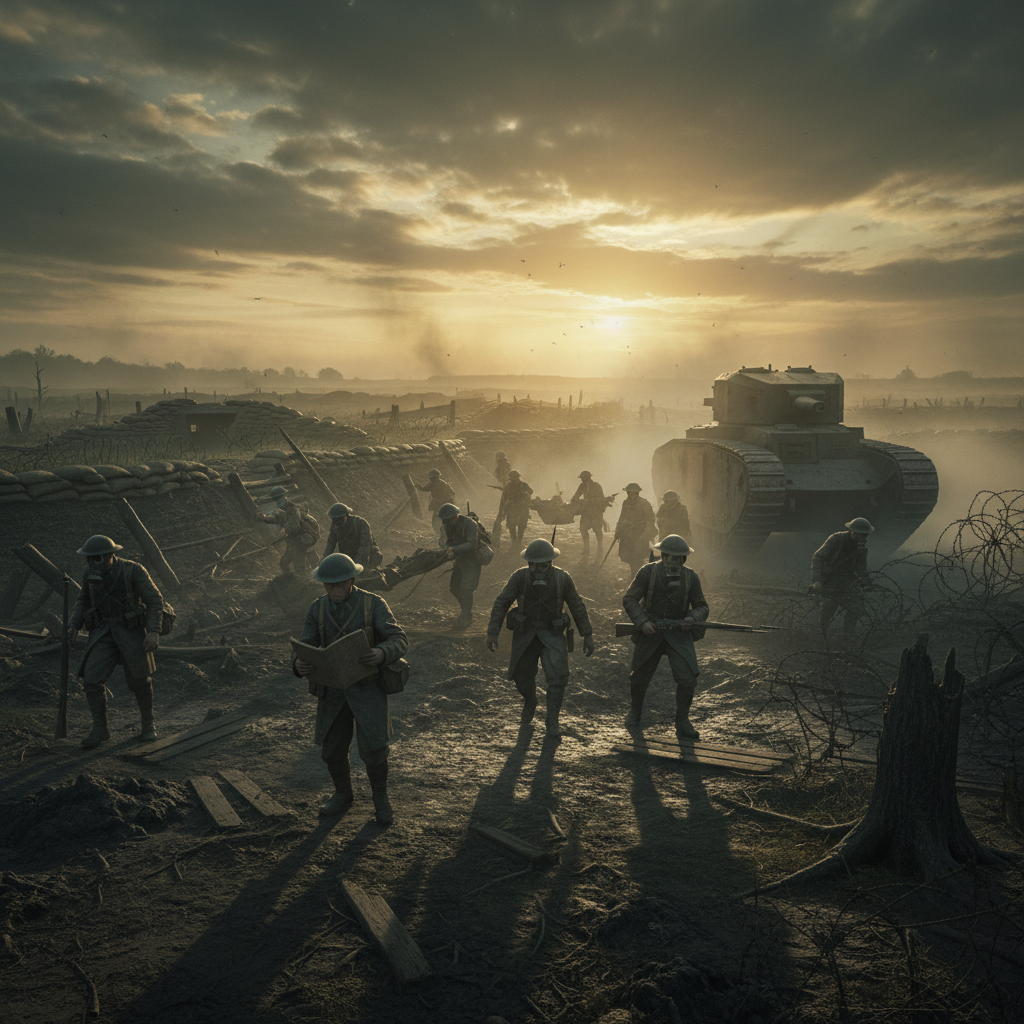
Battle of the Somme: Secrets, Suffering, and the First Tanks
Dawn came too slowly to the Somme Valley on 1 July 1916. The night before, British soldiers wrote final notes in pencil stubs, tucked photographs into tunic pockets, and stood quietly under a sky pulsing with distant gunfire. For a week, the ground had shaken without pause. The British artillery had been thundering since 24 June, sending more than a million shells into the German lines. Officers told their men that nothing could live through such a storm. The enemy wire would be cut, the trenches ploughed up, the machine guns buried forever. That confident script, rehearsed in training grounds across England and Scotland, would not survive morning.
What unfolded on the Somme was not a single battle but a grinding season of war, fought from 1 July to 18 November 1916 across chalk downs and smashed orchards, ruined villages and sunken lanes. It began with plans for a decisive breakthrough and ended with the front line edged forward by a few miles at an unimaginable price. Somewhere between those bookends—of optimism and exhaustion—an army changed its skin. The British Expeditionary Force, a small professional corps in 1914, had become by 1916 a citizen army of volunteers and Empire troops learning on the job, often at terrible cost.
There are episodes that cling to the memory like burrs: the detonation of colossal mines at the opening of the assault; whole battalions of friends, the “Pals,” cut down in minutes; the South African stand amid the shredded trees of Delville Wood; Australians clawing at the summit of Pozières Ridge under a rain of shells; and, in September, the first groaning advance of the tank, that new machine that seemed at once to promise and to mock salvation. Overhead, the Royal Flying Corps photographed, spotted, and fought for fleeting patches of sky. The Somme is a labyrinth of such images—astonishing improvisation tethered to unchanging pain. Yet, in the shadows behind each image, there is a question: what did it all accomplish? History’s answers are layered, and they still rustle when we pass.
Did you know? The Hawthorn Ridge mine was filmed as it erupted by official cameraman Geoffrey Malins—one of the earliest moving images of a battle’s opening blow.

Setting the Stage: Plans, Maps, and Miscalculations
The Somme offensive was conceived in the winter of 1915–1916 as a combined Franco-British hammer blow to break the stalemate on the Western Front. Joseph Joffre, the French commander-in-chief, initially expected to provide the bulk of the attacking divisions. But the German assault on Verdun in February 1916 bled France white and wrenched the plan into a new shape: the British would carry most of the weight that summer to relieve pressure on Verdun. Field Marshal Sir Douglas Haig, commanding the British Expeditionary Force (BEF), and General Sir Henry Rawlinson, commanding the British Fourth Army, were given the stage on the rolling farmland north of the Somme River between Gommecourt and Maricourt.
The plan depended on fire: a preliminary bombardment of unprecedented intensity would pulverize German defenses, cut wire, and crush machine-gun nests. The gunners started their work on 24 June, and the earth quaked for seven days. About 1.5 million British shells landed on the German positions. Yet numbers betray as well as illuminate. Many shells were shrapnel, deadly against troops in the open but ill-suited to destroy dugouts and barbed wire. A disturbing proportion of shells failed to explode due to faulty fuses and poor manufacturing, the inevitable scar tissue of rapidly expanded wartime industry. British intelligence underestimated the depth and resilience of the German defenses—thick belts of wire, strongpoints interlocked by fields of fire, and, crucially, deep dugouts driven into chalk, where infantry and machine-gunners could wait out the bombardment before swarming back to their firing steps as the guns lifted.
Rawlinson’s approach envisioned a “bite and hold” method—gaining limited objectives and then beating off counter-attacks with artillery. Yet the appetite of the plan grew as political and strategic demands pressed for a more decisive rupture of the front. The assault on 1 July would attempt to take the German first position across a wide front, and in some sectors the second position beyond. The BEF was still learning how to synchronize infantry and artillery—how to pace a creeping barrage, how to move signals forward, how to send reserves in step with the battle’s heartbeat. This was a vast experiment, and its protocols had been sketched more in hope than in experience.
Did you know? The British bombardment fired about 1.5 million shells before July 1, but many were shrapnel or duds; German dugouts as deep as 30 feet let machine gunners survive and re-man their posts within minutes.
The French Army, though reduced in numbers by Verdun, would still attack on the southern sector under General Émile Fayolle, with better results thanks to heavier artillery and more flexible tactics refined since 1915. North of the river, however, many British divisions would move into the unknown. Along the line, mine warfare specialists had planted enormous charges beneath German strongpoints. As zero hour neared, those fuses were coiled tight with expectation, the chalk seams loaded with the breath of catastrophe.
July 1, 1916: The Longest Day
At 7:30 a.m., whistles blew along the British front and waves of infantry rose from their trenches and advanced into history’s ledger. Seconds earlier, vast mines had shattered the morning. The Hawthorn Ridge mine, detonated too early at 7:20, erupted in a boiling pillar of earth near Beaumont-Hamel, a thunderclap that for a time illuminated the German parapets—and warned their defenders. Moments later, the Lochnagar and Y Sap mines tore open the ground near La Boisselle, excavating craters that still scallop the landscape today. The blast that was meant to stun also signaled, and the machine guns, husbanded in deep dugouts, began their work.
On the northern and central sectors, the British attack buckled under sheets of fire. In places, men advanced as rehearsed, shoulder to shoulder, only to find the wire uncut and the German trenches alive. In the first half hour, entire companies were mown down. The 36th (Ulster) Division surged into the Schwaben Redoubt near Thiepval, fighting with ferocity and taking ground, but were forced back by counter-attacks that afternoon and evening. At Beaumont-Hamel, the Newfoundland Regiment, attacking from St. John’s Road, walked into converging fire. Of about 800 men who went forward, only a fraction returned; the next day, just 68 answered roll call. To the south, however, the story bent differently: British and French units, with stronger guns and better wire-cutting, captured Montauban, Mametz, and other villages.
Did you know? Delville Wood became known to South Africans as “Devil’s Wood”; of approximately 3,153 men who entered, only around 780 were still standing or unwounded when relieved six days later.
By nightfall, the first day of the Somme had yielded the worst casualties in the history of the British Army: approximately 57,470 casualties, including 19,240 killed. The ground gained was a ragged patchwork, better on the southern flank than in the north. The plan to sweep through the German lines toward open country dissolved into a tale of courage and catastrophe, chaptered by trench names and sunken lanes.

The weight of local stories makes the day feel endless. In Accrington, Lancashire, the town’s Pals battalion—friends, neighbors, and co-workers—went over together and suffered devastating losses in minutes. Along the front, medical officers and stretcher-bearers worked amid shell holes and torn wire, marking the wounded with labels so crowded with details they barely fit. The German defenders, too, endured: hours under bombardment in dugouts followed by frantic returns to the parapet, the terror of mines, the concussion of shells battering their lungs. Fighting is always reciprocal. That day on the Somme, each side learned the price exacted by the modern defensive system: a geometry of fire mapped across open ground.
Attrition in the Summer: Pozières, Delville Wood, and Guillemont
The failure of a breakthrough on 1 July did not end the battle; it transformed it. Haig and Rawlinson resumed the offensive as a contest of attrition—grinding down the enemy with repeated attacks, each one aiming to bite off a salient and hold it. The fight shifted from rupturing the line to gnawing at its edges. Throughout July and August, the Somme sector became a mosaic of named engagements: Bazentin Ridge (14–17 July), where a surprise dawn attack cleared parts of the German second position; the desperate struggle for Longueval and Delville Wood; the monstrous shelling that chewed at Pozières Ridge.
Did you know? Over the course of the Somme campaign, British airmen compiled tens of thousands of aerial photographs—stitched into detailed maps that let gunners hit targets they would never see with the naked eye.
The 1st South African Brigade entered Delville Wood on 15 July. In six days, fighting tree to tree and shell hole to shell hole, it endured one of the most savage small battles of the war. German artillery registered the wood until it became a place of splinters and raw earth, and counter-attacks washed through like tides. Of more than 3,000 South Africans who went in, only a small remnant walked out when relieved; the casualty figures haunt a nation’s memory. East and north, the Australian divisions took and retook Pozières, beginning on 23 July. The village and ridge were pulverized landmarks, but their possession mattered: to look out from Pozières was to look down on German lines and supply routes. The cost was measured not in yards but in lives, and in the constant roar that veterans later recalled as an assault on the mind.
The Irish divisions etched their own chapter. In August and early September, the 16th (Irish) Division fought around Guillemont and then captured Ginchy on 9 September, a local success wrung from days of bitter street fighting and counter-attacks through orchards and trenches. Across these weeks, the battle became a choreography of lessons. Infantry began to move closer under the cloak of rolling barrages. Bombing teams cleared trenches in short, violent rushes. Telephone lines were buried deeper, pigeons and runners organized to compensate for broken communications. What had started as a blunt hammering evolved toward coordination, though too slowly for those caught between.
Innovation amid Mud: Artillery, Air Power, and the First Tanks
If the Somme was a school of suffering, it was also a laboratory. The British artillery refined the creeping barrage—curtains of shells that moved forward in timed lifts, under which infantry could advance. By late summer, barrages were being carefully plotted to “creep” at roughly 50 to 100 yards per minute, attempting to keep German defenders’ heads down until attackers were nearly upon them. Sound ranging and flash spotting matured as methods to locate enemy batteries, the work of soldier-scientists who wrestled mathematics and physics into weapons. Counter-battery missions grew more precise; heavy guns set out to blind the enemy artillery that had bled the infantry white on 1 July.
Did you know? Early tanks were so hot and fume-choked inside that crews sometimes collapsed; some carried carrier pigeons to maintain communication if the tank’s engines drowned out human voices.
Above, the Royal Flying Corps under Major-General Hugh Trenchard fought a largely offensive air strategy. Pilots flew fragile wood-and-canvas machines on reconnaissance and artillery observation, pinning photographic plates to the truth of the front. They experimented with “contact patrols,” buzzing low over the battlefield, blaring klaxon horns and dropping message bags to identify infantry positions amid smoke and dust. Dogfights spiraled above, but the measure of air power on the Somme lay mostly in what it saw and transmitted, not just what it shot down. The maps produced from mosaics of overlapping photographs became the nervous system of the artillery plan.

On 15 September 1916, at the Battle of Flers–Courcelette, the British introduced a new actor: the tank. The Mark I looked like a rhomboid barn on tracks, snorting fumes and clanking forward over trenches. It terrified some German soldiers and thrilled British infantry who saw it lurch through belts of wire. Yet the machine was not the war-ender of legend. Of roughly 49 tanks shipped to France, only about 32 reached the start line, and fewer still clanked into action that morning; breakdowns and mechanical frailty took their toll. Nevertheless, several tanks, advancing with the infantry, helped the capture of Flers, and one tank even rattled down the village’s main street, an image that felt like a postcard from the future. The arrival of armor announced how technology might change the dialogue between fire and movement—if reliability could catch up to imagination.

Lives Intertwined: Pals Battalions, Letters, and Home Front Echoes
From its first day, the Somme became a repository of local grief. The British New Armies had been raised in a rush after 1914, and many battalions were composed of friends who enlisted together—the “Pals.” Their strength in camaraderie translated into concentrated disaster. The Accrington Pals, Sheffield City Battalion, the Leeds Pals, and others saw their ranks shredded on 1 July. In the span of half an hour, a single town might lose its butcher and its bank clerk, the schoolteacher and the apprentice. Telegraph boys pedaled down rows of identical terraced houses carrying official slips that emptied kitchens of sound. The shared pride of enlisting together meant shared mourning in the aftermath.
Did you know? The Thiepval Memorial lists 72,000+ missing from the Somme—men with no known grave—making it the largest Commonwealth war memorial to the missing in the world.
Letters from the Somme filtered home months before the men themselves. Soldiers wrote about chalk dust that worked into every seam, about the taste of tea infused with cordite, about the nuisance of lice and the small joy of a dry pair of socks. In reserve trenches, battalion bands played, and chaplains moved quietly along duckboards. Stretcher-bearers learned routes by heart, measuring the safest approach to a forward sap by the angle of a shattered tree. The military bureaucracy—indifferent in stereotype—was in reality a lattice of human triage: medical officers making snap decisions under fire, quartermasters trying to get hot food forward, engineers repairing duckboards and bridging shell craters in the dark.
Commemoration, too, began even as shells were still falling. The dead who had no known grave—blown to nothing by high explosives or buried in the fluid lines of trench and counter-trench—would later be inscribed on monuments that refused forgetting. The Thiepval Memorial, unveiled in 1932, would carry the names of more than 72,000 British and South African missing of the Somme—a city of the unreturned in stone. At Beaumont-Hamel, the Caribou memorial remembers the Newfoundlanders whose advance was lashed apart on the first day. Across former fields, cemeteries settled like white flocks, rows of headstones angled slightly forward as if listening still.
German Perspectives and the Changing Defense
The German Army entered the Somme already engaged in the attritional furnace of Verdun. Its commanders along the Somme front—General Fritz von Below of the Second Army and later General Max von Gallwitz, appointed to coordinate as commander of Army Group Gallwitz—faced the twin imperatives of holding ground and economizing blood. Early on, German doctrine emphasized holding the front line at all costs, a reflex born of 1914–1915. But the Somme accelerated a doctrinal pivot. Under pressure from relentless bombardments and local British–French attacks, German defenses shifted toward greater depth: lightly held forward zones backed by counter-attack divisions poised to retake positions after the enemy barrage had moved on. Concrete machine-gun nests and shell-proof dugouts multiplied. Elastic defense—in which the front line might bend under assault, then spring back with reserves—became more than a phrase.
Did you know? The Hindenburg Line’s German name was “Siegfriedstellung”; its construction began in late 1916, with entire forests cut for concrete shuttering and villages dismantled to clear fields of fire.
Crown Prince Rupprecht of Bavaria, overseeing an army group that included the Somme, wrote darkly about the strain on his forces. German divisions rotated through a landscape where every approach road was registered by Allied guns and every daylight movement risked discovery from the air. The attrition worked both ways, but the Somme taught German commanders that even the best-constructed positions could be crushed if held too rigidly. Meanwhile, strategic leadership at the top of the German Army changed: on 29 August 1916, Paul von Hindenburg and Erich Ludendorff replaced Erich von Falkenhayn as the de facto chiefs of the German war effort. They quickly set about rationalizing the Western Front.
In the winter of 1916–1917, the Germans built and then withdrew to a shortened and heavily fortified defensive line—the Hindenburg Line (Siegfriedstellung)—in Operation Alberich, abandoning the battered salient created in part by Somme fighting. This withdrawal, executed in February–March 1917, shortened the front by scores of miles and traded ground for manpower economy, an acknowledgment that attrition had exacted a price Germany could not indefinitely afford. The Somme, then, was a lever. It did not pry the front open in 1916, but it shifted German thinking toward preservation—buying time with concrete and depth for another year of war.
Endgame on the Ancre and the Winter Reckoning
Autumn arrived at the Somme with a chill that seeped into chalk and bone. In September, with tanks stumbled into the play, the Allies made piecemeal gains at Flers–Courcelette, then pressed on through the Battles of Morval and the Transloy Ridges. But October rains fattened the mud. Guns sank on their platforms; shells slid harmlessly into ooze or, worse, showered their own crews when they burst in the soft ground. The creep of the barrage slowed because nothing could move fast. Stretcher paths became agonies plotted in boards and rope. Still the fighting went on, for attention in war has its own gyroscope, and commanders were reluctant to let the summer’s sacrifice fade into a mere reshuffling of trench lines.
Did you know? Despite its reputation for static slaughter, the Somme saw rapid tactical evolution—especially the creeping barrage—whose refinements underpinned Allied victories in 1918.
On the Ancre Heights, north of Thiepval, British units wrestled over landmarks named Regina Trench and Stuff Trench—names that read like jokes if they did not cost so much to spell in blood. The 51st (Highland) Division, the “Highlanders,” built a legend in November’s fighting. From 13 to 18 November, the Battle of the Ancre achieved local successes: Beaucourt fell, and Beaumont-Hamel—where men had died in windrows on 1 July—was finally taken. Snow flurries and mud vied to make movement impossible. Tanks were used again in small numbers, but their tracks churned without conviction in the mire.
By 18 November 1916, Haig called a halt. The Somme offensive had run for 140 days. The ground gained was measurable but modest: a bulge pressed into the German lines, a few miles deep in places. The cost was not modest. British casualties are commonly given at roughly 419,000; French casualties at around 204,000; German losses, still debated, likely fell between about 465,000 and over 500,000. Together these figures sum to more than a million casualties—killed, wounded, missing, or captured. The reckoning could not be totaled only in numbers. The BEF had learned; its artillery and staff work had improved; its air-ground cooperation had matured; and its infantry had shed illusions. But the ledger of learning was inked in lives.

Legacies in Chalk and Memory
To walk the Somme today is to read an old text with marginal notes scribbled by grief and time. The Lochnagar crater at La Boisselle still yawns like a lunar wound in the chalk. At Thiepval, Lutyens’s massive arch stacks voids upon voids until absence becomes architecture. Newfoundlanders pause beneath the bronze caribou at Beaumont-Hamel, and South Africans step quietly under the trees of Delville Wood, where the memorial’s avenues reimpose a geometry on chaos. Villages rebuilt in brick and tile sit on the footprints of those shattered in 1916. Farmers’ plows still drag up rusted shells and twisted shrapnel, the “iron harvest” of each spring.
What, then, did the Somme decide? It did not bring decision in 1916. Rather, it forced the German Army to spend lives and stamina it could not easily replace, accelerating the shift to strategic defense and the construction of the Hindenburg Line. It eased the vise on Verdun, where the French recaptured lost ground in the autumn. It taught the BEF lessons—many paid for twice or three times over—about barrages, bite-and-hold tactics, logistics, and command. In that sense, the Somme was prologue as much as it was act: a template, painful in its drafting, for how the British Army would fight in 1917 and 1918. When the final Allied offensives came in 1918, they rode on the back of artillery, air coordination, tanks used en masse, and infantry flexible in method—all crafts refined under the Somme’s pressure.
Yet the Somme also became a symbol of futility, a shorthand for waste. Both truths live uneasily together. The battle’s strategic effects are real; so, too, is its human cost, irreducible to equations of ground gained and enemy divisions shattered. To read diaries from the summer of 1916 is to hear men grappling with unanswerable questions. They measure victories in platoon mates survived and in letters received, in a dry trench bay after rain, in a cooked meal at midnight. Their calculus is not ours, but it compels respect.

In the English imagination, the Somme has sometimes dwarfed the rest of the war. But it belongs to a continental story: to Verdun, to the Brusilov Offensive in the east, to the sea lanes contested by U-boats, to Romania’s entry and empire troops’ service. On the Somme, Irish and Scots, English and Welsh, Australians and New Zealanders, South Africans and Canadians, Newfoundlanders and Indians, and French troops fought in intertwined arcs. German divisions drawn from Prussia, Bavaria, Saxony, and Württemberg answered them. The chalk holds these entanglements without preference.
In the end, the Somme’s mystery lies not in what happened—those facts are etched in unit diaries and official histories—but in how such a convergence of planning, courage, error, technology, and endurance could coexist in a single landscape for so long. The answer is unsatisfying because it refuses neatness. The Somme was a passage: from the old army to the new, from weapons imagined to weapons realized, from optimism in breakthroughs to the grim arithmetic of attrition. Its ghosts do not only haunt—they instruct. And if the battle did not end the war, it helped to shape the army that, two years later, would.
As we leave the valley and step back into our own century, the questions persist. Could the first day have been better planned? Could the tanks have been delayed until they were more reliable? Would narrower fronts and deeper objectives have outpaced German recovery? Historians debate, and the debate is itself a memorial—an insistence that the hard-won lessons not be left to sleep under the grass. The Somme remains many things at once: a caution, a crucible, a chapter that resists closure. Perhaps that is why visitors lower their voices among its headstones. In that hush lies the only answer we can offer: to remember precisely, and to walk carefully where the earth was once turned inside out.
How we verify this article
By the History Unlocked editorial team
This text is built on historical facts stored in our database and drafted with AI assistance. No signed human review is recorded for this article. Report any inaccuracy: we correct it and update the modified date.
Updated on
AI-assisted drafting.
Read our editorial standardsEnjoyed this? Discover more articles in the category World War I