The Unbreachable Line That Failed: France's Billion-Dollar Blunder
Symbolism is a powerful force in the life of nations. For France in the 1930s, no symbol was more potent, more reassuring, or ultimately more tragically misleading than the Maginot Line. It was an entity of almost mythical proportions, a shield forged in the national trauma of the Great War, promising a future free from the horrors of invasion. In the collective imagination of the French people, and indeed much of the world, it was not merely a fortification; it was a declaration etched in millions of tons of concrete and steel. It proclaimed that the soil of France was sacrosanct, that the border was absolute, and that the slaughter of 1914-1918 would never be repeated. This subterranean leviathan, a chain of interconnected fortresses stretching from the Swiss border to the Ardennes Forest, was hailed as the zenith of military engineering, a masterpiece of defensive warfare that made any direct assault suicidal. Its garrisons lived in futuristic underground cities complete with electric trains, air-conditioned barracks, and retractable gun turrets, waiting for an enemy that would surely dash itself to pieces against their impenetrable walls. Yet, the story of the Maginot Line is not one of glorious defense, but of stunning irrelevance. It is the story of a nation so fixated on preventing a repeat of the last war that it failed to anticipate the nature of the next. In May 1940, the formidable guns of the Maginot Line remained largely silent, its soldiers peering out from their concrete shells to watch the war, and their nation's defeat, unfold hundreds of kilometers away. How could the most advanced and expensive defensive system ever built fail so catastrophically? The answer lies not in faulty concrete or malfunctioning guns, but in a fatal flaw of imagination, a strategic blind spot that would be ruthlessly exploited by an enemy who had rewritten the rules of war. This is the story of the Maginot Line, a monument to military genius and a cautionary tale about the perils of believing your own myth.
The Ghost of Verdun: Forging a Shield of Concrete and Steel
To understand the Maginot Line, one must first understand the wound from which it grew. The First World War had bled France white. A generation of young men had been eviscerated in the trenches, with nearly 1.4 million military deaths and millions more wounded. This demographic catastrophe was a spectre that haunted every corner of French society and politics in the inter-war years. The nation's birth rate, already low, had plummeted, meaning that in the 1930s, France would have only half as many men of military age as its historic rival, Germany. The psychological scars were even deeper. The Battle of Verdun in 1916, a ten-month ordeal of relentless artillery fire and brutal, close-quarters combat, had become a national symbol of both heroic sacrifice and industrial-scale slaughter. The mantra that emerged from this crucible was "Ils ne passeront pas" ("They shall not pass"), but beneath it lay a terrified whisper: "Never again." This profound desire to avoid another war of attrition, another "blood tax" on its dwindling youth, became the central pillar of French military strategy. Static, defensive warfare was seen as the only moral and practical solution. The idea was to build a wall so formidable that it would deter any attacker, or at the very least, channel an invasion into a predictable route where it could be met by France's mobilized army. The man whose name would become synonymous with this grand project was André Maginot. A decorated sergeant who had been severely wounded at Verdun, Maginot became a passionate advocate for the fortification of France's eastern frontier as he rose through the political ranks to become Minister of War. He and his supporters, notably Marshal Philippe Pétain, the "Hero of Verdun," argued that a permanent, technologically advanced barrier would be a force multiplier. It would allow a smaller number of professional soldiers to hold off a much larger invading army, buying crucial time for the nation's reserves to be called up and deployed. It would protect the vital industrial heartlands of Alsace and Lorraine, which had been lost in 1871 and only recently regained. And, critically, it would force Germany to respect French territory, compelling any future invasion to detour through neutral Belgium, just as the Schlieffen Plan had dictated in 1914. After years of intense debate and lobbying, hammering on the themes of security and saving French lives, Maginot secured the first tranche of funding for his "Commission for the Fortification of the Frontiers" in 1929. The cost was astronomical, eventually consuming a significant percentage of the French military budget for a decade, but to a nation terrified by the ghost of Verdun, it seemed a small price to pay for peace and security. The great wall began to rise.
A Concrete Leviathan: Inside the Underground Fortress City
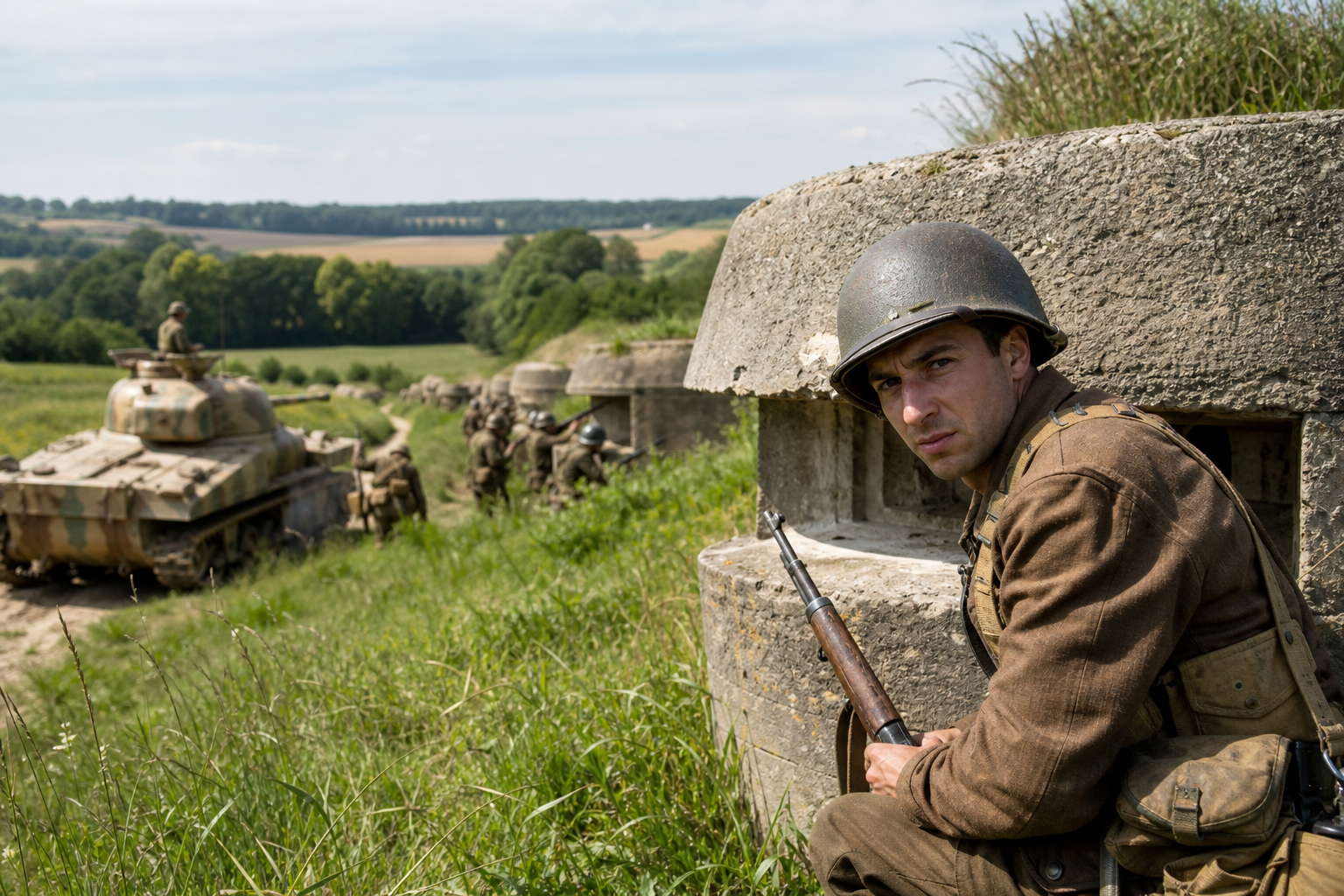
The Maginot Line was not a single wall in the ancient sense, but a sophisticated, deep-defense system of breathtaking complexity and scale. It was a subterranean world, a chain of concrete and steel islands designed to be entirely self-sufficient for months on end. The primary components were the ouvrages, a term that translates roughly to "works" but fails to capture their immense scope. These were divided into two main categories: the larger gros ouvrages (large works) and the smaller petits ouvrages (small works), interspersed with thousands of smaller casemates, observation posts, and infantry shelters. A gros ouvrage was essentially an underground battleship, a fortress-city buried deep beneath the hills of Lorraine. The only visible elements on the surface were the combat blocks (blocs de combat), discreet humps of an ultra-reinforced concrete and steel rising from the landscape. These blocks housed the fortress's teeth: heavy twin 75mm or 135mm artillery pieces and mortars, all mounted in ingenious retractable eclipsed turrets. When not in use, these turrets would retract flush with the concrete, protected from enemy artillery and bombing. When it was time to fire, they would rise, fire a salvo, and disappear back into their shell in a matter of seconds. Other combat blocks contained anti-tank guns, machine-gun cloches (armored bells), and observation posts with powerful periscopes.
Did you know? The Maginot Line had its own unique narrow-gauge electric railway system, with over 50 kilometers of tracks running inside the largest fortresses to transport ammunition and supplies.
Deep below, a network of tunnels, sometimes over a hundred feet underground, connected these combat blocks to the heart of the fortress. This was the living area, a veritable city shielded from the battle raging above. Electric trains, running on narrow-gauge tracks, ferried ammunition, supplies, and personnel along miles of brightly lit, whitewashed corridors. The air the garrison breathed was drawn in from the outside and passed through a complex filtration system, designed to neutralize poison gas—a lingering fear from the trenches of WWI. This conditioned air made the underground environment consistently cool and dry. The facilities were unparalleled for their time. Soldiers slept in tiered bunks in spacious barracks, ate meals prepared in fully-electric kitchens, and had access to modern hospitals complete with operating theaters and dental suites. Power was provided by massive diesel generators located in their own soundproofed chambers, ensuring the fortress would remain lit and functional even if cut off from the national grid. A vast command center, the brain of the ouvrage, coordinated everything from artillery fire to troop movements, communicating with neighboring fortresses and high command via a web of buried telephone lines. The sheer logistical scale was staggering; the largest ouvrage, Hackenberg, was designed to house over 1,200 men and contained 10 kilometers of tunnels. The builders had thought of everything, or so it seemed. This concrete leviathan was hermetically sealed, prodigiously armed, and expertly engineered. It was built to fight and win the Battle of Verdun all over again, a static slugfest where its immense firepower and protection would grind any attacker to dust.
The Concrete Tribe: Daily Life for the Soldiers of the Line
To serve in the Maginot Line was to be initiated into a unique and isolated world. The soldiers garrisoning these fortresses, known as troupes de forteresse (fortress troops), were not standard infantrymen. They were a specialized, elite corps, often recruited from the local region and possessing a mix of military and technical skills. An artilleryman in a retractable turret was also a trained mechanic, capable of maintaining the complex hydraulic and electrical systems of his weapon. The crews running the power plants, the railway, the communication hubs, and the air filtration systems were all highly skilled technicians. This created a distinct culture within the ouvrages, one of professional pride and immense confidence in their concrete-and-steel environment. Life underground was a study in contrasts. On the one hand, it offered a level of comfort and safety unimaginable to the soldiers of the Great War. The men were protected from the elements and enemy shells. They received high-quality food, a stark contrast to the grim rations of the trenches, and the largest fortresses even maintained extensive wine cellars. Discipline was strict but the routine was predictable and safe.
On the other hand, this existence came with its own psychological pressures. Life was lived entirely under the glow of electric lights, with no sense of day or night. The air, while clean, was recycled and sterile, and the constant hum of machinery was a permanent feature of the soundscape. Boredom was a constant enemy. The watch-and-wait nature of their mission meant long periods of inactivity, broken by endless drills and maintenance routines. The term "l'ennui," a deep, soul-crushing boredom, became a common complaint. The command structure did its best to combat this. Many ouvrages featured libraries, recreation rooms, and even rudimentary cinemas that showed films. Sports were encouraged, though they often took the form of competitions between different blocks or fortresses conducted via telephone, comparing metrics like speed in completing a drill. A unique camaraderie developed among these "men of concrete." They were isolated from the rest of the army and the nation, living in their own subterranean society. This fostered an "esprit de corps," but it also engendered a specific mindset, a fortress mentality. Their entire world, training, and purpose were oriented towards the direct defense of their specific sector. They were supremely confident in their ability to repel any head-on assault. However, this very isolation contributed to a lack of awareness of the rapidly evolving doctrines of mobile warfare being developed elsewhere, particularly in the German army. They were masters of their static domain, but the war of the future would be one of motion, a concept alien to the very nature of their concrete world.
Did you know? To combat boredom, many fortresses had libraries, cinemas, and even sponsored sports teams that competed (via correspondence) with teams from other ouvrages.
The Unwatched Gate: Germany's Daring Gamble
The downfall of the Maginot Line was not a matter of engineering but of geography and imagination. The line itself was a masterpiece, but it was an incomplete one. While the fortifications facing the German border directly were incredibly powerful, the line grew progressively weaker as it stretched northwards, petering out into a series of disconnected blockhouses near the Ardennes Forest. It did not extend along the Franco-Belgian border to the English Channel. This was not an oversight, but a calculated decision based on a rigid set of strategic assumptions. Firstly, a full-scale extension would have been prohibitively expensive and politically difficult, as it would have required militarizing heavily urbanized and industrial areas. Secondly, and more importantly, French military doctrine under General Maurice Gamelin assumed that Germany would repeat its 1914 strategy. The main German thrust was expected to come through the flat, open plains of central Belgium. A French extension of the line to the coast would have been seen as an abandonment of their Belgian allies. Instead, the plan was to rush the best and most mobile divisions of the French army, along with the British Expeditionary Force (BEF), into Belgium as soon as Germany invaded, meeting the enemy on foreign soil far from the heart of France.
This strategy left one critical sector relatively lightly defended: the Ardennes. This region of rolling hills, dense forests, deep valleys, and winding rivers was deemed impassable (impénétrable) for a major mechanized force. The French High Command, along with most military theorists of the time, believed that tanks and their vast logistical support columns could not navigate the difficult terrain and narrow roads quickly. Any German force attempting to do so would get bogged down, move at a snail's pace, and be easily destroyed by French airpower and reserves. The sector was therefore held by older, weaker reserve divisions, considered adequate for what was expected to be a quiet front. But across the border, a new, audacious plan was taking shape, one that targeted this very assumption as the centerpiece of its strategy. Initially, the German plan for invading France, Fall Gelb (Case Yellow), was indeed a conventional repeat of the Schlieffen Plan. However, General Erich von Manstein, a brilliant staff officer, argued this would only lead to a stalemate. He proposed a radical alternative, which, after gaining Hitler's enthusiastic support, became known as the Sichelschnitt, or "Sickle Cut." The plan was deceptively simple but incredibly daring. The northern army group would attack the Netherlands and Belgium as a feint, drawing the elite Allied armies northwards, just as the French expected. But the real blow, the decisive thrust, would come from Army Group A, comprising the bulk of Germany's Panzer divisions. This armored fist would punch directly through the "impenetrable" Ardennes, cross the Meuse River, and then race for the English Channel, cutting off and trapping the entire northern wing of the Allied forces. It was a high-risk gamble that relied on speed, surprise, and the enemy's psychological adherence to their preconceived notions. The Maginot Line, in this scenario, would not be assaulted; it would be rendered irrelevant, a mighty fortress guarding a door while the enemy smashed through the back wall.
A Spectator to Defeat: The Maginot Line's Silent Surrender
On May 10, 1940, the German war machine roared into life. As Panzer divisions feinted towards Belgium, the elite Allied armies, including the BEF and the French First and Seventh Armies, dutifully executed their pre-war plan, racing north to meet the threat. Meanwhile, hidden from Allied reconnaissance, General von Kleist's huge armored group plunged into the Ardennes. The French assumption of its impassability was shattered almost immediately. Led by brilliant commanders like Heinz Guderian, the German engineers worked miracles, building pontoon bridges and clearing roads, allowing the tanks to advance at a shocking pace. On May 13, German forces reached the Meuse River at Sedan, the same area where France had suffered a decisive defeat in 1870. Under the cover of overwhelming air support from Stuka dive-bombers, which terrorized the second-rate French defenders, Guderian’s Panzers forced a crossing. The breakthrough was achieved.
Did you know? Some French strategists, including a then-colonel Charles de Gaulle in his 1934 book "Vers l'Armée de Métier," had warned against over-reliance on static defenses and advocated for a professional, mobile armored force, but his ideas were largely ignored.
While this decisive action was taking place, the garrisons of the Maginot Line proper stood by in a state of surreal calm. They were at full alert, their guns aimed, their turrets ready to rise. They listened to radio reports of the chaos unfolding to their north with a mixture of confusion and disbelief. Their concrete world was secure, their sectors were quiet. The war was happening somewhere else. The German "Sickle Cut" plan worked more perfectly than even its authors could have hoped. The Panzer divisions tore across northern France, reaching the English Channel at Abbeville on May 20, just ten days after the offensive began. The hook was in place. The best armies of France and Britain were now trapped in a vast pocket with their backs to the sea. The evacuation at Dunkirk saved the men, but not their equipment or their strategic position. France was broken. With the northern armies encircled, the Germans turned south, attacking the remnants of the French army from the rear. It was only now that the Maginot Line itself came under direct, albeit secondary, assault. The Germans, using their experiences to attack some of the weaker fortifications from the undefended rear, managed to capture Ouvrage La Ferté, where the entire garrison suffocated after a brutal fight. Yet, the main gros ouvrages held firm. When Italy declared war on June 10, the Alpine section of the Maginot Line performed brilliantly, easily repelling the Italian invasion with minimal casualties. But these were isolated acts of defiance in a lost war. On June 22, 1940, the new French government led by Marshal Pétain signed an armistice with Germany. One of the conditions was the surrender of all fortifications. A wave of bitterness and disbelief swept through the Maginot garrisons. They had not been defeated. Their fortresses were intact, their ammunition bunkers full, their morale high. They were ordered by their own government to lay down their arms and march out to surrender to an enemy who had never managed to breach their walls. The most powerful fortress in the world had become a spectator to its own nation's collapse, its strength rendered meaningless by a revolution in warfare it was never designed to face.

Legacy in Concrete: A Monument to Miscalculation
The legacy of the Maginot Line is complex, layered with irony and tragedy. In the immediate aftermath of the Fall of France, it became an international symbol of failure, a shorthand for any expensive, static defense that is ultimately rendered obsolete. The term "Maginot Mentality" entered the lexicon, signifying a defensive mindset, a fatal over-reliance on past solutions that prevents one from seeing and adapting to new threats. And in this, there is undeniable truth. The line was a World War I solution applied to a World War II problem. Its very existence fostered a dangerous passivity in French military thinking, diverting immense resources and intellectual energy away from the development of the armored divisions and air power that would prove decisive in 1940. It was a strategic tranquilizer, lulling the nation and its military leaders into a false sense of security while their enemy was honing a new and dynamic form of warfare.
However, to dismiss it solely as a failure is to miss the nuance. The Maginot Line was not a failure of engineering; it was a triumph. The sections that were attacked, whether by the Germans or the Italians, performed exactly as intended, holding off superior numbers at a minimal cost in French lives. In this, André Maginot's vision was vindicated. The line was not breached through frontal assault. Its failure was purely conceptual. It failed because it was out-thought, bypassed, and made irrelevant by a strategy of audacious movement. It guarded the front door with unparalleled strength while the attackers simply knocked down a side wall presumed to be solid. After the French surrender, the Germans took possession of this incredible military asset, using it for propaganda to showcase their victory. Later in the war, some of the larger ouvrages were repurposed as bomb-proof underground factories and command centers. In the Cold War, the French military reactivated parts of the line as hardened command bunkers and shelters, fearful of a new threat from the east. Today, the great line is mostly silent. Many of the smaller casemates lie derelict, flooded and overgrown, concrete relics slowly being reclaimed by nature. But several of the largest ouvrages, like Hackenberg and Simserhof, have been preserved by dedicated local associations and converted into fascinating museums. They offer a chilling glimpse into the subterranean world of the fortress troops and stand as a powerful testament to the inter-war era's hopes and fears. The Maginot Line, therefore, remains a profound lesson in military history: a warning that the most formidable walls and the most powerful weapons are useless without the strategic imagination to deploy them correctly, and that no nation can afford to prepare only for the war it has already fought.
Did you know? After the surrender, the German army used the captured Maginot fortresses for propaganda films and as underground factories and storage depots, safe from Allied bombing.
How we verify this article
By the History Unlocked editorial team
This text is built on historical facts stored in our database and drafted with AI assistance. No signed human review is recorded for this article. Report any inaccuracy: we correct it and update the modified date.
Updated on
AI-assisted drafting.
Read our editorial standardsEnjoyed this? Discover more articles in the category World War II