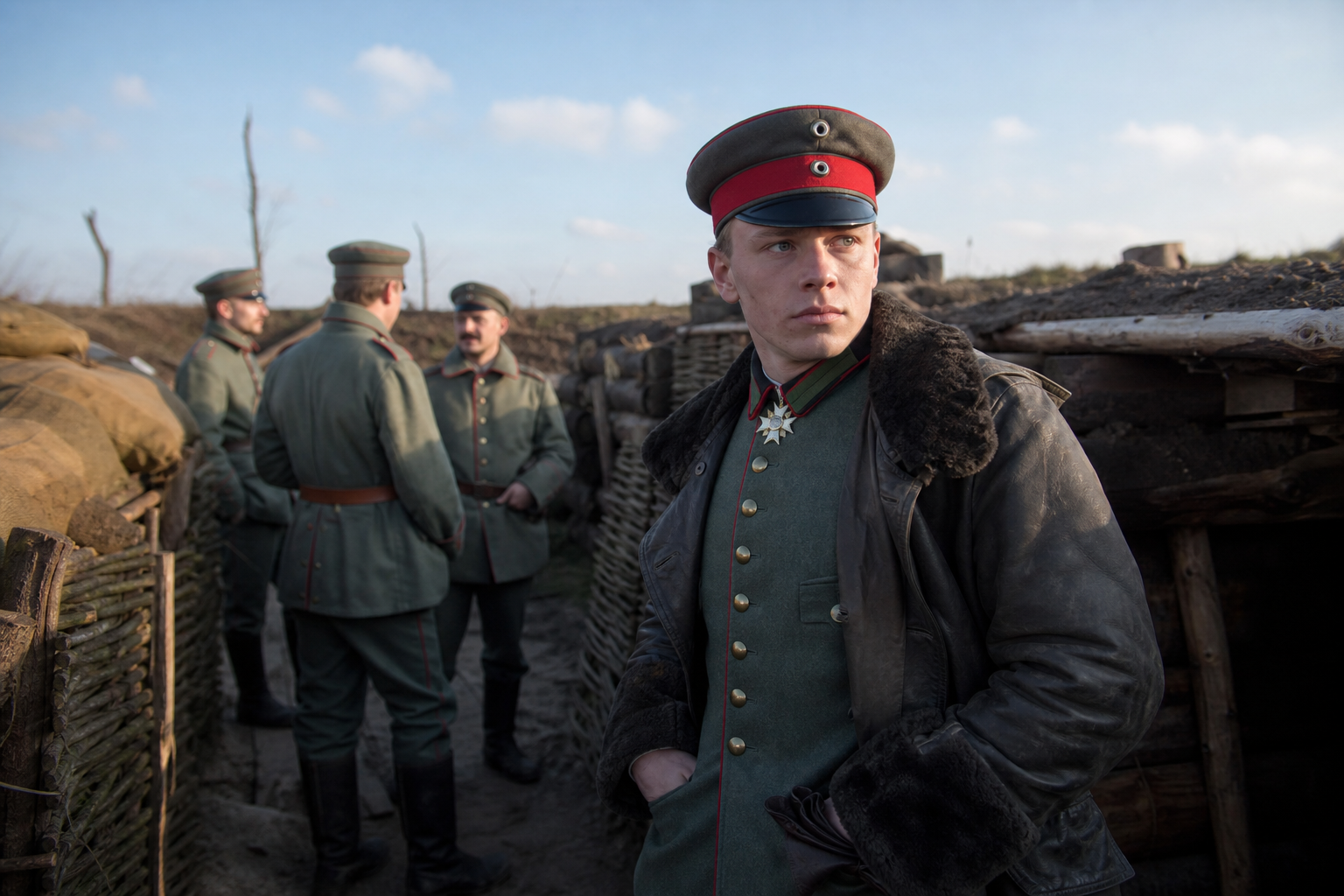
The Red Baron: Who Really Killed the Ace of Aces?
Above the scarred and muddy hellscape of the Western Front, a new kind of warfare was born. Here, in the vast, unforgiving skies, young men in fragile machines of wood, wire, and canvas dueled for supremacy, creating a brutal but strangely intimate form of combat. They were the knights of the air, and among them, one name soared above all others, casting a blood-red shadow across the trenches and striking fear into the hearts of Allied pilots: Manfred von Richthofen, the Red Baron. With 80 confirmed aerial victories, he was the ace of aces, a hunter of unparalleled skill and lethality. His legend transformed him from a mere man into a crimson specter, the embodiment of German martial prowess. But the very machine that made him a legend, a vibrant red triplane, also made him an unmistakable target. His story is not just one of victory, but of a calculated, almost scientific approach to killing that revolutionized aerial combat. Yet, for all his fame and the terror he inspired, the end of his story is shrouded in one of the greatest mysteries of the Great War. On April 21, 1918, the hunter became the hunted, and a single bullet ended his reign. Who fired that fatal shot? Was it the Canadian pilot credited with the kill, locked in a desperate dogfight? Or was it an anonymous soldier on the ground, firing his machine gun into the sky as the red triplane screamed past? The answer remains fiercely debated, a testament to the chaos of battle and the enduring power of a legend. This is the story of the man behind the myth, his bloody rise to fame, and the still-unsolved puzzle of his final, fateful flight.
From Cavalryman to the Cockpit: The Unlikely Genesis of an Ace
Before he was the Red Baron, Freiherr Manfred von Richthofen was a product of the Prussian Junker class, an aristocracy steeped in military tradition. Born in 1892, his path seemed preordained: a life of service in the Kaiser's army. True to his heritage, he began his military career not in the sky, but on horseback. As a young Uhlan (cavalryman) lieutenant, Richthofen anticipated a war of glorious charges and swift maneuver, the kind of romanticized conflict his ancestors had known. The reality of World War I, however, was brutally different. The advent of the machine gun and trench warfare quickly rendered cavalry obsolete on the Western Front. Instead of heroic charges, Richthofen found himself mired in the mud and stagnation of static warfare, relegated to monotonous duties as a dispatch rider and supply officer far behind the lines. This was not the war he had signed up for. His frustration and boredom grew with each passing day. He yearned for action, for a return to the thrill of the hunt, a passion he had cultivated during his aristocratic upbringing through extensive hunting on his family's estates. It was this deep-seated desire for a dynamic and individualistic form of combat that led him to look upwards, to the fledgling air service.
His transition to the air was not immediate or glamorous. In mid-1915, he applied for a transfer to the Imperial German Army Air Service, the Fliegertruppe. According to legend, his transfer application simply stated, "I have not gone to war in order to collect cheese and eggs, but for another purpose." Initially, he served as an observer in a reconnaissance unit on the Eastern Front, a role which involved leaning out of a shaky two-seater aircraft to take photographs and scout enemy positions. It was dangerous work, but it was his first taste of the three-dimensional battlefield. Here, he learned the critical skills of aerial navigation, spotting, and understanding the flow of battle from above. He even scored his first, albeit unconfirmed, kill from the observer's seat with a machine gun. However, being a passenger was not enough. The hunter in him wanted to be in control, to be the one dictating the terms of engagement. He was determined to become a pilot. His initial attempts at flight training were surprisingly clumsy. His first instructor allegedly told him he would never learn to fly. Richthofen, however, was nothing if not persistent. He crashed on his first solo flight but walked away unscathed and undeterred. Through sheer force of will and relentless practice, he mastered the unstable aircraft of the era, finally earning his pilot's wings in December 1915. He was not a natural, "seat-of-the-pants" aviator like some of his contemporaries. Instead, his success would be built on a foundation of grim determination, rigorous practice, and an analytical mind that saw the sky not as a space for acrobatic dueling, but as a three-dimensional hunting ground.
Did you know? Richthofen's autobiography, "Der rote Kampfflieger" (The Red Battle-Flyer), was written in 1917 while he was recovering from a head wound. It was a massive propaganda success, but he later expressed regret over its boastful and juvenile tone.
The Birth of a Legend: Jasta 11 and the Flying Circus
The turning point in Richthofen's career, and the moment his journey to becoming a legend truly began, came in August 1916. He was selected by Germany’s top flying ace at the time, Oswald Boelcke, to join a new elite fighter squadron, Jagdstaffel 2 (Jasta 2). Boelcke was not just a phenomenal pilot; he was a brilliant tactician and a visionary leader. He was the first to codify the rules of aerial combat in his famous "Dicta Boelcke," a list of fundamental tactical principles that included attacking from a position of advantage (ideally out of the sun), firing only at close range, and always keeping the enemy in sight. For the analytically minded Richthofen, Boelcke’s teachings were a revelation. He absorbed these rules, making them the cornerstone of his combat philosophy. Under Boelcke’s mentorship, Richthofen honed his skills, transforming from a competent pilot into a lethal predator. On September 17, 1916, flying a new Albatros D.II scout, he scored his first officially confirmed aerial victory over Cambrai, France. This was the first of many, and he began a macabre tradition that would follow him throughout his career: for each victory, he commissioned a small silver cup engraved with the date and the type of Allied aircraft he had shot down.
In January 1917, Richthofen’s rising star was recognized with a command of his own: Jagdstaffel 11. At the time, Jasta 11 was a newly formed squadron with a lackluster record and pilots of average ability. Richthofen, now an Oberleutnant, set about remaking it in his own image. He was a demanding but effective leader, drilling his pilots relentlessly in the tactical principles he had learned from Boelcke. He led by example, demonstrating his cold, calculated methods in the sky. To foster unit cohesion and to make his squadron’s aircraft easily identifiable to friendly forces from the ground, Richthofen had the noses of the Jasta’s Albatros fighters painted red. His pilots soon took this a step further, painting other parts of their aircraft in a riot of individual colors—yellows, blues, greens, purples—while Richthofen himself had his entire Albatros D.III painted a shocking, brilliant blood-red. This was a deliberate act of psychological warfare. The all-red aircraft was an unmistakable challenge, a symbol of his supreme confidence. Allied pilots soon learned to dread the sight of it. The collection of brightly colored planes became known as "Richthofen's Circus" or the "Flying Circus," a name that evoked both their vibrant appearance and their ability to quickly pack up their tents and move to new sections of the front, much like a travelling circus. Under his command, the once-unremarkable Jasta 11 became the most successful German fighter squadron of the war, a feared and deadly instrument of aerial dominance.

The Psychology of the Hunter: Richthofen's Rules of Engagement
What truly set Manfred von Richthofen apart from his peers was not natural flying talent or reckless bravado, but his mindset. He was, at his core, a hunter. He approached aerial combat with the same cold, methodical precision that he had applied to hunting wild boar and deer on his family estate. The sky was his new forest, the enemy aircraft his prey. He rejected the romanticized notion of the chivalrous dogfight, the improvised, acrobatic duel of equals. For Richthofen, combat was not a sport; it was a deadly science. His primary goal was not to damage a plane but to kill the pilot, a grimly practical objective that guaranteed the aircraft would fall. This chilling focus is what made him so incredibly effective. He saw no honor in a "fair fight." Instead, he adhered strictly to the "Dicta Boelcke," particularly the principle of attacking from a position of overwhelming advantage. His preferred method was to stalk his target from above, using clouds and the glare of the sun to remain unseen. He would patiently wait for the perfect moment, when his intended victim was distracted or isolated, before diving down in a swift, merciless attack. His attacks were characterized by discipline and control. He would close to a perilously short range—often less than 50 meters—to ensure his machine gun bullets would find their mark, a practice that horrified less experienced pilots.
Did you know? Richthofen’s constant companion on the ground was his Great Dane, Moritz. The dog was a beloved mascot of the Flying Circus and often flew with the Baron on transport flights between airfields.
This predatory approach was devoid of emotion. He did not hate the men he killed; in many ways, they were simply abstract targets, points to be scored in a lethal game. His collection of silver cups, one for each victory, further illustrates this detached, trophy-hunting mentality. He was not collecting souvenirs of men, but of a successful hunt. This detachment allowed him to remain calm and focused in the life-or-death chaos of a dogfight. While other pilots would engage in wild, spiraling maneuvers, Richthofen would often break off an attack if the situation turned unfavorable, flying away to reset the engagement on his own terms. This was not cowardice; it was tactical genius. He understood that survival was paramount to his continued success. His own survival, however, was seriously threatened in July 1917, when a bullet from an F.E.2d two-seater grazed his skull. The severe head wound grounded him for several weeks and is thought by many historians to have caused lasting effects. After the injury, he complained of headaches and post-flight nausea, and some of his fellow pilots noted a change in his personality. They observed that he became more moody and less willing to heed the advice of others. It is debated whether this injury, and the potential brain damage it caused, contributed to a subtle decline in his judgment, perhaps making him more aggressive and less risk-averse in his final months.
Bloody April: The Apex Predator of the Skies
April 1917 stands as the most terrifying testament to the Red Baron’s dominance. The month would go down in the annals of the Royal Flying Corps (RFC) as "Bloody April," a period of such catastrophic losses that it nearly broke the spirit of Allied aviation. During this single month, the RFC lost 245 aircraft, with 211 aircrew killed or missing and 108 captured. German losses, by contrast, were a mere 66 aircraft. At the heart of this slaughter was Manfred von Richthofen and his Flying Circus. Now flying his iconic red Albatros D.III, Richthofen was at the absolute zenith of his abilities. He led Jasta 11 with lethal precision, and his personal score skyrocketed. In April alone, he claimed 22 British aircraft, more than any other ace had achieved in a single month during the entire war. This included a remarkable day, April 29th, when he shot down four British planes in a single day. This was a period of total German air supremacy on the front, orchestrated by the Red Baron.
The technological and tactical superiority of the Germans was a key factor. The Albatros D.III was, for a time, superior to most of the aircraft flown by the British, particularly the slow and vulnerable B.E.2c, a two-seater reconnaissance plane that earned the grim nickname "Fokker Fodder." These planes were little more than flying coffins when pitted against the elite pilots of Jasta 11. Richthofen and his men would stalk the skies in packs, descending like wolves on isolated formations of RFC planes. The Baron’s tactics, drilled into his men, were devastatingly effective. They would use their superior climb rate to get above the British formations and dive down, firing with their twin synchronized Spandau machine guns. The British pilots, often flying outdated machines and with far less training than their German counterparts, were outclassed and outgunned. Morale in the RFC plummeted. A pilot’s life expectancy over the Arras sector could be measured in weeks, sometimes even days. The sight of the all-red Albatros was enough to cause panic, a harbinger of almost certain death.
Did you know? The silver cups Richthofen ordered for each victory became impossible to procure late in the war due to a blockade-induced silver shortage in Germany. He had 60 cups made before the practice had to be stopped.
Richthofen’s fame, carefully cultivated by German propagandists, grew to mythical proportions. He was awarded the Pour le Mérite, the "Blue Max," Germany’s highest military honor. He was a national hero, a symbol of German invincibility in the sky. Yet, the immense pressure took a toll. He was the leader of the newly formed Jagdgeschwader 1 (JG 1), the first "fighter wing" which combined four Jastas into one powerful, mobile fighting force. The administrative and strategic responsibilities were immense, and the strain of constant combat was relentless. He flew against orders, often taking to the sky when senior command wished for him to remain on the ground to preserve the life of their greatest propaganda asset. But the hunter could not be caged. His own personal code demanded that he lead his men from the front, a decision that would ultimately place him on a collision course with destiny in the skies over the Somme Valley.

The Fateful Day: The Mystery of April 21, 1918
By the spring of 1918, Manfred von Richthofen was a living legend, the most famous pilot in the world. He was now flying the distinctive Fokker Dr.I triplane, a highly maneuverable but relatively slow aircraft, painted in the same iconic, all-red scheme. On the morning of April 21, 1918, he led his patrol from JG 1 over the Somme River valley in France. The sky was filled with dogfights as the German Spring Offensive raged below. That morning, Richthofen’s squadron engaged a flight of Sopwith Camels from No. 209 Squadron, Royal Air Force. In the swirling melee, a young, inexperienced Canadian pilot, Lieutenant Wilfrid "Wop" May, made a rookie mistake. He had been instructed to stay above the fight, but he entered the fray and, after firing at a German plane, found his guns jammed. He broke away, heading for Allied lines. This was the sort of isolated, fleeing target the Red Baron specialized in. Richthofen spotted May’s lone Camel and immediately gave chase, separating from the main dogfight to pursue his 81st victory.
What happened next is one of the most debated events in military history. Seeing his friend May in mortal danger, another Canadian pilot from 209 Squadron, Captain Arthur "Roy" Brown, dove steeply to intervene. Brown, a school friend of May’s, flew down at high speed, firing a long burst from his Vickers machine guns at the red triplane that was now squarely on May’s tail. At the same time, the chase had descended to a dangerously low altitude, flying directly over the Allied front lines in the Morlancourt Ridge sector, an area heavily defended by Australian Imperial Force (AIF) machine gunners on the ground. As Richthofen’s Fokker, Brown’s Camel, and May’s Camel screamed past at treetop level, multiple machine guns from the 24th Machine Gun Company and the 53rd Battery, 14th Australian Field Artillery Brigade, opened fire on the distinctive red aircraft. For a fleeting moment, Richthofen continued his pursuit. Then, his triplane wavered. It broke off the attack, banking unsteadily before making a rough but controlled landing in a field just behind the Australian lines. When the soldiers reached the cockpit, they found the Red Baron dead, killed by a single .303 caliber bullet.
Did you know? Richthofen's body was later exhumed and reburied in Germany. His final resting place is now in a family grave in Wiesbaden, after his previous Berlin grave was found on the "death strip" of the Berlin Wall.
The controversy began almost immediately. Captain Roy Brown was officially credited with the victory by the RAF. The logic was sound: he was the only Allied pilot known to have engaged Richthofen directly during those final moments. Brown himself reported firing at the triplane and seeing it go down. However, the nature of the wound and the location of the landing raised serious doubts. The fatal bullet had entered Richthofen’s right side, passing diagonally through his chest and exiting higher up on the left. For this wound to have been inflicted by Brown, Richthofen would have had to have been turning in his seat or the plane would have had to have been in an unusual attitude, which seemed unlikely as he was in level pursuit of May. Many of the Australian ground gunners were adamant that they had hit the plane. Sergeant Cedric Popkin, using a Vickers machine gun, claimed to have fired a direct burst at the triplane as it flew straight towards his position, only banking away at the last second. Gunner Robert Buie also fired a long burst from his Lewis gun. Medical examiners who inspected the body shortly after the crash believed the wound was more consistent with a shot fired from the ground, angled upwards into the cockpit. The debate rages to this day. Was it Brown in his Sopwith Camel, making a heroic intervention? Or was it Popkin or Buie on the ground, an anonymous soldier who unknowingly brought down the war’s greatest ace? The evidence is inconclusive, and a definitive answer may never be found, cementing the final moments of the Red Baron in a permanent state of mystery.
A Legacy Forged in the Sky: The Unchivalrous Knight
The death of Manfred von Richthofen sent shockwaves through both sides of the conflict. For the Germans, it was a devastating blow to morale, the loss of an almost mythical national icon. For the Allies, it was a moment of triumph, but one tinged with a surprising degree of respect. The Red Baron was not treated as a hated enemy but as a fallen warrior of immense stature. The men of No. 3 Squadron, Australian Flying Corps, whose aerodrome was nearest to where the Baron crashed, took charge of his body. They afforded him a full military funeral with a guard of honor, burying him in a cemetery in Bertangles, France, with a level of reverence typically reserved for a high-ranking officer of their own. A wreath laid by his Allied enemies was inscribed: "To Our Gallant and Worthy Foe." This act speaks volumes about the strange paradox of aerial combat in World War I. While he was a cold and methodical killer in the air, the pilot community on both sides saw him as a master of their shared, deadly craft—a knight of the sky, even if his methods were far from chivalrous.
Richthofen’s legacy is complex and multifaceted. He was, without question, a pioneer of aerial warfare. His tactical principles, largely inherited from Boelcke but refined and perfected by his own analytical genius, became the foundation of fighter doctrine for decades to come. The concept of the "Fighter Wing" or Jagdgeschwader—a large, mobile unit of fighter squadrons that could be deployed to achieve air superiority at critical points—was a revolutionary idea that he helped bring to fruition. He transformed aerial combat from a series of individual duels into a coordinated, strategic endeavor. He was the prototype of the modern fighter ace: not just a skilled pilot, but a tactician, a leader, and a lethal hunter. His success was not based on luck, but on discipline, practice, and a ruthless understanding of the geometry of an aerial ambush. He was the antithesis of the romantic, swashbuckling aviator, and yet, paradoxically, his red plane and aristocratic background made him the ultimate symbol of that very archetype.
After the war, his legend only grew. He became a figure of fascination, his story told and retold in countless books, films, and even cartoons. He has been portrayed as a valiant knight of the air, a tragic hero, and a cold-blooded killer. The German military during the Nazi era appropriated his image, naming a fighter wing after him (Jagdgeschwader 2 "Richthofen") to embody their ideal of an Aryan warrior. This propaganda usage has, for some, tainted his legacy, linking him to an ideology he never knew. Yet, the core of his story—the tale of a young aristocrat who became the most feared pilot in the world only to be brought down by a single, mysterious bullet—continues to captivate. He remains a powerful symbol of the dawn of air power and the profound way in which technology transformed the face of war, creating new heroes and new horrors in the vast and silent theater of the skies. His story forces us to confront the uncomfortable dualities of war: the intersection of skill and slaughter, honor and ruthlessness, and the making of a hero out of the act of killing.
How we verify this article
By the History Unlocked editorial team
This text is built on historical facts stored in our database and drafted with AI assistance. No signed human review is recorded for this article. Report any inaccuracy: we correct it and update the modified date.
Updated on
AI-assisted drafting.
Read our editorial standardsEnjoyed this? Discover more articles in the category World War I