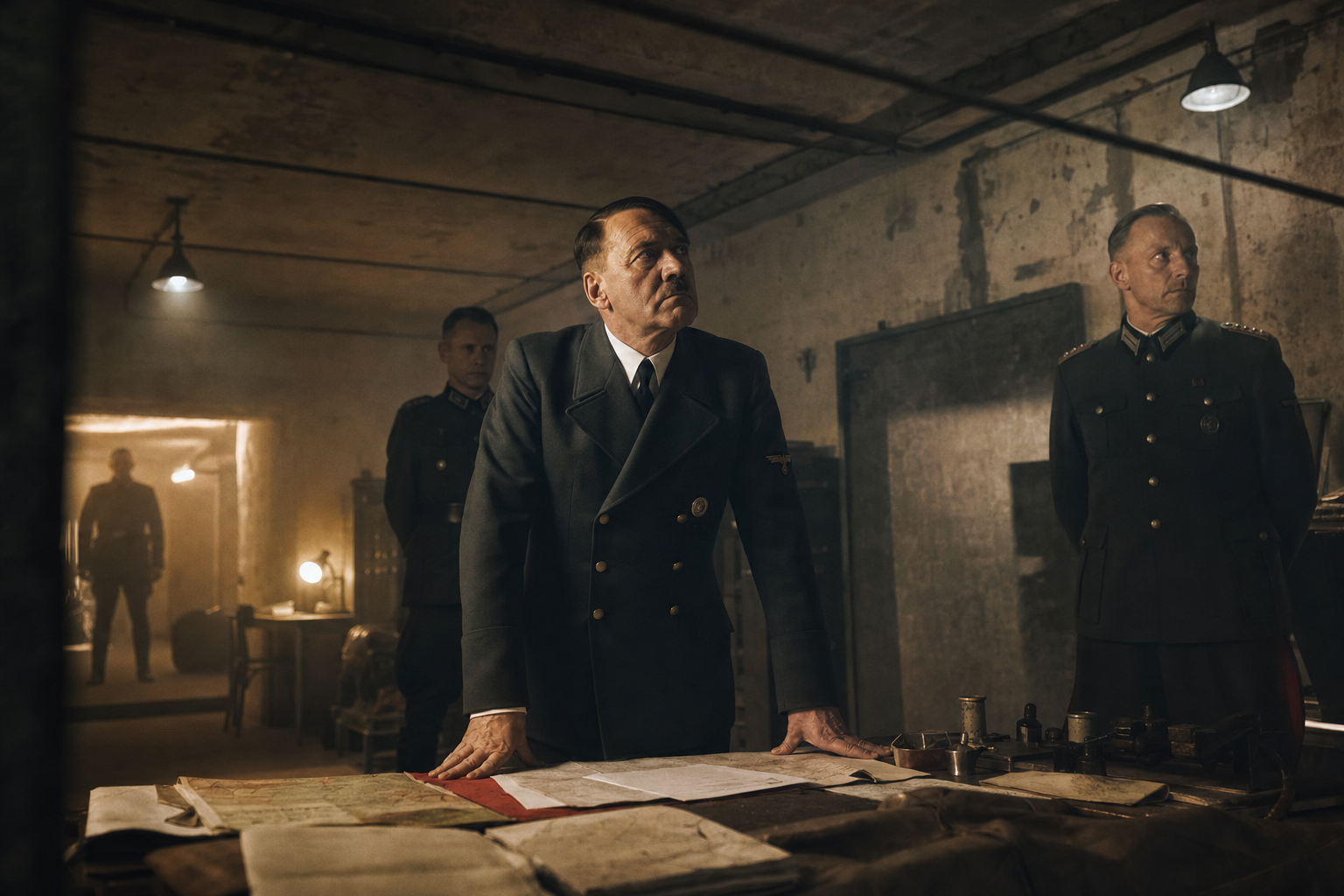
Inside Hitler's Bunker: Secrets of the Führerbunker Revealed
In the last brittle days of April 1945, beneath the scarred soil of central Berlin, a subterranean world held the final acts of the Third Reich. The Führerbunker — a network of concrete rooms and narrow corridors located under the Reich Chancellery garden — became for a time an improbable stage where decisions, confessions, marriages and deaths unfolded in a claustrophobic, electric hush. This was not merely an engineering feat of wartime protection; it was the sealed locus of Hitler's withdrawal from a world he had helped to shape and then watched unmake itself. The bunker combined banal domestic routines with the gravity of collapsing national institutions: dictation of last wills, whispered plans, the ritual of staff attending to a leader whose empire had vanished into smoke and rubble.
The story of the Führerbunker is at once architectural, human and mythic. Its concrete walls obscure as much as they reveal. For historians, the bunker is a locus where eyewitness testimonies converge and conflict — the typed notes of secretaries, the recollections of adjutants, the haggard statements of children of propaganda ministers, and the Soviet reports that folded the site under layers of secrecy. For the public imagination, draped in postwar fascination, the bunker offered a picture of the dictator as trapped, shrinking into a subterranean cocoon where his final choices were made far from the fevered rallies that once defined his power. That tension — between mundane detail and monumental consequence — is what makes the Führerbunker an enduring subject.
This article will plunge into the bunker’s origins and layout, explore what daily life looked like for those who labored and waited within, narrate the chaotic final days of April 1945, examine the suicides and immediate aftermath, trace Soviet investigations and the many persistent myths they fueled, and follow the bunker’s physical and memorial afterlife. Throughout, I will privilege documented testimony, archival records and the most reliable scholarship, while maintaining a narrative tone that tries to capture the claustrophobic mystery of those last days. Evidence is abundant but rarely simple; the bunker’s story is a collage of memory, forensic detail and the deliberate obfuscations of wartime actors. To understand the Führerbunker is to stand at the intersection of historical method and human drama — and to confront how the smallest rooms can contain events that alter the course of history.
Did you know? The Führerbunker lay roughly eight to ten meters below the Reich Chancellery garden, with several meters of concrete above it to protect occupants from bombs.
Origins and construction of the Führerbunker
Structurally, the Führerbunker was reinforced concrete designed to withstand blast pressure and close bombardments. It lay approximately eight to ten meters beneath the surface and had a thick concrete ceiling; accounts reference a roof consisting of several meters of concrete and soil above, which offered significant protection from aerial attack and artillery. The rooms were arranged along narrow corridors, fitted with basic amenities for living and working: a private study for Hitler, a map room, conference and radio rooms, and living quarters for senior staff and secretaries. Ventilation systems, power supplies and rudimentary plumbing were incorporated, although these systems were vulnerable to the broader collapse of Berlin’s utilities. The bunker was effectively a subterranean suite of offices and bedrooms designed to sustain a small, mobile government under siege.
The bitterness of its design was that, while it shielded its occupants from the immediate physical dangers of bombing, it imposed an atmosphere of constrained life. Descriptions by participants emphasize the play of artificial light and the unvarying echo of footsteps. The deliberate choice to situate the Führerbunker under the Chancellery garden was symbolic as well as practical — Hitler wished to remain as physically close to the state center as possible. That proximity allowed for continued communications with military commanders and messengers who could still reach the surface, but it also tethered him to a city rapidly being encircled and consumed. The bunker’s architecture therefore mirrored the political reality: solidity and permanence in form, increasing isolation in function.
Construction records and later archaeological study reveal that the bunker complex was built in stages, with later modifications intended to increase privacy and protection. Engineers who worked on similar projects noted that the materials used were of high quality because the Chancellery was considered an essential locus of command. Yet the bunker was never a luxury shelter; its rooms were functional, sometimes spartan, and fitted more for crisis management than for comfort. The mix of utilitarian engineering and the intimate scale of the rooms contributed to the psychological pressure that many occupants later described: the air felt stale, rumors multiplied in enclosed spaces, and the sense of being trapped intensified as Berlin’s defeat became unavoidable.
Did you know? Eva Braun moved into the Führerbunker in late January 1945 and married Adolf Hitler there on April 29, 1945.
Life inside the bunker: routines, personalities and the human scale
The image of life in the Führerbunker oscillates between the drab and the hair-raising. It was a place of routines interrupted by the extraordinary. Staff who lived there kept detailed, sometimes haunting journals and postwar interviews that give texture to daily life: the rounds of meals cooked in subterranean kitchens, the clack of typewriters transcribing last-minute orders, the flicker of radios transmitting fragmented reports from a city under siege. Hitler maintained a daily rhythm even as his external control waned — he dictated dispatches and messages, met with staff and listened to news — but the bunker compressed time and intensified interactions among a small group of people with varying degrees of loyalty and despair.
Among those who lived in or frequently visited the Führerbunker were key figures of the Nazi regime. Eva Braun, Hitler’s long-time companion, moved into the bunker in late January 1945. She and Hitler married in a brief civil ceremony on April 29, 1945, in a private, low-key event in the headquarters of the underground world they shared. Joseph and Magda Goebbels were present for much of the final week; Joseph served as Nazi chancellor nominally after Hitler’s death for about a day before both he and Magda committed suicide on May 1, 1945. Bormann, Hitler’s private secretary and head of the Party Chancellery, was a ubiquitous presence, controlling access and operational details. Traudl Junge, who was one of Hitler’s secretaries and typed many of the Führer’s last documents, later provided invaluable first-person testimony that scholars have used to reconstruct daily life and specific events.
Contrary to the cinematic image of constant shouting, many accounts describe the bunker as a site of constrained, subdued interactions — small talk, complaints about cold, and repeated requests for updates from the outside world. Food and fuel were scarce; the staff tried to maintain a semblance of normalcy with simple meals and makeshift comforts. Long bouts of waiting punctuated by sudden, stressful bursts of activity characterize many of the recollections. The psychological strain was corrosive: confidences were scarce, whispers spread rumor, and petty tensions exacerbated the larger sense of doom. The interpersonal dynamics mattered; people who could not be trusted were kept at a distance, and those who personified loyalty were rewarded with proximity.
Did you know? Hitler dictated his political testament on April 29, 1945, naming Karl Dönitz as his successor and denouncing several of his associates.
Yet it is critical to remember that the bunker also housed ordinary people in extraordinary circumstances: secretaries, cooks, nurses, and aides whose personal perspectives are often the most poignant. These individuals tended to experience the bunker less as a political theater and more as a cramped workplace where loyalty to the leader was mixed with concern for personal survival. Their testimonies reveal a daily life that alternated between grim humor and stoic endurance. Through their eyes, the Führerbunker was less a monument than a workplace with hours, chores and a growing dread that the lights might go out forever.
The last days: April 1945 and the unraveling of command
April 1945 was a month of irreversible collapse for the Third Reich. Soviet forces encircled and then entered Berlin; street-to-street fighting left the city a lattice of rubble and barricades. Within this context, the Führerbunker became the nerve center for a small, desperate cadre of Nazi leadership trying to manage defeat. Hitler, increasingly isolated and in failing health, grew more intransigent in strategy and more fatalistic about the future. By mid-April the strategic situation was clear to many observers in the bunker: the Red Army’s advance was inexorable and offers to negotiate were too late to reverse reality.
On April 20, Hitler’s birthday, he briefly appeared at the Chancellery and gave what would be one of his last public addresses, though the formal festivities were stripped of their earlier grandiosity. As Soviet shells closed in, the bunker’s occupants received reports that cut both ways: tactical updates on the front lines that still clung to hope, and grim news of islolated units surrendering. Inside the bunker, arguments over strategy became increasingly abstract — their presupposition was too late to alter the kinetic facts. Some officers proposed breakout attempts; others advocated holding positions. Most of these options were logistically impossible by late April.
Did you know? After their suicides on April 30, 1945, Hitler and Eva Braun’s bodies were carried to the Chancellery garden, doused with petrol, and burned in a shell crater.
During those days, Hitler’s mental state oscillated. Witness accounts describe him as alternately lucid and resigned, intermittently clinging to directives and at times withdrawn. He dictated his last will and his political testament on April 29, naming Admiral Karl Dönitz as his successor and denouncing members of his own inner circle he believed had betrayed him. These documents are among the most studied wartime artifacts: they attempt to justify the regime’s actions and distribute blame as Berlin collapsed. On April 30, Berlin was effectively encircled. Hitler and Eva Braun retreated into the most private rooms of the Führerbunker; few visitors were admitted. The separation from the world above became absolute in a way it had not been before.
The physical conditions worsened: the blanket of smoke and dust that accompanied the fighting filtered down; the phone lines were severed; radio communication became intermittent. Even daily essentials were not guaranteed. The city’s last available couriers risked their lives to carry messages and inject supplies. These constraints intensified paranoia and closed minds against new information. Decision-making in such an environment tended to regress into ritual, and the small group inside the Führerbunker began to enact their farewell performances. The final acts were coordinated with grim efficiency: the marriage to Eva Braun, the written last wills, and the last preparations that would precede the suicides.
The suicides and immediate aftermath
The final day in the Führerbunker plays out like a tight, tragic drama. On April 29, 1945, Hitler married Eva Braun in a brief ceremony; the marriage was a private event attended by a handful of close aides. The very next day, on April 30, Hitler and Braun died in the bunker. According to consistent testimony from surviving witnesses, Hitler shot himself while simultaneously taking cyanide; Eva Braun took cyanide. Their bodies were carried up to the Chancellery garden, drenched in petrol and set on fire by attendants who hoped to make identification more difficult and to adhere to Hitler’s desire that his corpse not be publicly displayed.
Did you know? Remains believed to be Hitler’s were held by Soviet authorities and reportedly cremated and scattered in 1970 to prevent any physical shrine from forming.
There are certain details around these events that have been the subject of rigorous historical scrutiny. The principal witness testimonies were collected from secretaries like Traudl Junge, his valet Heinz Linge, and others who were in the immediate circle. Their accounts collectively assert the sequence of marriage, will-dictation and suicide within the bunker. After the deaths, bodies were transferred to the Chancellery garden and burned in a shell crater; the British and Americans would later relay Soviet statements that reported finding charred remains. Soviet troops were the first to take control of the area and reported discovering remains and personal effects that matched Hitler and Braun. The Soviets took custody of the available fragments and conducted their own investigations and autopsies.
The immediate aftermath was chaotic, politically charged and subject to conflicting accounts. Some Nazi officials attempted to escape; Joseph Goebbels and Magda Goebbels remained behind; they murdered their six children on May 1 and then committed suicide themselves. Martin Bormann attempted a breakout but disappeared into the ruins. For many months after these events, the precise details of what had occurred remained shadowed by secrecy, rumor and the fog of war. Yet by collating survivor testimony with Soviet forensic reports, historians have been able to establish a consistent sequence of events that identifies suicides, the manner of disposal of the bodies and the swift Soviet effort to control information and narrative around these deaths.
Soviet secrecy, investigations and enduring myths
The Soviet handling of the Führerbunker remains and any physical evidence contributed heavily to postwar myth-making. Soviet troops entered the area and recovered charred remains and personal items, which they retained for forensic study. For decades, official Soviet statements about the events surrounding Hitler’s death were inconsistent and selective, sometimes reflecting propaganda concerns as much as a desire for historical clarity. For example, rumors persisted for years that Hitler had escaped to South America or that the Soviets had killed him elsewhere — claims amplified by Cold War secrecy and by sensationalist accounts.
Did you know? In 1988 construction work exposed parts of the Führerbunker; the remains were photographed and then resealed, and a modest information board was installed in 2006.
Despite the conspiracies, the forensic record stabilized over time. Soviet autopsy reports concluded that the remains consistent with Hitler showed evidence of a bullet wound to the skull and traces consistent with bitter poisoning, matching many witness testimonies indicating a simultaneous cyanide ingestion. The Soviets transported remains to Magdeburg and kept them in secret military archives. The uncertainty around the ultimate disposition of the physical remains — the Soviets later reportedly cremated and scattered the ashes in 1970 to prevent any shrine from forming — only stoked speculation. The unevenness of Soviet disclosures made it easier for myths to spread, but successive investigations and archival releases have clarified many points.
One important postwar development concerned Martin Bormann, whose fate remained one of the most persistent mysteries. For decades, rumors circulated that he had fled; in 1972 human remains were found near Lehrter Strasse in Berlin and later identified, through forensic analysis and eventually DNA testing in the 1990s, as Bormann’s. This provided a measure of closure for one of the regime’s most secretive figures. Similarly, numerous witness testimonies, official documents and contemporary photographic evidence have gradually undercut the more outlandish escape theories about Hitler himself.
The effect of Soviet secrecy is also instructive for historians: when primary authorities withhold or manipulate evidence, the vacuum is quickly filled by speculation. The bunker’s physical remains were carefully managed by postwar powers — demolished, sealed, inventoried and then in some instances hidden — which made public verification difficult. Yet careful archival work, forensic study and corroborating eyewitness accounts have allowed historians to reconstruct the most probable chain of events with a high degree of confidence.
Did you know? Martin Bormann’s fate was clarified when remains found in 1972 were later identified by forensic and DNA analysis as his, ending decades of speculation.

The bunker after the war: demolition, memory and the present site
What to do with the physical site of a dictatorial death is never a neutral question. In the immediate postwar years the Reich Chancellery above the bunker was largely destroyed by fires and bombardment and then demolished in the rubble-clearing operations that swept through central Berlin. The Soviets partially sealed and attempted to demolish parts of the bunker complex; subsequent East German authorities likewise engaged in efforts to obscure the site. In practical terms, the bunker was filled, built over and repeatedly obscured so that it would not become a physical shrine or a focus for neo-Nazi pilgrimage.
In 1988, during construction work in central Berlin, remnants of the bunker were exposed. Photographs and accounts from that excavation provided a rare, direct glimpse of the surviving concrete structure, stairwells and rooms. The remains were then sealed again. After German reunification, debates over how to treat the site intensified. By the early 2000s authorities agreed upon a minimalist approach: some small plaques and informational signs were erected to acknowledge the site, but no museum or memorial centered on Hitler’s bunker was established. In 2006 Berlin put in place a low-key information board near a car park and apartment block that marks the probable location of the Führerbunker and provides context about the events of 1945.
The decision reflected a sensitive balancing act. On one hand, historians and the public require access to places of historical significance for research and memory. On the other, there is an obligation not to permit sites associated with mass murder and totalitarian leadership to become pilgrimage destinations that might inspire reverence. Germany’s approach to the Führerbunker — unobtrusive marking and careful contextualization — aims to prevent any form of heroic commemoration while ensuring that the facts are not erased. The physical site of the bunker thus becomes an object lesson in how societies manage the memory of criminal regimes: neither entirely erased nor made into a shrine.
Did you know? Traudl Junge, one of Hitler’s secretaries, provided crucial testimony about the Führerbunker and later reflected on her role in documents typed there.
Conclusion: the bunker as a historical lens
The Führerbunker is more than a subterranean space of concrete and corridor; it is a lens through which historians examine the anatomy of collapse. Its physical structure and the lives inside illuminate how decisions are made under extreme stress, how routines can both comfort and deceive, and how small groups of people can enact enormous historical consequences in enclosed spaces. Studying the bunker forces us to confront uncomfortable moral questions, too: the ordinariness of many who worked there, the fanaticism and cowardice of others, and the ways that bureaucracy continued to function even as the world above burned.
For scholars, the bunker’s legacy also illustrates the value of combined methods: eyewitness testimony must be read alongside forensic evidence, material remains and administrative records. Soviet secrecy complicated this work, but it did not make the truth unknowable. Instead, it highlighted how gaps in the record invite myth and how careful archival work can slowly reclaim facts from obscurity. The human testimonies — from secretaries like Traudl Junge and attendants like Heinz Linge, to the fragments of documents and photographs — have allowed historians to piece together a coherent account of the last days, even where some details will probably remain contested.
Finally, the bunker’s afterlife in Berlin’s urban landscape invites reflection on how societies remember atrocity. The restrained, contextualized memorialization of the Führerbunker site aims to educate without sensationalizing, to mark without glorifying. That approach is not a denial of history but a deliberate attempt to shape memory responsibly. The Führerbunker will remain a place of intense public fascination because it embodies the paradox of modern tyranny: the public drama of a regime can end in a small, private room where human choices — ordinary and monstrous — determine the final act. Remembering those facts clearly, precisely and with moral reflection is the historian’s task.
Did you know? Joseph and Magda Goebbels murdered their six children on May 1, 1945, in the aftermath of Hitler’s suicide and then took their own lives.
How we verify this article
By the History Unlocked editorial team
This text is built on historical facts stored in our database and drafted with AI assistance. No signed human review is recorded for this article. Report any inaccuracy: we correct it and update the modified date.
Updated on
AI-assisted drafting.
Read our editorial standardsEnjoyed this? Discover more articles in the category World War II