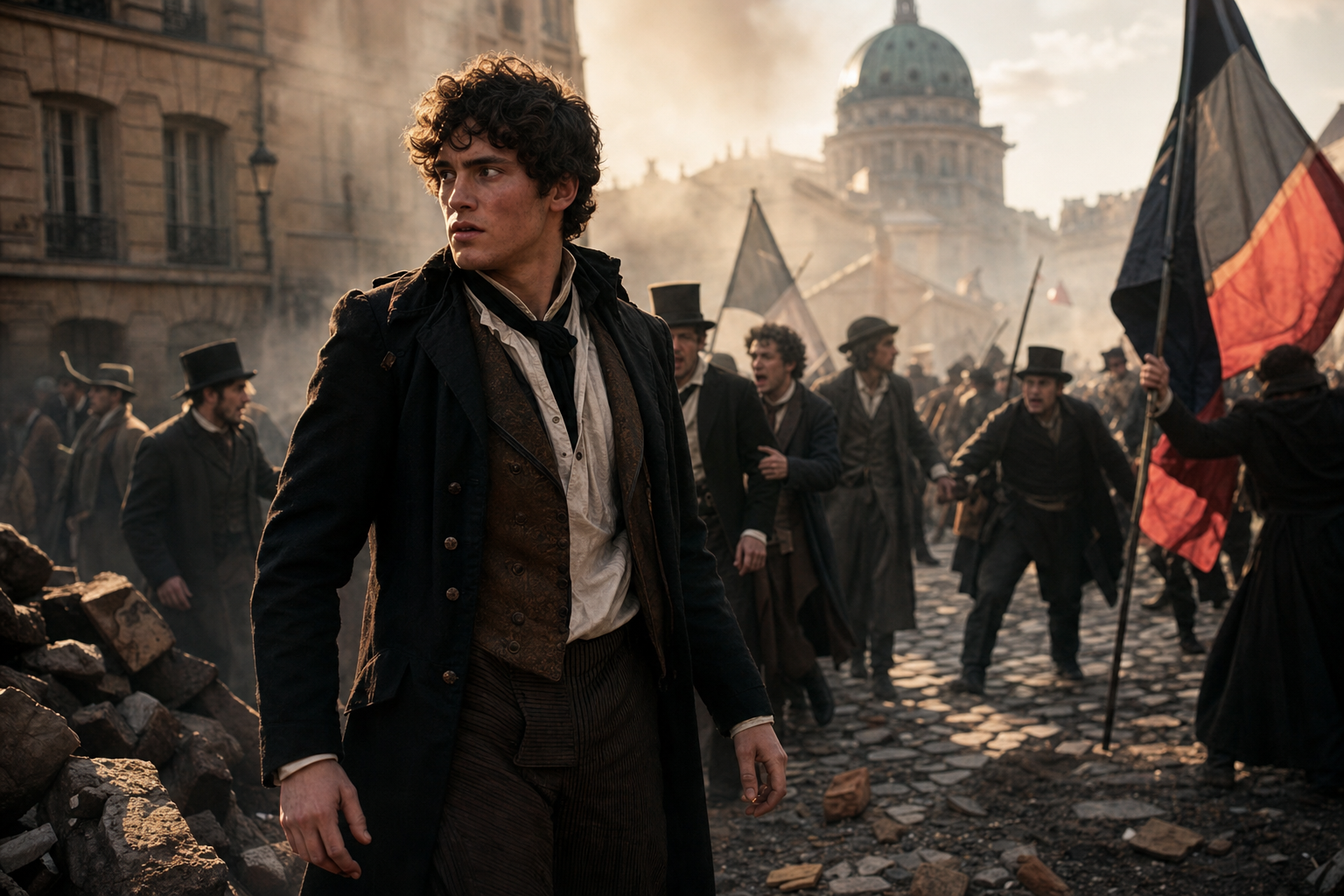
When the Wall Fell: Mystery, Momentum, and the Night of November 9, 1989
In the hushed twilight of a November evening, a rumor became an orderlessness that rolled through East Berlin like a sudden tide. People who had lived all their lives under curfews, travel permits and incessant surveillance walked toward border crossings because a flawed sentence, uttered at a press conference, sounded like permission. The city that had been bisected for nearly three decades — concrete, barbed wire, guard towers, and the infamous “death strip” — transformed in hours into a place of jubilation, bewilderment, and improvised history-making. The fall of the Berlin Wall on the night of November 9, 1989, did not happen as a single, inevitable act of history; it was the result of layers of policy, protest, human desperation, miscommunication, and a delicate international balance. It remains both a clear historical event with verifiable dates and actors and a moment of human drama that invites questions about contingency, courage, and coincidence.
This article traces the Berlin Wall from its origins and physical design to the lived experience of divided Berliners, from the slow erosion of Communist authority in 1989 across Eastern Europe to the peculiar immediacy of Günter Schabowski’s press briefing that set off a chain reaction no official had intended. We will explore how domestic dissent — from Polish Solidarity and Hungary’s opening of its border to the mass Monday demonstrations in Leipzig — intersected with Soviet leader Mikhail Gorbachev’s reforms to create a political milieu in which East Germany’s rigid structures could not indefinitely hold. We will recount the tense night when border guards, outnumbered and uncertain, made decisions that reverberated across the world. Finally, we will follow the legal and diplomatic path from the Wall’s opening to formal German reunification in October 1990 and consider the Wall's legacy: the scars visible in the city’s architecture, the memorials, and the way a single misstatement can catalyze epochal change.
Throughout this narrative I will prioritize verifiable facts — dates, speeches, treaties, and the names of principal actors — while also attending to the texture of everyday lives and the quieter human decisions that shaped events. The story of the Berlin Wall’s fall is often told as a triumphant ending; it was also a bewildering beginning. The months that followed would bring urgent questions about currency unions, diplomatic clearance, national identity and memory. Yet the arrival of that night, when concrete met champagne, remains one of the twentieth century’s most vivid testaments to the unpredictability of political change.
Did you know? On August 13, 1961, construction began in the early hours with the pretext of carrying out “repair work”; residents woke to new barbed wire and barricades.
The Wall’s Construction and Purpose: Lines, Towers, and a City Divided
On August 13, 1961, East German authorities, with the tacit backing of the Soviet Union, began constructing a physical barrier that would come to define the Cold War’s urban face. The immediate rationale was simple and brutal: stop the hemorrhaging of East Germans to the West. Between 1949 and the eve of the Wall’s erection, some 2.7 million East Germans fled to West Germany and West Berlin in search of political freedom and economic opportunity, a loss that threatened East Germany's human capital and governmental legitimacy. The leader of the German Democratic Republic (GDR), Walter Ulbricht, and his colleagues quickly moved to seal the border in a way that would be difficult to reverse.
What started as barbed wire and makeshift barricades evolved into a complex system of fortifications spanning approximately 155 kilometers around West Berlin. The barrier that most people visualize — a continuous concrete wall with watchtowers and a cleared death strip — was only part of that system. Inside central Berlin a continuous concrete wall ran for roughly 43 kilometers. The rest of the ring used fences, anti-vehicle trenches, and natural barriers to deter escape. The “death strip,” carefully illuminated and mined in places, incorporated sand that showed footprints, tripwires, lighted patrol paths, and the lethal presence of border troops authorized to shoot escapees. The GDR’s Ministry for State Security (Stasi) coordinated intelligence operations designed to prevent escapes through infiltration, informers, and harsh penalties. The human cost of the Wall is difficult to pin down exactly; historians and memorial projects have identified at least 140 confirmed deaths at the Inner German border and the Berlin Wall, though the precise number can vary depending on sources and definitions of related deaths.
The erection of the Wall immediately altered city life. Families were separated overnight; apartment buildings that once faced into mixed neighborhoods suddenly found themselves looking upon sealed concrete faces or no-man’s land. Bernauer Strasse became a grim symbol of separation: residents leapt from windows to reach West Berlin and rescue attempts, while authorities sealed off streets and used the architecture itself as part of the barrier. Internationally, the Wall crystallized a new status quo between the superpowers: West Berlin remained an island of Western rights within the Soviet zone, protected by Allied legal status and occasional displays of determination — such as the standoffs at Checkpoint Charlie in late October 1961 — but practically surrounded and vulnerable to a protracted freeze.
Did you know? In September 1979, two families escaped East Germany in a homemade hot-air balloon, flying to West Germany — one of the most famous escape attempts.
Constructed with speed and secrecy, the Wall served multiple purposes: it was a physical means to stop emigration, a propaganda instrument to justify the GDR’s existence by portraying the western world as a corrupting influence, and a demonstration of the Eastern bloc’s willingness to choose stability over freedom. Yet the Wall was also a daily reminder of the underlying tensions of a divided nation — a constant argument about the legitimacy of political systems and the value of personal liberty.

Life in a Divided City: Surveillance, Escape, and Ordinary Acts of Defiance
To understand why the Wall mattered so deeply, one must inhabit the ordinary rhythms of life it disrupted. For East Berliners, daily existence blended the ordinary — work, family, shopping — with the extraordinary weight of surveillance and restricted movement. The Stasi cultivated networks of informants and maintained files on millions of citizens. State-controlled media and education promoted a narrative of socialist achievement that often contrasted sharply with the visible consumer goods and cultural pluralism of West Berlin, a half-hour transit ride away for those who had the permits.
Yet the barrier did not eliminate agency. Escape attempts ranged from the improvisational to the technically audacious: tunnel diggings from West to East, hot air balloon escapes — most famously in September 1979 when two families flew a homemade balloon across the border to West Germany — and brazen runs at poorly lit stretches. The stories of those who crossed are central to the Wall’s human history. Some succeeded and built new lives; others were captured or killed. The GDR’s punitive legal framework made organizing any coordinated escape supremely risky, but it also fostered small acts of defiance: clandestine samizdat literature, covert religious gatherings, and cultural saloons where people exchanged forbidden music and ideas.
Did you know? Hungary’s opening of its border with Austria in 1989 allowed thousands of East Germans to cross into the West via Hungary, accelerating pressure on the GDR.
West Berlin developed its own identity as a frontier of Western culture and a stage for political theatre. Checkpoint Charlie, the famous crossing point for foreigners and diplomats, became a potent symbol — a place where American and Soviet tanks once faced each other during the 1961 crisis. Allied presence meant that West Berliners enjoyed access to Western television, goods, and a degree of cultural freedom that made the contrast with the East stark and palpable. Artists, students, and musicians gravitated to West Berlin’s vibrant but precarious scene, partly subsidized by federal funds that recognized the city’s geopolitical role.
This life of contrasts — the surveillance and scarcity in the East, the relative abundance and freedom in the West — produced both resentment and aspiration. Families resented separation; workers in the East resented wage disparities and limitations on travel; young people in both parts of the city chafed at ideological closure. All these pressures accumulated across decades and laid a foundation for the eventual mass mobilization of 1989.

1989 in Europe: Dominoes of Reform and the Weakening of Rigid Borders
By 1989 the Soviet bloc was no longer as monolithic as it had been in the 1950s or 1960s. Mikhail Gorbachev, who became General Secretary of the Communist Party of the Soviet Union in 1985, introduced policies—perestroika (restructuring) and glasnost (openness)—that loosened the ideological iron grip and encouraged reform-minded leaders across the Eastern bloc. Gorbachev also made the critical strategic decision that the Soviet Union would not use massive military force to prop up faltering satellite regimes in the same manner as in earlier decades. That policy shift changed the calculation for both dissidents and rulers throughout Eastern Europe.
Did you know? Günter Schabowski later claimed he had not known the implementation date; his hesitant “immediately” effectively triggered the border openings.
The summer of 1989 brought a cascade of events that would directly influence East Germany. In May and June, Poland held semi-free elections that led to the rise of Solidarity and the eventual shift away from Communist rule. Hungary took a decisive step in August by opening its border with Austria and beginning to dismantle border fortifications; in September the Hungarian government fully opened its border, creating a gap through which thousands of East Germans used holiday travel as an escape route to the West. Perhaps most symbolically, the Pan-European Picnic on August 19, 1989, when a temporary border opening along the Austrian-Hungarian border allowed hundreds of East Germans to flee, demonstrated the porousness of the bloc.
Within East Germany, citizens watched these developments and tested the political air. Travel to Hungary and to other Eastern bloc countries allowed many East Germans to leave and apply for asylum in West German embassies. Mass demonstrations in East German cities, especially the Monday demonstrations in Leipzig that grew throughout autumn 1989, signaled a new public willingness to demand change. Protesters called for reform, freedom to travel, and democratic rights; the scale and persistence of the demonstrations rattled the GDR leadership.
International actors also mattered. Western leaders, including West Germany’s Helmut Kohl and U.S. President George H.W. Bush, navigated a tricky path between supporting democratic aspirations and avoiding reckless provocations that might lead to confrontation. The Warsaw Pact’s fragility and the Soviet commitment to non-intervention created conditions in which Eastern European regimes could fall largely through domestic pressure and negotiated transitions rather than military suppression.
Did you know? Harald Jäger, the border guard at Bornholmer Straße, later described the moment he opened the checkpoint as a decision made to avoid bloodshed after hours of pressure.
The Fateful Press Conference: Schabowski, a Note, and the Collapse of Control
If the Wall’s construction was an act of state planning, its fall on November 9 played out as a human drama of error and improvisation. By early November 1989, the GDR leadership faced a choice between tightening control and offering concessions. On November 9, the Politburo decided to introduce new travel regulations that were intended to allow citizens to apply for permission to travel abroad more easily. These regulations, however, were to be implemented through a bureaucratic process that required formal documentation and controlled timing.
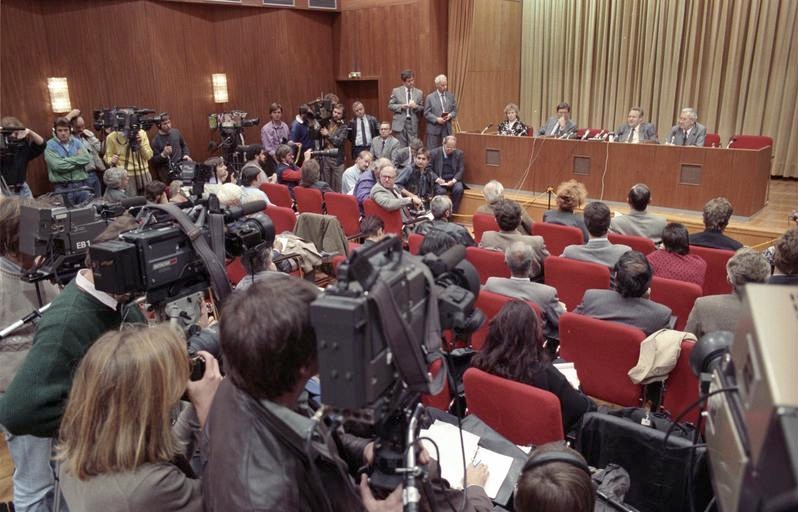
That afternoon and evening, information about the new policy was circulated within the Communist Party and the press office. Günter Schabowski, a member of the Socialist Unity Party’s Politburo and the party’s press spokesman, was handed a note summarizing the changes shortly before a scheduled press conference in East Berlin. When journalists at the press conference pressed him for details, Schabowski read from the note but did not have the precise implementation timetable. Asked directly when the new rules would come into force, he hesitated and then said that they would be effective “immediately, without delay.” That public statement — a slip between bureaucratic intent and on-the-record speech — was the spark.
Foreign correspondents relayed Schabowski’s words to audiences across the world, and East Germans watching television took them at face value. Crowds gathered at border crossings, particularly in the evening, expecting gates to be opened. Border guards, without clear orders from higher authorities and faced with growing, sometimes impatient, crowds, attempted to seek clarification. At several crossings the pressure became too large to contain. The Bornholmer Straße crossing near the district of Pankow witnessed one of the earliest openings when a guard, Harald Jäger, after hours of indecision and escalation, allowed people to pass. Accounts vary on precise timelines, but within hours other crossings yielded; Checkpoint Charlie saw West Germans and East Germans greeting each other in the street. The supposed bureaucratic precision collapsed into improvisation and human judgment.
Did you know? The Two-plus-Four Treaty was signed on September 12, 1990, and German reunification was formalized on October 3, 1990 — less than a year after the Wall fell.
Schabowski later said he had not intended to announce immediate changes and that he had been insufficiently briefed. His misstatement shows how brittle authoritarian systems can be at critical junctures: a single ambiguous public utterance can be interpreted by a restless populace as permission to act. The power of rumor, amplified by television and radio, met a regime that had lost the faith of its citizens and was unwilling or unable to use force to stem the tide without risking escalation.
The Night of November 9 and the First Days: Celebration, Chaos, and the Breaking of Concrete
The night of November 9, 1989, became a collage of scenes that would circulate around the world: East Berliners pressing against gates, border guards hesitating and then cheering, people dancing and singing on top of the Wall, and strangers embracing in disbelief. The Wall’s physicality invited improvisation; once crossings opened, some Berliners collected chunks of the barrier as souvenirs, using hammers and chisels to chip away fragments. These acts were both celebratory and symbolically defiant — taking pieces of the concrete that had divided loved ones and returning them as trophies of a moment when history seemed to be in human hands.
Not all responses were spontaneous joy. In places, crowds were large enough to pose safety challenges; vehicles and trains had to be rerouted, and local authorities scrambled to manage logistics. The international community reacted with a mixture of surprise and cautious encouragement. Soviet leader Mikhail Gorbachev did not order tanks into East Germany; his decision to respect reformist movements within the Eastern bloc mattered tremendously. Western leaders, including Chancellor Helmut Kohl, initially navigated the moment with political calculation; Kohl capitalized on the opening to propose plans for deeper cooperation and eventually reunification. Burned by decades of geopolitical caution, Western governments nonetheless recognized the overwhelming democratic fervor and sought to support a peaceful process.
Did you know? Pieces of the Wall were taken as souvenirs by Berliners and tourists; fragments ended up in museums, private collections, and as diplomatic gifts worldwide.
Media coverage transformed the night into a global spectacle. Images of a jubilant Berlin, people leaning out of windows, vehicles driving between formerly dangerous zones, and fragments of wall painted with slogans were broadcast worldwide. These images shaped public memory: the Wall’s fall became synonymous with liberation, joy, and the human capacity to dismantle oppressive structures. Yet the immediate weeks after November 9 were also full of administrative complexity. The GDR government, facing mounting internal and external pressure, weathered leadership changes: Erich Honecker resigned earlier in October 1989; his successor, Egon Krenz, could not stabilize the situation.
From Openings to Unification: Treaties, Currency, and the Long Road to October 3, 1990
The opening of the Wall did not instantly erase the legal, economic, and diplomatic obstacles to German unity. In the months following November 1989, political actors in both German states and in the international community negotiated the frameworks that would permit reunification without triggering a broader crisis. The West German government, led by Chancellor Helmut Kohl, proposed rapid integration measures: a monetary, economic and social union was implemented on July 1, 1990, replacing the East German mark with the Deutsche Mark and rapidly aligning East German wages and prices with West German standards. This currency union accelerated political momentum for formal reunification but also introduced immediate social and economic strains as East German industries struggled to adapt to market competition.
International diplomacy proved decisive. The Two-plus-Four Talks — involving East and West Germany plus the four postwar occupying powers (the United States, the Soviet Union, the United Kingdom, and France) — resolved sensitive questions about external security and final borders. The Treaty on the Final Settlement with Respect to Germany (commonly called the Two-plus-Four Treaty) was signed in Moscow on September 12, 1990. It settled outstanding international issues, including the withdrawal of Soviet troops, the settlement of Allied rights in Berlin, and the confirmation of Germany’s borders. With these agreements in place and domestic ratifications concluded, the German Democratic Republic was formally dissolved and the five new federal states (Länder) joined the Federal Republic of Germany on October 3, 1990 — the date still celebrated as German Unity Day.
Did you know? Erich Honecker, the GDR leader who presided over much of the Wall's existence, resigned in October 1989 amid mounting protests.
The social consequences of unification were profound. Millions of East Germans experienced rapid legal and economic transformation: property rights were contested and retrials of some political cases occurred; unemployment rose in former East German regions as industries restructured; and debates about identity — East vs West — became a staple of political life for years. Yet the symbolic triumph of reunification was unmistakable. Berlin was re-established as the capital of unified Germany; East Side Gallery and other preserved sections of the Wall became sites of memory, artistic reclamation, and controversy about how to remember pain without exploiting it.
Conclusion: Memory, Meaning, and the Fragile Contingencies of Political Change
The fall of the Berlin Wall is often narrated as a moral triumph of freedom over oppression. That reading captures a genuine truth: millions of people reclaimed mobility, families reunited, and a repressive frontier that enforced separation gave way to civic possibility. Yet to see the event only as a tidy moral arc would be to overlook the messy contingencies that produced it. A misread press note, a vigilant guard’s decision to open a gate, the steady pressure of protests, and the broader context of Eastern bloc reform combined in unpredictable ways. The Wall’s collapse reveals how brittle authoritarian orders can be when legitimacy erodes and how quickly public action can transform political reality.
Today the Wall’s remnants remain as both memorial and canvas. Sections like the East Side Gallery host murals by international artists; the Berlin Wall Memorial at Bernauer Strasse preserves reconstructed strips and commemorates those who died attempting to cross. Museums and research centers work to maintain exacting records: names, dates, and documents that honor victims and contextualize the political decisions. The physical scars are important, but so is the history of everyday life in a divided city — the kindnesses, betrayals, and ordinary choices that made up decades.
Did you know? The Berlin Wall’s most famous four-week period of tunnel escapes occurred in the 1960s and 1970s, with hundreds attempting the perilous underground routes.
The night of November 9, 1989, invites reflection about agency, communication, and the power of shared belief. A mere phrase, uttered under pressure by an unprepared spokesman, cascaded into a world-historical event. It is a reminder that large changes often require both long-term structural shifts and immediate moments of human decision. For students of history, the Wall’s fall is a lesson in contingency: revolutions and breakthroughs are rarely the product of single causes. For citizens, it is a lesson in vigilance and hope: even durable-seeming institutions can yield to persistent popular demands and to unexpected fractures.
Ultimately, the fall of the Berlin Wall remains an emblem of the late twentieth century — one that blends geopolitical shifts, personal risk, and the unpredictable choreography of human beings seizing a moment. As the city continues to reconcile its past and reimagine its future, the Wall stands less as a single answer than as an invitation to ask how political boundaries form, how they are maintained, and how they can be dismantled — sometimes through deliberation, sometimes through error, and sometimes through the daring acts of ordinary people.


How we verify this article
By the History Unlocked editorial team
This text is built on historical facts stored in our database and drafted with AI assistance. No signed human review is recorded for this article. Report any inaccuracy: we correct it and update the modified date.
Updated on
AI-assisted drafting.
Read our editorial standardsEnjoyed this? Discover more articles in the category Great Revolutions