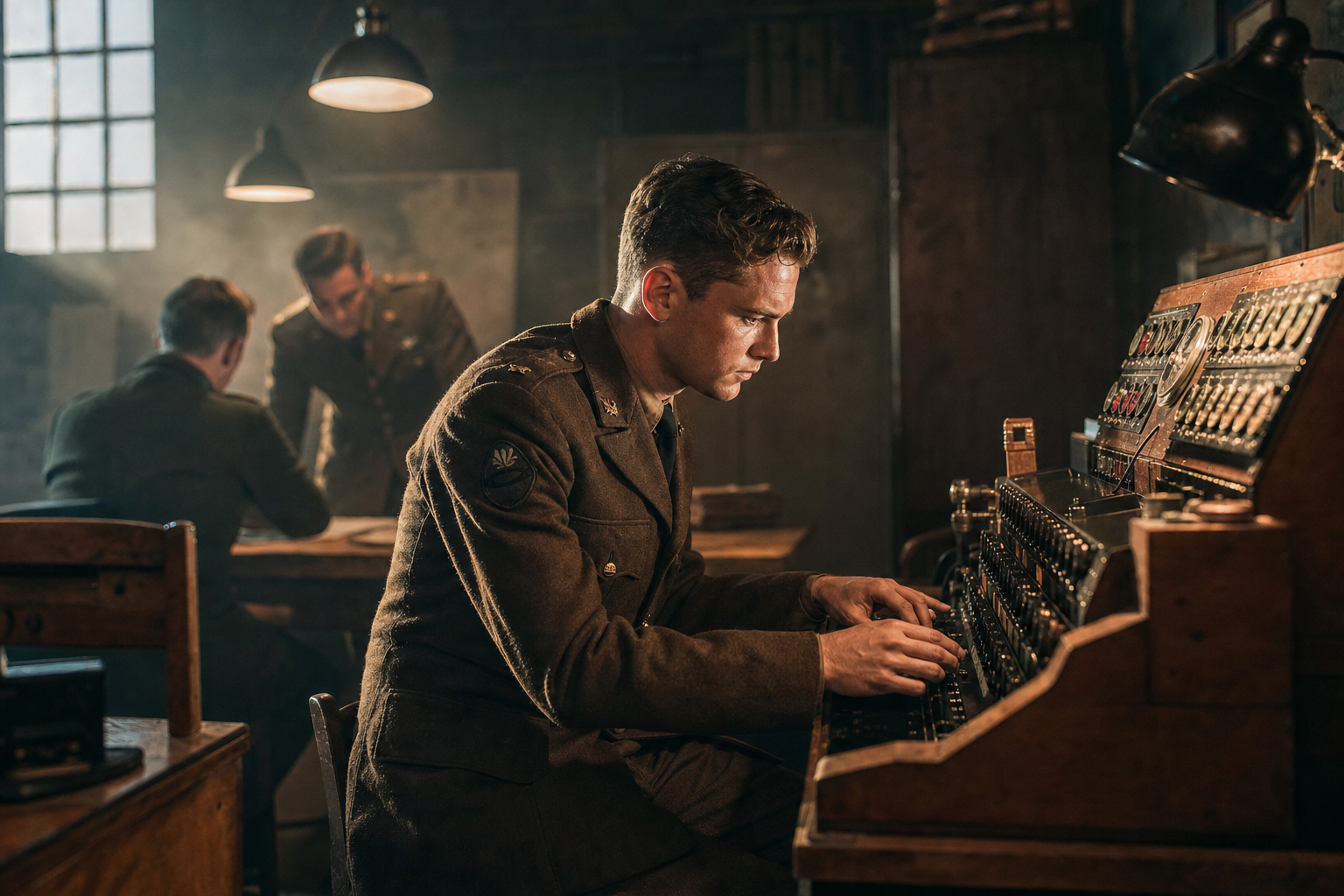
Cracking Enigma: The Secret Code That Shaped WWII
The smell of oil, metal and cedar permeated the cramped rooms where an unassuming electromechanical curiosity came to carry the fate of convoys and campaigns. Enigma began in the interwar commerce of cryptographic devices—an elegant machine with rotors and lamps, originally marketed as a business cipher. By the 1930s it had been adopted, adapted and weaponized by the Reich. In the fog of early World War II it became a fortress of secrecy for German communications, a cipher Germans trusted with the highest commands. Yet, like all fortresses, Enigma had seams and blind spots. Those fissures were probed by mathematicians and linguists, spies and sailors, and eventually exploited by a coalition of codebreakers whose story threads through Poland’s mathematicians, the labs of Bletchley Park, perilous naval encounters, and a culture of caution that guarded the secret of success long after the guns fell silent.
This article follows Enigma from its invention and mechanics to the mathematical breakthroughs that cracked it, and the operational intelligence known as Ultra that reshaped Allied strategy. The narrative will move between workshops and warrooms, between the meticulous patience of permutation theory and the violent chaos of the Atlantic. It aims to show not only how Enigma worked and how it was broken, but why the story reads like a mystery novel: secrets hidden behind settings, solutions teased out by intuition and logic, and the constant tension between using intelligence and keeping the exploit hidden. We will revisit pivotal captures, the technical art of the bombe, the human cast of figures such as Marian Rejewski and Alan Turing, and the strategic turning points — from convoy rescues to Rommel’s setbacks — where decrypted German signals changed history.
To appreciate the drama, one must grasp the paradox at the heart of Enigma: the machine was simultaneously simple and labyrinthine. Its operators knew the procedures; they did not know the consequences of minor routine choices that mathematicians would later exploit. Above all, understanding Enigma requires seeing cryptography not as an abstract contest of ciphers but as a human endeavor shaped by mistakes, improvisations and the persistent effort of small teams confronting a seemingly insurmountable problem.
Did you know? A German cipher clerk, Hans-Thilo Schmidt (codenamed Asché), sold German Enigma materials to French intelligence in the 1930s, providing crucial documentary clues later used by Polish cryptanalysts.
The Origins of Enigma and Its Early Use
Enigma’s origins lie in the heady period after World War I when inventors sought to capitalize on the new market for secure communications. Arthur Scherbius, a German engineer, patented an electro-mechanical rotor cipher machine in 1918 and formed a commercial company to sell it. The basic idea was intentionally straightforward: a keyboard, a set of rotating disks (rotors) with internal wiring, a lampboard to display letters, and an electrical path that permuted letters each time a key was struck. One of the machine’s deceptive strengths was that the permutation changed with every keypress — a single rotor step would alter the wiring path and therefore the resulting ciphertext letter.
Early versions of Enigma were marketed to businesses and embassies, but its military potential soon attracted attention. The German Navy, Army and Air Force each adopted slightly different variants. Military models introduced important modifications that greatly increased complexity: the addition of a plugboard (Steckerbrett), which swapped pairs of letters before and after the rotor mechanism, and later, modifications for multiple sets of rotors selectable from a larger pool. The plugboard dramatically multiplied the number of possible settings and contributed to the machine’s aura of invulnerability. For German operators, routine procedures — daily key lists, indicator formats, and message protocols — structured communications but also created predictable patterns that could be analyzed.
The interwar years witnessed an incremental escalation in operational security. Manuals, key schedules, and indicator procedures were issued centrally; radio operators were trained to follow precise formats. Yet these very structures had two consequences. First, they allowed German units across different theaters to synchronize communications, which was indispensable for coordinated operations. Second, because the procedures were standardized, they created statistical regularities that cryptanalysts later exploited.
Did you know? The Enigma reflector (Umkehrwalze) made encryption reciprocal — the same setting both enciphered and deciphered messages — but this reciprocity introduced algebraic constraints exploited by codebreakers.
The machine’s reflector (Umkehrwalze) — a hallmark of Enigma design — ensured reciprocity: encryption and decryption used the same settings. This feature simplified operations but introduced mathematical constraints that broke symmetry in predictable ways. Likewise, the fact that no letter could be encoded as itself (a consequence of the rotor and plugboard wiring) turned out to be a double-edged sword. It removed a trivial clue for cryptanalysts but also limited certain permutations, introducing patterns exploitable by rigorous analysis.

How Enigma Worked: Mechanics and Cryptography
To a machine operator, Enigma was a simple interface; to a mathematician, it was a cascade of permutations. Each rotor can be understood as a substitution: pressing a key sends an electrical current that traverses the plugboard, proceeds through a sequence of rotors (each representing a permutation of the 26-letter alphabet), is reflected, and then travels back through the rotors and plugboard before lighting a lamp. Crucially, after every keypress one or more rotors rotate, altering the substitution applied to the next key. This rotor stepping produced polyalphabetic substitution, a core principle in modern cryptography that prevents frequency analysis from directly revealing plaintext.
Mathematically, if we denote the plugboard as permutation P, the rotors at a given setting as R1, R2, R3 (each depending on rotor wiring and position), and the reflector as U, the encryption mapping E for a single keypress can be written in permutation notation as E = P · R1 · R2 · R3 · U · R3^{-1} · R2^{-1} · R1^{-1} · P^{-1}. Because the rotors step, R1, R2 and R3 change constantly, creating a massive space of possible mappings. The plugboard further compounds the complexity by introducing pairwise swaps. The reflector ensured reversibility: the same machine configuration could both encipher and decipher messages.
Did you know? The Polish mathematicians secretly handed their Enigma techniques and replica machines to British and French intelligence during a July 1939 meeting near Warsaw, a transfer that paid dividends when war erupted.
Despite this elegant design, the Enigma system was not cryptographically perfect. The physical constraints of rotor wiring and the fixed reflector produced algebraic properties that careful analysis could reveal. One of the most exploited facts was that no letter could be enciphered as itself — a property deriving from the reflector’s wiring and the symmetric traversal through rotors. That constraint meant that in a given cipher, if you guessed a plaintext letter for a position and it matched the cipher letter, your guess was certainly wrong — a useful elimination tool in cryptanalytic attacks.
Operators’ procedures also created patterns. Early German practice for sending an indicator — a short block of letters that revealed rotor start positions — involved repeated encipherment of the indicator or other predictable formatting. These operational slips opened the door for known-plaintext or quasi-known-plaintext attacks, where consistent fragments of a message could be inferred from context (weather reports, salutations, or repeated phrases) and used as footholds for deeper analysis. The variance between army, air force and naval procedures also mattered: the Kriegsmarine tended to be more rigorous about radio discipline, which paradoxically made their operational signals both more secure in some respects and more vulnerable in others when additional complexity (like the introduction of a fourth rotor) produced fresh opportunities for mistake and capture.
Cryptanalysis of Enigma therefore required both mechanical ingenuity and mathematical abstraction. It was not enough to brute-force every possible configuration; the space was too vast. Instead, cryptanalysts searched for structural weaknesses — algebraic invariants, repeated operations, human habits — and constructed machines and methods to exploit them. These efforts culminated in the Polish breakthroughs of the early 1930s.
Did you know? Gordon Welchman’s diagonal board, an improvement to the bombe design, significantly increased the machine’s efficiency by allowing cross-consistency checks across assumed letter pairings.

The Polish Breakthrough: Rejewski, Zygalski, and Early Methods
Poland’s contribution to cracking Enigma is a vital and often underappreciated chapter. In the early 1930s, the Polish Cipher Bureau (Biuro Szyfrów) assigned a young mathematician, Marian Rejewski, to study Enigma. Rejewski had access to documentation and messages provided partly through intelligence channels; among those was material from the German cipher clerk Hans-Thilo Schmidt. Rejewski used permutation theory and group theory — fields of pure mathematics — to model the Enigma’s operations and deduce rotor wirings. His approach was strikingly original: by treating the machine’s action as permutations and exploiting patterns in message indicators and repeating structures, he was able in 1932 to reconstruct the internal wiring of Enigma’s rotors.
Rejewski’s methods did not rely solely on theory. The Poles built electro-mechanical aids to speed analysis. Henryk Zygalski devised perforated sheets (later called Zygalski sheets) that helped recover rotor order and rotor positions for certain indicator procedures. Jerzy Różycki created a method called the “clock” (or the “bomba” in early Polish terminology), an electromechanical device intended to reduce the set of possible rotor settings. These inventions were tailored to known German operating procedures at the time — procedures that would later change, which in consequence demanded new cryptanalytic ingenuity.
By the mid-1930s the Polish successes allowed the Cipher Bureau to read many German messages. This capability was strategically important for Poland but also precarious; as war loomed in 1939, the Poles recognized that they could not hold the secret alone. In July 1939, on the eve of war, the Polish Bureau clandestinely shared their techniques, devices and documentation with French and British intelligence at a meeting near Warsaw. This transfer was a crucial seedbed for later Allied breakthroughs: it provided the British with a head start when war made large-scale effort essential.
Did you know? The capture of U-110 on 9 May 1941 provided British cryptanalysts with Enigma materials and codebooks that critically accelerated decryption efforts—while the Royal Navy concealed the capture to avoid alerting the Germans.
Poland’s work illustrates two persistent themes in the Enigma saga. First, the solution combined abstract mathematics and practical engineering — theoretical insight translated into physical tools. Second, intelligence arrives incrementally: documents and human sources supplied hints that, when combined with patient analysis, created decisive knowledge. Yet even with these breakthroughs, Enigma was not fully defeated in 1939; rather, the Poles had furnished methods to attack the machine as then-operational. German procedural changes and later hardware additions altered the landscape, forcing the British effort at Bletchley to innovate on a grander scale.
Bletchley Park and the British Exploitation
When the war began, Britain’s Government Code and Cypher School (GC&CS) at Bletchley Park became the epicenter of Allied efforts to scale up Enigma cryptanalysis. The work there was both collective and fiercely compartmentalized: huts and sections specialized in different tasks, from traffic analysis to bombe construction to linguistic cribbing. The human tapestry included mathematicians, classicists, linguists, chess champions, and engineers — a polyglot of talent recruited to imagine alternatives where brute force could not tread.
Alan Turing, one of Bletchley’s most luminous figures, theorized and implemented methods that extended the Polish approach. He conceived of a mechanized search device — the bombe — that could test hypotheses about rotor settings rapidly by simulating Enigma paths and eliminating inconsistent candidates. The bombe was not a brute-force machine in the modern sense; it used logical deductions to prune vast swathes of the key space. Gordon Welchman augmented the design with a diagonal board that greatly increased efficiency by detecting contradictions across multiple assumed pairings. These innovations, combined with industrial-scale manufacturing supervised by figures like Harold Keen at the Post Office Research Station and the British Tabulating Machine Company, produced operative bombes that tirelessly ran through candidate settings.
Did you know? For decades after WWII, the role of Ultra and the contributions of Polish cryptanalysts remained secret or underemphasized; the first widespread public disclosures began in the 1970s.
But machines alone were insufficient. Cribs — plausible guesses about parts of plaintext, such as predictable weather reports or standardized headings — were indispensable. Banburismus, a statistical technique developed by Turing and others, helped to weight likely rotor orderings and reduce the number of bombe runs needed. Linguistic patterns, operator habits, and traffic analysis also directed attention: the same radio call signs, repeated sequences, or routing quirks could reveal which nets to target.
Bletchley’s work had operational constraints that shaped how intelligence was used. The highest-level secrecy — Ultra — meant decrypted material was tightly controlled. Messages from decrypted Enigma traffic were often fed to field commanders but with care; sometimes other intelligence was used to corroborate and conceal the source. Successful exploitation required not only cracking the cipher but integrating the intelligence into decision cycles without betraying the cryptanalytic success. That secretive prudence sometimes frustrated commanders eager for timely information, but it preserved the source of the advantage.
The people at Bletchley worked under intense pressure and secrecy. Women constituted a crucial share of the workforce — from WRENS operating bombes to linguists translating intercepted traffic. The Hut system, with names like Hut 8 (Naval Enigma) and Hut 6 (Army and Air Force Enigma), became synonymous with particular struggles and triumphs. Bletchley’s achievements were technical, organizational and human: they combined factories of logic, morale, and an ethic of quiet duty.
Did you know? The combined efforts of Polish, British and Allied codebreakers, together with captures of Enigma material, contributed to shortening WWII by a significant margin, a consensus judgment among many historians.

Naval Battles and Ultra: Impact on WWII Outcomes
The most dramatic operational effects of Enigma decryption emerged at sea. The Battle of the Atlantic was a struggle of logistics: Hitler’s U-boat fleet sought to strangle Britain by sinking merchant tonnage, while Allied convoys and escorts fought to protect lifelines of food, fuel and matériel. Ultra intelligence — decrypted Enigma signals — allowed Allied commanders to anticipate U-boat wolfpack positions, reroute convoys, and direct ASW (anti-submarine warfare) resources more efficiently. The value was not merely tactical but strategic: keeping Britain supplied maintained its ability to wage war, train forces, and serve as a base for future operations.
Several tangible events illustrate Ultra’s impact. The capture of Enigma materials from surface actions and submarine incidents provided cryptanalysts with keys and codebooks that accelerated decryption. The seizure of U-110 on 9 May 1941 by HMS Bulldog yielded codebooks and an Enigma machine that, carefully handled, furnished immediate dividends. Later, the capture of U-505 by the U.S. Navy in June 1944 added more material. These physical captures, however, were less decisive than the daily intelligence gleaned from decrypted messages that routed convoys away from danger and exposed U-boat tactics.
Operational prudence was essential. Allied commanders could not act overtly on every decrypted hint; such actions might alert the Germans to a leak in their cipher system. Instead, Ultra was often used to create plausible alternative sources — reconnaissance flights, patrol sightings, encrypted radio traffic from double agents — to mask the fact that an Enigma read was guiding decisions. This careful choreography preserved the Enigma secret and prolonged the flow of intelligence over months and years, multiplying its value.
Ultra’s influence extended beyond the Atlantic. In North Africa, decrypted communications helped the British Eighth Army to anticipate supply movements and Axis intentions, contributing to Montgomery’s operational picture. In the Mediterranean and the air war over Europe, decrypted signals assisted in targeting and interdiction. The extent to which Ultra shortened the war has been debated; most historians who study wartime intelligence estimate that the Allies’ ability to read Enigma shortened the conflict by at least a year and possibly two or more. The precise count is contestable, but the consensus recognizes Ultra as a decisive force multiplier.

Legacy, Deception, and Postwar Secrecy
After 1945, the Enigma story did not conclude; it entered decades of secrecy, partial disclosure and contested narratives. The British government tightly guarded Ultra’s existence; only in the 1970s did public accounts begin to surface in full. F. W. Winterbotham’s The Ultra Secret (1974) was among the early works to describe the exploitation of Enigma in wartime, though even then many technical details remained classified or contested. The slow emergence of the full story owes much to operational caution: revealing Ultra’s role immediately after the war risked exposing the methods and people involved, and the Western Allies also hoped to leverage wartime cryptanalytic knowledge during the Cold War.
Recognition of the Polish contribution came even later. For decades the Polish achievements were obscured in English-language accounts that emphasized Bletchley figures. Increasingly, scholarship and public history have rightfully credited Marian Rejewski, Henryk Zygalski and Jerzy Różycki for the mathematical breakthroughs and for transferring key knowledge to Britain and France in 1939. Memorials, biographies and archival releases in Poland and elsewhere have restored the Polish chapter to its appropriate place in the Enigma saga.
The technological legacy of Enigma also rippled outward. The bombe concept anticipated modern algorithmic thinking: exploiting constraints to prune search spaces rather than naïvely enumerating possibilities. The wartime collaboration between mathematicians and engineers seeded postwar advances in computing and information theory. Yet Enigma’s larger moral and historical lessons remain human rather than technical: success depended on curiosity, cross-disciplinary cooperation, persistent labor, and the willingness of small teams to pursue abstract clues for long-term payoff.
There is also an ethical dimension to the secrecy that preserved Ultra. Operational secrecy saved lives and sustained the advantage, but it also denied many contributors public recognition for decades. Some who worked in the codebreaking community later bore personal costs unrelated to Enigma — most notably Alan Turing, whose scientific contribution was monumental while his personal life was tragically criminalized in postwar Britain. The contrast between covert wartime heroism and postwar injustice remains a sobering coda to the story.
Conclusion: The Enigma Tale as Mystery and Memory
The Enigma story persists because it blends several human attractions: the elegance of a mechanical cipher, the rigor of mathematical insight, the danger of clandestine naval encounters, and the moral tensions of secrecy. It is a narrative that rewards close attention to detail and patient reconstruction. The puzzle solved by Rejewski and his colleagues in Poland required abstraction and imagination; the scaling achieved at Bletchley required organization, engineering and secrecy. The operational results — saved convoys, thwarted wolfpacks and informed campaigns — were concrete and consequential. Yet Enigma’s most enduring legacy may be the way it highlights that intelligence is seldom the product of lone geniuses working in vacuums. Instead, it is cumulative: documents passed between allies, devices prototyped by engineers, cribs gleaned from operators’ habits, and policies that calibrated risk against reward.
As a historical episode, Enigma reminds us that technology and human fallibility are always entangled. The machine’s apparent perfection masked mundane vulnerabilities: sloppy indicator procedures, repeated phrases, and human tendencies to default to convenience. In the cryptanalytic contest, these small faults were the chinks in the armor. The story also illustrates the ethics of intelligence: the need to shield sources even when doing so complicates immediate operational responses; the weight of that balance is a recurring theme in wartime decision-making.
Today, museum displays of Enigma machines and bombes draw crowds who are fascinated by the mechanical objects and the stories they embody. Yet beneath the machines’ gleam lies a deeper lesson about cooperation across borders and disciplines. It took Polish mathematicians to find the structural keys, British mathematicians and engineers to industrialize the solution, sailors and soldiers to capture crucial material, and a disciplined intelligence culture to protect the advantage. That coalition — of minds and actions, secrecy and sacrifice — is the real cipher that Enigma ultimately revealed: that knowledge, when combined with patience and prudence, can change the course of history.
How we verify this article
By the History Unlocked editorial team
This text is built on historical facts stored in our database and drafted with AI assistance. No signed human review is recorded for this article. Report any inaccuracy: we correct it and update the modified date.
Updated on
AI-assisted drafting.
Read our editorial standardsEnjoyed this? Discover more articles in the category World War II