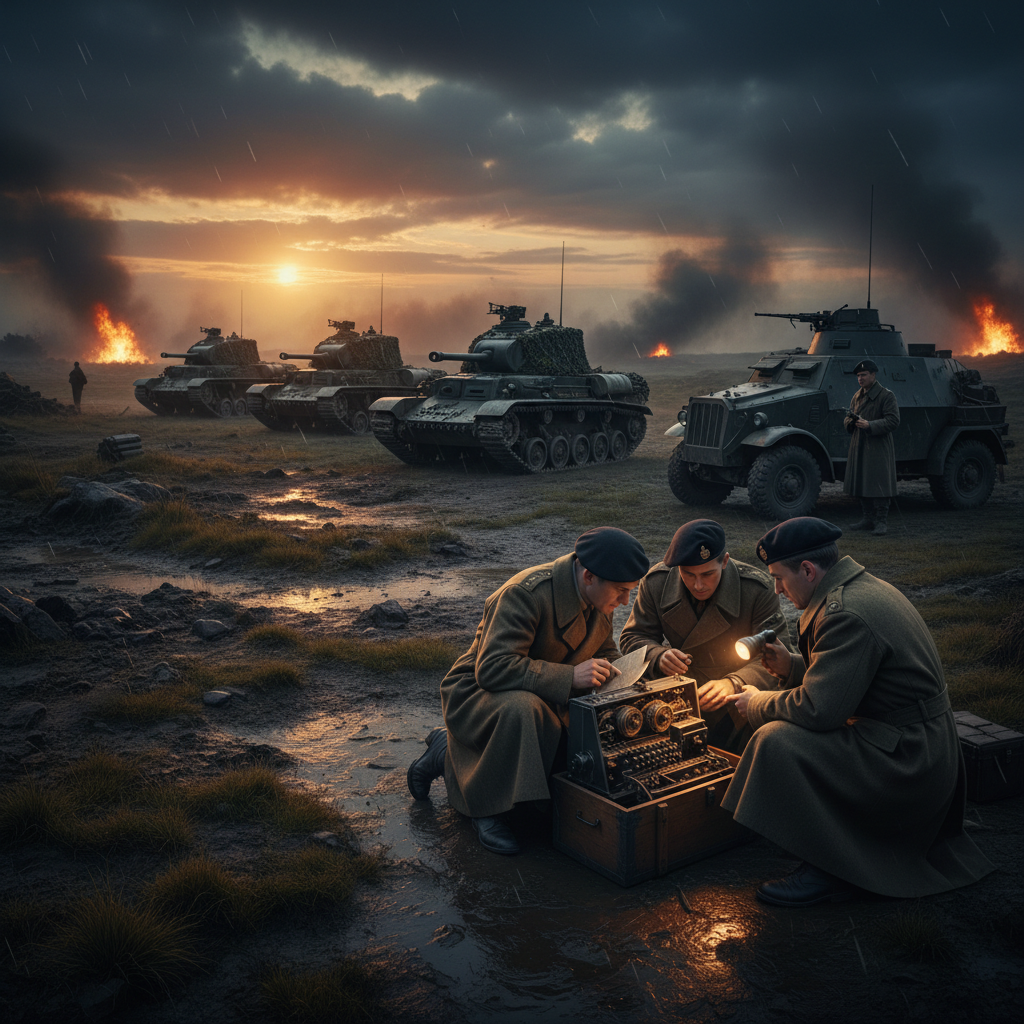
The Enigma Code: Inside WWII’s Greatest Secret
It begins in static and salt spray, with a convoy slipping across a harsh Atlantic while somewhere below, a submarine’s wireless sputters into life. The message is brief, rigidly formatted, and—so the sender believes—unbreakable. It travels in spikes of radio energy across the night and into listening posts on the east coast of England, where operators transcribe the clatter and pass it to a quiet mansion in Buckinghamshire. There, in low huts and high rooms, mathematicians and linguists bend over papers covered by letters that never seem to say what they mean. A machine clicks, wheels turning, lamps winking. Another wave of paper. Another chain of guesses, checks, and human hunches. And slowly, impossibly, the words disclose themselves. Convoy routes, submarine traps, weather whispers, the ordinary chatter of a war machine—suddenly intelligible.
This is the story of the Enigma code, the cipher Germany trusted to bind together its military during the Second World War. It was a device built on whirring rotors and mirrored currents, a riddle so intricate that German officers believed it was impregnable. Yet in backrooms across Europe—the Polish Cipher Bureau in Warsaw, the huts of Bletchley Park, naval labs in Dayton—people dismantled the riddle day after day, assembling intelligence codenamed Ultra. Enterprises rose and fell on those secrets: convoys rerouted from ambush, generals misled, spies turned, U‑boats hunted. For years, almost no one outside a chosen circle even knew it existed.
The Enigma story is not the myth of a lone genius pressing a single button to win the war. It’s a tapestry braided from mathematics and machinery, from blunders at wireless sets to brilliant leaps of inference, from the patience to test a million wrong answers so that the million‑and‑first can be right. It is also a story of ordinary people—clerks, Wrens, typists—whose routines greased the wheels of invention. And it is a story veiled for decades, not because it lacked drama, but because its power depended on silence.
Did you know? The first decisive break of military Enigma (1932) came from algebra, not language—Rejewski rebuilt its wiring using permutation theory and operator habits.

Origins of a Cipher: From Berlin to Warsaw
The Enigma machine did not begin as a weapon of empire but as a product pitched to banks and businesses. In 1918, German engineer Arthur Scherbius patented a portable cipher device that used rotating wired discs to permute the alphabet. By the early 1920s, his firm Chiffriermaschinen AG marketed several commercial models. The German Navy was the first military branch to embrace the concept, adopting an adapted Enigma variant for radio use in 1926. The Army followed in 1930. It would not remain a mere accounting gadget for long.
Even as Germany standardized Enigma for its armed forces, a leak in Berlin began a chain of events that would culminate in the first systematic break. In 1931, a German cipher clerk in the Army’s cipher office, Hans‑Thilo Schmidt, codenamed “Asché,” sold manuals and operating procedures for Enigma to French intelligence. The French shared this trove with their Polish allies, who possessed a rare combination of resources: an extraordinary cadre of young mathematicians and a willingness to treat cryptography as a field of rigorous algebraic analysis rather than linguistic puzzle‑solving.
In late 1932, three mathematicians at the Polish Biuro Szyfrów—Marian Rejewski, Jerzy Różycki, and Henryk Zygalski—made the decisive breakthrough. Using group theory, Rejewski reconstructed the internal wiring of the military Enigma from intercepted messages and the procedural information obtained via the French. Crucially, German practice at the time required operators to choose a three‑letter message key, encrypt it twice at the start of each message, and send it under the day’s system settings. That repetition exposed mathematical structure that Rejewski exploited. Within weeks, Poland could read current German Army and Air Force messages routinely.
Did you know? Because of the reflector, Enigma never encrypted a letter as itself—an oddity that allowed codebreakers to reject wrong guesses fast when testing cribs.
To industrialize the process, Rejewski devised the cyclometer to catalog the cycle structures produced by rotor settings, then the team constructed “Zygalski sheets,” perforated overlays that, when stacked for different configurations, revealed likely keys. In 1938, as German operators improved security and additional rotors were introduced, the Poles created the “bomba kryptologiczna,” an electromechanical aid to search rotor combinations efficiently. Yet the German introduction of two extra rotors for Army and Air Force in late 1938 expanded choices from three to five, ballooning the configurations and outpacing Poland’s limited resources.
With Europe sliding toward war, the Poles made a choice as consequential as any decryption. In July 1939, at a secret meeting in the Kabaty Woods near Pyry south of Warsaw, Polish cryptologists shared their methods, their replica Enigma machines, and their hard‑won insights with representatives from Britain’s Government Code and Cypher School (GC&CS) and France’s Section D. The gift was incalculable. When Germany invaded Poland in September, much of the Polish team escaped through Romania and regrouped in France, continuing the struggle at cryptologic centers codenamed Bruno and later Cadix. Their science, seeded into British practice, would flower in the fields and huts of Bletchley Park.
Machines and Methods: Why Enigma Seemed Unbreakable
Why did trained German officers trust Enigma so completely? At first glance, the machine justified their faith. A standard wartime Army/Air Force Enigma used three rotors chosen from a set (eventually five), placed in an order decided each day, each rotor set to a ring position and an initial starting point. A plugboard (the “Steckerbrett”) at the front swapped pairs of letters before and after the rotor cascade. And a reflector (the “Umkehrwalze”) sent current back through the rotors along a different path, ensuring that encryption was reciprocal: the same settings that turned plaintext into ciphertext would turn ciphertext back into plaintext. The mathematics of composed permutations and the motion of the rotors with every keystroke meant that each letter was enciphered differently from the one before. It seemed less a code to be collected and more a storm to be weathered.
Did you know? The word “bombe” has contested origins—Poles named their 1938 device “bomba,” possibly after an ice‑cream dessert; British bombes inherited the name for a very different machine.
The numbers were stunning. With three rotors selected from five, there were 60 possible rotor orders. Each rotor had 26 starting positions; three rotors together meant 26³ possibilities for a given order, and the separate ring settings compounded the total further. The plugboard multiplied the keyspace astronomically: with ten paired plug leads, the number of ways to connect letters soared into the tens of quadrillions. A common ballpark figure for the overall keyspace of the three‑rotor Army/Air Force Enigma with typical plugboard connections is on the order of 150 quintillion. No human could ever search such a space naively.
Yet machines are only as infallible as the people who use them. The reflector made Enigma elegant and portable but introduced a fundamental, exploitable quirk: no letter could ever encipher to itself. If “A” lit as anything, it would never be “A.” German operators, moreover, were human. They chose predictable message keys (initials, seasonal words), repeated weather formats, or stayed close to the starting positions they’d just set. Improperly changing plugboard cables or carrying over settings from previous days added to the pattern. Early procedures such as sending the message key twice—abandoned as the war progressed—provided more structure to grip.
The British and their allies learned to make a science of these weaknesses. They hunted “cribs,” guessed snippets of plaintext likely to appear in a message—greetings, headings, routine weather phrases, repeated addresses—and slid those guesses under the cipher like a key under a door. Statistical techniques flourished. When naval messages resisted direct attack, mathematicians developed methods to compare and score overlaps in enciphered text. Eventually, they shaped a workflow in which human intuition proposed starting points, electromechanical devices checked millions of implications, and disciplined post‑processing verified and distributed the harvest.
Did you know? The U.S. Navy built 121 high‑speed bombes in Dayton, Ohio, by 1943–44—electromechanical workhorses tailored to the four‑rotor naval Enigma problem.

Bletchley Park Rises: Turing, Welchman, and the Bombe
Bletchley Park began the war as an eccentric experiment: a Victorian estate pressed into duty as the headquarters of GC&CS, a place where chess champions, classicists, debutantes, and logicians could mingle and, if all went well, crack an empire’s secrets. From the start, it leaned on Poland’s gift. The British Tabulating Machine Company built replicas and adaptations. Dilly Knox, a veteran codebreaker from World War I, led early attacks on non‑Army systems. But it was the formalization of machinery and method in 1940–41 that turned Bletchley Park from a clever outpost into an industrial plant for intelligence.
Alan Turing, a mathematician whose name has since become a byword for modern computing, arrived before the war and gravitated to the problem of the German Navy. He brought with him a restless, methodical imagination. Turing conceived a new kind of “bombe”—named in homage to the earlier Polish device—that would automate the testing of rotor settings against cribs. The British bombe did not brute‑force all keys; instead, it exploited chains of logical constraints implied by a crib and the known steckerboard structure to prune vast swathes of possibilities.
Gordon Welchman, another mathematician, supplied a decisive improvement: the “diagonal board,” a wiring scheme that allowed the bombe to test interrelated stecker implications in parallel, making the machine vastly more efficient. With the diagonal board, the fleet of bombes could discard inconsistent settings quickly and flag a handful of candidates for human checking. This union of speculative cribs, mechanized searching, and human verification became the beating heart of Hut 6 (Army and Air Force Enigma) and Hut 8 (Naval Enigma), the two principal units attacking German traffic.
Did you know? Churchill called Bletchley’s staff “the geese that laid the golden eggs and never cackled”—a tribute to their results and their ironclad silence during and after the war.
The work was more than genius; it was grind. Operators—many from the Women’s Royal Naval Service (Wrens)—tended the ranks of bombes, setting plugboards, swapping drums (rotor simulators), and recording “stops” when the machines found a compatible setting. Cryptanalysts prepared menus, diagrams of logical links extracted from cribs, that the bombe would follow; the better the menu, the less time wasted. John Herivel’s early‑war insight—later dubbed “Herivelismus”—anticipated operator laziness in setting message keys close to the day’s starting positions, providing an initial foothold when other avenues stalled. Turing’s “Banburismus,” a paper‑slip statistical technique named for the cheap Banbury perforated sheets it employed, helped rank rotor orders for naval traffic, turning a search from a haystack into a row of smaller haystacks.
The machine room’s clatter was only part of the enterprise. Once a key and day settings fell, an army of translators and traffic analysts poured over the haul, tagging unit call signs, correlating positions, and rebuilding the shape of a front in motion. The intelligence, codenamed Ultra, moved swiftly along guarded channels to admirals and generals. Winston Churchill, a devotee of the fruits of Bletchley, would later call its staff “the geese that laid the golden eggs and never cackled.”


The Battle of the Atlantic: Naval Enigma and the U‑boat War
If Army and Air Force Enigma yielded rich intelligence, German naval traffic proved a thornier prize. The Kriegsmarine enforced stricter discipline, rotated settings carefully, and keyed messages with formats less amenable to casual cribs. Yet the stakes were highest here. Britain’s survival depended on convoys feeding the island state. Admiral Karl Dönitz’s wolfpacks prowled the North Atlantic, guided by radio instructions whose safety seemed guaranteed by Enigma. Hut 8, Turing’s domain, battled this system day and night.
Did you know? The three‑rotor Army/Air Force Enigma with typical plugboard wiring had roughly 150,000,000,000,000,000,000 (150 quintillion) theoretical configurations—a mountain scaled by math, machines, and mistakes.
Fortune and bravery supplemented mathematics. In March 1941, a British commando raid on the Lofoten Islands (Operation Claymore) seized valuable codebooks and components from German vessels. In May the same year, Royal Navy sailors boarded the crippled U‑110 and recovered an Enigma machine and its keying materials; this coup delivered current keys that allowed Bletchley to read swathes of naval traffic and sharpen convoy routing. German weather ships, lightly defended and broadcasting standardized formats, yielded further treasures when captured. Each haul of rotors, plugboard settings, and code manuals shortened the time between guesswork and certainty.
Then came a setback that tested the entire enterprise. In February 1942, the German Navy introduced a new four‑rotor machine (the M4) for U‑boat traffic on a key network the British codenamed “Shark.” Overnight, precious windows of naval insight slammed shut. The extra rotor increased complexity and, more crucially, severed the continuity on which Banburismus and accumulated experience thrived. Losses at sea mounted as convoys once again sailed with less than perfect knowledge of lurking submarines.
Recovery was painstaking. British and American engineers accelerated bombe production and adapted designs to handle four rotors. In October 1942, a Royal Navy destroyer force forced U‑559 to the surface; in a desperate boarding, Lieutenant Anthony Fasson and Able Seaman Colin Grazier, with the help of canteen assistant Tommy Brown, hauled codebooks from the sinking submarine. Fasson and Grazier drowned when the U‑boat foundered, but their documents, including vital weather short‑signal material, fed back into Hut 8’s machinery. By late 1942 and into 1943, aided by improved bombes and fresh cribs, Bletchley Park reestablished regular reads on U‑boat traffic. Convoy tactics adapted, air coverage expanded, and the Allies began to turn the tide in the Atlantic.
Did you know? Thanks to the reflector, Enigma’s reciprocity meant a single set of daily settings worked for both enciphering and deciphering—elegant in the field, but a rich source of logical constraints.
It is tempting to imagine a straight line from decipherment to victory, but reality was subtler. Ultra could not prevent every loss; operators could be sloppy or suddenly meticulous; storm and chance rule the sea. What the decrypts provided was a persistent edge. They allowed planners to mass escorts where danger was greatest, to pounce on refueling rendezvous, and to anticipate the movement of wolfpacks. American industry joined the fray as well: the U.S. Navy, working with the National Cash Register Company in Dayton under engineer Joseph Desch, built high‑speed bombes optimized for naval problems, weaving its own cryptanalytic production line into the Allied effort.

People, Secrecy, and the Ethics of Ultra
Numbers and wires do not tell the full tale of Enigma. The secret war rested on the labor and resolve of thousands. Bletchley Park’s staff swelled into the thousands as the war progressed, with a high proportion of women shouldering essential roles: operating bombes, transcribing intercepts, translating intelligence, and running the logistics of a 24‑hour enterprise. Wrens worked in draughty bombe halls, turning drums and tightening belts through the night. Many recruits came from universities; others from the civil service, the Foreign Office, or the armed forces. Some, like Joan Clarke, rose to become formidable cryptanalysts despite institutional obstacles that denied them rank parity or pay equality with male peers.
Secrecy wrapped it all. Staff signed the Official Secrets Act and lived by it, often for decades. Parents did not know what their children did; spouses learned nothing. Messages moved along secure channels under the codename Ultra, and their distribution was tight—only those who needed to act were told, and even they were often shielded from how the information had been obtained. To use ULTRA insights without tipping off the enemy required careful stagecraft: reconnaissance flights staged to “discover” targets already known from decrypts, patrols diverted for plausible reasons, caution taken not to act on every intercept when doing so would betray the source.
This shadow work raised moral questions that strategists and historians still debate. When intelligence suggested that a convoy would be savaged, commanders sometimes had to judge whether to act at the risk of revealing their knowledge. Bletchley’s product also flowed into broader deception campaigns. The cracking of German intelligence service (Abwehr) Enigma variants by Dilly Knox’s team, with major contributions from cryptanalyst Mavis Batey by late 1941 and into 1942, enabled the famed Double‑Cross System: the running of German agents as British double agents who fed carefully crafted falsehoods back to their controllers. That machinery culminated in operations like Fortitude, the deception that cloaked the true D‑Day landing site in 1944. Again, prudence and patience trumped the short‑term thrill of scoring a tactical victory at the cost of a strategic miracle.
The human cost flickers at the edges of the pages. Jerzy Różycki, one of the Polish pioneers, died in January 1942 when the passenger ship Lamoricière sank in the Mediterranean while he was returning from North Africa. Fasson and Grazier’s sacrifice on U‑559 saved lives they would never know. And Alan Turing, whose ideas seeded not only cryptanalysis but modern computing, suffered prosecution in postwar Britain for his homosexuality and died in 1954 under circumstances long debated. Only decades later would the nation that owed him so much begin to reckon with its debt.
Myths, Misconceptions, and the Legacy of Enigma
The Enigma saga has attracted legends, some illuminating, others distorting. One common confusion merges Enigma with the Lorenz cipher used for high‑level German Army communications between Berlin and field commanders. The difference matters. Lorenz—codenamed “Tunny” by the British—was a teleprinter cipher with an entirely different structure. Breaking Lorenz required different insights and a different machine, the electronic Colossus, arguably the world’s first large‑scale programmable electronic computer. Colossus did not attack Enigma; bombes did. Keeping those lines clear honors distinct feats achieved in parallel.
Another misconception crowns a single hero. Alan Turing’s genius merits the attention it receives, particularly in the realm of method and statistical insight. Yet Bletchley was a collective, and Enigma’s fall a multinational effort. Polish mathematics hacked the path through the first forest; French intelligence supplied the maps; British and American industry built the roads; sailors and commandos fetched keybooks and wheels out from under fire. Gordon Welchman’s diagonal board made the bombe a weapon. John Herivel’s operator psychology provided early toeholds. Stuart Milner‑Barry and Hugh Alexander steered huts through storms of traffic. Joan Clarke broke naval enigmas with cool clarity. Mavis Batey leapt code‑fences that guarded deception and naval battles alike. Without that web, there is no story.
Then there is the question of effect. How much did Ultra shorten the war? Estimates vary; no single ledger tallies what would have happened otherwise. Still, many historians judge that consistent access to Enigma traffic—especially on the naval side—helped save the British from strangulation and likely shortened the European war by one to two years. This is not because decrypts made generals clairvoyant. Rather, over time they nudged the odds again and again in hundreds of decisions: detouring a convoy at the right hour, striking a U‑boat rendezvous, redirecting aircraft to a gap in German radar coverage inferred from signals analysis.
Enigma’s legacy reaches beyond victory. In the decades after the war, secrecy around Ultra was so tight that many veterans went unrecognized. Public understanding shifted only in the 1970s, when works like F. W. Winterbotham’s “The Ultra Secret” finally revealed the scale of the enterprise. Meanwhile, the technical and organizational lessons of Bletchley—how to fuse math, engineering, and disciplined process—echoed in postwar computing and intelligence. And in a twist of history, some countries continued to use Enigma‑like cipher machines after 1945, unaware that their traffic might be vulnerable to those who had mastered the riddle during the war.

Decoding the Human Factor: Cribs, Errors, and Everyday Genius
What ultimately made Enigma readable was not a single eureka but a discipline of noticing. Take cribs. Analysts learned to hunt routines: meteorological stations used standardized headers; situation reports followed formulaic templates; many messages ended with valedictions. In the early war years, Luftwaffe operators were fond of the phrase “ANX” (Anschlusszeichen) and sometimes “Heil Hitler” crept into non‑naval circuits—habitual phrases that became opening gambits in deadly games. A crib did not have to span an entire line; a single well‑placed guess could generate a chain of deductions, lighting entire swathes of the bombe’s logic network.
Operators’ errors were a gold mine. Even after Germany ditched the dangerous practice of double‑enciphering the message key, human fallibility persisted. An operator might choose a message key that was only a few letters away from the day’s starting position; he might repeat a key across messages to speed his shift; he might forget to alter steckers according to plan or to reset the machine properly after a coffee break. Herivelismus rested precisely on this kind of fatigue and inertia. Traffic analysts at Bletchley built personality profiles of stations, learning who was meticulous and who was slapdash, which in turn shaped where to focus effort.
The architecture of the bombe transformed such hunches into results. Cryptanalysts drafted menus—maps of how a guessed plaintext letter at one position would, via the Enigma’s wiring and steckering, propagate through the machine to constrain letters at other positions. If a contradiction arose—say, the logic demanded a letter map to itself, which Enigma’s reflector forbade—the entire branch of the search collapsed. The diagonal board allowed all those interdependencies to be tested in concert. A promising stop on the bombe then went to a checking machine or to a human “reconstructor,” who would verify and expand the key by comparing the ciphertext with the putative plaintext and ironing out stecker pairs. Success born in mechanics matured in craft.
Nor did Bletchley work in isolation. Intercept networks across Britain and the Commonwealth supplied the raw material—strings of five‑letter groups caught by Y‑stations ringing the coasts. In North Africa, in the Mediterranean, and in the frozen Arctic, other listening posts added to the streams. Traffic analysis—counting call signs, measuring transmission patterns, gauging the rhythm of nets—even without decryption, outlined enemy order of battle. When decrypts arrived, they snapped those outlines into focus. The intelligence loop closed as frontline units fed back confirmations that sharpened further attacks.
What all this reveals is not a war won by magic, but a culture in which close attention to detail multiplied into grand effects. The glamour of the bombe could obscure the artisanship around it: the patience to type and retype groups without error; the managerial art to keep huts fed with accurate intercepts and fast machine time; the humility to throw away a beautiful theory when the traffic said otherwise. Without that scaffolding, Enigma might still have fallen in flashes, but it would not have yielded so continuously for so long.

The mystery that enveloped Enigma during and after the war has not, even now, fully lifted. Papers lost, memories dulled, and deliberate misdirection—necessary in wartime—leave historians to stitch together a record from fragments. But this too is part of its fascination. A cipher is a machine for turning meaning into noise and back again. The story of Enigma in the Second World War is the story of people who learned to listen to the noise until it betrayed its maker.
Conclusion is perhaps the wrong word, because puzzles like Enigma leave echoes rather than endings. Yet we can draw lessons. The first is that security is never a property of a gadget alone. Procedures, training, and the friction of human habit determine whether a cipher resists attack. The Germans did many things right: they deployed a machine with an immense keyspace, standardized disciplined procedures (especially in the Navy), and adjusted when leaks appeared. But they also relied on radio, on speed, and on people working under stress. Those needs opened narrow seams. The second lesson is the power of synthesis—of letting mathematicians talk to engineers, engineers to clerks, and all of them to commanders who must act. Each alone could do little. Together, they became the quiet current under great events.
Finally, there is the matter of recognition. For years, the pioneers of this shadow struggle—Polish mathematicians, British cryptanalysts, American engineers, sailors and Wrens—kept their pact of silence. Many died unknown to the public they had protected. Today, their huts are museums and their machines line quiet halls, but the best monument is not a display case. It is the ongoing insistence, in every field where complexity tempts us to trust the inscrutable, that understanding is possible. Machines bear riddles; people write the answers. And inside a country house once hemmed by barbed wire, a cohort of listeners proved it, one impossible message at a time.
How we verify this article
By the History Unlocked editorial team
This text is built on historical facts stored in our database and drafted with AI assistance. No signed human review is recorded for this article. Report any inaccuracy: we correct it and update the modified date.
Updated on
AI-assisted drafting.
Read our editorial standardsEnjoyed this? Discover more articles in the category World War II