Secrets of the Ice Ages: How a Frozen World Forged Humanity's Fate
Imagine a world utterly alien to our own, yet this very planet. A world where vast sheets of ice, kilometres thick, bury entire continents. The air is thin, crisp, and brutally cold. The coastline is a distant memory, with sea levels having plummeted by over a hundred metres, exposing land bridges that connect islands and continents. This is not science fiction; this was the reality of our world during the Pleistocene epoch, the era of the great Ice Ages. For nearly 2.6 million years, Earth has been locked in a cyclical dance of glacial advance and retreat, a planetary heartbeat of freeze and thaw. We often think of "The Ice Age" as a single, monolithic event, perhaps popularised by animated films, but the truth is far more complex and profound. We are living in an Ice Age right now, an extended warm spell known as an interglacial period, a brief respite before the ice is due, by cosmic appointment, to return. The story of the Ice Ages is not just one of climate; it is the fundamental context for our own evolution. It is the story of how colossal beasts, the megafauna, rose and fell. It is the saga of our ancestors, from the hardy Neanderthals to the innovative Homo sapiens, who not only survived but thrived in this punishing environment. Their struggle against the encroaching cold forged the resilience, ingenuity, and adaptability that define us today. To understand the Ice Ages is to understand the powerful forces that shape our planet and the deep history written into our very DNA. It is a journey into a lost world of mammoths and saber-toothed cats, of ice-carved landscapes and the dawn of human consciousness. It is a mystery driven by the subtle wobbles of our planet as it hurtles through space, a cosmic clockwork that dictated the fate of all life on Earth. This epic tale is etched into the deepest ocean sediments, locked within ancient ice cores, and revealed in the scattered bones and primitive art of our courageous predecessors. It is the ultimate story of survival.
The Great Freeze: What Exactly Is an Ice Age?
When we speak of an "Ice Age," the term itself can be misleading. It conjures images of a perpetually frozen planet, a static state of extreme cold. The geological reality, however, is a dynamic rhythm of glacial and interglacial periods. An Ice Age, more accurately called a glacial age, is a long-term reduction in the Earth's surface and atmospheric temperature, resulting in the presence or expansion of continental and polar ice sheets and alpine glaciers. Within a larger Ice Age, we experience colder phases, known as "glacials," where ice sheets advance dramatically, and warmer phases, like the one we are in today called the Holocene, known as "interglacials," where the ice retreats. The current Ice Age is the Quaternary Glaciation, and it began around 2.6 million years ago. Since then, the planet has pulsed through dozens of these glacial-interglacial cycles. The last glacial period, known in popular culture as "the" Ice Age, reached its maximum extent, the Last Glacial Maximum (LGM), around 20,000 years ago. At its peak, the scale of this glaciation was almost incomprehensible. The Laurentide Ice Sheet covered most of Canada and the northern United States, reaching as far south as New York City. In Europe, the Scandinavian Ice Sheet enveloped Scandinavia, Great Britain, and northern Germany. These were not mere frozen fields; they were mountains of ice, in some places over two miles (3.2 kilometers) thick. The sheer weight of this ice was so immense that it physically depressed the Earth's crust into the mantle by hundreds of metres, a process known as isostatic depression. As a direct consequence of this vast amount of water being locked up as ice, global sea levels were drastically lower—by as much as 120 meters (about 400 feet). This exposed vast stretches of the continental shelf, creating new landmasses. The most famous of these is the Bering Land Bridge (Beringia), which connected Asia and North America, and Doggerland, a fertile plain that once existed where the North Sea now lies, connecting Britain to mainland Europe. The world was a profoundly different place, not just colder but also significantly drier, as much of the planet's water was trapped in the ice sheets, disrupting the global water cycle and creating vast, arid grasslands where forests might be today.
The Cosmic Pacemaker: Unraveling the Causes of Ice Ages
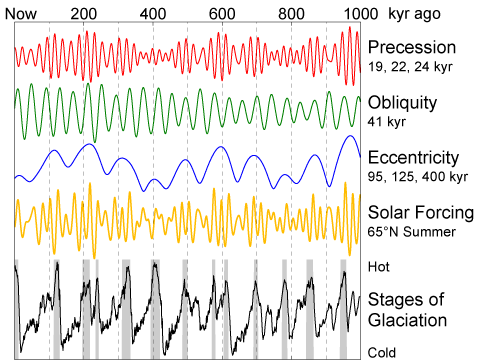
For centuries, the cause of these dramatic climate shifts was one of geology's greatest mysteries. What powerful force could plunge the planet into a deep freeze and then, just as mysteriously, release it? The answer, it turns out, is not found on Earth, but in the sky. The primary driver of the glacial-interglacial cycles is a set of predictable, long-term variations in Earth's orbit around the Sun. This celestial clockwork is known as the Milankovitch cycles, named after the Serbian astrophysicist and mathematician Milutin Milanković, who painstakingly calculated their effects in the early 20th century. He theorized that these subtle astronomical movements alter the amount and distribution of solar energy—or insolation—reaching the Earth, particularly affecting the summers in the Northern Hemisphere, which is home to most of the planet's landmass. If northern summers are too cool to melt the previous winter's snow, an ice sheet begins to grow. This sets off a positive feedback loop: the bright white ice reflects more sunlight back into space (a higher albedo), which further cools the region, allowing even more ice to accumulate. Milanković identified three main orbital cycles that conspire to create this effect. The first is Eccentricity, the changing shape of Earth's orbit from nearly circular to more elliptical. This cycle has a period of about 100,000 years. A more elliptical orbit means more variation in the Earth-Sun distance throughout the year. The second is Axial Tilt or Obliquity, the variation in the tilt of Earth’s axis relative to its orbital plane. This tilt ranges between 22.1 and 24.5 degrees over a cycle of about 41,000 years. A greater tilt means more extreme seasons—hotter summers and colder winters. A lesser tilt means milder seasons, including cooler summers that prevent snow from melting. The third cycle is Precession, the slow "wobble" of Earth’s axis, similar to a spinning top. This has a cycle of about 26,000 years and determines the timing of the seasons relative to Earth's closest approach to the Sun (perihelion). When these three cycles align to produce a prolonged period of reduced summer sunlight in the Northern Hemisphere, the conditions are ripe for glaciation to begin. While Milankovitch cycles are the pacemaker, they aren't the whole story. Other factors act as amplifiers. The concentration of greenhouse gases like carbon dioxide (CO2) in the atmosphere plays a crucial role. Ice core data from Antarctica shows that CO2 levels fall during glacial periods and rise during interglacials, amplifying the initial temperature change triggered by the orbital cycles. Tectonic plate movements also play a long-term role by changing the position of continents and altering ocean currents, which are vital for distributing heat around the globe.
Did you know? The immense weight of the Laurentide Ice Sheet was so great that the land beneath it is still "bouncing back" today in a process called post-glacial rebound. Areas around Hudson Bay are rising by as much as 1 centimeter per year.
Life on the Edge: Megafauna of the Frozen Plains
The Pleistocene was not a barren wasteland of ice. In the unglaciated regions, a unique and now-vanished biome thrived: the Mammoth Steppe. This vast, cold, and dry grassland ecosystem stretched from Spain across Eurasia to Canada and was the most extensive biome on Earth. It was a world dominated by giants, a cast of spectacular creatures known collectively as the Pleistocene megafauna. These animals were exquisitely adapted to life in a harsh, cold environment, and their story is one of magnificent success followed by abrupt extinction. The undisputed king of this realm was the Woolly Mammoth (Mammuthus primigenius). Standing over 3 meters tall at the shoulder, this iconic beast was protected from the biting winds by a thick undercoat of fine wool and a shaggy outer layer of long guard hairs. A thick layer of fat provided further insulation. Its large, curved tusks, which could reach over 4 meters in length, were not just for defense but were likely used as giant snowplows to sweep away snow and uncover the frozen grasses and sedges that formed its diet. They roamed the steppe in herds, their thundering footsteps a constant drumbeat on the frozen tundra. Sharing this landscape was the formidable Woolly Rhinoceros (Coelodonta antiquitatis), a bulky herbivore covered in thick fur with two massive horns on its snout, the front one of which could grow up to a meter long. It used this horn to clear snow and defend itself from the era's top predators. Among those predators, none were more fearsome than the Saber-toothed Cat (Smilodon fatalis). While most famous from the Americas, similar large cats prowled Eurasia. Smilodon was not a fast runner but a powerfully built ambush predator. Its most terrifying feature was its pair of canine teeth, which could grow up to 18 centimeters long. These were not for biting in the traditional sense, but for delivering a precise, stabbing deathblow to the soft throat or belly of large prey like bison and young mammoths. Other titans included the immense Cave Bear (Ursus spelaeus), a creature larger than any modern grizzly, which was surprisingly mostly herbivorous; the majestic giant Irish Elk (Megaloceros giganteus), with an antler span of up to 3.6 meters (12 feet); and the terrifying Short-faced Bear (Arctodus simus) of North America, the largest mammalian land carnivore of its time, which could run at high speeds to chase down its prey. This was a world of epic predator-prey battles, a dynamic and surprisingly rich ecosystem that supported a greater diversity of large mammals than anywhere on Earth today.
Our Ancestors, The Ice Survivors: Human Evolution in a Harsh World
The relentless cycles of the Ice Ages were the crucible in which modern humanity was forged. The fluctuating climate and harsh environmental pressures acted as a powerful engine of natural selection, favoring intelligence, cooperation, and technological innovation. It was in this challenging world that our ancestors not only survived but evolved into the species we are today. For much of this period, Europe was the domain of the Neanderthals (Homo neanderthalensis). Far from the brutish cavemen of popular caricature, Neanderthals were a highly successful and intelligent human species, superbly adapted to the cold. Their stocky, muscular build and relatively short limbs conserved body heat, while their large, broad noses likely helped to warm and humidify the cold, dry air they breathed. They wereapex predators of their time, masters of their environment. Archaeological evidence reveals that they were sophisticated hunters, working in coordinated groups to ambush and kill a astounding range of large and dangerous megafauna, including mammoths, woolly rhinos, and giant cave bears. They crafted a complex toolkit of stone implements, known as the Mousterian industry, with specialized scrapers for preparing hides, sharp points for spears, and knives for butchering meat. They controlled fire, a critical technology for warmth, cooking, and protection. Importantly, Neanderthals showed clear evidence of symbolic thought and culture. They deliberately buried their dead, sometimes with grave goods like tools or animal bones, suggesting a belief in an afterlife or at least a deep sense of ritual and community. Around 45,000 years ago, a new group of humans, our own species Homo sapiens, migrated into Europe from Africa. Taller and more slender than the Neanderthals, these anatomically modern humans brought with them a new wave of technological and cultural innovation. Their toolkits, such as the Aurignacian and later Gravettian cultures, were more diverse and complex, featuring fine, long blades, tools carved from bone and antler, and the revolutionary invention of the spear-thrower (atlatl) and needle. The sewing needle, in particular, was a game-changer, allowing for the creation of tailored, multi-layered clothing from animal hides that provided superior insulation against the extreme cold. For several thousand years, these two human species coexisted, and genetic evidence proves they also interbred, leaving a small but significant Neanderthal legacy in the DNA of most modern non-Africans. Why Homo sapiens ultimately thrived while the Neanderthals vanished around 40,000 years ago is a subject of intense debate, likely involving a combination of factors including climate instability, direct competition for resources, and perhaps the slightly more efficient technologies and larger social networks of the newcomers. These early modern humans left behind an astonishing legacy of their own: the world’s first art. In caves across France and Spain, such as Chauvet and Lascaux, they created breathtaking paintings of the animals they lived amongst, a vibrant testament to their complex minds and deep connection to the natural world.
The Great Thaw and the Younger Dryas: An Unstable End
The end of the last great glacial period was not a gentle, gradual warming but a turbulent and volatile transition marked by catastrophic events and dramatic climate swings. After the Last Glacial Maximum peaked around 20,000 years ago, the Milankovitch cycles shifted, delivering more solar radiation to the Northern Hemisphere’s summers. The colossal ice sheets, which had held dominion for millennia, began to melt. This process of deglaciation unleashed unimaginable quantities of freshwater into the global system, fundamentally reshaping the world’s geography and climate. The meltwater didn't just trickle away; it formed vast proglacial lakes, some larger than any lake on Earth today. One of the most famous was Lake Agassiz in North America, which held more water than all of the world's current freshwater lakes combined. When the ice dams holding back these lakes inevitably broke, the result was cataclysmic. The Missoula Floods, for instance, were a series of colossal outbursts from a glacial lake in what is now Montana. These floods scoured the landscape of eastern Washington, creating the bizarre channeled scablands, with water flowing at a rate ten times the combined flow of all the rivers in the world today. Sea levels rose rapidly, inundating the low-lying coastal plains and land bridges. The English Channel was formed, severing Britain from Europe, and the Bering Land Bridge disappeared beneath the waves, cutting off the overland route between Asia and the Americas. Just as the world seemed to be settling into a warmer, more stable state, the climate system delivered a final, shocking twist. Around 12,900 years ago, temperatures in the Northern Hemisphere plummeted, plunging the region back into near-full glacial conditions in a matter of decades. This sudden and dramatic reversal is known as the Younger Dryas stadial. Tundra replaced forests across Europe, glaciers re-advanced, and the human and animal populations that had adapted to the warming world were thrown into crisis. The leading theory for this drastic shift points to the catastrophic draining of Lake Agassiz into the North Atlantic. This sudden, massive influx of cold, fresh water is thought to have shut down the Atlantic Meridional Overturning Circulation (AMOC), a crucial ocean current system that acts like a conveyor belt, bringing warm tropical water north. With the heat pump switched off, the north froze once more. The Younger Dryas lasted for about 1,200 years before ending as abruptly as it began, with temperatures rocketing back up. This climatic whiplash had a profound impact. It is strongly implicated in the final extinction of many of the remaining Pleistocene megafauna, who could not adapt to such a rapid change. For human populations, it created immense pressure, and many scholars believe this prolonged period of environmental stress may have been the critical catalyst that pushed some communities in the Fertile Crescent toward the systematic cultivation of plants, sparking the Agricultural Revolution and setting the stage for the rise of civilization.
Did you know? The gracefully curved tusks of the Woolly Mammoth were not just for show; they grew throughout the animal's life, and much like tree rings, the layers of dentin in a tusk can tell scientists about the animal's age, diet, and even the climate conditions it experienced each year.
In conclusion, the Ice Ages represent one of the most formative chapters in Earth's history, a grand narrative of planetary change and biological resilience. The Pleistocene was far more than a long winter; it was a dynamic and powerful force that sculpted our modern landscapes, drove the evolution of magnificent creatures, and presented the ultimate challenge to our own ancestors, forging in them the intelligence and adaptability that would eventually lead to global dominance. The legacy of the ice is all around us, in the Great Lakes of North America, the fjords of Norway, the fertile loess soils of our farmlands, and the very rhythm of our planet's climate. Reflecting on this immense history serves as a profound reminder of our planet's capacity for dramatic and rapid change. We live in a brief, warm interlude in an ongoing Ice Age, a time of unusual climate stability that has allowed human civilization to flourish. The story of the Younger Dryas, in particular, offers a sobering lesson: the climate system is not a gentle dial but a complex machine with tipping points that can trigger breathtakingly swift transformations. As we now confront our own era of human-induced climate change, the deep past of the Ice Ages provides essential context, teaching us about the delicate balance of the forces that govern our world and the critical importance of understanding our planet's immense and often unpredictable power.
How we verify this article
By the History Unlocked editorial team
This text is built on historical facts stored in our database and drafted with AI assistance. No signed human review is recorded for this article. Report any inaccuracy: we correct it and update the modified date.
Updated on
AI-assisted drafting.
Read our editorial standardsEnjoyed this? Discover more articles in the category Prehistory