The Last Human Standing: Our 7-Million-Year Story of Survival
Our story does not begin with written words, empires, or kings. It begins with a footprint, a shard of bone, a simple stone tool. It is an epic saga written across millions of years, a sprawling family history with countless branches, most of which have withered away. This is the story of human evolution, a detective mystery where the crime scene is the entire planet and the clues are separated by eons. We, Homo sapiens, are the last surviving witnesses, the sole inheritors of a legacy forged in the crucible of ancient Africa. For millennia, we have looked at ourselves and wondered: Where did we come from? What makes us human? The journey to answer these questions takes us back through a dizzying expanse of time, to a world unimaginably different from our own, a world populated by beings both strangely familiar and profoundly alien. They were our ancestors, our cousins, our predecessors. They walked, they struggled, they innovated, and they ultimately vanished, leaving behind only tantalizing whispers of their existence.
The narrative of our origins is not a simple, linear ascent from a hunched ape to an upright astronaut. It is a messy, branching tree, a tale of relentless experimentation by nature. At various points in our deep past, the Earth was home to multiple species of humans, each with its own unique set of adaptations and skills. They competed, they coexisted, and, as we now know, they even interbred. Why did we, and we alone, survive this grand evolutionary tournament? Was it our larger brains, our more sophisticated tools, our capacity for language and art, or was it simply a matter of luck, a roll of the cosmic dice at a critical moment in history? The quest to understand our genesis is the ultimate exploration of identity. It requires us to piece together the fossilized remains of long-lost relatives and to decode the genetic echoes they left within our very DNA. It is a journey into the heart of what it means to be human, a story of adaptation, extinction, and the improbable triumph of one species that would go on to change the world forever.
The Dawn of Bipedalism: Our First Steps
Our story begins not with a thought, but with a step. Roughly six to seven million years ago, in the dynamic landscapes of Africa, a profound transformation was underway. The dense, tropical forests that had blanketed the continent were slowly giving way to a mosaic of woodlands and open savannas, driven by global climate shifts. This environmental upheaval was the stage upon which the first act of our human drama unfolded. For our ape-like ancestors, who were comfortably adapted to a life in the trees, this change presented both a crisis and an opportunity. The solution they stumbled upon was revolutionary: they stood up. This transition to bipedalism, walking on two legs, is the foundational split, the moment our lineage diverged from that of other apes. It was not a sudden event but a gradual adaptation, playing out over millions of years. Fossils of early potential hominins like Sahelanthropus tchadensis, discovered in Chad, hint at this shift with a forward-positioned foramen magnum—the hole where the spinal cord enters the skull—suggesting a more upright posture than a typical chimpanzee. But the most famous evidence comes from a creature that lived much later.
Did you know? The Laetoli footprints, preserved in volcanic ash for 3.6 million years in Tanzania, show a small group of *Australopithecus afarensis* walking together, providing a haunting snapshot of our distant ancestors' social life.

That creature is Australopithecus afarensis, and its most iconic representative is "Lucy," a 3.2-million-year-old partial skeleton discovered in Ethiopia in 1974. Lucy was a small-brained hominin, a hybrid creature who was still an adept tree climber but was unequivocally built for walking upright. Her pelvis was short and broad, more like a human’s than an ape’s, providing the stability needed for bipedal motion. Her leg bones and the arch in her feet confirmed it. Why make such a risky evolutionary bet? The savanna hypothesis suggests that standing tall allowed our ancestors to see over high grasses, spotting predators and resources alike. Another compelling idea is that walking upright is more energy-efficient over long distances, a crucial advantage for foraging in a more spread-out environment. Furthermore, it freed the hands. These were not yet hands for crafting intricate tools, but for carrying food, holding infants, and perhaps gesturing, laying the groundwork for all the technological and social innovations to come. Bipedalism was not an endpoint but a gateway, the critical adaptation that opened up a world of new possibilities for our ancestors to explore.
The Birth of Technology: The Handy Man
For millions of years after our ancestors first stood up, their hands were free, but their world remained largely unshaped by them. This changed dramatically around 2.6 million years ago with the arrival of a new character in our evolutionary play: Homo habilis, the "Handy Man." Discovered in the Olduvai Gorge in Tanzania, this species was so named because its fossils were found alongside the first definitive evidence of stone tool manufacturing. This was not just tool use, which is seen in other animals like chimpanzees who use sticks to fish for termites; this was tool creation. Homo habilis possessed a cognitive foresight that was unprecedented. They could look at one rock (the core) and envision how striking it with another (the hammerstone) would produce sharp-edged flakes. This collection of simple cores and flakes, known as the Oldowan industry, represents the dawn of technology, the very first items in the human archaeological record.
These tools, though crude to our modern eyes, were transformative. The sharp flakes were Stone Age scalpels, capable of slicing through tough animal hides to access meat and breaking open long bones to get at the nutrient-rich marrow inside. This dietary shift was a monumental turning point. While australopithecines were primarily vegetarian, Homo habilis became a scavenger and opportunistic hunter, unlocking a dense source of calories, protein, and fat. This high-energy diet acted as a powerful fuel for the most energy-hungry organ in the body: the brain. Homo habilis had a noticeably larger brain than its australopithecine predecessors, and many scientists believe a feedback loop was established. The creation of tools allowed for a better diet, which in turn fueled the growth of a larger, more complex brain. This bigger brain was then capable of creating even better tools and developing more complex social strategies for acquiring food. The Handy Man had initiated a cycle of cognitive and technological acceleration that would define the rest of human evolution. They were no longer just passive participants in their ecosystem; they were actively beginning to shape it to their will, one sharp stone at a time.
Did you know? Early stone tools were so effective that cut marks made by *Homo habilis* are often found on animal bones over the top of tooth marks from large predators, suggesting our ancestors were bravely scavenging fresh kills from fearsome carnivores like saber-toothed cats.
Out of Africa: The Great Human Migration
The innovations of Homo habilis were just the beginning. The next major leap forward came with the emergence of a taller, stronger, and far more ambitious hominin: Homo erectus, the "Upright Man." Appearing in the fossil record around 1.9 million years ago, H. erectus was a game-changer. They possessed body proportions remarkably similar to our own, with long legs and shorter arms, indicating a full commitment to a terrestrial life. Their brains were significantly larger than those of H. habilis, approaching the lower range of modern human brain size. This new physique and enhanced intellect equipped them for a feat no hominin had ever accomplished: they walked out of Africa. For the first time, a human species pushed beyond its ancestral homeland, embarking on a slow but steady colonization of the globe. Fossils of Homo erectus have been found as far afield as Georgia (at the site of Dmanisi), Indonesia ("Java Man"), and China ("Peking Man"), a testament to their incredible adaptability.

This grand migration was powered by two key technological and cultural breakthroughs. The first was a new toolkit, the Acheulean industry, defined by its signature tool: the hand-axe. Unlike the simple Oldowan choppers, Acheulean hand-axes were large, symmetrical, teardrop-shaped implements, carefully crafted on both sides. This bifacial working required significant planning, skill, and a standardized mental template that was passed down through generations. This tool was the Swiss Army knife of the Paleolithic, used for butchering animals, digging for roots, and working wood. The second, and perhaps more profound, innovation was the controlled use of fire. While the exact timing is debated, sites associated with H. erectus show evidence of hearths dating back at least a million years. Fire provided warmth in colder climates, protection from nocturnal predators, and a way to cook food. Cooking was revolutionary; it not only killed parasites and bacteria but also broke down tough fibers and proteins, making food easier to digest and unlocking far more calories. Fire also became a social anchor, a gathering point for the group to share food, find security, and perhaps even begin to tell stories under the stars. With advanced tools and the power of fire, Homo erectus was no longer just surviving; it was thriving and expanding its dominion across the Old World.
A World of Humans: The Neanderthal Enigma
For much of our deep past, we were not alone. The world that Homo erectus had opened up eventually gave rise to a diverse cast of human species. As recently as 100,000 years ago, the planet was home to at least four or five different kinds of humans simultaneously. In the cold lands of Europe and Western Asia, the famous Neanderthals reigned. On the islands of Indonesia, the diminutive Homo floresiensis (the "Hobbit") may have persisted. And in a cave in Siberia, the recent discovery of a tiny finger bone revealed the existence of a mysterious "ghost lineage" known as the Denisovans, a species we know almost entirely from their DNA. This was not a world with a single human protagonist, but an ensemble cast. And among our ancient cousins, none captivate the imagination more than the Neanderthals, Homo neanderthalensis.
Did you know? Some late Acheulean hand-axes are found in pristine condition, having never been used for butchery, and are made from beautiful, exotic stones. Archaeologists speculate they might have served a social or symbolic purpose, perhaps as a display of skill and fitness to potential mates.
Far from the brutish, hunched cavemen of popular stereotype, Neanderthals were an incredibly successful and sophisticated species that thrived for over 350,000 years in some of the harshest environments imaginable. Their bodies were a masterclass in adaptation to the cold: short and stocky to conserve heat, with a powerful build and a massive nasal cavity thought to have warmed and humidified the frigid, dry air of Ice Age Europe. Their brains were, on average, even slightly larger than our own. Their culture was rich and complex. They were apex predators, masters of the hunt who successfully brought down mammoths, woolly rhinos, and giant cave bears using sturdy spears in close-quarter combat. Their tool technology, the Mousterian industry, was a significant advance over the Acheulean, featuring a wider variety of specialized flake tools. There is now compelling evidence that they were not devoid of symbolism. They used ochre pigments, collected eagle talons and unusual shells, and at sites like Shanidar Cave in Iraq, there are hints they may have intentionally buried their dead, sometimes with offerings of flowers. They were a parallel humanity, another way of being human.

The discovery of the Denisovans has added another layer of profound mystery. Known from just a few fossil fragments, their genome tells a stunning story. They were a sister group to the Neanderthals, spreading across Asia and interbreeding with them. More startlingly, both Neanderthals and Denisovans met and interbred with the new arrivals on the scene: our own ancestors, Homo sapiens, as they began to spill out of Africa. The proof is written in our genes.
The Sapien Revolution: The Rise of Us
Amidst this world of multiple human species, our own story began. The earliest fossils of Homo sapiens have been found in Africa, at sites like Jebel Irhoud in Morocco, dating back a staggering 300,000 years. For hundreds of thousands of years, these early sapiens were not radically different from their cousins in terms of technology or behavior. They used Middle Stone Age tools, hunted, and survived. But then, somewhere between 70,000 and 50,000 years ago, something extraordinary happened. It was a change so profound that it is often called the "Great Leap Forward" or the "Upper Paleolithic Revolution." This was not a physical evolution but a cognitive and cultural one. It was the moment Homo sapiens truly became "us."
Did you know? DNA analysis has revealed that most modern humans with ancestry outside of Africa have between 1-2% Neanderthal DNA, proving that our ancestors not only met but also successfully interbred with them.
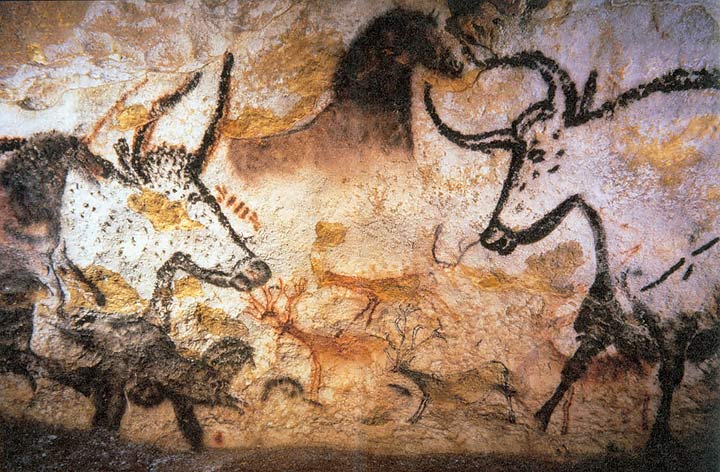
Suddenly, the archaeological record explodes with a creativity and innovation never before seen. The static, million-year-long traditions of the Acheulean and the Mousterian were replaced by a dizzying array of regional and rapidly changing cultures. Technology became more complex and efficient. Long, slender blades were struck from prepared cores, and these were then fashioned into a huge variety of specialized tools. For the first time, bone, antler, and ivory were used extensively to create spear-throwers (atlatls) that increased the range and power of hunters, finely crafted harpoons for fishing, and delicate needles with eyes, signaling the invention of tailored clothing. But the most spectacular leap was in the realm of the symbolic. This was the birth of art. Across the globe, our ancestors began carving exquisite figurines like the Venus of Willendorf, and, most famously, they descended into the deep, dark, and dangerous CAVES to paint breathtaking murals of the animals that dominated their world. The galleries of Lascaux, Chauvet, and Altamira are the first great cathedrals of the human spirit. At the same time, they were making music, evidenced by the discovery of flutes carved from bird bone. What powered this revolution? The leading theory is the final development of fully modern, complex language—the ability to not just communicate about the here and now, but to discuss the past, plan for the future, tell stories, and create shared myths.
This new cognitive toolkit gave Homo sapiens an unparalleled adaptive advantage. Armed with superior technology, larger and more complex social networks held together by language and ritual, and an incredible capacity for innovation, they embarked on the final, decisive wave of migration out of Africa around 60,000 years ago. As they spread across the globe, they encountered the Neanderthals and Denisovans. While some interbreeding occurred, within a few thousand years of our ancestors' arrival in any given region, the other human species disappeared forever. Whether they were outcompeted, absorbed, or actively exterminated remains one of the most haunting questions in our entire history.
Conclusion: The Last Survivor
The story of human evolution is an epic tapestry woven over seven million years, a narrative of survival against incredible odds. It is the story of a small, ape-like creature that dared to stand on two legs on an African savanna and, in doing so, freed its hands to one day shape the world. It is the story of the first stone tool, a simple flake of rock that unlocked a new diet and fueled the expansion of the brain. It’s a tale of fire, of migration, of the courage to walk into unknown lands and adapt to new challenges. For the vast majority of our history, this story had multiple protagonists. We shared our world with other kinds of humans, species who also loved, struggled, and innovated. But one by one, they vanished, leaving us as the last human standing.
We were not inevitable. Our survival was not preordained. We are the beneficiaries of a unique combination of adaptations—bipedalism, tool use, a large brain, and above all, the profound power of cooperative culture, language, and symbolic thought. These traits allowed us to form larger social groups, to out-think our competitors, to share knowledge with unprecedented fidelity across generations, and to adapt to every environment on Earth, from the frozen tundra to the remote islands of the Pacific. We carry within our DNA the genetic ghosts of our lost relatives, the Neanderthals and Denisovans, a permanent reminder that we are the product of a complex and interconnected human family. Our evolutionary journey has not ended. The same forces of culture, technology, and cooperation that brought us to this point are now shaping our future at a breathtaking pace. We, the last survivors of a once-diverse human world, now hold the fate of the planet in our hands. The story of our past is the essential primer for understanding our present and contemplating our future, a humbling reminder of our deep origins and our extraordinary, improbable existence.
How we verify this article
By the History Unlocked editorial team
This text is built on historical facts stored in our database and drafted with AI assistance. No signed human review is recorded for this article. Report any inaccuracy: we correct it and update the modified date.
Updated on
AI-assisted drafting.
Read our editorial standardsEnjoyed this? Discover more articles in the category Prehistory