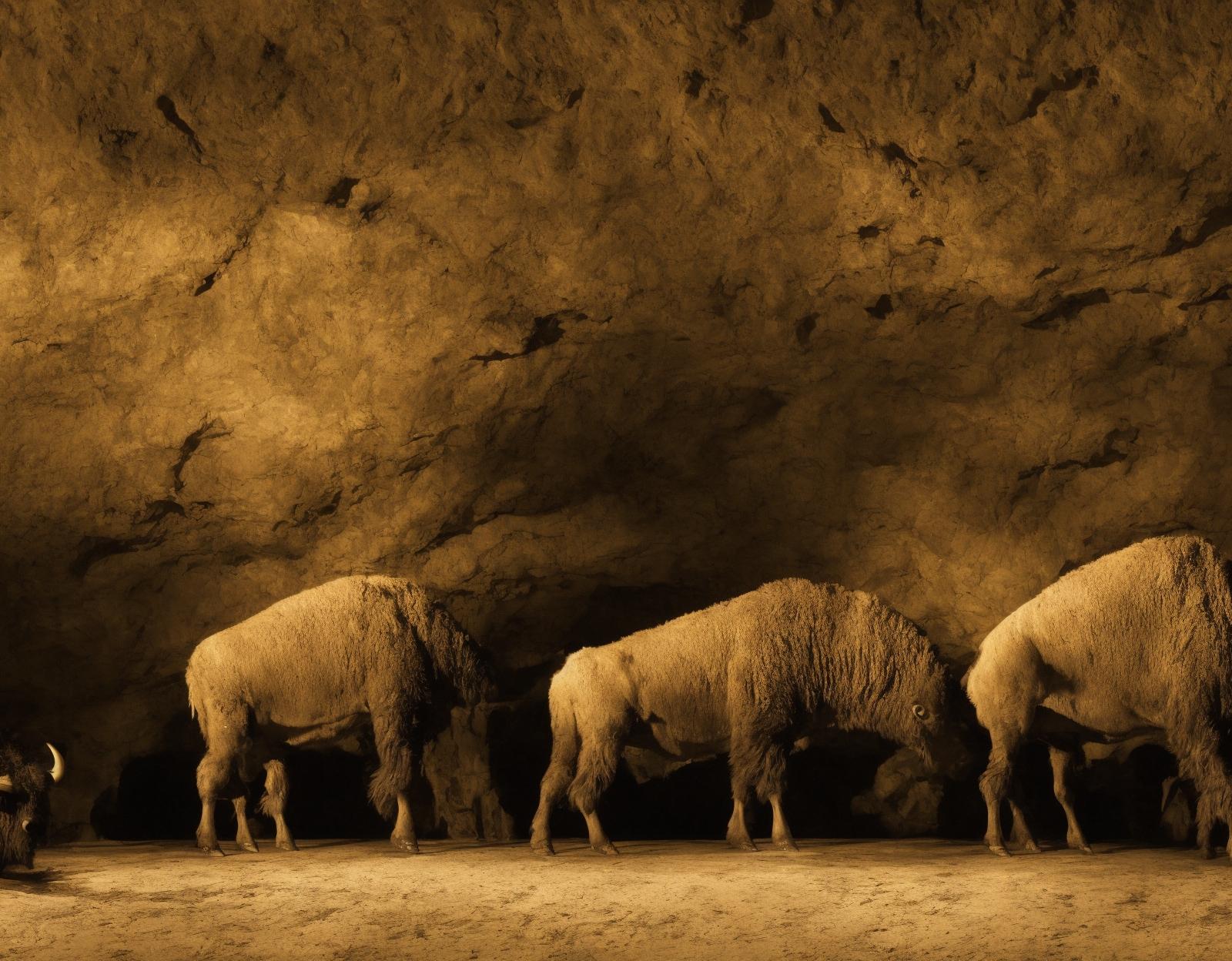
Altamira: The Cave of Bison and the Dawn of Prehistoric Wonder
The cool breath of a mountain, centuries of darkness, and the patient hand of time: the opening of Altamira's story feels like the turning of a page in a half-forgotten book. In the autumn of the nineteenth century a small party of curious eyes peered into a low, rocky mouth above the Cantabrian hills and found color where none had been expected. The ceiling shimmered with animals rendered in ochre and manganese, not as crude doodles but as living bodies - bison with rounded flanks, horses frozen mid-stride, and phantom hands leaving ghostly negatives beside geometric signs. For anyone who steps into the narrative of Altamira, there is a sense of entering a deliberate act of seeing across millennia: human beings with the cognitive and aesthetic capacities to shape narrative, memory, and ritual.
Altamira's discovery has the fragrance of serendipity and the sting of controversy. The man usually credited with bringing the cave to the attention of modern science was Marcelino Sanz de Sautuola, a wealthy landowner and antiquarian who explored the region in the late 1870s. It was his daughter, María, who famously noticed the polychrome ceiling in 1879, pointing out the vivid bison painted above a rock shelter used by Paleolithic hunters. Yet the story did not end with delighted recognition. The British and French scholarly worlds of the time had difficulty accepting that people of the distant past could produce art of such quality. Altamira became a battleground between skepticism and evidence, a cultural Rorschach that exposed the limits of contemporary assumptions about prehistoric intelligence and aesthetics.
This article takes you into the chambers of the cave and into the larger chambers of scientific debate, social reception, and conservation policy. We will trace the pigments and brushstrokes, follow the arguments over dating and authenticity, and accompany the paintings through a turbulent modern history that alternates between reverence and damage, closure and replica. Along the way we will consider what these painted animals might have meant to their makers: images of prey and power, mnemonic devices in an oral culture, or part of ceremonial life woven into the landscape. The prose that follows blends archaeological fact with narrative perspective designed to evoke the deep, sometimes uncanny intimacy we feel when confronted by the visual traces of distant ancestors. We will not invent: dates, names, and events presented here are grounded in published research and well-documented history. But we will linger on the mystery, because mystery is where Altamira insists we pause.
Did you know? The first person to note the polychrome ceiling at Altamira was María Sautuola, the daughter of Marcelino Sanz de Sautuola, in 1879.
The Discovery and the Initial Storm
The opening of Altamira into modern consciousness is part detective story, part family anecdote, and part scientific controversy. Marcelino Sanz de Sautuola, a Madrid-educated lawyer and landowner with a passionate interest in the archaeological record of Cantabria, had been surveying the caves of the region for several years. In 1879, during exploration of a shallow cave near Santillana del Mar, his young daughter María noticed pigments on a low ceiling while her father's attention was distracted by other finds. What they saw were not mere lines but a complete frieze of polychrome bison, rendered with a mastery of form and use of natural relief to create a three-dimensional effect. Sautuola recognized the importance of the images and published his observations, emphasizing their artistry and apparent age.
If the discovery's human element tugs at the heart—an observant child pointing to a painted bison—the subsequent reaction from the academic community revealed the era's intellectual constraints. When Sautuola presented the find internationally, many leading archaeologists and prehistorians refused to accept that Paleolithic humans could have produced such refined work. In particular, skepticism emerged from parts of the French archaeological establishment; doubts were not only about the technical skill but about the possibility of such polychromy in prehistoric times. The most vocal critic was Émile Cartailhac, a respected French archaeologist, who publicly denounced Sautuola’s work as a forgery. The charge was not polite disagreement but a moral and reputational threat. Sautuola, already in fragile health, endured humiliation. He died in 1888 convinced by some accounts that his reputation had been irreparably harmed by the accusations.
The controversy took decades to resolve. New discoveries of parietal art in other caves—ordeals of discovery in southern France and elsewhere—began to undermine the certainty of the skeptics. By the turn of the century, the weight of comparative evidence, better descriptions, and improved scientific methods forced a reappraisal. Émile Cartailhac himself famously published a retraction and apology in 1902, acknowledging that the sites and the quality of the work left no reasonable doubt about the authenticity of Altamira's paintings. His caveat and contrition are instructive: they reveal how entrenched theoretical frameworks can blind scholars to evidence that challenges prevailing narratives. Altamira, then, is as much a story about the past as it is a cautionary tale about the history of science.
Did you know? Artists at Altamira used the cave’s natural bulges to create a three-dimensional effect, effectively turning the rock itself into part of the composition.

The Art: Materials, Techniques, and Visual Mastery
One of the most striking elements of Altamira is not merely that the figures exist, but how they were made. The artists exploited the natural relief of the rock ceiling, using bulges and hollows as sculpted supports for volume and motion. The result is not a static set of images slapped onto a surface; it is an ensemble in which shape, light, and pigment collaborate. The dominant motifs are bison—rendered in sweeping ochres with black outlines and engraved lines for fur—alongside horses, hands, and occasional signs that might be symbolic or shorthand for ideas now lost. Pigments were mineral-based: red and yellow ochres come from iron oxides; blacks derived from manganese dioxide and charcoal. The application involved a range of techniques: painting with brushes likely made from tufts of hair, applying pigment with fingers, blowing pigment (stenciling and spray techniques), and engraving lines with stone tools.
The polychrome bison of Altamira demonstrate an intuitive understanding of chiaroscuro: the alternation of light and shade that makes a painted form appear voluminous. In some cases, artists scraped away the dark patina on the rock before painting, revealing a lighter matrix that would intensify the color. They also harnessed calcite deposits and the cave's microrelief. This strategic engagement with the substrate suggests an aesthetic sensibility as complex as any later artistic tradition. While we can never know the full cognitive process behind these choices, material analyses indicate a deliberate and skilled approach to visual narrative.
Scientific studies—microscopic pigment analysis, stratigraphic excavation in front of panels, and more recently non-invasive spectrometry—have confirmed the mineral composition of the pigments and suggest a multilayered chronology for some panels. Some images show evidence of repainting or superimposition: later artists may have traced or refreshed earlier figures. This palimpsest effect complicates simplistic readings of the cave as a single, instantaneous artistic event. Instead, Altamira emerges as a palimpsest of human attention over generations, a place where successive hands added, revised, or reinterpreted images.
Did you know? Émile Cartailhac, the critic who initially declared Altamira a forgery, publicly retracted his statement in 1902, acknowledging the cave’s authenticity.
The visual mastery at Altamira was not merely technical; its subjects and compositions demonstrate selective choices. Bison appear often in dynamic groupings, sometimes overlapping, as if the artists were composing a narrative tableau. The prominence of these large ungulates aligns with the subsistence economy of Pleistocene hunter-gatherers, yet representation and hunt are not synonymous; symbolic, ritual, or mnemonic functions remain plausible and are a matter of ongoing scholarly debate.
Dating, Authenticity Debates, and the Evolution of Scientific Methods
From the outset, Altamira forced archaeologists and natural scientists to confront questions about method and inference. Early debates hinged on stylistic comparisons and the plausibility of prehistoric sophistication. As scientific techniques developed over the twentieth century, direct and indirect dating methods have been used to place Altamira within the broader chronology of Upper Paleolithic Europe.
Radiocarbon dating of charcoal pigments and associated archaeological layers established a general timeframe: the principal paintings at Altamira are conventionally placed within the Upper Paleolithic, particularly the Magdalenian period (roughly 17,000–12,000 years ago), though some motifs and engravings may be older or younger. Caution is necessary: direct radiocarbon dating of pigments is challenging because pigments are often mineral-based and lack organic carbon, and organic binders—if they existed—may have been lost. Where charcoal from torches or hearths associated with human activity was present, radiocarbon provided relative anchors. More recently, uranium-thorium dating of thin calcite deposits that formed over or under paintings has offered minimum or maximum ages for some parietal art sites. These methods can flank radiocarbon results and provide additional constraints.
Did you know? The deeper galleries of Altamira show fewer signs of domestic life, suggesting some painted chambers may have been reserved for ritual or special access.
The evolution of scientific techniques also transformed the authenticity debate. In the late nineteenth century, critics argued that Sautuola might have been duped by a skilled forger. But as comparable imagery was documented across the Franco-Cantabrian region and as laboratory analyses improved, forgery became an implausible explanation. Émile Cartailhac's public retraction in 1902 symbolically closed the scandal, but the methodological lessons persisted. Scientists learned to triangulate stylistic evidence with stratigraphic context and laboratory dating—an approach that matured through the twentieth century.
The continuing refinement of non-invasive imaging—photogrammetry, DStretch (a digital enhancement technique), and portable X-ray fluorescence (pXRF)—has enriched the picture without necessarily resolving all questions. These tools allow analysts to discern faint marks, differentiate pigment layers, and map elemental composition in situ. They reveal that the cave's imagery may have been the product of episodic visitations across millennia, a palimpsest in which artists revisited and reworked the site. That complexity underlines an important historiographic point: scientific advances do not simply settle the past once and for all; they reveal more layers for interpretation and invite fresh questions.
Who Painted Altamira? Social Contexts and Possible Functions
The people who created Altamira's images lived in a Pleistocene world of shifting climates, megafauna, and mobile lifeways. Their material culture—stone tools, bone implements, and seasonal camps—tells of adaptable hunter-gatherer groups. Yet the social identity of the actual painters remains subject to inference rather than direct evidence. Were they specialist artists? Elders with ritual knowledge? Small household groups periodically entering the cave? Archaeological excavations in and around the cave's entrance have produced domestic debris, stone tools, and occasional carved objects that suggest episodic occupation, but the deepest galleries where the best paintings occur show little sign of repeated domestic activity. This divergence suggests that access to the painted chambers might have been restricted, ritualized, or controlled.
Did you know? A full-scale replica of the Altamira polychrome chamber was created for the National Museum and Research Center of Altamira, opened in 2001, to protect the originals from tourist damage.
Ethnographic analogy offers some pathways for interpretation, though with caution. In many hunter-gatherer societies, caves are liminal spaces imbued with cosmological significance: they are thresholds between worlds, places for initiation, and repositories of knowledge. The recurring depiction of powerful ungulates at Altamira could reflect a suite of meanings: direct hunting magic intended to influence animal populations, totemic or clan symbolism, mnemonic devices recounting successful hunts, or cosmological narratives connecting people to the landscape and its spirits.
Another possibility emphasizes the performative aspects of cave art. The act of painting in a dark chamber with the light of torches or stone lamps is itself a ritual performance; shadows and movement could animate the animals. The interplay of darkness and painted light might have been part of a sensory experience involving sound, storytelling, and communal memory. The traces left on the walls—scratches, overlapping images, and handprints—point to a dynamic social practice rather than isolated acts of depiction. If Altamira was indeed a place with cosmological or ritual resonance, then its paintings served as a stage for social reproduction: teaching, initiation, or negotiated memory.
The Long Modern Life of Altamira: Tourism, Damage, and the Replica
Altamira’s modern afterlife has been turbulent. Once the painting's authenticity was accepted, public interest swelled. Early in the twentieth century the cave became a destination for scholars and tourists alike. That attention, however, carried costs. The microclimate of a cave is a delicate equilibrium of temperature, humidity, and carbon dioxide concentration. Hundreds or thousands of visitors across decades introduce heat, moisture, and microorganisms that can upset that balance. In Altamira’s case, successive waves of visitation led to the growth of black and green microbial mats, condensation-related calcite deposition, and flaking of pigments. By the mid-to-late twentieth century concerns about deterioration intensified.
Did you know? Altamira’s revelation helped shift scientific opinion about prehistoric people’s cognitive and artistic capabilities, overturning many 19th-century assumptions.
In response, Spanish authorities and international conservationists implemented measures to protect the site. These measures included limiting access, installing airlocks in some cases, and monitoring microclimatic variables. When public access proved incompatible with long-term preservation, the idea of a high-quality replica gained traction. The National Museum and Research Center of Altamira, inaugurated in 2001 near Santillana del Mar, includes a meticulous reproduction of the cave’s Salon of the Polychromes. The replica—executed with painstaking attention to shape, texture, and pigment—allows visitors to experience something like the aesthetic impact of the originals without endangering the actual paintings.
This solution raises philosophical questions about authenticity and experience. Is a perfect replica ethically equivalent to the original in terms of public education? For many visitors, seeing a faithful reproduction is transformative; for scholars, the replica cannot replace primary research access to original pigments and microstratigraphy. Yet with the original cave under stringent access restrictions, the replica performs an important democratic function: it conveys the visual power of Altamira while ensuring that the fragile original remains conserved for future scientific study. The conservation story of Altamira thus becomes emblematic: it forces us to weigh public access against preservation, education against stewardship.
Altamira in Cultural Memory and Scientific Legacy
Altamira's significance extends beyond its painted animals and archaeological strata. It changed the way scholars and the public conceive of the cognitive abilities of Ice Age people. Before Altamira, many nineteenth-century thinkers doubted that Paleolithic humans had the aesthetic sense or symbolic competence to produce complex imagery. The cave's revelation forced a re-evaluation: technological and cognitive sophistication existed long before the rise of settled agricultural civilizations.
Did you know? The Altamira case became a classic example in the history of science for how entrenched skepticism and cultural bias can delay acceptance of new discoveries.
The cave has also influenced cultural production. Writers, painters, and filmmakers have invoked Altamira as a symbol: a place where modern humanity confronts its deep past. The drama of Sautuola’s life and the controversy surrounding the paintings provides narrative fuel that resonates beyond academic journals. The apology of Émile Cartailhac and the subsequent vindication of Sautuola are often cited in methodological discussions about the sociology of scientific acceptance: how new data must overcome not just empirical scrutiny but the inertia of entrenched paradigms.
Scientifically, Altamira was pivotal in the development of Paleolithic archaeology and cave art studies. It prompted systematic surveying of other caves in the Franco-Cantabrian region, leading to discoveries in Lascaux, Chauvet, and places beyond. Together these sites form a corpus that reveals regional styles, recurring motifs, and chronological sequences, enabling comparative approaches that remain central to the discipline. Techniques developed to study Altamira—microscopic pigment analysis, stratigraphic recording, and more recently non-invasive imaging—have become standard tools in the study of parietal art worldwide.
Conclusion: The Quiet Voice of the Painted Bison
Walking, even imaginatively, through Altamira is an exercise in humility. The images on the ceiling are not loud proclamations; they are quiet interventions that cross time. They invite questions rather than providing answers; they demand careful listening rather than hasty theorizing. The story of the cave—its discovery by María Sautuola, the humiliation and later vindication of her father, the technical mastery of artists who used pigment and rock as one, and the modern struggle to preserve fragile heritage—reads like an extended parable about how we value the past. Science has given us tools to date, analyze, and preserve, but it has not removed the mystery.
What remains perhaps most arresting is the sense of continuity: that human beings, tens of thousands of years ago, encountered the same magic of representation that we still prize. They painted to render, remember, and perhaps to commune with forces we can only hypothesize about. Today, when access to the original cave is tightly controlled for its survival, a faithful replica allows the public to stand under a painted sky of bison and horses and to feel, for a fleeting instant, a connection with a voice from the deep past.
Altamira resists reduction to a single meaning. It is simultaneously a key archaeological site, a chapter in the history of scientific debate, a conservation cautionary tale, and a locus of wonder. The painted bison are more than images; they are an invitation to continue looking, to refine methods, and to allow the past to speak in its own, enigmatic way. It is this mixture of evidence and enigma that secures Altamira’s place in both the scholarly imagination and the popular heart.

How we verify this article
By the History Unlocked editorial team
This text is built on historical facts stored in our database and drafted with AI assistance. No signed human review is recorded for this article. Report any inaccuracy: we correct it and update the modified date.
Updated on
AI-assisted drafting.
Read our editorial standardsEnjoyed this? Discover more articles in the category Prehistory