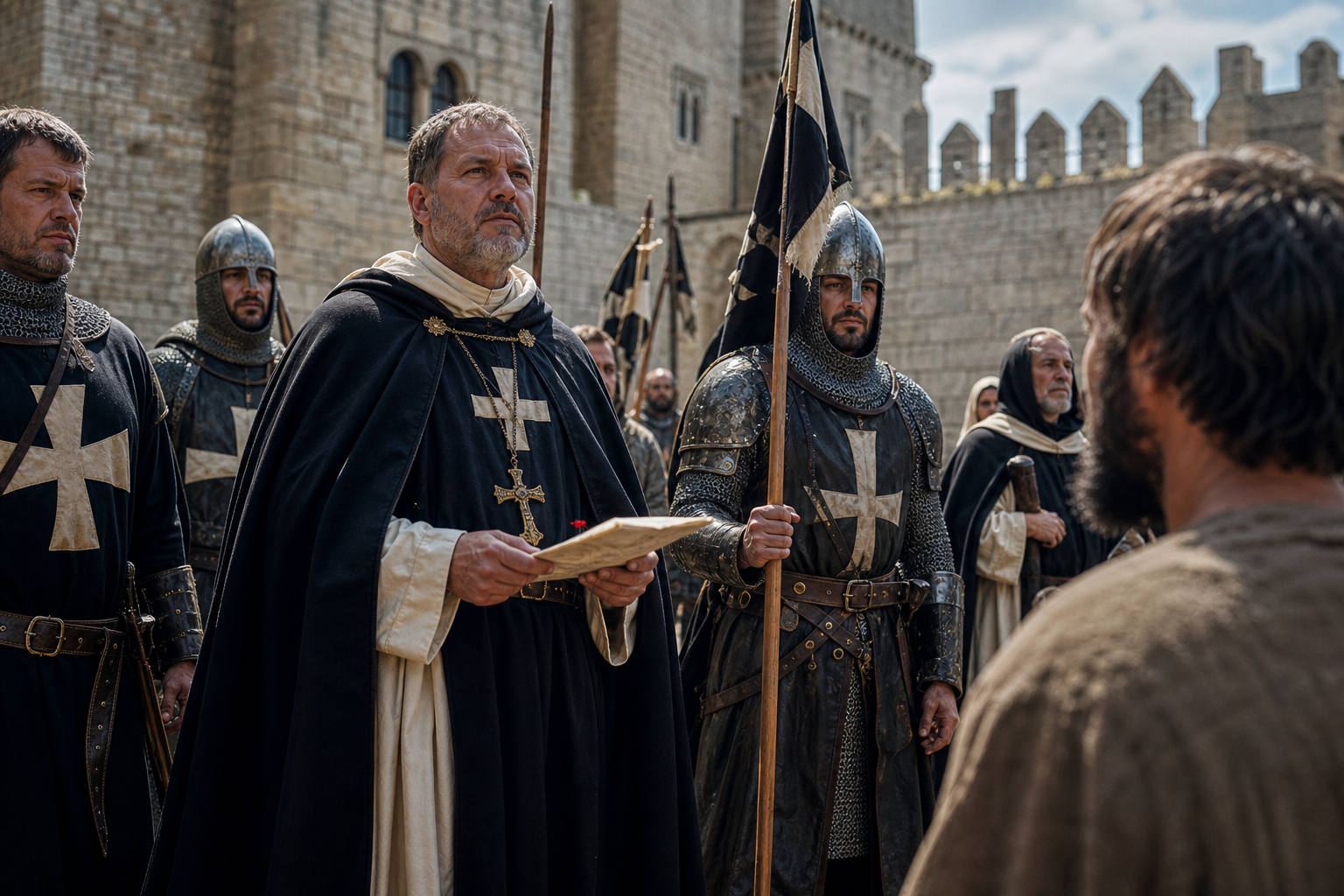
Shadows of Faith: The Medieval Inquisition Revealed
The Medieval Inquisition casts a long shadow over European history, a confluence of fear, law, faith and bureaucracy that shaped medieval society in ways both visible and hidden. This was not a single uniform institution but a series of ecclesiastical responses to perceived heresies that emerged between the late 12th and 14th centuries. Its story is strewn with crusades, councils, mendicant friars, learned decretals, and the slow accretion of legal procedures that would influence criminal justice far beyond the Middle Ages. At its heart, the Inquisition was driven by a simple and terrifying premise: heresy was not merely an error of belief; it threatened communal order and salvation.
Seen through a narrative lens, the Medieval Inquisition reads like a detective story written in parchment and wax seals. Bishops, royal magistrates, and papal legates exchanged letters; Dominican and Franciscan friars crossed valleys and climbed walled towns to interrogate alleged dissenters; secret denunciations arrived in chancery boxes; confessors and informers negotiated the thin line between salvation and punishment. The atmosphere was often charged by local rivalries and political imperatives as much as by doctrinal disputes. The inquisitorial system was adaptive, changing across regions — from the episcopal inquiries conducted by bishops in southern France to the papal inquisitors dispatched by Rome to the same troubled provinces. To trace the Inquisition’s medieval path is to follow intersecting currents of theology, canon law, social anxiety, and the development of institutions that sought to police belief.
This article will travel chronologically and thematically through that terrain. We begin with the origins and the rise of heretical movements that provoked such ecclesiastical responses. Then we will examine the critical transition from episcopal initiatives to papal centralization under figures such as Gregory IX, and the later legal clarifications like Pope Innocent IV's toleration of judicial torture in Ad extirpanda. We will analyze the practical mechanics of investigation, the manuals that codified practice, and the penalties that ensued. Case studies—the Cathars of Languedoc, the Waldensians, and other local episodes—will anchor the discussion in human stories of belief, conviction, recantation and, sometimes, death. Finally, we will consider the social consequences, the transformation in legal culture, and how later centuries remembered and often mythologized the medieval Inquisition. The tale is true and peculiar: an institutional attempt to reconcile mercy and coercion, to secure orthodoxy while claiming to keep souls from perdition. The mystery remains modern: how much did these procedures transform the medieval imagination, and what echoes of that transformation linger in our legal and cultural memory today?
Did you know? The papal decretal Ad abolendam (1184) was among the first official texts to prescribe systematic measures for identifying and punishing heresy, marking a turning point in Church policy toward dissent.
Origins and the Rise of Heresy
The roots of the Medieval Inquisition cannot be understood without first understanding the religious and social ferment of the 11th to 13th centuries. Europe was changing rapidly: population growth, urbanization, and economic expansion brought new ways of living and new movements of thought. Within this environment, several alternative Christian movements emerged that the institutional Church judged to be dangerous. The most prominent among them in the medieval period were the Cathars (often called Albigensians by their enemies) in southern France and northern Italy and the Waldensians in parts of France and Lombardy. The formal turning point in ecclesiastical policy toward heresy came through a series of synods and papal actions in the late 12th century. In 1184 Pope Lucius III promulgated the decretal Ad abolendam, which represented an early attempt to set out measures for the identification and punishment of heretics and their supporters. Ad abolendam was not a comprehensive inquisitorial code, but it established a precedent: the Church could coordinate measures, including collaboration with secular authorities, to suppress what it defined as doctrinal contagion.
Earlier councils also influenced how the Church would view dissent. The Third Lateran Council (1179) insisted on ecclesiastical discipline and identified certain crimes that could destabilize Christendom; while this council did not found inquisitorial practice, it contributed to a legal environment in which bishops were expected to act against heterodoxy. The escalation from episcopal concern to crusade and then institutional inquiry is most starkly visible in the Albigensian Crusade (1209–1229). Conceived as a holy war against a large-scale dualist movement that the Church judged a doctrinal threat, the crusade brought brutal military force into the suppression of belief. The fall of key towns in Languedoc, and the violence inflicted upon populations perceived as complicit with heretics, created a context where ecclesiastical authorities sought more regularized mechanisms of detection and correction.
Local episcopal inquiries continued in many places, but they struggled to keep pace with the scale of alleged heterodoxy. The inadequacy of local responses prompted wider measures. In towns and rural districts, bishops sometimes convened tribunals that would call witnesses and extract confessions, but without uniform procedures results varied wildly: what was called mercy in one diocese might seem arbitrary or vindictive in another. The need for consistent juridical technique — from summonses to the taking of sworn testimony — grew as an imperative for both the Church and secular authorities worried about public order. The formation of mendicant orders, especially the Dominicans and Franciscans, provided a resource for the Church: educated friars trained in theology and canon law who could be deployed to preach and to judge. Their presence in urban centers and universities made them effective agents in both persuasion and procedure.
Did you know? From 1231 onward, papal inquisitors — often Dominicans — were increasingly appointed by Rome to supervise heresy trials, marking a decisive shift from diocesan independence to central oversight.
As charges multiplied, so did the mechanisms to address them. Yet it is crucial to recognize that the medieval response to heresy had layered origins. It involved papal decretals, local synods, crusading armies, and the growing involvement of specialized religious orders. The Inquisition, as historians recognize, grew less from a single decree than from a process: a gradual centralization of responses to doctrinal dissent that attempted to crowd-control the fears of error that haunted church leaders. This confluence of fear, law and administrative will opened a path toward a new kind of ecclesiastical judicial practice — one that would be formalized in the decades to come.

From Episcopal to Papal Inquisition
The transformation from ad-hoc episcopal inquiries into a papally-directed Inquisition was incremental but decisive. Bishops had long been responsible for maintaining orthodoxy in their dioceses, yet the late 12th and early 13th centuries revealed the limitations of a decentralized approach. Rome’s response was to centralize authority by appointing specially commissioned inquisitors empowered directly by the papal curia. Pope Gregory IX (pontificate 1227–1241) is conventionally credited with creating a truly papal Inquisition from 1231 onward by authorizing the appointment of papal inquisitors — often Dominicans — to conduct investigations with papal backing. This was not simply an administrative convenience. It marked a shift toward a system where Rome could, at least in principle, supervise and standardize the methods used to detect and correct heresy.
The papal inquisitors were entrusted with broad powers: to hear accusations, to examine witnesses, and to impose penances. They were often selected from the mendicant orders because these friars combined theological training with mobility and a presence in urban communities. The Dominicans in particular were prized for their scholastic training and reputation for orthodoxy; their emphasis on preaching overlapped with investigative work. Unlike the episcopal inquiries that often depended on local political conditions, papal inquisitors carried a direct line to Rome’s authority and, as a result, could sometimes act with greater autonomy and consistency.
Did you know? Bernard Gui’s Practica Inquisitionis Heretice Pravitatis (early 14th century) served as a practical handbook for inquisitors, combining theological categories with procedural instructions that influenced procedures across Europe.
Two papal decretals in the 13th century clarified the inquisitorial mission. While Lucius III’s Ad abolendam set precedents in 1184, Gregory IX’s administrative actions in the 1230s laid the groundwork for consistent papal oversight of heresy trials. Later in the century, Pope Innocent IV formalized certain legal aspects of inquisitorial procedure. His 1252 bull Ad extirpanda permitted the use of judicial torture by inquisitors under specific restrictions: it had to be sanctioned by ecclesiastical authority, not to cause loss of life or limb, and intended to secure confession where other means had failed. The authorization did not make torture an everyday tool; rather, it acknowledged an existing judicial practice under tightly constraining clauses. Historians have debated how often and how brutally this provision was applied in practice, but its existence changed the legal chemistry of inquisition by giving explicit papal sanction to coercive interrogation under restrictive conditions.
The papal turn toward centralized inquisitors also brought with it a new emphasis on documentation and process. Inquisitorial acts were recorded in registers — detailed notebooks of testimonies, verdicts and penances — which allowed Rome to monitor proceedings and to create institutional memory. These records, many preserved in ecclesiastical archives, are among our best windows into the workings of the medieval Inquisition. They reveal a legal culture that prized written evidence, the sworn depositions of neighbors and the careful construction of juridical narratives. This bureaucratic turn meant that the Inquisition, although feared, also became more and more a mechanism of law in a textual age: careful records, formalized procedures and papal letters governed a system that sought both doctrinal purity and juridical legitimacy.
Mechanics of Inquiry: Procedure and Punishment
The inquisitorial process developed a technical vocabulary and set of practices that distinguished it from secular criminal trials of the same period. Where secular courts often relied on accusatorial systems (a private accuser bringing charges before a judge), the Inquisition cultivated an inquisitorial model in which the public interest in orthodoxy gave the Church an active role in initiating investigations. A typical inquisition proceeded through stages: denunciation; preliminary inquiry; formal summons or arrest; detailed examination of witnesses and the accused; judgment; and sentencing. The inquisitor, as both investigator and judge, directed the process with an eye to both salvation and order.
Did you know? When Montségur fell in 1244, contemporary accounts note that around two hundred Cathar perfects were burned, a stark symbol of how medieval religious conflict could culminate in mass execution.
Denunciations were the usual starting point. Accusers could be anonymous, and the Church accepted that fear of reprisals made secrecy sometimes necessary. The prevalence of anonymous accusations, however, encouraged criticisms and concerns about false charges and vendettas. Swiss historian Jean-Marie Carbasse and others have highlighted how communities could weaponize denunciations in local disputes. Once an allegation had been accepted, the inquisitors would collect testimony from neighbors, clergy, and other witnesses. Witness statements were taken under oath and recorded in registers. The inquisitor aimed not simply to secure a conviction, but to evaluate the sincerity of belief and the potential for repentance.
Confession and penance were central outcomes the Church sought. When an accused heretic recanted sincerely and abjured errors, they might receive ecclesiastical penances: pilgrimages, wearing distinctive garments, making charitable contributions, or being placed under supervision. Penances could be public and humiliating, designed to restore the individual within the Christian community. A repeat offender, or one judged unrepentant, was typically handed over to secular authorities for punishment. Canon law forbade clergy from shedding blood in carrying out sentences; thus executions (most commonly by burning) were executed by secular magistrates applying civil penalties.
The question of torture remains one of the most contested aspects of inquisition practice. The papal bull Ad extirpanda (1252) did permit judicial torture under strict conditions and as a last resort; its contours required that it not cause loss of life or limb and that it be proportionate. In practice, the use of coercive interrogation varied by region and over time. Documentary evidence preserved in inquisitorial registers shows occasional use of painful techniques but not invariably the image of constant, indiscriminate brutality that later polemics would emphasize. In many cases, recorded outcomes show that inquisitors preferred confessions, abjurations, and reconciliations that could be monitored. This is not to understate the suffering that inquisitorial procedures inflicted on many individuals; it is to acknowledge that the system had legal norms and constraints that were observed, imperfectly, in many cases.
Did you know? Medieval inquisitorial registers, often meticulously kept, are now primary sources that reveal daily life, family disputes, and local economies — not only records of doctrinal trials.
Inquisitorial manuals codified these practices. Bernard Gui’s Practica Inquisitionis Heretice Pravitatis (compiled in the early 14th century) and Nicholas Eymerich’s Directorium Inquisitorum (late 14th century) became reference texts, offering guidance on identification of heresy, procedural steps, and penances. The manuals blended theology with practical jurisprudence, testifying to how the Inquisition had matured into a technically sophisticated institution. They enshrined norms such as how to take testimony, how to evaluate recantations, and the categories of heretical error. Such texts also contributed to a ritualized form of juridical terror: the image of an inquisitor consulting a manual lent an air of grim professionalism to a process that could also be intensely local and personal.
Targets: Cathars, Waldensians and Local Cases
The medieval inquisitions concentrated heavily on movements that challenged core doctrinal claims or ecclesiastical authority. In southern France, the Cathars presented one of the most dramatic cases. They espoused a dualist theology that the orthodox Church considered a fundamental heresy, rejecting the sacramental economy and ecclesiastical hierarchy in ways that alarmed both bishops and secular lords. The Albigensian Crusade (1209–1229) was launched to crush this movement militarily; its violent trajectory, including the infamous massacre at Béziers in 1209 and the prolonged siege of Montségur that culminated in 1244, set a harsh precedent. When Montségur fell in March 1244, a large number of Cathar parfaits (spiritual leaders) were executed — contemporaneous accounts place the number of perfects burned at the stake at roughly two hundred. The fall of Montségur is often remembered as a grim symbol of the consequences of religious dissent in medieval Europe.
The Waldensians offered another test case for ecclesiastical discipline. Founded by Peter Waldo in the late 12th century, the Waldensians advocated poverty, lay preaching and a return to apostolic simplicity. These practices put them at odds with the ecclesiastical order; by the time of the later 12th and early 13th centuries, many Waldensians were declared heretics and became objects of inquisitorial scrutiny. Unlike the Cathars, Waldensian teachings were more reformist than dualist, but the Church resisted lay preaching without episcopal authorization and the challenge to clerical prerogatives posed by Waldensian activity.
Did you know? The most cited manuals for inquisitors — Bernard Gui’s Practica and Nicholas Eymerich’s Directorium Inquisitorum — were written down after the institution’s core development, showing how practice crystallized into textual authority over time.
In many localities the inquisitorial machinery addressed a range of alleged offenses beyond organized movements: Jewish convert communities (in certain regions), rumors of clandestine teachings, sacrilegious practices, or simply persistent nonconformity. It is important to be precise: the medieval Inquisition was regionally variable. In southern France the machinery operated at the intersection of crusade-era violence and papal legal oversight; in northern Italy and parts of the Holy Roman Empire inquisitorial procedures were used too but adapted to local political conditions. The Spanish Inquisition — established later in 1478 by Ferdinand and Isabella and operating predominantly in the early modern period — is related by lineage but different in organization and political embedding from the 13th-century papal Inquisition.
Evidence from surviving registers yields powerful individual stories: villagers accusing neighbors, women defending unorthodox devotion, itinerant preachers prosecuted for unauthorized sermons. These records reveal not only the doctrinal categories but also the human texture of inquisitions — how fear, rivalry, charity and genuine belief all mixed within communities under scrutiny. The judiciary logic of the Inquisition was not merely punitive; it also aimed, at least in theory, to restore errant souls to orthodoxy through confession and penance. Yet the coercive potential, the readiness to involve secular officials for punishments up to execution, meant that the stakes were always mortal for those judged unrepentant.

Inquisition's Social Impact and Legal Legacy
The social consequences of the medieval Inquisition were complex and often paradoxical. On the one hand, it undeniably reinforced ecclesiastical authority and contributed to a climate in which deviation from normative belief could be both publicly stigmatized and legally punished. On the other hand, the inquisitorial system also regularized procedures, promoted written records, and even offered avenues — however narrow — for reconciliation. For many communities, the presence of inquisitors reshaped social networks: denunciations could create divisions, penances could reintegrate offenders under supervised conditions, and the fear of investigation changed the ways neighbors interacted.
Legally, the inquisitorial form left a substantial legacy. By emphasizing active judicial inquiry, the medieval Inquisition influenced the development of legal practices that would later be recognizable in continental European criminal procedure: the use of written depositions, the centrality of documentary records, and a judge with active investigatory powers. This juxtaposed with English common-law practice, which remained more accusatorial for longer. The records of inquisitorial tribunals — the registers of proceedings preserved in archives — offer historians a rich source of civic and legal information. They reveal not only doctrinal disputes but also patterns of kinship, property conflict, and everyday life.
Culturally, the mere idea of the Inquisition produced a climate of suspicion that could be weaponized in political struggles. Rulers sometimes used accusations of heresy to dispossess enemies or to centralize power. Yet the institutional constraints of canon law and the need for documented procedures also made the Inquisition a rationalizing force. In many cases, inquisitorial sentences favored non-lethal penalties: public penance, fines for the church or charity, and restrictions on movement. Historians caution against simplistic tallies; the image of an endlessly burning pyre does not always align with surviving data. That said, lethal punishments certainly occurred and left indelible scars. For those condemned as relapsed heretics or for the handful whose cases escalated to death sentences, the Inquisition could be fatal.
The inquisitorial emphasis on confession and conversion also had theological rationales. Church authorities framed the process as medicinal: the punishment aimed at healing the sinner’s soul rather than merely exacting retribution. In practice, however, the interweaving of spiritual aims with coercive methods created moral tensions and practical ambiguities. The inquisitors’ paperwork — their registers and manuals — reveals a nuanced legal culture trying to balance mercy, deterrence and deterrence’s darker sibling, coercion.
Myths, Memory, and Modern Historiography
The Medieval Inquisition did not vanish with the Middle Ages; it was reinterpreted, demonized, and deployed in debates across centuries. From the Reformation onward, Protestant polemicists used the Inquisition as an emblem of papal tyranny and cruelty. Enlightenment thinkers, too, invoked the Inquisition as a symbol of superstition and repression. These powerful narratives contributed to a popular memory in which the Inquisition becomes nearly synonymous with an era’s darkest cruelty. Yet modern historiography has complicated that picture, arguing that the reality was more varied and institutionally specific than older polemics allowed.
Scholars such as Edward Peters have produced synthetic surveys that emphasize procedural detail and documented practice. Others — Henry Kamen in the context of the Spanish Inquisition and R.I. Moore more broadly about social control — have debated the scale and function of inquisitorial courts. Recent work has stressed context: the differences between episcopal, papal, and later royal inquisitions; the regional variability in application; and the significant number of reconciliations and penances compared with sentences of death in many jurisdictions. This does not absolve the institution of brutality where it occurred; rather, it insists on a nuanced appraisal grounded in archival evidence.
Some myths have proven remarkably resilient. The notion that the Middle Ages were virtually monolithic in persecuting dissent is belied by episodes of toleration and negotiation. Similarly, statistics sometimes quoted in older polemical accounts — often wildly inflated — have been revised by careful documentary study. For instance, while executions did occur, the broader pattern in many regions shows that most cases resulted in penance or incarceration rather than death. The Spanish Inquisition, later and territorially distinct, supplied much of the lurid imagery that was later projected backwards onto the medieval period.
Memory is also political. Debates over the Inquisition have been harnessed to contemporary arguments about religious freedom, national identity and the history of state power. Monuments and popular culture have continued to draw on the Inquisition’s dramatic imagery. Yet for the historian, the sources demand a measured reconstruction: registers, papal bulls, local chronicles and inquisitorial manuals together point to an institution that was juridically inventive, often severe, sometimes merciful, and always embedded in the realpolitik of medieval Europe.

Conclusion: Shadows and Records
The Medieval Inquisition remains one of history’s morally charged institutions: at once an effort to preserve doctrinal unity and a mechanism that could employ secrecy, coercion and, at times, lethal sanction. Its genesis in the social and intellectual ferment of the 12th and 13th centuries reveals why the medieval Church moved from fragmented episcopal responses toward a centralized, documentary, and legalistic approach. Mendicant orders, papal decretals, crusading violence and the practical exigencies of communal order all contributed to an apparatus that aimed to identify, correct, and, if necessary, punish doctrinal error.
Yet the story is not one of simple malevolence. The inquisitorial project also bore the marks of legalism, an insistence on procedure and an aspiration — however imperfect — to reconcile individuals to the Church rather than merely to annihilate them. The records of inquisitors, now housed in archives from Toulouse to Rome, preserve voices otherwise lost: neighbors’ accusations, the precarious defenses of accused laypeople, the recorded penitential acts. These documents allow us to reconstruct a social history of suspicion, mercy and authority. They also complicate our modern judgment. The Inquisition’s standardizing tendencies helped form a European legal culture that prized written procedure; its methods, including the calculated use of punishment, shaped authority in ways that would resonate down the centuries.
Finally, the medieval Inquisition reminds us how institutions designed to save souls can become instruments of social control. The balance between pastoral concern and juridical coercion was always fragile, shaded with local politics and human frailty. When we read the records, we encounter real people who negotiated terror and charity in equal measure. The lesson for modern readers is double-edged: respect for documentary rigor and the historian’s craft is essential to understand the past accurately, but so too is moral clarity about the human costs when institutions claim coercive powers in the name of spiritual ends. The Medieval Inquisition, with its registers and its rhetoric, its penances and its flames, remains both a cautionary tale and a subject for sober, archival study — a labyrinth of shadowed corridors and bright, surviving documents that continue to challenge and to teach.
How we verify this article
By the History Unlocked editorial team
This text is built on historical facts stored in our database and drafted with AI assistance. No signed human review is recorded for this article. Report any inaccuracy: we correct it and update the modified date.
Updated on
AI-assisted drafting.
Read our editorial standardsEnjoyed this? Discover more articles in the category Middle Ages