The Lost Spectrum: Uncovering the Secret Meanings of Ancient Colors
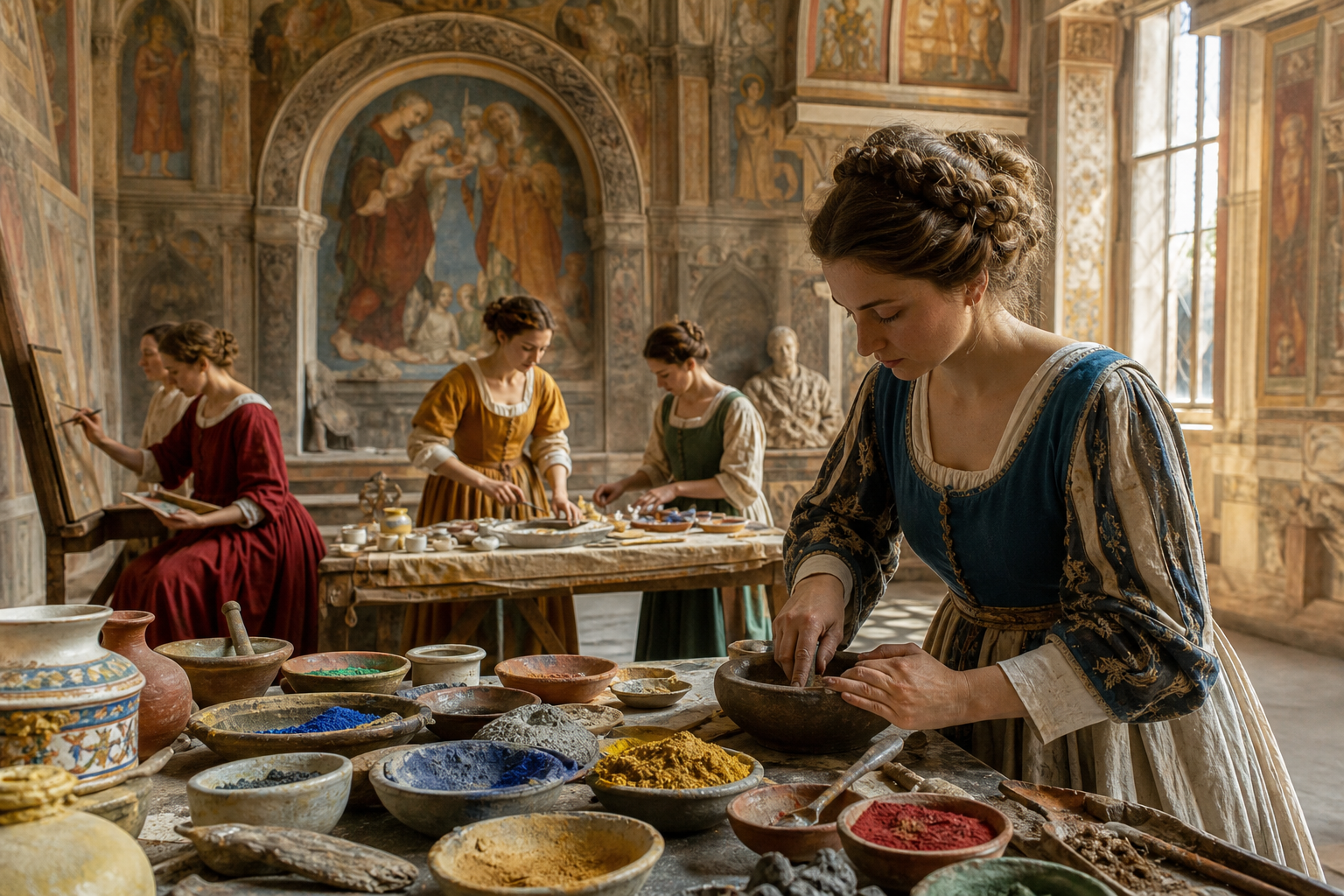
Step into a museum and gaze upon the silent, marble-white statues of Greece and Rome. Their blank eyes and pale forms project an image of a serene, monochrome past. We imagine ancient cities as a wash of stone, earth, and terracotta—a world less vibrant, less saturated than our own. This vision, however, is a grand illusion, a trick of time that has bleached the past of its true, breathtaking dynamism. The ancient world was not quiet and colorless; it was an explosion of brilliant hues, each one laden with profound meaning, sacred power, and social currency. Color was not merely decoration. It was a language, a technology, and a marker of destiny. To wear a certain shade was to declare your status, your devotion, or even your fate. The quest for these colors drove economies, sparked innovation, and sent men to the far reaches of the known world, or deep into the toxic bowels of the earth. From the celestial blue of an Egyptian pharaoh’s tomb to the blood-red face of a triumphant Roman general, color was the thread that connected mortals to gods, life to death, and power to the people who wielded it. This is the story of that lost spectrum, a journey to repaint the ancient world and uncover the secret codes hidden within its most precious pigments. We will explore how the first synthetic color was born on the banks of the Nile, why a single purple robe was worth more than a mansion in Rome, and how a mysterious blue pigment became the color of sacrifice for the Maya. Prepare to see the past not in shades of grey, but in the dazzling, and often dangerous, colors it truly wore.
The Divine Brilliance: White and Gold in Ancient Egypt
In the ancient Egyptian worldview, color was not an abstract property but an essential part of a substance's identity and essence. The pantheon of gods and the journey to the afterlife were deeply entwined with a specific and symbolic palette. Among the most significant of these were white (hedj) and gold (nebu). They were the colors of purity and divinity, light and eternity, representing the two core pillars of Egyptian belief: the sacred order of the present world and the promise of an indestructible afterlife. White, sourced from common minerals like gypsum and chalk, was paradoxically both a humble and a profoundly sacred color. Its primary symbolism was purity, cleanliness, and truth. The priests who served the gods wore robes of pure white linen, signifying their ritual purity. The tools used in sacred ceremonies were often white. Most strikingly, the great pyramids of Giza were not the sandy brown stones we see today; they were originally encased in gleaming, polished white Tura limestone, reflecting the sun's rays with a blinding intensity that must have appeared truly divine, a man-made mountain of pure light. This white represented the sacred and ordered world, a physical manifestation of Ma'at—the fundamental concept of truth, balance, and cosmic order. The "Hedjet," the White Crown of Upper Egypt, was not just a political symbol but a sacred emblem, connecting the pharaoh to the divine origins of his rule.

If white was the color of sacred purity, gold was the color of the gods themselves. It was not merely a precious metal; it was believed to be the very flesh of the deities, eternal and imperishable. Its warm, radiant gleam was inextricably linked to the sun and the supreme sun god, Ra, the ultimate source of all life and power. Gold did not corrode or decay, making it the perfect material to represent the unending nature of the afterlife. This is why it was used so lavishly in funerary contexts. The famous mask of Tutankhamun is not just an artistic masterpiece; it is a theological statement. By covering the pharaoh's face with pure gold, the artisans were magically transforming his mortal flesh into the divine, imperishable flesh of a god, ensuring his rebirth and eternal existence among them. Sarcophagi, divine statues, amulets, and the inner sanctums of temples were all adorned with gold leaf, creating spaces that shimmered with an otherworldly light, a taste of the eternal realm of the gods. The contrast and combination of white and gold created a powerful visual language: the pure, white-robed priest making offerings at a gleaming golden shrine, or the white-clad mummy resting within a golden sarcophagus. Together, they told the story of a journey from the pure, ordered life on Earth to an eternal, deified existence in the hereafter, a radiant path from the light of the sun to the incorruptible flesh of the gods. The Egyptians did not just paint with these colors; they built their entire cosmology out of them.
Did you know? The ancient Egyptian word for gold, "nebu," was geographically linked to the region of Nubia (in modern-day Sudan), which was the primary source of gold for the Egyptian empire.
Egyptian Blue: The World's First Synthetic Pigment
While nature provided ancient civilizations with a rich palette of ochres, charcoals, and chalks, the story of Egyptian Blue marks a pivotal moment in human history: the birth of chemistry in the service of art. Invented around 2,600 BCE during the Old Kingdom, it is widely considered the world's first synthetic pigment. Its creation was not an accident but a feat of deliberate and sophisticated pyrotechnology, a testament to the advanced scientific knowledge of Egyptian artisans. They discovered that by heating a precise mixture of quartz sand (a source of silica), a copper-containing mineral (like malachite), calcium carbonate (lime), and a small amount of an alkali flux (like natron) to temperatures between 800 and 900°C, they could create a beautiful, stable, and vibrant blue crystalline material. This new substance, calcium copper silicate (CaCuSi₄O₁₀), was a color that nature could not easily provide. Lapis lazuli, a deep blue metamorphic rock, was astronomically expensive and had to be imported from the treacherous mountains of what is now Afghanistan. Egyptian Blue, once the formula was perfected, could be manufactured, offering a more accessible—though still valuable—alternative.
Its symbolism was as profound as its chemistry. In the arid landscape of Egypt, blue was the color of life and divinity. It was the color of the life-giving Nile River and the vast, eternal heavens. It represented creation, fertility, and the cosmic ocean from which all life emerged. Consequently, the color was associated with powerful deities of creation and wisdom. Amun, the king of the gods, was often depicted with blue skin, signifying his role as a hidden, cosmic creator. The god Thoth, the divine arbiter and master of knowledge, was also linked to this celestial shade. By creating their own blue, the Egyptians were, in a sense, capturing the divine essence of the universe itself. This manufactured pigment was used extensively across all forms of art and decoration. It adorns the star-covered ceilings of pharaonic tombs, like that of Seti I in the Valley of the Kings, creating an immersive celestial environment for the deceased’s journey. It was used to paint sarcophagi, create intricate faience beads and amulets, and even as a cosmetic. Ground into a fine powder, Egyptian Blue was used as an eyeshadow, allowing its wearer to carry the symbolic power of creation and divinity directly on their body. The color’s legacy is as remarkable as its origin. Its use spread throughout the Mediterranean, adopted by the Greeks and Romans, but the complex formula was eventually lost after the fall of the Roman Empire, and the secret of its creation remained a mystery for over a millennium until it was finally deciphered in the modern era.
The Blood of Emperors: Tyrian Purple and Cinnabar Red in Rome
In the rigid social hierarchy of the Roman Republic and Empire, no color screamed power, wealth, and prestige more loudly than purple. But this was not just any purple; it was purpura, known today as Tyrian purple. Its story is one of astonishing luxury, immense labor, and staggering cost. The source of this legendary dye was not a mineral or a plant, but a humble sea snail, the Bolinus brandaris (formerly Murex brandaris). Phoenician dyers in the city of Tyre had discovered that a tiny gland in the snail secreted a mucous fluid that, when exposed to sunlight and air, transformed through shades of yellow, green, and blue before finally settling into a deep, vibrant, and incredibly lightfast purple. The process was nauseatingly smelly and breathtakingly inefficient. Tens of thousands of rotting snails were required to produce enough dye for the trim of a single garment. It was said that the dye workshops were so pungent they had to be located on the outskirts of cities. This difficulty of production made Tyrian purple more valuable than its weight in gold. A pound of purple-dyed wool could cost more than a year’s wages for a skilled artisan.
Did you know? Egyptian Blue has a unique property: it emits powerful near-infrared radiation when red light is shone on it. This luminescence is so strong that archaeologists can detect traces of the pigment on artifacts where the blue color has long since faded to the naked eye.
This exorbitant cost ensured that it became the ultimate status symbol. During the Republic, high-ranking magistrates and victorious generals wore togas with a Tyrian purple border (toga praetexta). Later, under the Empire, the color became the exclusive domain of the Emperor. To wear a full toga picta of solid purple was to equate oneself with the divine ruler. Sumptuary laws were enacted that strictly forbade its use by lower classes, making it a legally enforced symbol of imperial authority. The color was associated not just with worldly power, but with divinity, a chromatic bridge between the emperor and the gods. Meanwhile, another color, Red, held a different but equally potent meaning. The most prized red pigment was vermilion, derived from the mineral cinnabar (mercury sulfide). This brilliant, blood-red hue was inextricably linked to Mars, the god of war, and to the very concepts of victory, vitality, and life force. Its use was central to one of Rome’s most important rituals: the triumph. A victorious general, granted a triumphal procession through the city, would have his face painted entirely red with vermilion, temporarily embodying the spirit of Jupiter and Mars. This act transformed him from a mere mortal into a living symbol of Rome’s military might. Red was also a popular color for the vibrant frescoes that decorated the homes of the wealthy, particularly in cities like Pompeii and Herculaneum. The famous murals in the Villa of the Mysteries, for instance, use a rich red background to create a dramatic and sacred atmosphere for their depiction of an ancient religious rite. However, this color had a dark side. Cinnabar was highly toxic mercury, and the mines, primarily in Almadén, Spain, were a death sentence for the slaves and criminals condemned to work there. The vibrant red that decorated a general’s face or a villa’s wall was paid for with the lives of countless individuals. Thus, red and purple stood as the twin pillars of Roman power: one the color of imperial authority, extracted from the sea at immense cost, the other the color of life and military victory, wrested from the toxic earth through immense human suffering.

The Painted Lie of Greece and the Sacrificial Hues of Mesoamerica
The whitewashed ruins of the Parthenon and the serene marble forms of classical sculpture have long perpetuated a myth: that the ancient Greeks existed in a world of minimalist aesthetic and pure form. This is a profound historical misunderstanding. In reality, the temples, statues, and public buildings of ancient Greece were riots of color. This practice, known as polychromy (from the Greek for "many colors"), was not an afterthought but an integral part of the art. Scientific analysis has revealed traces of pigments on everything from the Elgin Marbles to the most stoic kouros statues. They were painted with vibrant reds, blues, greens, and yellows, with skin tones, colored hair, and patterned clothing. The clean, white marble we associate with classical beauty is an accident of time, the result of two millennia of wind and rain stripping the original paint away. The Greek palette was, for a time, somewhat limited compared to the Egyptians. They relied heavily on natural earth pigments like red and yellow ochre, carbon for black, and gypsum for white. Egyptian Blue was imported and highly valued. Yet, within this palette, they created dazzling works designed to be lifelike and immediate. This reality challenges us to reconsider the Greek aesthetic entirely. It was not one of cool, detached intellectualism, but one of vibrant, an-almost-gaudy realism.
This conversation about Greek color inevitably leads to the famous Homeric "wine-dark sea." Scholars once debated whether the Greeks were color-blind, as their language lacked a specific word for "blue" and used strange color descriptors. Most modern experts now agree this was not a physiological issue, but a linguistic and cultural one. The Greeks categorized colors differently, often focusing on texture, luminosity, and substance rather than just hue. Glaukos, for example, could describe the light, shimmering quality of the sea, an eye, or a leaf, encompassing modern ideas of blue, green, and grey. Their color world was simply organized differently from ours.
Did you know? It is estimated that it took over 250,000 *Bolinus brandaris* sea snails to produce just one ounce of pure Tyrian purple dye, making it the most expensive dye in the ancient world by a massive margin.

Thousands of miles away, in Mesoamerica, colors held an even more direct and visceral connection to life, death, and sacrifice. For the Maya and Aztec civilizations, two colors stand out: Maya Blue and Cochineal Red. Maya Blue is another of history’s great pigment mysteries. Like Egyptian Blue, it is incredibly durable, resisting centuries of sun and jungle humidity. Its murals, like those at Bonampak, remain astonishingly vibrant. For decades, its composition was unknown. It is now understood to be a unique molecular combination of organic indigo dye derived from the leaves of the Indigofera plant, which is chemically bonded with a special type of clay called palygorskite. This ingenious process created a stable, non-fading pigment that was central to their cosmology. Maya Blue was the color of sacred ritual. It was the color of Chaak, the rain god. It was used to paint temple walls, pottery, and, most chillingly, the bodies of human sacrificial victims before their hearts were offered to the gods. The color was a direct link to the divine, sanctifying the ritual and the victim. Just as vital was red, sourced not from toxic minerals, but from the tiny cochineal insect. These insects live on prickly pear cacti, and when crushed, the females produce a powerful carminic acid, yielding a deep and beautiful crimson. Cochineal was a major commodity in the Aztec empire, demanded as tribute from conquered peoples. It represented blood, the most sacred substance, and therefore life, vitality, and authority. It was used to dye the cloaks of rulers and elite warriors, to color manuscripts, and for ritual body painting. For the cultures of Mesoamerica, color was not an imitation of the world; it was an active ingredient in the sacred chemistry of their universe.
The Shades of Authority and Nature in the Far East
In Imperial China, the symbolic power of color was codified and controlled with a rigor unmatched by almost any other civilization. The palette was not just symbolic; it was political. At the very heart of this system was the color yellow. According to the Five Elements or Phases theory (Wuxing), which organized all of cosmic and human phenomena, yellow was the color of the Center, representing the element of Earth. As China saw itself as the "Middle Kingdom"—the center of the civilized world—the Emperor, the "Son of Heaven," became inextricably linked to this central color. During the Sui, Tang, and particularly the Ming and Qing dynasties, Imperial Yellow (huángsè) became the exclusive color of the Emperor. It was a hue reserved for his robes, his personal belongings, and even the architecture of his home. The famous tiled roofs of the Forbidden City in Beijing are a sea of Imperial Yellow, a constant, glowing reminder to all who saw it of the Emperor’s supreme and divinely sanctioned authority. The color was so strictly regulated that, during certain periods, its private use by anyone else was a crime punishable by death. This connection was also rooted in mythology, with the "Yellow Emperor" (Huangdi) being a legendary sovereign and cultural ancestor of all Han Chinese. The Yellow River, or Huang He, was similarly seen as the cradle of Chinese civilization. Therefore, to wear yellow was to wear the color of the earth, the center of the universe, and the very foundation of the empire.
Just as stone can be a color, in China, jade was a color and so much more. The greenish-white luster of jade (yù) was prized above gold or silver. It was more than a beautiful material; it was the embodiment of the highest virtues. Confucius and his followers associated jade with purity, wisdom, justice, compassion, and courage. Its hardness symbolized intelligence, its smoothness represented benevolence, and its translucence was a metaphor for loyalty. It was cool to the touch, linking it to calm and composure. Carving the incredibly hard stone required immense skill and patience, and this difficulty further added to its value and the virtues it represented. Jade was used for ritual objects, like the bi discs that symbolized heaven, and personal seals of authority. Most famously, it was used in burial practices for the elite. Some Han dynasty royals, like Prince Liu Sheng and his wife Dou Wan, were famously interred in entire suits made of thousands of small jade plaques sewn together with gold thread. The belief was that the stone’s incorruptible nature would prevent the body from decaying, granting the deceased a form of physical immortality. Jade was not just a symbol of virtue; it was a technology for achieving eternal life.
Did you know? The Greek word for color, *chroma* (χρῶμα), originally meant the surface or skin of an object, emphasizing the ancient view of color as an integral part of a thing’s substance, not just an abstract visual property.
Beyond the natural symbolism of yellow and jade, ancient Chinese alchemists also produced their own synthetic wonders. Parallel to the story of Egyptian Blue, Chinese artisans independently created a series of unique purple pigments around the time of the Qin and Han Dynasties (c. 221 BC – 220 AD). Now known as Han Purple and Han Blue, these were barium copper silicate pigments. Their invention, lost for centuries, demonstrates an incredible level of chemical knowledge. The most famous application of these pigments was on the Terracotta Army, the legion of life-sized soldiers built to guard the tomb of the First Qin Emperor. While today they appear as grey clay, they were originally painted in dazzling colors, including significant amounts of Han Purple on trousers and ribbons. This synthetic purple suggests it was a highly valued color, perhaps an attempt to create a more accessible alternative to expensive natural dyes, much like Egyptian blue. It stands as a testament to a forgotten chapter of Qin and Han scientific innovation.

Conclusion: Repainting the Past
The journey through the palette of the ancient world reveals a truth far more vivid and complex than the muted tones of weathered ruins suggest. We have seen that for the Egyptians, color was a tool for deification, transforming mortal flesh into the eternal gold of the gods and bottling the blue of creation itself. For the Romans, specific hues were a public declaration of power so potent they were regulated by law, with the imperial purple of an emperor’s robe representing a value greater than gold, and the triumphal red on a general’s face signifying divine favor in victory. In Greece, we have unmasked the great "white lie" of classicism, rediscovering the brightly painted, polychrome world that was intentionally hidden by time and misunderstanding. In the Americas, colors like Maya Blue and Cochineal Red were not just pigments but active ingredients in the most sacred and terrifying rituals, the very medium of communication with the gods. And in Imperial China, the spectrum was an instrument of state control, where the color yellow became the ultimate symbol of centralized power. What this history of color shows us is that the ancient mindset was fundamentally different from our own. Color was not a superficial choice; it was imbued with essence, power, and meaning. The search for these colors drove technological innovation, established global trade routes, and defined social hierarchies. To understand the past, we must learn to see it through ancient eyes, to recognize the language they spoke not just in words, but in the brilliant, meaningful, and now often vanished colors they used to paint their world. The silent stones of antiquity are not telling the whole story. They are a blank canvas, waiting for us to restore the lost spectrum and, in doing so, to finally appreciate the true and dazzling vibrancy of human history. word_count=2810, reading_time=14) Chopra```json_response = { "title": "The Lost Spectrum: Uncovering the Secret Meanings of Ancient Colors", "meta_description": "Journey into a world where color was power. Discover the secrets of Tyrian purple, Egyptian blue, and cinnabar red, and learn how ancient civilizations used them.", "slug": "en-art-and-symbolism-meaning-of-ancient-colors", "keywords": [ "ancient colors meaning", "symbolism of color history", "Tyrian purple", "Egyptian blue", "ancient pigments" ], "content": " Step into a museum and gaze upon the silent, marble-white statues of Greece and Rome. Their blank eyes and pale forms project an image of a serene, monochrome past. We imagine ancient cities as a wash of stone, earth, and terracotta—a world less vibrant, less saturated than our own. This vision, however, is a grand illusion, a trick of time that has bleached the past of its true, breathtaking dynamism. The ancient world was not quiet and colorless; it was an explosion of brilliant hues, each one laden with profound meaning, sacred power, and social currency. Color was not merely decoration. It was a language, a technology, and a marker of destiny. To wear a certain shade was to declare your status, your devotion, or even your fate. The quest for these colors drove economies, sparked innovation, and sent men to the far reaches of the known world, or deep into the toxic bowels of the earth. From the celestial blue of an Egyptian pharaoh’s tomb to the blood-red face of a triumphant Roman general, color was the thread that connected mortals to gods, life to death, and power to the people who wielded it. This is the story of that lost spectrum, a journey to repaint the ancient world and uncover the secret codes hidden within its most precious pigments. We will explore how the first synthetic color was born on the banks of the Nile, why a single purple robe was worth more than a mansion in Rome, and how a mysterious blue pigment became the color of sacrifice for the Maya. Prepare to see the past not in shades of grey, but in the dazzling, and often dangerous, colors it truly wore.
The Divine Brilliance: White and Gold in Ancient Egypt
In the ancient Egyptian worldview, color was not an abstract property but an essential part of a substance
Did you know? In a discovery that bridges ancient history and modern physics, scientists found that Han Purple has bizarre quantum properties. When exposed to extreme cold and a high magnetic field, the magnetic waves within the pigment’s structure "lose" a dimension, collapsing from 3D into 2D.
How we verify this article
By the History Unlocked editorial team
This text is built on historical facts stored in our database and drafted with AI assistance. No signed human review is recorded for this article. Report any inaccuracy: we correct it and update the modified date.
Updated on
AI-assisted drafting.
Read our editorial standardsEnjoyed this? Discover more articles in the category Art & Symbolism