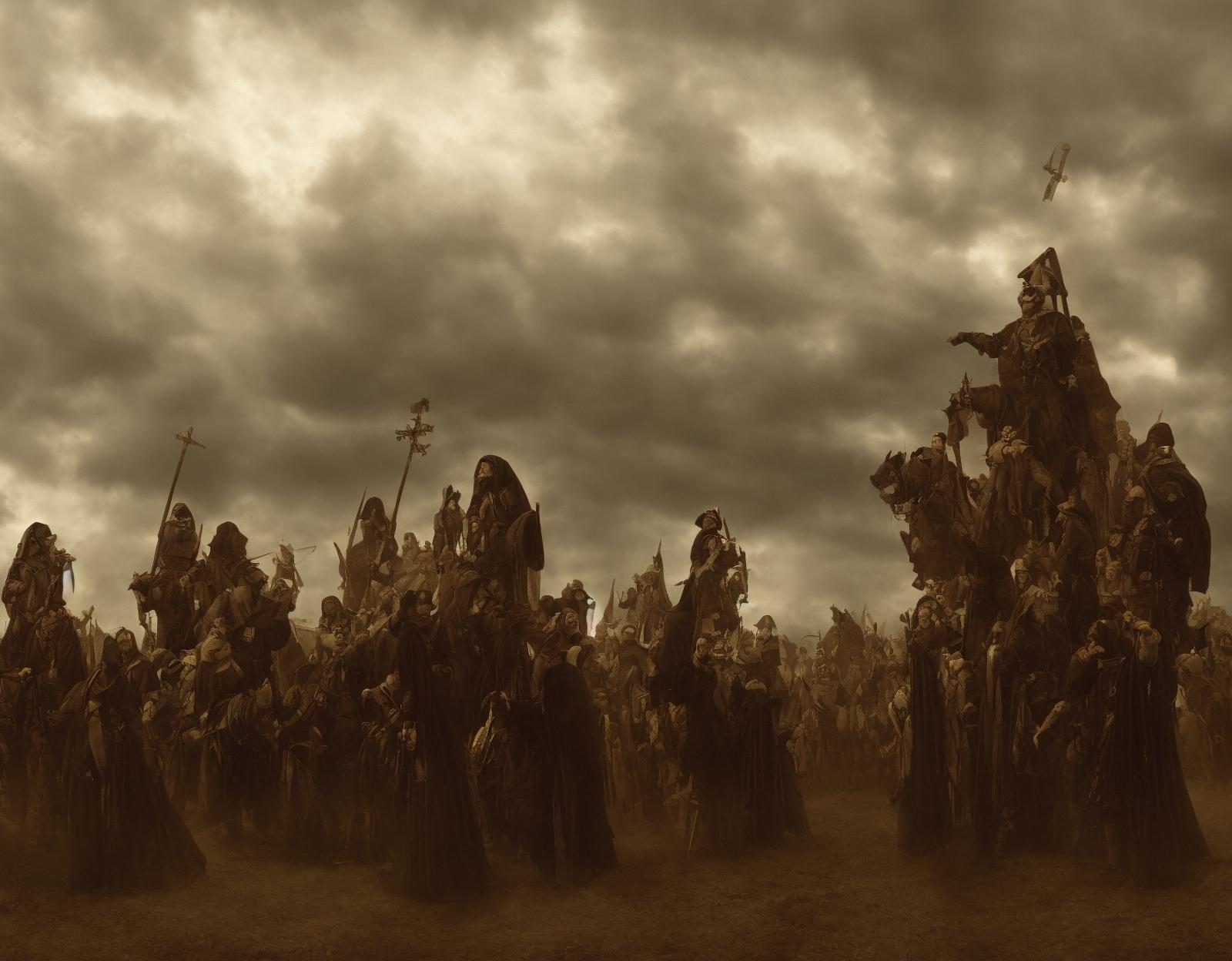
Shadows of the Black Cross: The Teutonic Order's Rise and Fall
In the heat and shadow of the Third Crusade, amid the dust of sieges and the clamor of hospitals, a German hospital brotherhood took shape that would reshape the map of northeastern Europe. The Teutonic Order—formally the Order of Brothers of the German House of Saint Mary in Jerusalem—was born of charity and necessity, an institution that folded the contradictions of monastic piety and militarized zeal into one austere identity. From its beginnings tending the sick in Acre to its later emergence as a sovereign territorial power in the Baltic, the order cultivated myth and discipline in equal measure. The narrative of the Teutonic Knights reads like an epic: piety turned into conquest, crusading zeal translated into colonization, and a monastery that became a medieval state.
There is an almost cinematic progression in the Order's story: humble origins, papal sanction, martial transformation, territorial greed, architectural grandeur, catastrophic defeat, and eventual metamorphosis. Yet beneath the broad strokes lie subtler truths—diplomatic cunning, legal innovation, and cultural integration—that historians still debate. The Order’s castles intercepted trade routes and anchored German law and settlement across pagan lands; their clerical ranks administered hospitals and courts, while knights fought in plate and chain for causes that shifted from Jerusalem to Prussia and Livonia. In the hush of vaulted halls and along crenelated walls, the Order wrote a paradoxical history of sanctity and sovereignty.
This article follows the Teutonic brothers across the centuries: how they emerged in the Levant, were invited into the Polish sphere to combat pagan tribes, built a state that fused monastic rule with princely authority, and ultimately encountered forces that would break their regional hegemony. Through archival evidence, contemporary chronicles, architectural remains, and modern scholarship, we will narrate not just the military campaigns but the administrative systems, economic foundations, cultural imprint, and the mysteries—both strategic and moral—that defined the Order. Expect the familiar milestones—Hermann von Salza’s diplomacy, the conversion of the Sword-Brothers, the sieges and castles, Grunwald’s bloody reckoning, and the secularization in 1525—but also lesser-told details about recruitment, daily monastic routine, legal instruments like Kulm law, and the Order’s long afterlife in memory and heritage. The Teutonic Order’s legacy is not merely a chronicle of conquest; it is a story of identity-making, of how religious institutions can become dynastic states and how symbols—like the black cross on white surcoat—outlived the very polity that adopted them.
Did you know? The Teutonic Order’s founding hospital in Acre originally served German-speaking pilgrims and was distinct from the more international hospitals of the Hospitallers.
Origins and Early Years in the Holy Land
The Teutonic Order’s beginnings are rooted in the exigencies of crusader society in the Levant. Around 1190, during the siege of Acre, a group of German merchants and pilgrims established a hospital to care for sick and wounded German-speaking Crusaders. This charitable brotherhood was organized under the patronage of Saint Mary and initially served as a hospice operated by German-speaking brethren, distinct from the larger and older Hospitaller and Templar orders. The exact moment the hospital transformed into a military order is gradual rather than instantaneous: the brothers adopted martial responsibilities as the crusading situation demanded and received increasing privileges from local and papal authorities that allowed them to bear arms and possess property.
The Order's formal institutionalization occurred in the closing years of the 12th century and early 13th century, as papal and imperial support crystallized. Their Latin name, Ordo Domus Sanctae Mariae Theutonicorum, reflects the duality of their vocation—both hospitaller and German. While many medieval narratives emphasize dramatic turning points, the Teutonic Order’s metamorphosis into a military-monastic community was an administrative and spiritual evolution: rules were drawn up that combined the Augustinian-inspired canonical discipline with a militant ethos. Membership consisted of knights (usually of noble birth), chaplains, sergeants, and lay brothers—each class with defined duties, privileges, and obligations. The Grand Master emerged as the order's head, elected by a chapter and responsible for both spiritual leadership and temporal governance.
Hermann von Salza’s elevation to Grand Master in the early 13th century exemplified the Order’s growth from a narrow hospice to a powerbroker in international politics. Salza cultivated ties with the Holy Roman Emperor and the papacy alike, securing privileges and territorial grants that would alter the Order’s trajectory. The brothers acquired properties across Europe, not merely to fund missions in the Levant but to create a cross-continental resource network. Their early period included participation in campaigns within the Holy Land, but it was the shifting geopolitics of the early 13th century—decline of Crusader fortunes and new opportunities in northeastern Europe—that set the stage for their most consequential transformation.
Did you know? The Teutonic Knights applied Kulm law to many newly founded towns—a German-derived municipal code that encouraged settlers by promising rights and self-governance.

In these formative decades, the Order’s identity remained deliberately Germanic—its statutes and recruitment catered to German knights and patrons. Yet it projected a universal Christian mission; this ambivalence—national in composition, universal in ideology—was a recurring theme. The brothers’ early reliance on donations, bequests, and papal exemptions allowed rapid accumulation of wealth and property. Those assets would later finance fleets, garrisons, and the massive brick castles that characterized the Order’s dominion in the Baltic. It was in the Levant that the Teutonic Order learned the institutional arts of diplomacy, papal negotiation, and the disciplined military-religious life that would suit them well in more northerly theaters.
Invitation to the Baltic and the Prussian Crusade
The decisive pivot of the Teutonic Order’s history came in northeastern Europe: specifically, when Polish dukes enlisted the Order to aid in the Christianization and pacification of pagan tribes. In 1226 Duke Conrad of Masovia, beset by raids from the pagan Prussian tribes and unable to subdue them alone, sought a military-religious partner. He invited the Teutonic Knights to settle on the borderlands, a decision that had profound consequences. In accepting Conrad’s invitation, the Order was granted the right to wage a campaign of conquest and consolidation in Prussian lands, but crucially they secured considerable autonomy: legal and territorial privileges that enabled them to act with quasi-sovereign authority.
Once established in the Baltic, the Teutonic Knights embarked upon a program of conquest and colonization that fused crusading rhetoric with a rigorous administrative approach. They pursued military campaigns against the Prussians and later against Livonian, Lithuanian, and other Baltic pagan groups. These campaigns were not merely episodic raiding; they aimed to dismantle polity structures, build garrisons, and implant German settlers under municipal laws (notably Kulm law, which governed town administration and attracted merchants and artisans). The order’s strategy combined force with careful legal and urban development: castles protected territories; towns under German municipal law fostered economic activity and demographic change.
Did you know? The Teutonic Order’s emblem—a black cross on a white field—became a powerful symbol of identity and was emblazoned on surcoats, banners, and seals.
The Order’s success in the Baltic also derived from political maneuvering. Papal crusading bulls legitimized their actions as part of a broader holy war, while alliances with certain local Christian rulers helped consolidate gains. Yet this expansion was far from linear; resistance was persistent. Major uprisings and campaigns—protracted sieges, scorched-earth tactics, and shifting alliances—marked the centuries-long Prussian Crusade. The Teutonic state became a fortress-network, designed to project power across forests and marshes that had stymied earlier invaders.

One watershed moment in the Baltic theater was the absorption of the Livonian Brothers of the Sword, a smaller military order devastated at the Battle of Saule in 1236. After their defeat, remnants of the Sword-Brothers integrated into the Teutonic Order (1237), extending the Order’s reach to Livonia and consolidating a northern front that would prove central to its medieval identity. Over the 13th and early 14th centuries the Teutonic state expanded through conquest and colonization to include vast territories along the southeastern Baltic coast, establishing towns such as Königsberg (founded 1255) and seizing critical ports that enhanced trade and strategic depth. The military campaigns, town-building, and legal transplantation across these regions created a durable, if contested, state apparatus.
Governance, Monastic Life, and Military Organization
The Teutonic Order’s governance blended monastic institutions with the trappings of statecraft. At the apex stood the Grand Master, elected by a chapter composed of high-ranking officials—bailiffs, commanders, and provincial masters. The Grand Master’s authority combined spiritual leadership with secular rule: he issued ordinances, directed military campaigns, managed estates, and represented the Order in diplomatic forums. Below him, the administrative hierarchy fractured the territory into bailiwicks and commanderies, each centered on castles that functioned as military, judicial, and economic nodes. Chapters convened regularly, and the Order maintained a code of statutes that regulated everything from attire to judicial process.
Did you know? Malbork Castle served as the Teutonic Order’s headquarters after the early 14th century and became a symbol of their administrative and military power.
Monastic life for a Teutonic brother meant strict observance of religious duties—daily prayers, liturgical cycles, and vows akin to those of other military orders. Yet the Order’s monasticism was pragmatic: knights swore obedience and poverty in ways that accommodated the necessities of warfare and rulership. The Order’s clerical arm—priests, chaplains, and monastic officials—sustained sacramental life and managed hospitals and almsgiving. A distinct cadre of mercenary sergeants and lay administrators carried out manual labor and logistical tasks, enabling a social division of labor that sustained castles, workshops, and agricultural estates.
Militarily, the Teutonic Knights were professional warriors. The knightly class wore the order’s emblem—black cross on white surcoat—and fought in close formation with heavily armored cavalry supported by infantry and siege engineers. Castles were not mere symbols but sophisticated military complexes designed for defense and logistical projection. Supply chains, riverway control, and the ability to field sizeable cavalry units distinguished the Order in northern warfare. Their military efficacy was enhanced by recruitment of nobles from the Holy Roman Empire and by imposing feudal obligations on vassals within their lordship.

Yet governance brought contradictions. The Order had to reconcile its monastic vows with princely obligations, to administer justice while also extracting resources for war. Its fiscal base relied on rents, tolls, urban taxes, and sometimes coinage. The administration experimented with legal innovations: promulgating internal statutes to regulate conduct, instituting court systems within commanderies, and adopting municipal laws to attract settlers. Diplomacy, too, was vital: treating with princes, the papacy, and even the Mongol khans when needed. The Grand Masters—politicians as much as spiritual leaders—navigated shifting alliances, balancing autonomy against suzerainty claims by Poland, the Holy Roman Empire, and the papacy.
Did you know? The Battle of Grunwald (1410) is commemorated in paintings and national memory; the name Tannenberg, adopted later by Germans, ironically references a medieval order defeated by Slavic-Lithuanian forces.
Architecture, Economics, and Cultural Impact
The Order’s imprint on the physical and economic landscape of northeastern Europe remains perhaps its most visible legacy. Massive brick castles—Marienburg (Malbork), Königsberg’s early fortifications, and numerous coastal and inland fortresses—are testament to an architectural program that fused defensive necessity with symbolic dominance. Malbork Castle, constructed in phases from the 13th century onward, stands as the largest brick castle in Europe and a center of administration and ceremonial life. Such complexes housed chapels, armories, granaries, and administrative offices; they served as centers of craft production and hubs for regional markets.
Economically, the Teutonic state integrated agricultural innovation, craft production, and long-distance trade. The Order facilitated the settlement of German and other colonists, bringing new agrarian techniques and legal forms that stimulated productivity. Control of key ports allowed participation in Baltic trade networks—grain, timber, amber, and furs flowed through towns under the Order’s auspices and into the Hanseatic League’s arteries. Indeed, the interface between the Teutonic polity and the Hanseatic cities created both cooperation and friction, as economic interests could align or clash depending on tariffs, privileges, and geopolitical shifts.
Culturally, the Order implanted Western ecclesiastical structures, Latin literacy, and Romanesque-Gothic architectural forms in regions that had been pagan or organized under different social norms. Churches, hospitals, and monasteries provided loci for religious life and education. The imposition of German municipal law and settlement patterns contributed to a demographic transformation often described as Ostsiedlung—the eastward migration of German settlers during the High Middle Ages. This process produced lasting linguistic, social, and legal footprints that would influence regionally distinct identities for centuries.
Did you know? The secularization of the Teutonic state in 1525 directly facilitated the rise of the Duchy of Prussia, later crucial to the formation of the Kingdom of Prussia.
The Order’s patronage of the arts was pragmatic and devotional: illuminated manuscripts, liturgical objects, and architectural embellishments reflected both piety and prestige. Yet the cultural consequences were ambivalent: while towns prospered and material culture advanced, native populations often experienced dispossession, forced baptism, and cultural displacement. The legacy of the Order’s colonizing project is thus contested—simultaneously a driver of economic development and a vector of cultural domination.
Crises, Grunwald, and the Turning Point
By the late 14th and early 15th centuries, the Teutonic Order faced mounting challenges. Its territorial expansion had produced a powerful monastic state, but that power provoked rivals and fostered internal strains. Conflicts with neighboring Poland and Lithuania intensified as the Polish crown consolidated power and the Grand Duchy of Lithuania converted to Christianity under Polish influence through the Union of Krewo (1385) and the subsequent Christianization of Lithuania (late 14th century). The rise of a Polish-Lithuanian alliance presented a formidable counterweight to Teutonic ambitions.
The conflicts culminated in the Battle of Grunwald (Tannenberg) on 15 July 1410, one of the largest battles of medieval Europe. The allied forces of King Władysław II Jagiełło of Poland and Grand Duke Vytautas of Lithuania decisively defeated the Teutonic army. Grand Master Ulrich von Jungingen fell in the battle, and the Order suffered catastrophic losses in knights and leadership. While the Order’s fortress at Marienburg withstood subsequent sieges, the defeat at Grunwald marked a psychological and military turning point: not immediate collapse but the end of unchallenged dominance.
Did you know? Malbork Castle is a UNESCO World Heritage Site and one of the largest brick fortresses in Europe, reflecting the Order’s monumental building program.
The aftermath catalyzed diplomatic and military recalibration: the Peace of Thorn (1411) brought limited territorial changes but significant financial indemnities. The Order entered a period of internal reform attempts and external pressure. The War of the Cities and later conflicts exposed weaknesses in sustaining a costly multinational knightly force. Financial distress, revolts among native populations and towns, and the growing power of regional states eroded the monastic state’s structure. By the mid-15th century the Order’s position had weakened to the point where the Second Peace of Thorn (1466) fundamentally altered its sovereignty: western Prussian territories were ceded to the Polish crown, and the remaining Teutonic lands became a Polish fief, reducing the Order’s independence.

The long-term consequences were profound. The Order transitioned from a major territorial sovereign to a polity constrained by vassalage and diplomatic subordination. Financial burdens from war indemnities and the costs of maintaining castles and garrisons curtailed its autonomy. These pressures set the stage for the most radical transformation in its history: secularization.
Secularization, Reformation, and the Order’s Later Life
The early modern era brought ideological and political ruptures that the medieval monastic-military model could not easily accommodate. The Protestant Reformation transformed religious landscapes across northern Europe and presented both ideological and practical challenges to monastic institutions reliant on Catholic legitimacy. In 1525, the grand master Albert of Brandenburg-Ansbach (Albrecht von Brandenburg-Ansbach), facing dynastic pressures and the untenable position of a monastic state weakened by war and indebtedness, chose a path of conversion and secularization: he resigned the monastic mantle, embraced Lutheranism, and transformed the remaining Teutonic territories into the Duchy of Prussia, becoming its hereditary duke and accepting vassalage to the King of Poland.
Did you know? After 1525 the Teutonic Order continued as a Catholic order within the Holy Roman Empire, surviving in reduced form and shifting its headquarters over time.
This act of secularization—the Prussian Homage—was revolutionary: a crusading monastic state became a dynastic duchy and embraced Protestant identity. The Order’s political sovereignty in Prussia thus vanished, but the institution itself did not entirely disappear. The Teutonic Order continued to exist as a Catholic religious order within the Holy Roman Empire, retaining holdings and a diminished role. It survived in altered form as an ecclesiastical body with charitable and religious functions, based later in Austrian lands and maintaining a small presence into modern times.
The folded fate of the Teutonic State contributed to the rise of new powers. The Hohenzollern dynasty, which acquired the Duchy of Prussia and later united it with Brandenburg, used its Prussian inheritance as a stepping stone toward the creation of the Kingdom of Prussia and, eventually, the German Empire. Thus, the Order’s medieval conquests—once a symbol of religious and military zeal—became the territorial nucleus around which early modern state-building would occur. In cultural memory, the Order was alternately vilified as an instrument of Germanic colonization and celebrated as an engine of statecraft and Christianization, depending on later nationalist narratives.
The Teutonic Order’s later centuries were ones of reinvention. While stripped of its medieval territorial sovereignty, the order adapted to new roles—charitable, religious, and symbolic—preserving archives, heraldry, and a memory that influenced historiography. In Catholic lands the Teutonic brotherhood preserved liturgical traditions and maintained properties; in Protestant realms the memories of their castles and campaigns were reinterpreted through new political lenses. Modern historians view the Order with a mix of perspectives: as a crusading phenomenon, a colonizing agent, a medieval state-builder, and a cultural conduit. The surviving castle complexes—ruined or restored—function as museums that invite reflection on the contested legacies of conquest and conversion.
Did you know? The Grand Masters of the Teutonic Order were both spiritual leaders and sovereign princes, a hybrid role that complicated relations with kings and popes.
Conclusion: Legacy, Memory, and the Shadows of the Black Cross
The Teutonic Order’s arc—hospitality in the Levant to sovereign statehood in the Baltic, from victorious expansion to humiliating defeat, and finally to reinvention and legacy—reads like a parable about the transformation of religious institutions into political powers. Its black cross remains emblematic: a symbol that once signified a militant piety now hangs in museums, on preserved seals, and in the emblems of later military and civic imaginations. The organization’s achievements were real—administrative innovation, urban foundations, and a lasting architectural legacy—but so too were its violences: forced baptisms, dispossession, and the long-term displacement of native cultures. The moral complexity of the Order resists simple categorization.
Historically, the Teutonic Knights illuminate several larger medieval dynamics: the elasticity of crusading ideology, the capacity for religious orders to wield territorial sovereignty, and the interplay between military force and legal-administrative institution-building. They were architects of a region’s medieval transformation: building towns, codifying law, and shaping trade. Yet their story also demonstrates how military orders could be brittle, their power vulnerable to coalitions of emerging medieval states and changing religious climates.
In present-day Poland, Lithuania, Russia (Kaliningrad), and Germany, echoes of the Order appear in language, archaeology, and civic memory. Malbork Castle, a UNESCO World Heritage site, invites more mundane questions—how do we preserve such monuments?—and deeper ones about the narratives told within their walls. The Teutonic Order’s narrative still provokes passions: scholars dispute motives and methods; nationalists and revisionists mine the past for modern claims. Yet carefully read, the Order’s history offers an object lesson in complexity: a community that began with a hospital bed and a vow of aid transformed into a crucible of state formation and conflict.
Did you know? The Order’s absorption of the Livonian Brothers of the Sword in 1237 followed the Sword-Brothers’ defeat at the Battle of Saule (1236), extending Teutonic influence in Livonia.
In the final reckoning, the Teutonic Order is neither simple villain nor unalloyed hero. It is a historical actor whose institutions, architecture, and legal innovations shaped a large portion of medieval northeastern Europe. Its rise and fall underscore how religious motivations can be repurposed into instruments of territorial rule and how states—no matter how pious—must reckon with finance, diplomacy, military limits, and the currents of cultural change. To trace the Order’s trajectory is to confront the entwined shadows of sanctity and sovereignty, an enduring tale of medieval ambition that still resonates amid the stone and brick of the Baltic shores.
How we verify this article
By the History Unlocked editorial team
This text is built on historical facts stored in our database and drafted with AI assistance. No signed human review is recorded for this article. Report any inaccuracy: we correct it and update the modified date.
Updated on
AI-assisted drafting.
Read our editorial standardsEnjoyed this? Discover more articles in the category Knights Templar