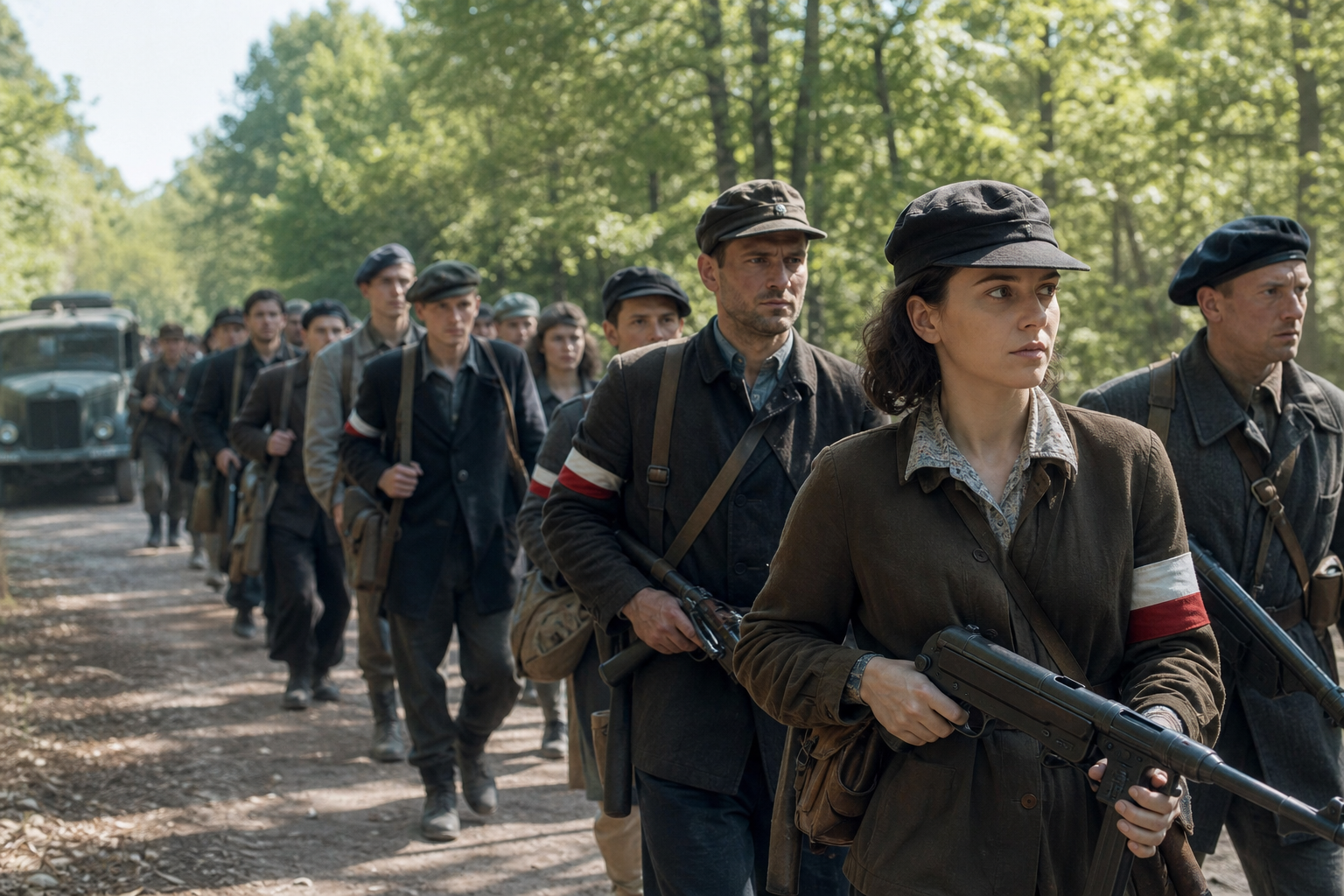
Shadows of Resistance: Partisans in Europe During WWII
The forests, mountains and ruined towns of wartime Europe were more than a backdrop: they were a theatre in which ordinary people became clandestine soldiers, agents of sabotage, and keepers of secret networks. In the fog of occupation, where borders blurred and official armies were crushed or co-opted, partisan groups rose like ghosts—improvised, local, and often contradictory. This article tracks those ghosts, from the forests of Belarus to the mountains of Yugoslavia, from the hidden cells of Paris to the ruined streets of Warsaw, with a narrative that seeks the human face of resistance as well as the shadowy strategies that defined it.
Partisans were not a single uniform movement. They ranged from disciplined, centrally commanded forces to scattered bands of villagers with muskets; from communist-led guerrillas pursuing both liberation and revolution, to conservative home-armies intent on restoring prewar order. They were supported to varying degrees by the Allies—through supplies, radios, and the daring insertion of special operatives—and they were hunted by brutal counterinsurgency campaigns that often punished civilians. The interplay of courage, betrayal, ideological conflict, and sheer survival created episodes of profound heroism and profound tragedy.
This introduction sketches the panorama. In the sections that follow I will examine major theaters of partisan activity: Tito’s Yugoslav Partisans, the French Maquis and the SOE-trained networks, Soviet and Eastern European partisan warfare, the Italian Resistance that helped topple Mussolini’s regime, and the tactics and moral ambiguities that defined guerrilla conflict. Each section blends strategic description with personal stories, documented operations, and the cold consequences of reprisal. Along the way, curious anecdotes—sometimes almost too strange to be true—will appear as flashes of human detail.
Did you know? The Special Operations Executive (SOE), created by Winston Churchill in 1940, had the covert motto "Set Europe Ablaze," reflecting early British intent to foment resistance behind German lines.
The reader should be prepared for complexity. Resistance was never purely heroic in the neat way history textbooks sometimes portray it: collaboration, internecine rivalry, and the heavy-handed responses of occupying powers made partisan warfare a crucible that forged new nations and also left raw wounds. Yet it is precisely from that crucible that some of Europe’s postwar political maps, legends, and scars emerged. Our exploration will keep a steady eye on verifiable events, dates and documented operations, while allowing the narrative tone to wander into the mystery and drama that surrounded partisan life in wartime Europe.
Origins and Contexts of Partisan Warfare in Europe
Partisan warfare in Europe during World War II arose from a confluence of military collapse, ideological ferment, and the geography of occupation. The German invasions, beginning with Poland in 1939 and exploding with Operation Barbarossa in June 1941, created vast territories where regular armies were absent and occupying forces were thinly stretched. In those gaps, local resistance could organize. In countries like Yugoslavia, Greece, and the Soviet Union, where rugged terrain and deep social networks existed, the conditions for guerrilla warfare were especially favorable.
The phenomenon had precedents: guerrilla resistance had been a feature of European warfare in the Peninsular War against Napoleon and again in World War I. But WWII’s partisan movements were distinct for their scale and for the ideological components embedded in many groups. Communist parties, often well-established before the war, were quick to mobilize clandestine cells and often had cadres experienced in underground activity. In Eastern Europe, Soviet-directed partisan centers coordinated sabotage against German supply lines, while in Western Europe clandestine groups coalesced around nationalists, monarchists, communists, and apolitical patriots alike.
Did you know? Josip Broz Tito maintained a shadowy network of encampments in the Bosnian and Dinaric mountain regions, often moving his headquarters to avoid Luftwaffe reconnaissance and German anti-partisan sweeps.
Geography shaped strategy. Dense forests of Belarus and the Dinaric Alps of Yugoslavia allowed partisans to establish semi-permanent bases. Urban areas favored sabotage, assassinations, and clandestine intelligence gathering. The Maquis in France preferred rural mountain hideouts, such as the Vercors Plateau, which offered natural defensive positions. Weather and seasons were also decisive: deep winter could isolate a band for months, while spring thaw left roads impassable and German motorized units less effective.
The occupying powers developed specific counterinsurgency doctrines. German anti-partisan warfare evolved from punitive reprisals to organized counter-guerrilla operations, often employing local collaborators and ruthless scorched-earth tactics. Reprisals against civilian populations were a deliberate policy: the destruction of Lidice in 1942 after the assassination of Reinhard Heydrich, for example, signaled that Nazi occupiers would strike civilians to deter resistance. In France and Italy similar reprisals took place—Oradour-sur-Glane in June 1944 and Sant'Anna di Stazzema in August 1944—tragic episodes reflecting how occupation policy fused security and terror.
Allied strategy toward partisans was pragmatic and evolved with the war’s progress. Britain’s Special Operations Executive (SOE) was founded in 1940 to "set Europe ablaze" by supporting clandestine movements; it supplied arms, training, and agents to multiple resistance groups. The United States’ Office of Strategic Services (OSS) undertook similar missions later in the war. The level of support often depended on strategic priorities: after the Allied landings in North Africa and Italy, and especially after D-Day, supplies to Western European resistance groups increased to sabotage German troop movements and logistics ahead of advancing Allied armies.
Did you know? Jean Moulin, the principal unifier of French resistance groups, was captured in June 1943 after a betrayal and died under torture in a German prison—his death became a symbol of resistance sacrifice.
Partisan leadership variety was another defining feature. Some groups, like the Yugoslav Partisans under Josip Broz Tito, grew into regular armies with political wings and centralized command. Others remained local and fragmentary. The Polish Home Army (Armia Krajowa) conducted coordinated operations aiming to assert Polish sovereignty and to prepare for postwar governance, a motive that later created lethal friction with Soviet-backed groups. These political aims shaped tactics, targets, and the postwar fate of combatants.

Tito’s Yugoslav Partisans: From Guerrilla Bands to a Red Army in Waiting
Few partisan movements in Europe demonstrated the transition from clandestine guerrillas to a quasi-state military machine as completely as the Yugoslav Partisans. Led by Josip Broz Tito, the movement began in the chaotic early months following the Axis invasion of Yugoslavia in April 1941. Initially the resistance was fragmented—local and irregular—but the Communist Party of Yugoslavia quickly provided ideological discipline and organizational structures that helped unify disparate bands into a cohesive force known as the People’s Liberation Army and Partisan Detachments of Yugoslavia.
By exploiting the rugged karst landscapes, the Partisans conducted hit-and-run attacks against Axis garrisons and supply convoys, while simultaneously building political organs—people’s committees—that administered liberated territories. Their ability to hold and govern territory distinguished them from many other resistance groups. By 1943 and 1944 the Partisans organized large brigades and even corps-level formations, which could engage in set-piece battles as well as guerrilla actions. This evolution was facilitated in part by shifting Allied support: the Allies initially favored the royalist Chetniks under Draža Mihailović, but intelligence reports and Allied missions increasingly concluded that the Chetniks were collaborating with Axis forces against communists and focusing on preserving their own strength.
Did you know? The Warsaw Uprising of 1944 lasted 63 days, during which the Home Army attempted to liberate the city before Soviet arrival; the Red Army’s pause remains a subject of historian debate.
The shift in Western support toward Tito’s forces crystallized in 1943–44. The Partisans received larger quantities of arms and supplies, and they also gained legitimacy as an allied force capable of tying down significant Axis units. Their strategic importance was not just military: the Partisans’ ability to organize civil administration provided a basis for postwar governance. Tito’s forces liberated Belgrade in October 1944 in coordination with advancing Soviet forces, and they claimed extensive territory by war’s end. Estimates of their strength vary, but by 1945 the Partisans had become a mass army numbering in the hundreds of thousands, a transformation extraordinary for what had begun as local resistance.
The Yugoslav case also illustrates the intertwining of wartime resistance and postwar politics. The Partisans’ communist leadership used the legitimacy gained through wartime victories to consolidate political power after 1945, establishing the Federal People’s Republic of Yugoslavia. This outcome was not inevitable; it was the product of battlefield success, organizational discipline, and the distrust of the Allies toward other Yugoslav factions. Moreover, the Partisans’ conduct—both valorous and sometimes ruthless—left complex legacies. Ethnic tensions and wartime atrocities were later instrumentalized in postwar politics and memory.
Tactically, the Partisans excelled in mobility, intelligence, and logistics improvisation. Their liaison with the Allies allowed for airdropped supplies and specialized training, but much of their sustenance came from local requisition and the ability to tap into population networks. Their operations forced the Germans to commit divisions to internal security in the Balkans, diverting resources from other fronts. This strategic effect—compelling the occupier to disperse and garrison—was one of the most tangible contributions of partisan warfare across Europe.
Did you know? Mussolini was captured by Italian partisans on 27 April 1945 while trying to flee to Switzerland; the next day he was executed and his body publicly displayed in Piazzale Loreto, Milan.

The French Resistance: Maquis, SOE, and the Long Shadow of Occupation
In France the resistance was an amalgam of varied political tendencies and social backgrounds. From Parisian clandestine cells organizing sabotage and intelligence to rural maquis fighters in the Limousin and Vercors, the Resistance evolved from scattered acts of defiance in 1940–41 into a coordinated force by 1944. Key organizational transformations included the formation of the Conseil National de la Résistance (CNR) under Jean Moulin (who was captured and tortured by the Gestapo in 1943), an effort to unite diverse groups under a single political and military strategy aligned with General Charles de Gaulle’s Free French.
Urban groups specialized in clandestine press, intelligence gathering for the Allies, and targeted assassinations of collaborators. Rural maquis units sought to create liberated zones and cut German lines of communication. The Maquis’ name—originally a Corsican term referring to scrubland—came to signify small guerrilla units often composed of local men and escaped conscripts. Many maquisards were former soldiers evading the Service du travail obligatoire (forced labor) or the STO, scooped up by the Vichy regime for labor in Germany. Their motives were mixed: patriotism, anti-German sentiment, social grievances, and sometimes radical politics.
British SOE agents famously parachuted into France to train and equip these groups. Operations ranged from sabotage of railway lines and telegraph networks to more audacious actions like supporting the uprisings in Paris in August 1944. The French Forces of the Interior (Forces Françaises de l'Intérieur, FFI) became an umbrella organization that, by the time of the Allied advance after D-Day, was able to coordinate widespread sabotage to impede German troop movements.
Did you know? Operation Gunnerside (Norway, 1943), a sabotage mission against the heavy water plant at Vemork, is celebrated as one of the most successful SOE-backed partisan operations against German nuclear ambitions.
However, the Resistance paid a high cost. German counteractions included reprisals against villages and brutal roundups. The massacre at Oradour-sur-Glane on 10 June 1944, when 642 civilians were murdered by an SS unit under the pretext of anti-partisan operations, remains a stark example of the lethal stakes involved. These reprisals influenced tactical choices; at times resistance leaders hesitated to mount large-scale operations that might provoke wholesale reprisals against civilian populations.
The contribution of the Resistance to the liberation of France was both martial and symbolic. Not only did sabotage and intelligence materially assist Allied operations, but the existence of an active internal movement helped to legitimize Free French claims to authority at liberation. The integration of the maquis into regular French forces after liberation was politically important: it allowed de Gaulle and his interim government to present a narrative of national resistance rather than collaboration. Yet this narrative also tended to smooth over the ambiguities, collaborations, and internecine conflicts that had characterized wartime France.

Soviet and Eastern European Partisans: Belarus, Poland, and the Baltic Forests
In the vast eastern theaters the partisan phenomenon took on a scale and ferocity distinct from Western Europe. In Soviet territories occupied by the Wehrmacht, partisan warfare was both a continuation of Red Army resistance and a popular reaction of civilians to the brutality of occupation policies, including mass shootings, deportations, and scorched-earth tactics. Belarus, in particular, became a center of partisan activity: dense forests, swamps, and a network of villages allowed Soviet partisans to establish sustained operations that hampered German logistics.
Did you know? The Jedburgh teams—composed of officers from Britain, France, and the United States—landed in Normandy weeks before and after D-Day to coordinate large-scale sabotage in support of the invasion.
Soviet partisan operations were often coordinated by the central command, and they included sabotage of railways, ambushes on supply convoys, and coordination with the advancing Red Army in 1943–44. The German countermeasures were harsh and included the so-called "anti-partisan" actions that combined mobile units, collaborationist auxiliaries, and punitive sweeps that decimated whole villages suspected of supporting partisans. The human toll was devastating: occupation and the counterinsurgency together caused mass civilian casualties.
Poland’s resistance stands in a complex position. The Armia Krajowa (Home Army) was loyal to the Polish government-in-exile and aimed to liberate Poland and assert sovereign authority before the arrival of the Soviets. The most dramatic expression of this aim was the Warsaw Uprising that began on 1 August 1944 and lasted until 2 October 1944. The AK hoped that a successful uprising would enable Poland to emerge as an independent state after the war. The operation was heroic but tragically miscalculated: the Soviet Red Army halted its advance on the eastern bank of the Vistula and did not intervene effectively, leaving the insurgents isolated. The Germans crushed the uprising; tens of thousands of civilians died and much of Warsaw was deliberately destroyed.
The Baltic states and parts of Ukraine saw another variety of partisan conflict, where nationalist groups, Soviet partisans, and German anti-partisan units often clashed in a three-way struggle. In these theaters, ethnic tensions and competing visions of postwar order made the partisan war brutally personalized. For example, in Lithuania, the Soviet partisans fought both Germans and anti-Soviet Lithuanian groups; after the war, anti-Soviet partisan activity continued into the early 1950s.
Did you know? The partisan experience influenced postwar intelligence structures—many early Cold War intelligence officers had wartime experience in SOE or OSS liaison with resistance movements.
The Soviet partisan movement’s strategic effect was significant: German supply lines and rear-area security were repeatedly disrupted, requiring the diversion of divisions to suppress the insurgency. Yet the partisan movement also reflected the brutality of the Eastern Front: reprisals, forced collaboration, and mass displacement were widespread. The wartime experience hardened postwar politics and memory across the region.

The Italian Resistance and the Collapse of Fascism
Italy’s path to partisan warfare took a dramatic turn in 1943. Mussolini’s regime crumbled in July 1943, and Italy signed an armistice with the Allies on 8 September 1943. The German Wehrmacht rapidly moved to occupy large portions of Italy and installed Mussolini as head of a German-backed Italian Social Republic (Repubblica Sociale Italiana) in northern Italy. This occupation created fertile conditions for partisan activity. Italian partisans—composed of communists, monarchists, socialists, and anarchists—organized into bands known as brigades and fought both German units and Fascist collaborators.
The partisan movement in Italy was geographically diverse, with notable activity in the Apennine mountains, the Po Valley, and around the city of Rome. Partisans freed cities and towns, and they also seized control of local institutions in "partisan republics" such as the short-lived Republic of Montefiorino and the Republic of Ossola. These liberated zones often implemented radical social reforms and attempted to create new local governance structures before being retaken by German forces. The liberation of Northern Italy in April 1945 saw coordinated uprisings: Milan and Turin rose against Fascist authorities in the final days of the war, and the capture and execution of Mussolini on 28 April 1945 by partisans symbolized the definitive collapse of Fascist rule.
Allied assistance, including supplies and liaison via OSS and SOE channels, helped sustain partisan operations. Italian partisans also coordinated with advancing Allied forces in 1944–45, conducting sabotage against German supply lines and providing local intelligence. The contribution of the Resistance to the final collapse of Fascism in Italy was tangible: partisan uprisings accelerated the disintegration of German control and forced Axis forces to divert resources.
The Italian resistance’s political consequences were profound. Partisans played a central role in postwar politics, with left-wing parties—particularly the Italian Communist Party—gaining significant influence due to their prominent role in resistance. The liberation narrative also shaped Italy’s republican constitution and memory politics. Yet bitter controversies remained: accusations of excesses, summary executions of collaborators, and violent retribution in the chaotic months of liberation created enduring debates about justice, vengeance, and reconciliation.
Tactics, Sabotage, Allied Liaison, and Moral Ambiguities
Partisans operated at the intersection of improvisation, local knowledge, and, when available, Allied technology. Their tactics included ambushes, demolition of bridges and railways, targeted assassinations of collaborators and enemy officers, and the use of intelligence networks to guide Allied bombing raids to military targets. The Jedburgh teams—three-man Allied units parachuted into occupied France in 1944—are emblematic of combined Allied-partisan operations: an officer, a radio operator, and a non-commissioned officer whose mission was to train local resistance, coordinate sabotage, and link the maquis to Allied armies.
Supply was a perpetual constraint. Where airdrops were available, as after the Allied invasion of Western Europe in 1944, partisans could undertake more ambitious operations. In other contexts, they relied on smuggling, requisitioning, or local production. Weapons were a patchwork of confiscated arms, captured German rifles, and Allied-supplied Sten guns, explosives, and radios. Logistical networks—both formal and improvised—were crucial to the survival of units that often subsisted off the land and the support of sympathetic locals.
The ethical landscape of partisan warfare was fraught. Occupying forces often justified draconian countermeasures by labeling entire populations as complicit in supporting guerrillas. The German policy of reprisals—executing civilians in response to partisan attacks—was a deliberate strategy to deter resistance but it also galvanized many to fight. Partisan groups sometimes exacted harsh punishments on perceived collaborators; summary executions and revenge killings were not uncommon. In some theaters, internecine violence between rival resistance groups—often along political lines—added another layer of brutality.
Assessing the strategic impact of partisans requires nuance. Tactically, sabotage operations delayed and complicated Axis logistics, but they rarely overturned the balance of power alone. The greatest strategic effect of partisan warfare was in forcing occupying powers to commit significant resources to rear-area security, thereby indirectly aiding conventional Allied operations. The psychological effect—forcing occupiers to live with insecurity and stretching their attention—had consequential military and moral effects.
Postwar, the legacy of partisan warfare was contested. In some countries, resistance fighters were honored as national liberators; in others, partisan conflicts blended into civil wars that shaped postwar purges, trials, and politics. Trials and investigations into wartime atrocities attempted to grapple with excesses on all sides, though the chaotic finale of the war often meant incomplete justice.
Conclusion: Memory, Myth, and the Lingering Shadows of Resistance
The story of Europe’s partisans during World War II is at once inspiring and unsettling. It is a story of ordinary people who refused occupation, who risked everything to sabotage supply trains, to shelter fugitives, and to defy the machinery of domination. It is also a story of politics, ruthlessness, and ambiguity: partisans sometimes pursued revolutionary ends, sometimes fought for national restoration, and sometimes committed acts that blur the line between justice and revenge.
The postwar map of Europe was shaped in part by which partisan groups succeeded on the ground and which secured the legitimacy of Allied governments or occupying forces. Tito’s Partisans emerged as a ruling force in Yugoslavia; in France the narrative of unified resistance helped shore up de Gaulle’s provisional government; in Poland and the Baltic states, partisan struggles merged with the tragic imposition of Soviet influence and the suppression of non-communist resistance. Memory politics—who is commemorated and how—continues to influence contemporary attitudes toward wartime resistance and collaboration.
The moral lessons are complex. Resistance in the face of tyranny has a moral luster, but the methods and consequences of partisan warfare challenge simple hagiography. Reconciling the courage of many with the excesses of some is part of the historian’s task. That task requires attention to verifiable facts and the human stories underneath them: the radio operators in forests, the maquisard who buried explosives beneath a railway sleeper, the housewife who hid a fugitive soldier at the cost of her own safety.
Even today, the landscapes of former partisan struggle bear traces: memorials in mountain passes and city squares, village cemeteries filled with partisan graves, and archival records that continue to be examined. The partisan war of WWII left an imprint on Europe’s political culture and collective memory—an imprint that often returns in times of crisis as a reminder that ordinary people can resist occupation, at great cost and with uncertain consequences.

How we verify this article
By the History Unlocked editorial team
This text is built on historical facts stored in our database and drafted with AI assistance. No signed human review is recorded for this article. Report any inaccuracy: we correct it and update the modified date.
Updated on
AI-assisted drafting.
Read our editorial standardsEnjoyed this? Discover more articles in the category World War II