Hiroshima and Nagasaki: The Shadow of the Atom
In the humid dawn of August 6, 1945, a single B-29 Superfortress cleaved the low Japanese sky above the city of Hiroshima. The aircraft, Enola Gay, carried a device that would alter the course of history and open a new, terrifying chapter in human capability. Yet the story of Hiroshima and Nagasaki is not merely about two explosions; it is a weave of scientific ambition, wartime calculation, moral quandary, and the indelible human experiences of those who survived. This article takes a narrative, almost detective-like approach to lift back the veil on those three days in August 1945 and the long aftermath that reshaped geopolitics, memory, and ethics.
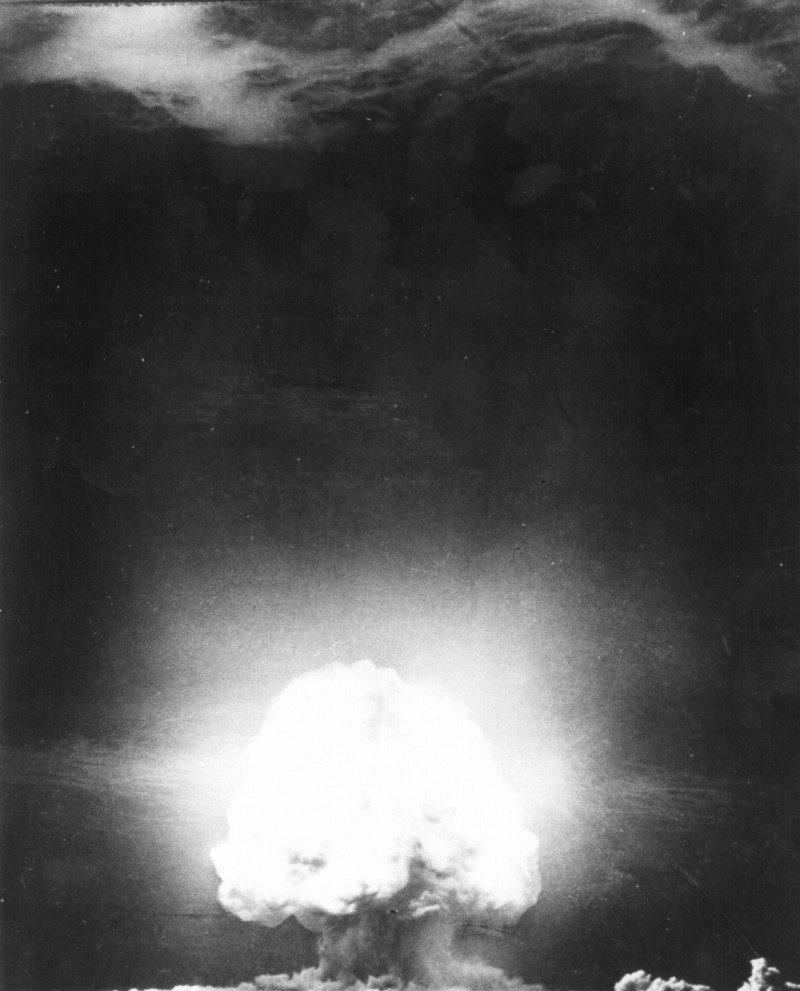
The Manhattan Project, a vast and secretive wartime enterprise, had culminated in the Trinity test on July 16, 1945, in the New Mexico desert. In the space of weeks, the first test of an atomic device moved from remote experiment to operational deployment. The decisions that led to the use of nuclear weapons against cities were not made in a vacuum: they came out of a brutal, global conflict, political brinksmanship, and the complex interplay of military strategy and international diplomacy. The Potsdam Conference, convened in July 1945, framed an ultimatum for Japan to surrender unconditionally, while the Allied leaders also wrestled with postwar balance of power concerns, especially in light of Soviet movements in East Asia. Against this background, United States leadership resolved to use the bombs — believing it would end a war that had already cost millions of lives and promised to prevent even more.
But behind every technical schematic and military order were human stories: pilots and scientists who knew the destructive potential of what they were delivering, Japanese civilians who had carried on with daily life under a decade of war, and soldiers for whom possibilities of invasion spelled unimaginable casualties. The narrative of August 1945 reads like a thriller — sequences of reconnaissance, technical assembly of lethal devices, weather checks, last-minute target changes, and a degree of uncertainty that still generates debate among historians. Yet the two detonations are also enduring test cases in ethics and law: how to judge decisions made in wartime when the stakes and uncertainties are enormous, and what responsibilities they leave for future generations.
Did you know? The Trinity test on July 16, 1945, produced a blast with an energy equivalent to about 20 kilotons of TNT, similar to the yield that would later destroy a Japanese city.
This article will move from the scientific origins through the operational details of the missions, into the agonizing immediate aftermath in both cities, and finally to the global reverberations that followed. The words that follow are anchored in archival records, survivor testimonies, military logs, and decades of scholarship. My aim is to present a close, vivid, and accurate portrait of those days while keeping a mystery-driven voice — attending to the choices, the surprises, and the human texture that make history so difficult to categorize and so crucial to remember.
Prelude: Science, Secrecy, and the Manhattan Project
The Manhattan Project began as a frightened, urgent reaction: Allied scientists, including émigré physicists who had fled Europe, feared that Nazi Germany would be first to harness nuclear fission as a weapon. By 1942 the United States had committed unprecedented resources to transform theoretical physics into an operational arm of war. Under the direction of General Leslie Groves and scientific leadership of J. Robert Oppenheimer, the project coalesced across multiple sites — Los Alamos for design and assembly, Oak Ridge for uranium enrichment, and Hanford for plutonium production. The scale of the endeavor was massive and cloaked in intense secrecy. Thousands of workers, many with no clear sense of the ultimate purpose, built factories, processed fissile materials, and created the infrastructure of the nuclear age.
The technical approach to an atomic device was not singular. Scientists pursued multiple designs in parallel: one path used highly enriched uranium in a gun-type assembly, the other used plutonium in an implosion assembly. The latter was technically demanding and required the development of explosive lensing systems to compress a plutonium core symmetrically. The former — the gun-type concept — was simpler in principle and more certain to work with uranium-235. The Trinity test, on July 16, 1945, used a plutonium implosion device and proved the implosion method's feasibility. That proof had immediate strategic consequences: it meant that the atomic weapon had left the realm of laboratory possibility and entered an operational phase.
Did you know? Colonel Paul Tibbets named his aircraft Enola Gay after his mother; the plane's serial number was 44-86292.
Militarily and politically, the existence of a functioning atomic capability was not simply about achieving a decisive battlefield advantage; it was also about shaping a postwar order. By mid-1945, Allied leaders were already adjusting their calculus: the Soviet Union, an ally against Japan, was slated to enter the war in the Pacific once its commitments in Europe were settled. The U.S. top brass worried both about the human cost of an invasion of the Japanese home islands and about postwar influence in East Asia. Within this lattice of concerns, the deployment of atomic weapons became attractive to some commanders as a means to bring the war to a swifter end.
Yet the transition from laboratory to battlefield was not without moral unease. Scientists who had contributed to the project were not unanimous in supporting the use of bombs on populated cities. Prior to deployment, several prominent physicists urged a demonstration to Japanese authorities or a warning that would allow for surrender without mass casualties. The Franck Report, drafted in June 1945, argued that an unannounced use on a city would threaten the moral high ground of the United States and might not prevent a costly invasion. Others, including military planners and President Harry S. Truman's advisers, feared that a demonstration might fail or prove insufficient to compel surrender. It is within these tensions — technical success, political calculation, and ethical debate — that the story of Hiroshima and Nagasaki takes its first decisive turns.
The Aircraft and the Mission: Enola Gay and Bockscar
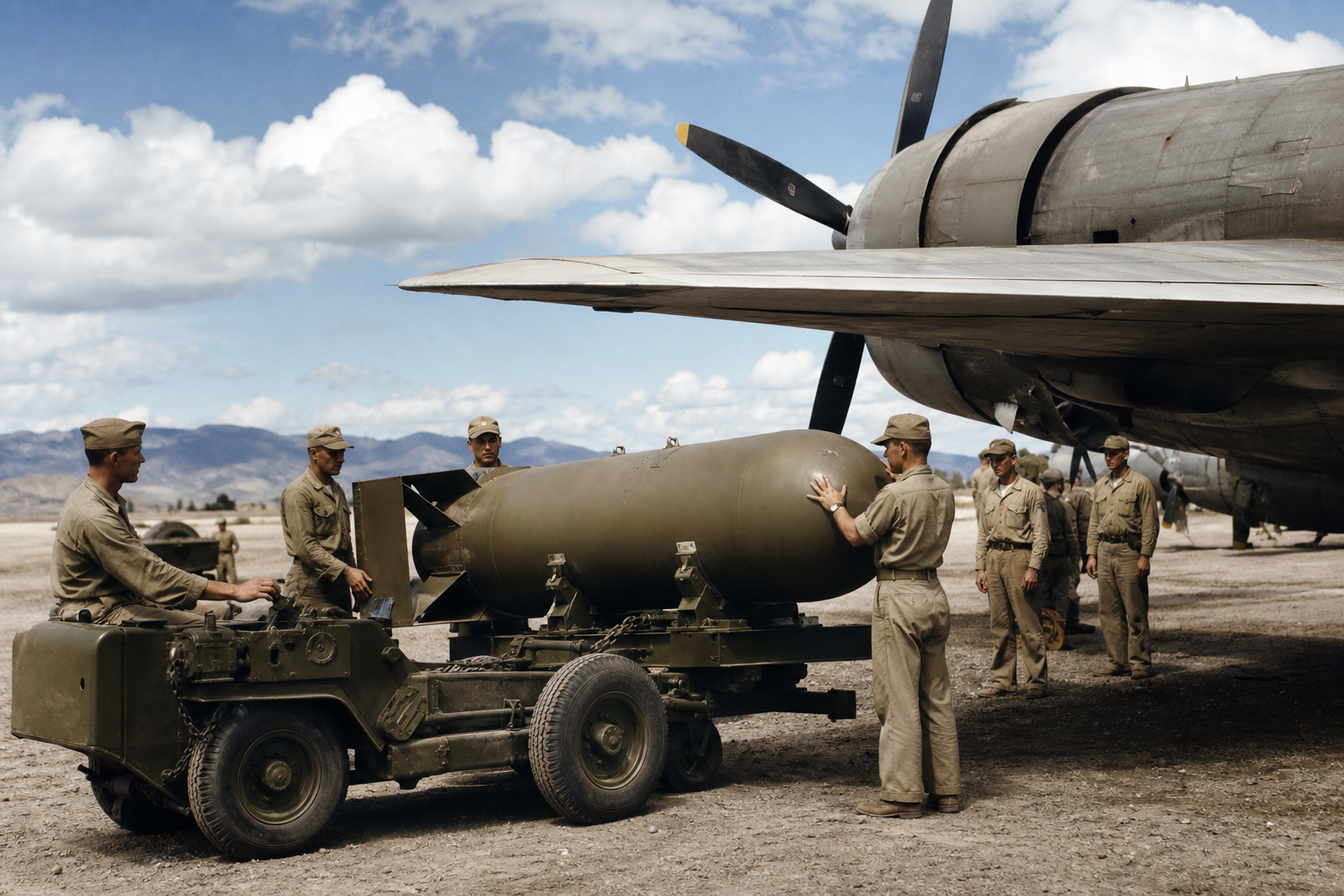
The operationalization of an atomic weapon required not just laboratories and factories but the logistical and human components to deliver it. The two missions that would drop nuclear weapons on Japan were executed by specially modified B-29 Superfortress bombers. On August 6, 1945, Enola Gay, piloted by Colonel Paul W. Tibbets Jr., lifted from Tinian Island in the Mariana chain, carrying the uranium gun-type bomb later nicknamed 'Little Boy.' The crew had trained for months for high-altitude delivery, formation flying, and the specific procedures required to arm and release the device. Their mission was spliced together with a sense of urgency and secrecy; very few on board fully comprehended the magnitude of what they carried.
Did you know? Little Boy never underwent a full-scale test before use; confidence in the gun-type design came from theoretical calculations and laboratory experiments rather than a field detonation.
The crew of Enola Gay had rehearsed various mission elements, including rendezvous with observation aircraft and photographic planes. A weather reconnaissance plane assessed conditions over the primary target, Hiroshima. The bomb assembly had been partly completed in flight by military ordnance specialists riding in separate aircraft due to safety protocols. At 08:15 local time, Enola Gay released the weapon over Hiroshima from an altitude of approximately 31,000 feet. The timing and the altitude were chosen to maximize the weapon's blast radius and destructive power while accounting for variables like blast reflection in an urban environment.
Three days later, another B-29, Bockscar, piloted by Major Charles W. Sweeney, executed the second mission. Bockscar carried the plutonium implosion bomb called 'Fat Man.' That mission's narrative is more complex: Bockscar's primary target was the city of Kokura, but smoke, haze, and scattered cloud cover obscured the target, making visual aiming unreliable. After multiple passes and dwindling fuel, and under orders to use visual bombing when possible, the crew diverted to their secondary target, Nagasaki. At 11:02 local time on August 9, 1945, Fat Man detonated over Nagasaki. Bockscar's crew faced controversies later about their decisions and the last-minute target change, sparking postwar discussion about the mission's execution and the role of human judgment under pressure.
The missions' human dimension is haunting: those who flew felt the weight of history, and yet operated in a fog of routine procedures, checklists, and split-second choices. Pilots later described strange mixtures of clinical detachment and visceral horror upon seeing the mushroom cloud bloom on the horizon. Ground crews on Tinian had little information about ultimate targets; many were told only that their aircraft were undertaking special operations. These layers of compartmentalization — necessary for security — also insulated broader discussions about whether alternatives to direct city strikes had been fully exhausted.
Did you know? The Aioi Bridge was used as an aiming point for the Enola Gay crew; it survives today near the Hiroshima Peace Memorial as a marker of the detonation's ground zero.

The Bombs: Little Boy and Fat Man — Design and Difference
Little Boy and Fat Man were distinct in design, yield, and the way they transformed military theory. Little Boy, the weapon dropped on Hiroshima, used a gun-type design that fired one piece of highly enriched uranium (U-235) into another to reach a supercritical mass. This method was mechanically simpler and more predictable in detonation mechanics; it did not require testing for confidence, partly because scientists were confident the physics were straightforward. Little Boy's estimated yield is approximately 15 kilotons of TNT. The weapon's casing and engineering were specifically built to be air-delivered from the B-29 at high altitude.
Fat Man, on the other hand, used a plutonium core and an implosion assembly: shaped explosive charges around the core were detonated with precise timing to compress a subcritical sphere into a supercritical state. The implosion design had been tested at Trinity and necessitated more sophisticated explosive lensing and timing systems. Fat Man's yield over Nagasaki was approximately 21 kilotons, though the topography of Nagasaki — a valley city hemmed in by hills — contained the blast differently than Hiroshima's relatively flatter terrain. The difference in physical design meant the bombs had different logistical requirements for arming and handling, and the Manhattan Project maintained specialized crews trained for each weapon type.
Contemporaneous military planning included contingencies for dud devices, misfires, and the possibility that a demonstration might not compel a surrender. The Franck Report and other scientific advisories had urged that the United States consider a non-lethal demonstration, such as detonating a bomb on a barren island, but military leaders argued the uncertainty of such demonstrations and the political necessity of decisive action. Moreover, scientists such as Enrico Fermi and others had been uncertain about the scale of the humanitarian fallout and long-term radiation effects. The exact biological consequences of ionizing radiation were not yet fully understood; acute radiation syndrome had been observed in some industrial contexts and earlier radiographic work, but the scale witnessed in Japan exceeded prior experience.
Did you know? Nagasaki’s primary target that day was Kokura; Bockscar made three passes over Kokura before diverting due to obscured visibility, a sequence sometimes called the “Kokura gun” episode.
Technical secrecy pervaded operations: detailed drawings, fissile material shipments, and assembly operations were compartmentalized across the Pacific. On Tinian Island, specially prepared bomb bays and assembly hangars were kept secret, and ordnance teams assembled components under strict protocols as aircraft prepped for the missions. That distance between designers and executors created a world in which those who loaded the bombs often could not fully grasp their global consequences, and those who designed them could not fully see the scenes of destruction that would follow.

Hiroshima, August 6, 1945: Detonation and Immediate Aftermath
At 08:15 on August 6, 1945, the Little Boy device detonated approximately 600 meters (about 1,968 feet) above the city center of Hiroshima, over a location near the Aioi Bridge and the bustling T-shaped intersection. The blast created a shockwave and a thermal pulse whose shock front obliterated buildings, ignited fires, and instantaneously killed tens of thousands of people. Contemporary estimates of immediate fatalities range from 70,000 to 80,000. By the end of 1945, accounting for injuries and those who succumbed later, estimates of deaths attributed to the bombing rise to about 140,000. The devastation extended beyond the immediate physical trauma: intense heat caused people to be burned severely, leaving characteristic patterned injuries from clothing and objects; fires raced through wooden neighborhoods; and the collapse of emergency infrastructure complicated rescue and care.
Hiroshima was a military and administrative center with a mix of factories, offices, and civilian populations. At the moment of detonation, people were performing ordinary tasks: students heading to school, workers in factories, and residents engaged in daily life under wartime conditions. Eyewitness testimonies describe a blinding flash, followed by an enormous roar and the sight of a towering mushroom cloud. Those close to ground zero were vaporized or suffered catastrophic injuries; those further away experienced severe burns, blindness, and concussive injuries. Many survivors later recount surreal scenes: buildings appearing to melt, shadows burnt onto walls where people had been standing, and a sky filled with paper, debris, and the smell of burning flesh.
Did you know? Emperor Hirohito cited the threat of “the new and most cruel bomb” in his statement to the Japanese people on August 15, 1945, explicitly referencing atomic devastation.
The medical response was overwhelmed. Hospitals near the blast were destroyed, and surviving medical staff lacked supplies and knowledge about treating radiation injuries. Symptoms of acute radiation sickness — nausea, vomiting, bleeding, hair loss — appeared in many survivors, often days after initial injuries. The Japanese government and local authorities struggled to account for the wounded and dead amid widespread chaos. Burial, firefighting, and rescue operations proceeded at great human cost. The city's infrastructure, including communications and transportation, was rendered dysfunctional, complicating relief efforts.
The intellectual and scientific communities around the world watched the aftermath with a mixture of horror and grim scientific curiosity. Photographs of Hiroshima's flattened neighborhoods, the twisted skeletal remains of industrial structures, and the Genbaku Dome (the Prefectural Industrial Promotion Hall), which later became an emblem of the attack, circulated widely and entered the global imagination. The physical and psychological impact endured: survivors — later termed hibakusha — faced stigma, medical complications, and long-term uncertainties. Radiation's latent effects, including increased cancer risk and genetic concerns, would unfold over decades, complicating the already profound human toll of the initial blast.

Nagasaki, August 9, 1945: Terrain, Targeting, and Aftermath
Three days after Hiroshima, weather and chance produced a different tableau of destruction in Nagasaki. The Fat Man device detonated over Nagasaki at 11:02 local time on August 9, 1945, after the primary target, Kokura, had been obscured by smoke and haze — attributed partly to prior firebombing operations and possibly recent attacks on the industrial areas. Bockscar's crew made multiple visual passes over Kokura, and with fuel and daylight dwindling, the bomber diverted to its secondary target, Nagasaki. The blast occurred over the Urakami Valley, a pocket within a highly contoured urban area, and the resulting destruction was channeled by the city's hills and topography in ways that made its devastation different in pattern from Hiroshima's.
Did you know? The Genbaku Dome was one of the few structures near Hiroshima’s hypocenter that retained a recognizable outline and was deliberately left as a memorial in the postwar reconstruction.
Nagasaki had a significant industrial base, including shipyard facilities and arms factories, and housed both Japanese residents and Korean forced laborers. Immediate fatality estimates for Nagasaki range from 40,000 at the moment of detonation to around 70,000 by the end of 1945, as injuries and radiation effects claimed more lives. The Fat Man explosion yielded an estimated 21 kilotons, and its blast wave reflected differently against Nagasaki's terrain, producing intense localized destruction. Comparatively, although Fat Man had a larger yield than Little Boy, the total number of casualties in Nagasaki was lower due to the city's hilly topography and the bomb's detonation point being offset from the most densely populated areas.
Survivor accounts from Nagasaki share patterns with Hiroshima: sudden blinding light, searing heat, collapsing structures, and the chaos of fleeing crowds. Medical personnel again faced an overwhelming influx of casualties with limited supplies. Nagasaki's Catholic community suffered greatly, including the Urakami Cathedral area, which was heavily damaged; remnants of religious buildings later became focal points for memory and mourning. The combination of death, destruction, and social dislocation left an indelible mark on the city's fabric, and survivors carried physical and emotional scars for the rest of their lives.
The sequence of Hiroshima followed by Nagasaki triggered immediate diplomatic and strategic consequences. The Soviet Union declared war on Japan on August 8, 1945, and its invasion of Manchuria began August 9, 1945, providing further pressure on Japanese leaders weighing surrender. Historians continue to discuss the relative influence of nuclear devastation versus Soviet entry into the Pacific War in compelling Japan's leaders to accept unconditional surrender. The interior debates within the Japanese government — between military hardliners and civilian leaders — intensified as the scale of defeat became apparent.
Did you know? The Radiation Effects Research Foundation, which followed postwar research on survivors, was a joint U.S.-Japan effort established to study long-term health effects from the atomic bombings.

Immediate Political Consequences and the Path to Surrender
The detonations over Hiroshima and Nagasaki produced an immediate political shockwave. On August 9, 1945, the same day Nagasaki was bombed and Soviet forces entered Manchuria, Emperor Hirohito and his advisors faced the stark reality that Japan might be on the verge of national collapse. Internal cabinet debates, which had raged for months over whether to accept the Allied Potsdam terms, now occurred under the grim pressure of mass casualties and the prospect of further nuclear attacks. On August 15, 1945, Emperor Hirohito delivered his surrender announcement — the first time the emperor's voice had been heard by the public over radio — marking the formal end of hostilities when Japan accepted the Allies' terms.
The role of the atomic bombs in prompting surrender has been the subject of intense historical debate. Some historians argue that the psychological and physical shock of two nuclear detonations made continued resistance untenable and that the bombs saved lives that would have been lost in an Allied invasion of the home islands. Others contend that the Soviet declaration of war and rapid advances in Manchuria were at least as decisive in the Japanese decision to surrender; still others emphasize a combination of these pressures. There is also strong critique of the moral and legal frameworks used to justify the bombings, including whether alternatives had been adequately explored and whether civilians were unlawfully targeted. These debates persist because they touch on deep questions of wartime necessity, proportionality, and the evolving laws of armed conflict.
In the immediate geopolitical rearrangement, the presence of atomic weapons transformed diplomatic calculations. The United States emerged as the sole possessor of nuclear arms, a fact that would shape early Cold War dynamics. The Soviet Union quickly accelerated its own atomic program, successfully testing a device in 1949, which set off the nuclear arms race. Within Japan, the shock of defeat precipitated occupation under General Douglas MacArthur, sweeping political reforms, demilitarization measures, and a new constitution that renounced war. The reconstruction of Japanese society and political order was rapid and profound, but deeply shadowed by the human toll of 1945.
Did you know? The phrase “hibakusha” literally means “explosion-affected people” and is used in Japan to describe survivors of the atomic bombings.
War crimes tribunals and postwar accountability addressed many aspects of wartime conduct, but the atomic bombings themselves occupied a different legal and moral sphere. International law at the time did not explicitly ban the use of weapons of mass destruction, and the postwar tribunals did not adjudicate the bombings as war crimes. The ethical debate would instead evolve through scholarship, literature, survivor testimony, and later international treaties aimed at limiting or outlawing certain classes of weapons. The experiences of Hiroshima and Nagasaki thus contributed directly to subsequent arms control impulses and humanitarian law discourse.

Memory, Reconstruction, and the Long Shadow
The path from rubble to reconstruction was both physical and symbolic. Hiroshima and Nagasaki rebuilt from ashes into thriving modern cities that also became centers for peace activism and memorialization. The Genbaku Dome in Hiroshima — a skeletal remnant of the Prefectural Industrial Promotion Hall — was preserved amid redevelopment and later designated a UNESCO World Heritage Site as a testament to the city's history. Peace parks, museums, and annual remembrance ceremonies emerged as both local rituals and global calls for the abolition of nuclear weapons. Hibakusha advocacy groups worked domestically and internationally to seek medical care, recognition, and legal redress; they also became moral voices in decrying the human costs of nuclear warfare.
Survivors’ testimony has been central to preserving the human record. Hibakusha recount not only physical injury but long-term health effects: elevated cancer rates, cataracts, and chronic illnesses linked to radiation exposure. The social dimensions were also severe: survivors sometimes faced discrimination in marriage, employment, and social life due to fears about radiation-related heredity and contagion. Over decades, medical science has tracked the epidemiology of survivors; studies conducted by the Radiation Effects Research Foundation (successor to the Atomic Bomb Casualty Commission) documented increased risks for leukemia and other cancers among those exposed.
The global legacy of the bombings includes an accelerating arms race and the formation of institutions aimed at preventing nuclear proliferation. The memory of Hiroshima and Nagasaki shaped activism, policy, and culture. In science, the bombings catalyzed debates over the responsibilities of scientists in society — prompting some to advocate for arms control and others to see military-research partnerships as inevitable. International treaties such as the Treaty on the Non-Proliferation of Nuclear Weapons (NPT) and successive test ban agreements trace intellectual and political lineage to the shock of 1945. Meanwhile, cultural production — novels, poems, films, and visual arts — has grappled with themes of loss, guilt, survival, and moral reckoning.
The moral questions linger and new dilemmas continually arise. The preservation of memorials and educational programs seeks not merely to recount facts but to engender reflection on human capacity for destruction and on the ethical obligations of future generations. Civic commemorations in Hiroshima and Nagasaki emphasize peace education to younger generations worldwide, aiming to convert memory into preventive wisdom. Yet geopolitical reality and technological advancement continue to present risks: modern nuclear arsenals are far larger and more sophisticated than the first devices, and the governance of these weapons involves complex international trust and verification structures.

Science, Ethics, and the Lessons for Today
The story of Hiroshima and Nagasaki sits at the intersection of scientific breakthrough and moral responsibility. The Manhattan Project forcefully demonstrated that theoretical physics, with sufficient resources and political backing, could be converted into instruments of unprecedented force. The ethical conversation has never settled: some argue that the bombings prevented an even greater catastrophe by precluding an invasion of Japan and forcing a faster end to a total war; others maintain that the deliberate targeting of cities and the introduction of atomic weapons into warfare constituted a profound moral breach. Both positions rely on counterfactual reasoning — “what would have happened if…” — which means historical analysis must weigh probabilities, strategic alternatives, and the human calculus of decision-makers.
Scientifically, the experiences in Japan taught hard lessons about radiation biology, fallout, and long-term epidemiology. Acute radiation syndrome became better understood as medical teams documented symptom progression and long-term survivors were tracked. These scientific insights informed safety protocols, medical treatments, and later civil defense planning. The tragic human data inadvertently provided the world with empirical knowledge about radiation’s effects, knowledge that later shaped occupational regulations, medical radiology safety, and international guidelines for nuclear incidents.
Ethically and legally, Hiroshima and Nagasaki seeded an ongoing dialogue about weapons of mass destruction and civilian protection. The postwar period saw the development of the Geneva Conventions' humanitarian law corpus, although many of the specific prohibitions regarding nuclear weapons evolved later and remain contested in international forums. Nuclear weapons' deterrence logic has dominated strategic thought for most of the postwar era, but this logic is periodically challenged by humanitarian and legal arguments that seek to delegitimize their existence and use. The rise of nonproliferation institutions and treaties represents a political acknowledgment that unchecked nuclear expansion poses existential threats.
Finally, the human legacy — the hibakusha, the memorials, the legal debates, the science — offers a multilayered lesson about power and restraint. The detonation of two atomic devices in wartime was a pivotal inflection point that combined technological mastery with the ambiguous moral terrain of total war. For present-day policymakers and citizens, the memory of Hiroshima and Nagasaki functions as a cautionary tale: technological capability divorced from ethical restraint can produce consequences that echo for generations. The challenge remains to translate remembrance into effective policies that reduce risk and honor the lives lost.

The bombings of Hiroshima and Nagasaki are simultaneously concrete historical events — with dates, aircraft, technological designs, and casualty estimates — and profound moral mysteries that continue to prod historians, ethicists, politicians, and citizens. In three catastrophic days, the 20th century's technological capacity was displayed at full, terrifying scale. The immediate devastation took tens of thousands of lives; the longer-term consequences extended into decades through radiation illness, psychological trauma, and social dislocation. At the geopolitical level, the events accelerated the entry into a nuclear age that shaped Cold War strategy and spawned institutions charged with preventing the same specter from recurring.
Remembering the bombings involves moving beyond dry numbers to the human stories of those who lived through them and those who made the fraught decisions from secure rooms thousands of miles away. It involves acknowledging the scientific genius that made these devices possible as well as the ethical blindness that allowed them to be used on populated cities. Memory work — through museums, survivor testimony, and scholarly inquiry — does not aim to settle all moral questions but to preserve the complexity of choices and the reality of human suffering. The aim is both to honor victims and to cultivate a deeper prudence about the link between power and responsibility.
The shadow of the atom remains long: nuclear weapons still exist, and their potential for destruction is orders of magnitude greater than in 1945. The history of Hiroshima and Nagasaki thus persists as a foundational lesson for humanity: that the capacity to unleash annihilation carries with it an imperative to seek limits, to build institutions of restraint, and to never allow technological triumph to eclipse moral judgment. Those who witnessed the blasts, the hibakusha, and those who have studied the events since their occurrence, have bequeathed a legacy — a warning within the annals of history — that the future depends on how well we remember and how wisely we act.

How we verify this article
By the History Unlocked editorial team
This text is built on historical facts stored in our database and drafted with AI assistance. No signed human review is recorded for this article. Report any inaccuracy: we correct it and update the modified date.
Updated on
AI-assisted drafting.
Read our editorial standardsEnjoyed this? Discover more articles in the category World War II