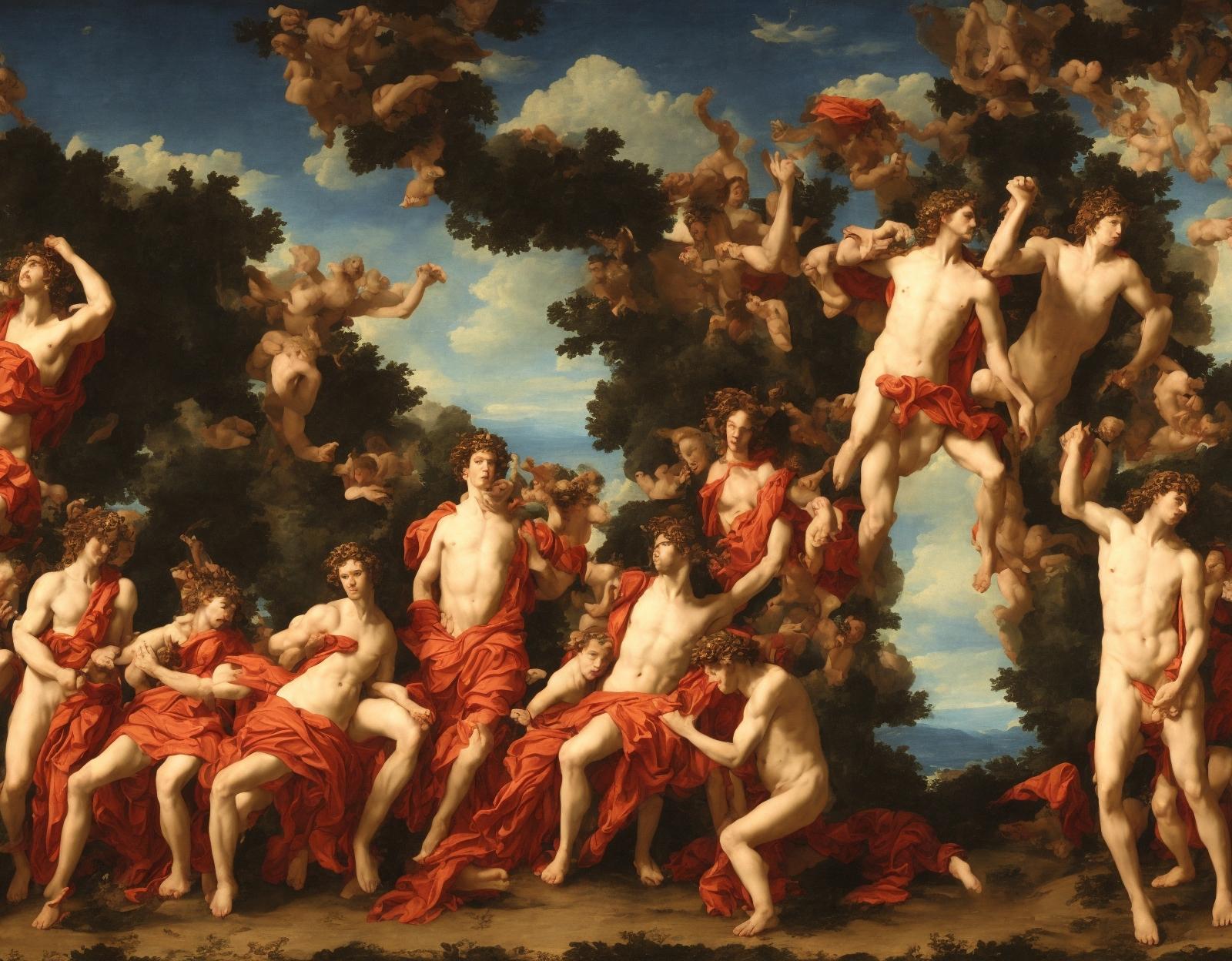
Apollo and the Muses: Music, Prophecy, and the Birth of Inspiration
In the shimmering fog of antiquity where song, prophecy and ritual braided into the daily life of Greek polities, Apollo and the Muses stand as a singular constellation. Together they form a narrative that shaped how the Greeks—and later Romans and Europeans—understood inspiration, the relationship between creativity and divine authority, and the very geography of sacred space. Apollo, the luminous son of Zeus and Leto, embodies a compound divinity: god of music and song, of prophecy and purification, of archery and plague, of healing and the sun. The Muses, daughters of Zeus and Mnemosyne, are the personified graces of memory and artistic practice—patrons of epic, lyric and choral performance, and, in the imagination of antiquity, the indispensable breath behind every true poem and scientific account.
This article embarks on a close, evidence-based exploration of how these divine figures intersect: from Hesiod’s catalogues and the Homeric Hymns to Pausanias’s travel-worn descriptions of Delphi and the archaeological traces of Delos and Parnassus. I will trace Apollo’s mythic biography—his birth on Delos, his slaying of Python and foundation of the Delphic oracle, his acquisition of the lyre from Hermes—and the Muses’ shifting identities from archaic localities to the canonical nine daughters of Mnemosyne described in Theogony. We will look at the famed mythic contests—the hubris of mortals like Thamyris or the fatal challenge of Marsyas—and how these stories encode cultural anxieties about the limits of human ambition against divine skill. The article will also follow the tangible remains of cultic practice: dedicatory song, votive offerings, inscriptions, statuary and the topography of shrines that turned particular slopes into stages for the sacred drama of inspiration.
Narrative and mystery will guide the tone: the past is not presented as a clean chronology so much as a palimpsest where later authors reinterpret earlier cult, and where archaeology both confirms and complicates literary testimony. Wherever possible I rely on primary ancient sources—Hesiod, the Homeric Hymns, Pindar, Pausanias, and tragic fragments—alongside modern archaeological and philological scholarship. Expect concrete, verifiable facts about cult places, textual traditions and iconic myths, and also attention to the ambiguity and contradictions which are themselves illuminating. The Muses and Apollo do not speak in a single voice; their myths were adapted generation after generation, reflecting shifting politics, aesthetics and religious sensibilities. Read on to discover how the melodies of the past still echo on marble slopes and in the very words that have told their stories for millennia.
Did you know? Hesiod’s Theogony (lines 35–370) names the nine canonical Muses as daughters of Zeus and Mnemosyne, establishing their standard genealogy in Greek poetic tradition.

Origins and Genealogy
The figure of Apollo in Greek myth is complex because he consolidates traits that may have been originally distinct in various local cults. Classical sources converge on a set of core genealogical and biographical facts: Apollo is the son of Zeus and Leto and the twin brother of Artemis. His birth on the island of Delos is narrated most fully in the Homeric Hymn to Apollo (often dated to the 7th–6th century BCE), which celebrates the island as his honored birthplace and describes its sanctification: Leto, persecuted by Hera and wandering to find a place to give birth, finally finds Delos, which becomes forever prominent in Apollo’s cult. Delos retained an active sanctuary and calendar festival—the Delia—where athletic and musical contests celebrated the god.
The Muses, by contrast, are consistently presented by Hesiod (Theogony, late 8th–7th century BCE) as daughters of Zeus and Mnemosyne (Memory). Hesiod lists nine Muses—Calliope, Clio, Erato, Euterpe, Melpomene, Polyhymnia, Terpsichore, Thalia, and Urania—each associated with different poetic or performative genres. However, this ninefold schema overlays earlier regional traditions that knew fewer Muses or different local names: at Delphi and Boeotia, for example, earlier traditions sometimes identified three Muses connected to particular springs or sacred sites; elsewhere they appear as prophetic oracular figures. This process—local polytheistic figures being assimilated into a pan-Hellenic divine family—explains the diversity in how the Muses were represented and worshipped across Greek-speaking regions.
Apollo’s role relative to the Muses is both paternal and collaborative. In some mythic accounts Apollo leads or presides over the Muses, granting musical authority and setting the standards of art. Yet the Muses also personify memory, the very faculty needed for oral poets and performers—thus their genealogy from Mnemosyne is theologically apt: poetry is not merely invention but recollection.
Did you know? The Homeric Hymn to Hermes recounts that Hermes crafted the first lyre from a tortoise shell and later traded it with Apollo, establishing the lyre as Apollo’s emblematic instrument.
Pausanias, the 2nd-century CE Greek traveler and antiquarian, records local accounts that preserve variation: for example, he notes sanctuaries of the Muses on Mount Helicon (Boeotia) and Mount Parnassus (near Delphi) and records different local rites and dedications. These geographical anchors—Helicon and Parnassus—became emblematic of the poetic arts. The dual anchoring of Apollo’s cult in Delos and Delphi mirrors this topographical pluralism: Delos emphasizes birth and early rites, Delphi emphasizes prophecy and ritual performance. Both landscapes are central to the genealogical and cultic story that articulates Apollo’s relationship to the Muses.

Apollo's Lyre and the Power of Music
Few images in Greek mythology are as durable as Apollo holding a lyre: the instrument embodies the god’s dominion over ordered sound, poetry, and celestial harmony. The myth of Apollo receiving the lyre from Hermes appears in the Homeric Hymn to Hermes (one of the Homeric Hymns traditionally dated between the 7th and 5th centuries BCE). According to this tale, Hermes invents the lyre from the shell of a tortoise and sacrifices the animal to craft strings and a resonant box; when Apollo discovers the theft of his cattle by Hermes, the two reconcile after Hermes offers the lyre to Apollo in exchange for the caduceus. Through this exchange Apollo acquires a symbol of cultural superiority—the refined lyre replacing the more rustic aulos (double-reed flute), often culturally associated with Dionysus and folk music.
The lyre’s symbolism is not merely aesthetic but ethical and political. Apollo’s music is frequently associated with order (kosmos), measured rhythm, and the training of youth. Plato in his Republic insists on musical education’s role in shaping moral character and mentions the lyre as a proper instrument for the education of an aristocratic state. Greek tragedy and lyric poetry were performed with lyre accompaniment; Homeric performance, though conventionally portrayed with the epic poet’s lyre, likely had regional variations in performance practice. Even in iconography, the lyre connotes civilized, courtly artistry.
Did you know? The Hellenistic Mouseion in Alexandria, established by the Ptolemaic dynasty, was named for the Muses and functioned as a major center for scholarship and poetic patronage in the 3rd century BCE.
Yet the mythic conflict between musical instruments is instructive. The aulos, often linked to ecstatic rites and martial accompaniment, remains deeply ambivalent in Greek cultural imagination. The inventor of the aulos (in some versions the goddess Athena who discarded it, causing her cheeks to puff) yields to its later association with Dionysian frenzy and female cultic practice. Apollo’s supremacy over the lyre therefore implies a cultural preference for measured harmony over unbridled passion. This theme appears in the stories of musical contests, where the adjudication often becomes a metaphor for moral and civic order.
Apollo’s lyre is also tied to poetic authority. The Muses inspire poets; Apollo gives the instrument and the formal authority to sing. Pindar and other lyric poets invoke Apollo and the Muses together; the Homeric Hymn to Apollo itself is framed by invocations to the god. The lyre is thus not only an object but a social technology that mediates between human performers and divine sanction.

The Muses: Names, Domains, and Worship
Hesiod’s canonical list of nine Muses fixed each sister to a creative or scholarly domain: Calliope (epic poetry), Clio (history), Erato (lyric and love poetry), Euterpe (song and flute), Melpomene (tragedy), Polyhymnia (sacred hymn and eloquence), Terpsichore (dance), Thalia (comedy and pastoral), and Urania (astronomy). These assignments reflect a cultural taxonomy of arts and knowledge in classical Greece, one that served both religious and pedagogical functions. A poet or performer would invoke a particular Muse as patron for a given genre—a formal ritual that in practice acknowledged the social institution that sustained oral composition and performance.
Did you know? The Pythian Games, held at Delphi every four years, included musical and poetic competitions in addition to athletic events, reflecting Apollo’s dual patronage of sport and the arts.
Cult practices around the Muses varied significantly by region. On Mount Helicon, for example, rural Boeotian cult included natural springs like the Hippocrene—a fountain struck by Pegasus according to legend—which became associated with poetic inspiration. The Muses of Helicon are often depicted in pastoral settings, dancing and singing by springs. On Mount Parnassus, near Delphi, the Muses were associated with the larger sanctuary complex and the professional, oracular, and choral traditions centered there. In Athens, the Muses had urban sanctuaries and festivals; the Roman-era musician and writer Pausanias describes altars and statues dedicated to the Muses across Greece.
The Muses were not only patrons of entertainment but were understood as guardians of knowledge. In Hellenistic and eventually Roman educational curricula, the Muses served as emblematic supports for specialized fields: Urania for astronomy and science, Clio for historical inquiry. Museums—literally “places of the Muses”—such as the Mouseion at Alexandria (a Hellenistic institution founded in the early 3rd century BCE under the Ptolemies) institutionalized the Muses’ protective association with literature, scholarship, and the arts. The Library and Mouseion at Alexandria functioned as a state-sponsored center for textual scholarship, which itself is an institutional analog to the Muses’ patronage: preserving, copying, and interpreting texts was an act of divinely sanctioned memory.
Artistic depictions of the Muses present them as a chorus—interrelated but distinct figures—often with specific attributes (lyre for Erato, scrolls for Clio, globe and compass for Urania in later iconography). In performance contexts, choruses of young men or women could be ritually consecrated to particular Muses, and these cultic enactments reinforced communal identity, linking local polis history to pan-Hellenic mythic memory.
Did you know? Ancient vase paintings and literary sources depict the flaying of Marsyas as a cautionary emblem of divine retribution against mortal hubris in artistic contests.

Delphi, Parnassus, and Sacred Geography
No study of Apollo and the Muses is complete without a careful look at sacred geography, the places where cult and myth converged into lived practice. Delphi, situated on the slopes of Mount Parnassus, was arguably the most famous sanctuary of Apollo and the most renowned oracle in the ancient Greek world. The Homeric Hymn to Apollo offers an etiological account: after slaying Python—a chthonic serpent or dragon associated with the earth and earlier pre-Hellenic cults—Apollo established his oracle at the Omphalos (navel) of the world. The sanctuary accumulated monumental architecture—the Temple of Apollo, treasuries, stoas, a theater, and the famed Castalian spring—where pilgrims from across the Mediterranean sought divination and delivered votive offerings.
Archaeological work at Delphi since the late 19th century has unearthed layers of dedication and construction that corroborate ancient literary testimony: stone foundations and monumentalizing in the Archaic and Classical periods (7th–4th centuries BCE) match the textual record of pan-Hellenic festivals, athletic contests (the Pythian Games), and increasing civic involvement in the sanctuary. Inscriptions record dedications by city-states, victor lists, and financial endowments. The role of the oracle itself—a human priestess (the Pythia) delivering Apollo’s responses—has been described in various ancient authors. Plutarch’s account (De defectu oraculorum) is among the most detailed, describing the Pythia entering trance states on the tripod in the adyton and uttering ambiguous pronouncements interpreted by priests.
Mount Parnassus and Mount Helicon, although geographically proximate, mark different strands of tradition. Parnassus became associated with the Delphic complex and a more formalized, pan-Hellenic cultic center; Helicon retained a more rural, poetic identity, a locus for choral and Dionysian-tinged cult that emphasized springs and the bucolic aspect of inspiration. Both mountains, however, contributed to a symbolic landscape where divine inspiration was topographically anchored: the idea that poets and seers drew from specific springs or heights made inspiration a physical, localizable phenomenon.
Did you know? The sanctuary of Asclepius at Epidaurus, associated with healing rituals and votive offerings, became one of the most famous centers for ancient medical pilgrimage, showing the practical side of divine healing cults.
Delos, Apollo’s birthplace, preserved a different set of practices: it served as a religious and mercantile hub in the Cyclades, with sanctuaries, an amphitheater, and an annual festival (the Delia) that combined athletic and musical contests. Archaeological finds on Delos—housing, sanctuaries, votive bronzes—attest to its long-term pan-Mediterranean connections and to the island’s role as a cultic center where Apollo’s birth was ritualized.
Contests, Punishments, and the Moral of the Arts
The mythic motif of artistic contest runs through many Apollo-and-Muses narratives, functioning as a moral theater where hubris, excellence, and divine justice are adjudicated. Perhaps the starkest example is the contest between Apollo and the satyr Marsyas. Marsyas, having discovered the double-piped aulos, challenges Apollo to a musical duel judged by the Muses or by gods (accounts vary). Apollo plays the lyre while Marsyas plays the aulos. The judge’s decision turns on musical rules and, tellingly, on a test Apollo invents—he plays the lyre upside down and asks Marsyas to do likewise; Marsyas cannot, and Apollo wins. The punishment—Marsyas’s flaying—is brutal and shocking. Ancient authors employ this tale to exemplify the punitive consequences of challenging divine artistry for mortals and to underscore the cultural valuation of the lyre’s ordered music over the aulos’s rustic vigor.
Other stories, such as the fate of Thamyris or the case of the daughters of Pierus, explore similar themes. Thamyris, a male Thracian singer, boasts that he can out-sing the Muses and is punished by them: he loses his sight and his skill, and sometimes his voice. The daughters of Pierus challenge the Muses and are transformed into birds. These tales enact a social lesson: poetic skill is not merely technical virtuosity but a gift that, if arrogantly claimed, invites retribution.
Did you know? Roman poets like Virgil explicitly model their invocations on Greek precedent but situate Apollo within new political frameworks, notably Augustus’s cultural program which associated the emperor with Apollonian ideals.
But the moral calculus is not simply about punishing pride; it also clarifies the source of artistic authority. The Muses are memory’s personification: a poet’s facility depends on proper technique, communal tradition, and ritual sanction. A wandering bard claiming originality without apprenticeship to tradition or without the patronage of the god risks being read as impious or dishonest. In other words, the mythic punishments protect a cultural economy in which authorship is embedded in lineage, ritual, and communal norms.
At the same time, the myths leave room for ambivalence. Orpheus, the archetypal musician-poet, is sometimes described as the son of Calliope and either Oeagrus or Apollo in some traditions. Orpheus’s music can charm animals, stones, and even gods—yet his descent into the underworld to retrieve Eurydice speaks to the limits of art: certain boundaries (death, grief) remain ultimately resistant even to divine melody. Thus, contests and transgressions function as mythic explorations of the power and limits of the arts.

Apollo, Healing, and the Broader Sacred Portfolio
Apollo’s divine portfolio extends beyond music and prophecy into medicine, plague, purification, and civic welfare. The god is closely associated with Asclepius, the healing god who is often described as Apollo’s son (by Coronis). Asclepius’s cult—centered at sanctuaries like Epidaurus—represents a medical specialization that grew from broader Apollonian associations with healing songs (paean), ritual purifications, and the control of pestilence. Homeric poems and later medical writers reflect the interplay between ritual prayer, songs of paean, and practical healing techniques.
Did you know? The Delphic oracle remained a political force through the Classical and Hellenistic periods, consulted by city-states and rulers, until imperial and Christian transformations in late antiquity curtailed its traditional functions.
Apollo could both send and avert plague: Homer’s Iliad opens with Apollo sending a plague on the Achaeans at the behest of Chryses, priest of Apollo, as recompense for offended sanctity. Conversely, Apollo’s role as a paean-inspiring healer and purifier is attested in cult practice where dedications, hymns and ritual purifications sought his intervention for disease and communal disaster. Archaeologically, votive offerings to Apollo and Asclepius at healing sanctuaries comprise anatomical votives, inscriptions thanking the god for cures, and evidence of organized rituals that combined prayer with practical regimens.
The Muses intersect with this healing register in subtle ways. Memory and recollection are central to medical practice and pedagogy; the mnemonic arts in Greek antiquity—poetic meters, formulaic phrasing—enabled the transmission of medical and technical knowledge across generations. The Muses, as patrons of memory and technical genres, thus stand along a spectrum where poetry, science, and ritual meet. In the Hellenistic period, Muses were appropriated as patrons of particular sciences—Urania for astronomy being an obvious instance—indicating the broadening role of inspiration from strictly poetic realms into learned disciplines.
This broad portfolio helps explain why festivals in Apollo’s honor included diverse activities: athletic games, musical competitions (the Pythian Games), processions, and ritual performances that interconnected civic life, health, military success, and cultural production. Apollo’s authority was multifaceted and practical as well as symbolic, shaping civic calendars and communal identities.
Legacy: From Antiquity to Renaissance and Modern Reception
The entwined figures of Apollo and the Muses exerted a long shadow across Mediterranean and European history. During the Hellenistic period, the Muses’ affiliation with learned institutions like the Mouseion at Alexandria turned poetic inspiration into institutional sponsorship: courtly patronage, textual scholarship, and the systematic compilation of knowledge owed their ideological legitimacy to the Muses’ remit. Roman poets—Virgil, Ovid, Horace—invoke Apollo and the Muses as part of their poetics: Virgil’s invocation of the Muse (and the Augustan patronage that associated Augustus with Apollo) fashions Augustus’s regime as a cultural restoration and moral reordering.
In the Renaissance, Apollo and the Muses were central to humanist conceptions of classical restoration. Artists and poets reclaimed classical motifs: the lyre, the laurel (Apollo’s emblem), and the image of the Muses appeared in emblem books, civic monuments, and courtly programs of patronage. The image of Apollo as a rational, ordered god fit the Renaissance ideal of harmony, while the Muses represented the arts that civilized the court and civic life. Sculptors such as the creators of Roman copies (for example, the Apollo Belvedere, a Roman imperial copy of a Hellenistic original) and painters used Apollonian imagery to express ideals of beauty and proportion.
Modern scholarship has complexified earlier receptions by examining local cult variation, the archaeology of sanctuaries, and the performative contexts of song and oracular practice. The work of archaeologists at Delphi, Delos, Epidaurus, and other sites has grounded literary accounts in material evidence: inscriptions, votive ex-votos, architectural phases, and artistic representations provide a fuller picture of how cult was practiced. Philologists tracing the Homeric Hymns and Hesiod’s fragments have shown how oral performance and literate composition coexisted and informed one another.
Today Apollo and the Muses appear throughout cultural memory: from museum galleries exhibiting Roman copies to musical metaphors in literature and scholarship. The intellectual lineage from mnemonic poetics to modern academic disciplines recalls the Muses’ patronage of institutional knowledge. Apollo’s image as an arbiter of order and beauty continues to inform Western aesthetics, even as scholars emphasize the plural and contested nature of his cult.

Conclusion: Why Apollo and the Muses Still Matter
The myths and cults of Apollo and the Muses are more than charming backdrops for ancient poetry; they enshrine a cultural system in which memory, ritual, musical practice, and civic identity were interdependent. The ancients did not separate art from ritual or knowledge from piety; to compose was to participate in a chain of recollection sanctioned by memory itself, and to sing was to align oneself with a divine order. The varied myths—birth on Delos, oracle at Delphi, musical contests, the punitive lessons against hubris—are narrative mechanisms that preserve social values: respect for tradition, humility before the divine, and an appreciation of the arts as communal labor rather than private vanity.
In archaeological terms, the sanctuaries, votive deposits, and inscriptions transform myth from abstract narrative into social practice. In textual terms, the Homeric Hymns, Hesiodic catalogs, Pindaric odes, and the tragedies and lyric fragments preserve a living web of performance-centered culture. The Muses and Apollo together model a creative economy where inspiration is both gift and institution—bestowed by the gods but carried forward by performers, teachers, and communities.
Finally, the endurance of these figures in later art and thought—Renaissance humanism, Roman imperial poetry, modern neoclassicism—attests to their adaptability and conceptual richness. They supply metaphors that help societies understand creativity, pedagogy and authority. Whether invoked in an Augustan dedication, sung by a chorus on a Parnassian slope, or displayed in the cool marble of a museum gallery, Apollo and the Muses continue to speak to our anxieties about genius, the sourcing of knowledge, and the fine line between tribute and hubris. The mystery of inspiration, once pictured as a spring on the slopes of Helicon or a voice in the adyton at Delphi, persists: we still ask where ideas come from and whom they serve.

How we verify this article
By the History Unlocked editorial team
This text is built on historical facts stored in our database and drafted with AI assistance. No signed human review is recorded for this article. Report any inaccuracy: we correct it and update the modified date.
Updated on
AI-assisted drafting.
Read our editorial standardsEnjoyed this? Discover more articles in the category Mythology & Ancient Gods