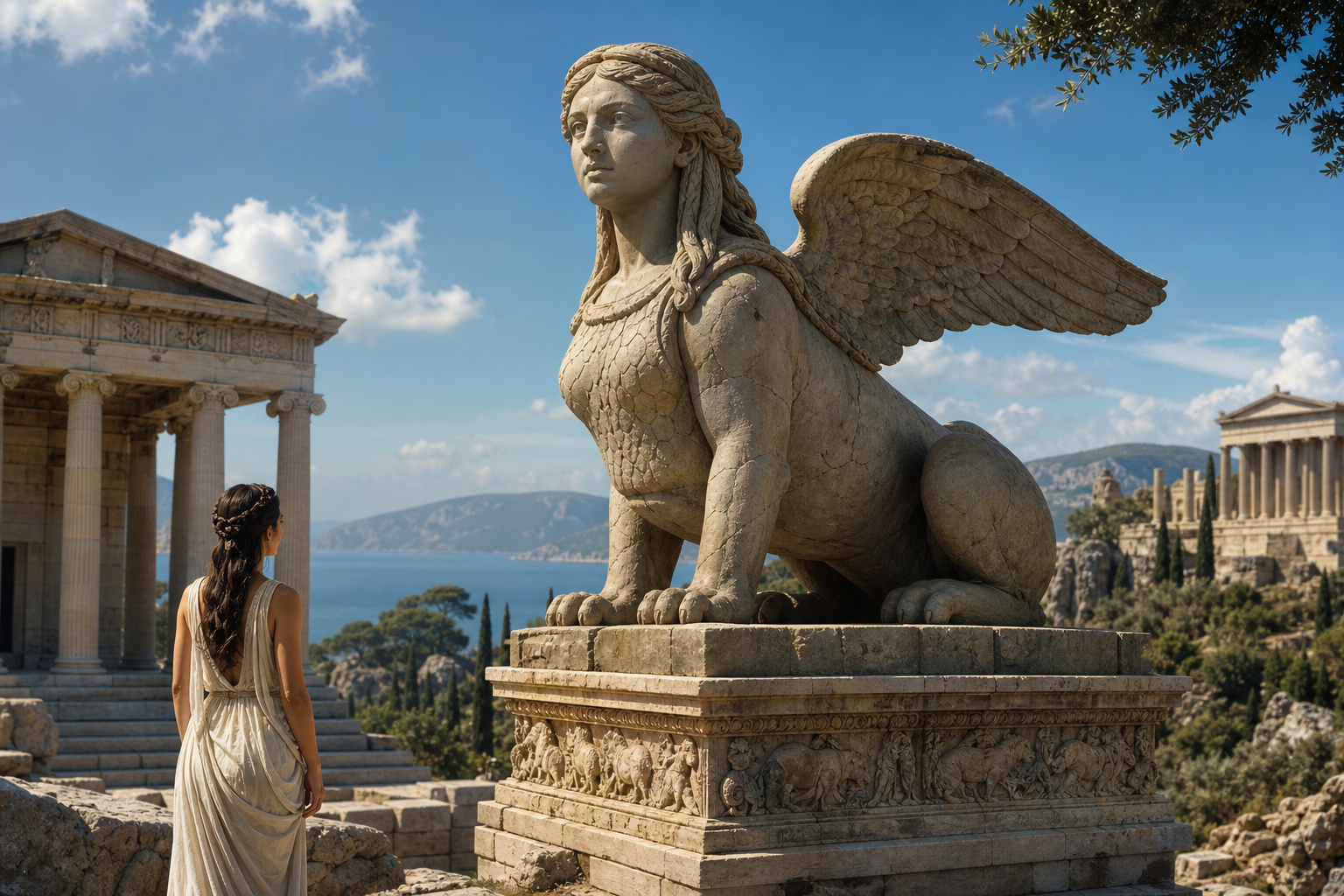
The Sphinx of Thebes: Riddle, Ruin, and Mythic Power
The Sphinx of Thebes has haunted Western imagination for more than two millennia: a liminal creature perched at the edges of human knowledge, a creature of riddles that transforms public terror into an act of revelation. In the shadowed retellings of the Oedipus cycle, the Sphinx stands between life and civic order, between the suffocating doubt that blocks a road and the liberating clarity that opens a city to a new ruler. Though popularly conflated with the massive limestone Sphinx of Giza, the Theban Sphinx belongs to a distinctly Greek set of images and stories—winged, leonine, and feminine—woven into tragedies, mythographic handbooks, ritual landscapes, and stone monuments across the archaic and classical world. The creature's reputation rests primarily on one famous test: a riddle posed to travelers that only Oedipus would answer, freeing Thebes from the creature's strangling grip and setting in motion the tragic revelations that follow.
Yet the Sphinx is not merely a narrative obstacle used to make a hero; she is a node in a complex web of cultural exchange, religious symbolism, and political meaning. Ancient sources disagree about her parentage, divine purpose, and ultimate fate, and later commentators layered philosophical and psychoanalytic readings upon the original myth. Archaeologists and art historians have traced how the image of the sphinx evolved from Orientalizing influences borrowed from Near Eastern and Egyptian art into a fully Greek icon—deployed on temples, treasuries, grave stelai, and pottery as both guardian and enigma. This article follows the Sphinx from its mythic origins in literary sources through the material traces that keep the creature alive: pottery, inscriptions, sculpted acroteria, and dedicatory monuments. It also examines how the riddle itself functions as a symbolic fulcrum in the Oedipus myth and how later ages reinterpreted the Sphinx to express changing anxieties about knowledge, identity, and the boundary between human and divine.
To understand the Sphinx of Thebes is to listen for the silences as much as for the statements preserved in fragments and plays. The ancient testimonies—Sophocles' tragically preserved Oedipus Rex, the mythographia of Pseudo-Apollodorus, the topographical notes of Pausanias, and countless vase-painting scenes—offer discontinuous glimpses. Where texts fall short, images speak. Where monuments survive, their contexts can be read against the grain of myth to show how communities used the sphinx as a symbol of danger, protection, and the mystery of human passage. The following sections unpack origin stories, the riddle's textual history, iconographic development, the Sphinx's role in Theban social imagination, and its reception from antiquity to modernity. Each part seeks to remain faithful to the surviving evidence while exploring the interpretive richness that has ensured the Sphinx's enduring presence in the European cultural canon.
Did you know? Pseudo-Apollodorus lists the Sphinx among monstrous offspring linked to Orthus and Echidna, reflecting her placement within a broader monstrous genealogy.
Origins and Parentage
The Sphinx's origin story is a patchwork of ancient claims, reflecting the broader tendency in Greek myth to situate monstrous figures at the intersection of chthonic and hybrid genealogies. In the most commonly cited ancient compilations, the Sphinx is presented as a monstrous offspring associated with Echidna and either Typhon or Orthus—names that signal a deep-rooted connection to primordial chaos and the monstrous brood that populates the earliest Greek theogonies. Pseudo-Apollodorus, the mythographic compiler whose Bibliotheca (Library) remains one of our primary handbooks for Greek narrative tradition, lists the Sphinx among the offspring of Orthus and Echidna in some accounts, while other sources suggest Typhon and Echidna. Such variations are typical: Orthus, a two-headed dog often linked with the underworld and with the monstrous lineage of Geryon, and Echidna, the frightening half-woman, half-serpent mother of many famous monsters, comprise the genealogical logic that legitimizes the Sphinx as part of a monstrous family rather than as a unique anomaly.
Ancient poets and mythographers sometimes emphasize different aspects of the Sphinx's origin to suit thematic needs. In tragic contexts, as in Sophocles' Oedipus Tyrannus, the Sphinx's presence is best understood not merely as a product of lineage but as the instrument of divine or quasi-divine retribution: sent, according to some traditions, as a punishment upon Thebes for offenses against the gods or as an oracle-enforcing device during a dynastic crisis. The attribution of the Sphinx as a creature associated with Hera—though not universally attested—appears in some treatments where she functions to chastise mortal transgression. Within this conceptual frame the Sphinx is not an originless terror but a statement, a divine instrument whose monstrous form corresponds to a moral and communal disorder that needs to be corrected.
Mythographers also sometimes treat the Sphinx as a localizing force: a mythic presence that concretizes anxieties about liminal spaces—roads, city gates, and crossroads—places where identity and safety are negotiated. Its leonine body with human features and wings dramatizes hybridity: it is neither fully beast nor fully human, a threshold figure that raises questions about exclusion and belonging. The heterogeneity of parentage in the sources—Typhon in some lists, Orthus or Echidna in others—can be read as less an inconsistency and more a reflection of the Sphinx's symbolic function. Rather than fixating on an exact birth myth, ancient writers embraced the Sphinx's polyvalence: a creature born from chaos, tasked with policing the boundary between Thebes and the outside world.
Did you know? The most familiar wording of the riddle appears in later ancient summaries; early dramatic accounts preserve the story but not always the exact text of the Sphinx's question.
Archaeological evidence does not offer a literal 'birth certificate' for the Sphinx, of course, but the persistence of sphinx imagery in archaic and classical Greece—from pottery scenes to temple sculpture—shows how the creature's hybrid form became a visual shorthand for otherness and protective ambivalence. Where literary sources diverge, material culture converges upon the Sphinx as an emblem of the unknown as well as a guardian against it. That duality—both terror and sentinel—shaped how ancient audiences read the Sphinx within the Theban myth: as both curse and test, as instrument and interlocutor.
The Riddle and Its Variants
Central to the Sphinx's mythic authority is the riddle she poses—a short, imagistic challenge that both mystifies and reveals. The most familiar version of the riddle asks what creature walks on four legs in the morning, two at midday, and three in the evening; the answer, 'man,' compresses human development into a single trope that links infancy, maturity, and old age. Yet the history of the riddle's wording and display in ancient sources is complicated: some early dramatists and mythographers convey the riddle in slightly different phrasings, and in certain early plays the Sphinx's voice itself may be only partially preserved or summarized by narrators. The rhetorical power of the riddle lies less in a single canonical wording than in its function as a test of insight—an epistemic trial that separates the perceptive from the bewildered.
Sophocles' Oedipus Tyrannus is the single most influential literary treatment of the riddle in antiquity. In the play the riddle operates as a narrative pivot: Oedipus' success in solving it not only saves Thebes, it legitimates his claim to kingship and sets the stage for the deeper, tragic recognition of his own origins. Importantly, the play places the riddle within a network of oracular authority, familial secrecy, and civic crisis—suggesting that intellectual insight and political legitimacy are entwined. Later retellings and mythographical summaries preserve the same general structure but sometimes simplify or alter the wording. Hellenistic and Roman commentators felt free to reproduce and adapt the riddle according to rhetorical taste.
Did you know? Aeschylus wrote a play titled The Sphinx, but only fragments and later references survive, indicating the creature's dramatic appeal in archaic Athens.
The riddle has attracted scholarly attention for its symbolic density. At its simplest it is an anthropological allegory about human life stages, but ancient and modern interpreters have read more layered meanings into the exchange. Some have emphasized the riddle's liminal geometry: morning, noon, and evening are metaphors for transition that mimic the Sphinx's own hybrid form. Others have treated the riddle as a test of interpretive skill—an analogous ritual to cultural or initiatory tests in other traditions, where the successful decipherer gains entry into knowledge or social status. When Oedipus solves the riddle, he is not merely answering a word puzzle but performing an act that reveals the capacity to integrate contradiction.
Beyond the canonical 'four-two-three' formulation other versions circulated. Some writers preserved alternate puzzles associated with sphinxes in other locales or periods; some heroes in other myths encounter sphinx-like riddlers with different questions. Those variations reveal that the sphinx remained a flexible motif, appropriated to suit varying moral, civic, or theatrical aims. The riddle's endurance—both in antiquity and later—owes much to the balance it strikes between simplicity and profundity: accessible enough to be intelligible, ambiguous enough to be emblematic.

Literary Sources and Interpretations
The Theban Sphinx occupies a peculiar place in the Greek literary imagination because she intersects with tragedy, epic summaries, and local legend. Sophocles' Oedipus Tyrannus (Oedipus Rex) is the canonical tragedy where the Sphinx's role becomes pivotal; surviving fragments and the full play show how the riddle functions as both plot device and symbolic axis. Aeschylus wrote a play titled The Sphinx, and though only fragments and later references survive, ancient commentators indicate that the monster and its riddle provided rich theatrical material. Beyond dramatic poets, the myth appears in summaries by mythographers such as Pseudo-Apollodorus and in topographical descriptions by Pausanias. Each source, shaped by differing aims, emphasizes different aspects: Sophocles explores psychological and civic ramifications; mythographers set the Sphinx within genealogical and chronological frames; antiquarian writers note local cultic associations and monuments.
Did you know? The Naxian Sphinx stood on a tall column at Delphi and was dedicated around the mid-6th century BCE, attesting to the sphinx's use as a monumental dedication in pan-Hellenic sanctuaries.
Interpretive traditions in antiquity read the Sphinx through varied lenses. Stoic and allegorical exegetes sometimes converted myth into moral exempla. In the Hellenistic period, literary scholars interested in riddles and paradoxes collected the Sphinx's enigma as a paradigmatic example. Philosophers could read the riddle as an epistemological challenge about the nature of human knowledge and temporality. The dramatic tradition, especially in Sophocles, anchors the creature in civic concerns: a city's suffering under an oracular curse, the obligation of the ruler to respond to communal need, and the precariousness of revealed truth. Sophocles' handling of recognition (anagnorisis) is often studied as a masterclass in how mythic motifs—like the riddle—can be reworked into complex psychological narratives.
Modern scholarship has extended these readings, situating the Sphinx at intersections of gender, threshold rituals, and territorial sovereignty. The Sphinx is often gendered feminine in Greek sources, and scholars have debated the meaning of a female hybrid guarding the male-dominated spaces of roads and gates. Some feminist readings argue that the Sphinx's femininity and monstrousness articulate anxieties about female agency; others emphasize the creature's role as a liminal figure, embodying the peril of ambiguous identities. Archaeological and iconographic work has also shifted attention from purely textual readings to material contexts: where sphinxes were carved or painted in sanctuaries, grave contexts, or treasuries, they often function as protective symbols, connecting the mythic narrative to lived religious practice.
Because the Sphinx appears in so many registers—poetic, dramatic, philological, and archaeological—no single interpretive frame suffices. The creature can be read as an instrument of divine will, a mythic representation of social crisis, an allegory of human life stages, or a dramatic device engineered to expose character. Each reading relies on overlapping but distinct pieces of evidence, and modern interpretations must therefore remain attentive to the plurality of ancient voices.
Did you know? The term 'Oedipus complex' was coined by Sigmund Freud; though focused on other aspects of the myth, psychoanalytic interest helped sustain modern engagement with the Oedipus-Sphinx narrative.
Iconography: From Egypt to Greece
Visually, the sphinx is a study in cultural adaptation. The image of a creature with a lion's body and a human head predates Greek usage in the ancient Near East and Egypt, where the sphinx appears as a royal or protective figure—most famously in the Great Sphinx of Giza, which dates to the Old Kingdom of Egypt. Greek artists and patrons absorbed and transformed these motifs during the Orientalizing and Archaic periods (roughly late 8th to early 6th centuries BCE), integrating Near Eastern and Egyptian iconographic elements into a new Hellenic vocabulary. The Greek sphinx often acquires wings and a female human head, differentiating it from the Egyptian royal sphinx and aligning it with the Greeks' taste for hybridity and narrative dynamism.
Important archaeological examples trace the diffusion and localization of the sphinx motif. One of the most famous is the so-called Naxian Sphinx, a monumental sculpture erected on a tall column at Delphi and dedicated by the people of Naxos around the mid-6th century BCE. Pausanias, writing in the second century CE, records many such dedications at Delphi and other sanctuaries. On pottery, particularly in the black-figure and later red-figure traditions, sphinxes decorate kraters, kylikes, and funerary lekythoi, often marking liminal zones or acting as attendant figures in mythic scenes. In architecture, sphinxes are common as acroteria—ornaments placed on temple roofs or treasuries—serving a protective or apotropaic function that dovetails with their mythic role as guardians.
The Greek sphinx's aesthetic emphasizes movement and expression: wings poised, face often rendered in an archaic smile or sternness, body musculature displaying the animal strength beneath. This formal language reinforced the sphinx's conceptual duality as both alluring and threatening. Significantly, the Greek image of the sphinx was not static: it evolved according to local practices and the demands of ritual context. On grave stelai, for example, sphinxes could be empathetic or funerary guardians; in sanctuary contexts they protected sacred precincts; in narrative art they could be active participants in the story, confronting heroes and travelers.
Did you know? The Sphinx is frequently depicted as female in Greek sources, a contrast to many Near Eastern sphinx figures that are often male or royal; the Greek feminine form interacts with ancient anxieties about liminality and power.
Archaeologists and art historians have also explored the interplay between imported motifs and local invention: how, for instance, eastern models provided a template that Greek sculptors reworked to suit Hellenic composition and narrative interest. The result is a sphinx that is recognizably part of an international iconographic family yet unmistakably Greek in its emphasis on hybridity and narrative agency.

The Sphinx in Theban Society and Ritual
The mythic account of the Sphinx is embedded within a web of Theban concerns—dynastic succession, civic welfare, and the morale of a polis under siege. In the narrative cycle, the Sphinx's appearance corresponds with a moment of crisis: a plague upon the city or an oracle's pronouncement that the community must yield something essential to restore order. In some versions, the Sphinx's stranglehold on Thebes is linked to a social or familial failing that requires rectification; in Sophocles, Oedipus' solving of the riddle is tied directly to political stabilization and his elevation to the throne. The story thus functions as a mythic charter for regime change: knowledge—embodied in Oedipus' cunning—translates into political power.
Within Thebes itself, the Sphinx operates as a narrative agent that justifies certain civic responses. The figure's attacking of travelers who cannot answer the riddle dramatizes the idea that certain thresholds must be negotiated intelligently: the road into Thebes is not merely geographic but ethical and epistemological. Ancient Greek cities often used mythic narratives to encode local customs and to articulate the conditions for legitimate rulership; the Sphinx-Oedipus story is exemplary in this regard. A hero capable of solving riddles demonstrates the capacity to integrate contradictory claims and to interpret divine will, qualities desirable in a king.
Archaeological records of Theban cult practices are fragmentary and must be handled with caution. Pausanias' travelogue offers glimpses of the Theban landscape and monuments—shrines, temples, and tombs that later Greek visitors could read as material anchors for mythic stories. While direct evidence for a cult of the Sphinx in Thebes is limited, the prevalence of sphinx images in Boeotian art and the prominence of Theban myth in theatrical repertoires suggest that the Sphinx story had salience in local ritual and civic identity. Festivals and theatrical performances could have functioned as ways of rehearsing communal memory—evoking the Sphinx's terror and Oedipus' subsequent rule as foundational moments in the city's moral and political imagination.
Beyond ritual and polity, the Sphinx story also addresses personal and philosophical questions about human knowledge. The riddle emphasizes interpretive competence, while the Sphinx's ambiguous gender and form complicate straightforward binary categories. The Theban myth thus contributes to Greek reflection on the limits of knowledge: Oedipus' intellectual triumph in answering the riddle later gives way to a ruinous recognition of his own origins, suggesting that human insight can be both salvific and destructive. That paradox may have resonated in ritual contexts where festivals combined celebration with purification and memory with admonition.
Later Reception: From Antiquity to Modernity
The Theban Sphinx did not remain a static artifact of the ancient world; it was reimagined across eras and disciplines, its enigmatic presence adapted to new intellectual and aesthetic climates. In antiquity itself, the Sphinx continued to appear in diverse registers: scholarly exegesis, rhetorical collections of riddles, and pan-Hellenic artistic programs. During the Hellenistic and Roman periods, the Sphinx's symbolism was broadened, often used as an emblem of riddling knowledge or as a decorative motif in urban elite contexts.
In the modern era, the Sphinx acquired new resonances. Renaissance and Enlightenment scholars rediscovered classical texts and images, and the figure of the Sphinx provided an attractive emblem for literary and philosophical meditation—an image of inscrutability that could be harnessed for diverse symbolic ends. The rise of Egyptology in the nineteenth century produced widespread fascination with sphinx imagery, but this also had the effect of conflating Greek and Egyptian traditions in popular imagination. Scholars eventually emphasized the formal and functional differences between the Egyptian royal sphinx and the Greek winged, female sphinx, but the visual and conceptual conflation persists in many modern depictions.
Psychoanalytic theory offered another powerful afterlife to the Oedipus cycle—with Sigmund Freud's coinage of the 'Oedipus complex' reframing Oedipus' patricide and incest as a paradigm for infantile psychosexual development. While Freud did not focus primarily on the Sphinx, the creature's role in initiating Oedipus' trajectory ensured that the sphinx-episode remained linked to modern debates about family, knowledge, and the unconscious. Literary and artistic modernists—from symbolists to surrealists—invoked the sphinx as a figure of enigmatic femininity and forbidden knowledge. Visual artists, sculptors, and poets repeatedly returned to the sphinx's image, exploiting its capacity to evoke ancient dread and contemporary ambiguity.
Contemporary classical scholarship continues to refine our understanding of the Sphinx by integrating textual philology, iconographic analysis, and archaeological context. Interdisciplinary studies examine how the Sphinx functioned within ancient performance cultures, the political economies of sanctuary dedications, and the construction of gendered monstrosity. As new fragments and sculptures are published and as museum collections digitize artifacts, the scholarly picture grows more textured. Yet the myth retains its core attraction: a creature that asks a question with the power to reconfigure a city's fate.

The Sphinx of Thebes endures because it occupies a space that is at once narratively compact and symbolically capacious. Within the Oedipus cycle she accomplishes a paradoxical function: she is both the instrument of civic crisis and the test that validates civic renewal. Her hybrid form—part lion, part woman, part bird—symbolizes the ambiguity that lies at the heart of human experience: thresholds, transformations, and the uneasy overlap of knowledge and ignorance. Ancient authors and artists exploited this ambiguity to different ends, producing a multifaceted figure whose meanings shift with context.
Studying the Theban Sphinx requires attention to a range of evidentiary forms. Literary texts provide the skeleton of the narrative: tragedies, summaries, and scholia that preserve different moments of the story. Artistic and archaeological materials flesh out visual expectations and ritual uses. Together, these sources show the Sphinx as more than a mere puzzle-maker: she is an emblem of liminality, a motif of protection and menace, and a narrative engine that furnishes ethical, political, and psychological lessons. From Sophocles' stage to the columns of Delphi, from mythographic libraries to modern psychoanalysis, the Sphinx keeps returning because each age can find in the creature a mirror for its own preoccupations about knowledge, power, and the dangerous ambiguities of human existence.
The riddle remains provocative because it reduces human life to a simple image, inviting both triumph and reflection. Oedipus' answer unwinds the mystery and legitimates his kingship, yet what follows—discovery, catastrophe, exile—reminds readers that knowing is not always liberation. The Sphinx therefore resists a single moral: she is at once a guardian of inscrutable law and an oracle of tragic insight. Her silence after Oedipus' victory—traditionally ending in her death—does not end the questions she raises. In cultures and disciplines across time, the Sphinx continues to embody the tension between what can be known and what remains irrevocably obscure.
To encounter the Sphinx of Thebes, then, is to engage with a long conversation about the nature of riddles, the role of monstrous hybrid figures in human narrative, and the ways in which communities use myth to frame political legitimacy and moral understanding. Whether encountered on a black-figure vase, in the cadences of a tragic chorus, or in the margins of a medieval manuscript, the Sphinx still asks us to answer—and in doing so, to measure how we live between morning and evening, between the first step and the last.
How we verify this article
By the History Unlocked editorial team
This text is built on historical facts stored in our database and drafted with AI assistance. No signed human review is recorded for this article. Report any inaccuracy: we correct it and update the modified date.
Updated on
AI-assisted drafting.
Read our editorial standardsEnjoyed this? Discover more articles in the category Mythology & Ancient Gods