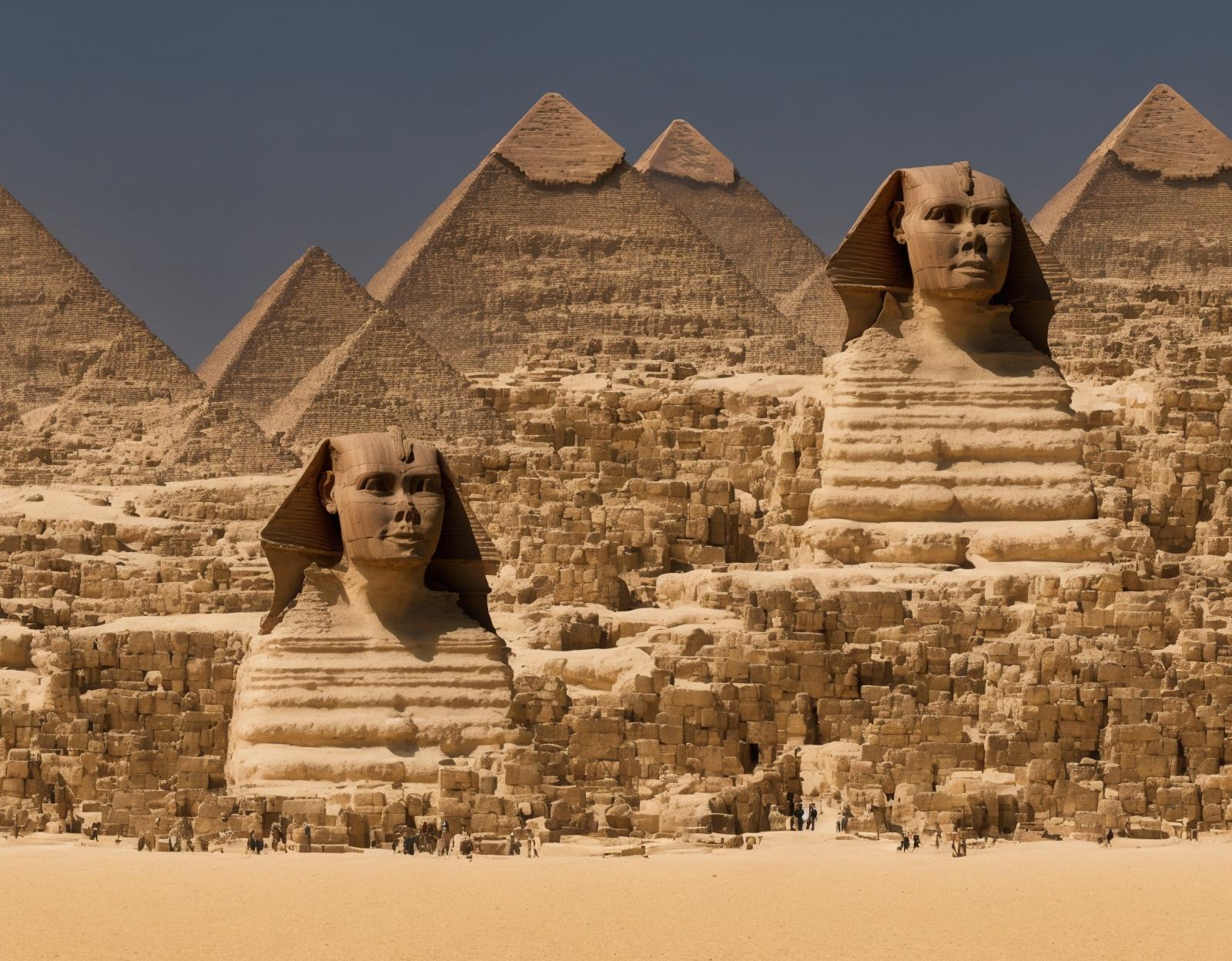
The Sphinx's Riddles: Unearthing the Secrets Buried Under Giza
It stands as a silent sentinel, a creature of impossible scale born from the living rock of the Giza plateau. For forty-five centuries, the Great Sphinx has gazed towards the eastern horizon, its expression a mask of serene indifference to the empires that have risen and crumbled before it. Part lion, part human, it is the embodiment of a riddle, not one spoken in words, but one etched in limestone and debated in the halls of archaeology. While tourists flock to capture its iconic profile against the backdrop of the great pyramids, they are often unaware of the deep, swirling controversies that churn beneath its sandy domain. The Sphinx is not a settled matter; it is a live archaeological mystery, a focal point where orthodox history clashes with radical new theories. The story we are told is of a monument carved by the Pharaoh Khafre around 2500 BC, a testament to a powerful king’s divine authority. But is this the truth, or merely the most convenient story? The stone itself seems to whisper a different tale—of rains that should not have fallen, of a face that does not match its supposed owner, and of hollow spaces deep within the earth that may hold secrets far older than Egypt itself. This is not just a journey into the past, but an investigation into a profound and enduring enigma. We will strip away the layers of sand and dogma to explore the evidence, from the geological scars on its body to the forensic analysis of its face, and venture into the speculative realms of lost technologies and forgotten histories. The Sphinx is more than a monument; it is a question aimed directly at our understanding of human civilization. Its silence is its greatest challenge, daring us to look closer, think deeper, and question everything we believe we know about the ancient world.
The Traditional Portrait: A Monument for a King
In the grand narrative of Egyptology, the Great Sphinx of Giza is inextricably linked to one man: the Fourth Dynasty Pharaoh Khafre (also known as Chephren), who reigned circa 2558–2532 BC. This attribution, for a long time presented as historical fact, paints a picture of a confident and powerful civilization at its absolute zenith. The logic is compellingly straightforward. The Sphinx is a central component of the sprawling Giza necropolis. It sits adjacent to a causeway that leads directly to the second largest pyramid on the plateau, the Pyramid of Khafre. Furthermore, the architectural style of the Sphinx Temple, located directly in front of the statue, is remarkably similar to Khafre's mortuary temple, utilizing massive limestone blocks, some weighing over 100 tons, quarried from the Sphinx enclosure itself. This creates a cohesive architectural and thematic link. The Sphinx, with the body of a lion—a symbol of royal power and the sun—and the head of the king, would have served as a divine guardian, an awesome manifestation of the king’s connection to the gods, particularly the sun god Ra. It is a masterpiece of landscape engineering, not built from blocks, but sculpted from a single, monstrous outcrop of bedrock limestone left in the quarry used to extract stones for the Great Pyramid of Khufu, Khafre's father. The planning and labor required to achieve this are staggering, a clear demonstration of the logistical and artistic prowess of the Old Kingdom. The head, adorned with the classic Nemes headdress, rises nearly 66 feet (20 meters) from its base, while the body stretches an imposing 240 feet (73 meters) in length. It was a vision of power meant to intimidate and inspire awe for eternity. Yet, for all this contextual evidence, one crucial piece is missing: there is not a single, unambiguous Old Kingdom inscription that declares, "Khafre built this." The primary piece of textual evidence often cited is the Dream Stele, erected much, much later by Pharaoh Thutmose IV around 1400 BC. This granite slab, placed between the Sphinx’s paws, tells the story of how the young prince Thutmose, while hunting, fell asleep in the shadow of the Sphinx’s head. The Sphinx, buried in sand up to its neck, appeared to him in a dream as the deity Horemakhet-Khepri-Ra-Atum and promised him the throne of Egypt if he would clear away the encroaching desert. Thutmose fulfilled his promise and became king, renovating the statue and building mud-brick enclosure walls. Critically, the stele refers to the Sphinx as a powerful, ancient entity, but it breaks off and is damaged in the very lines where it might have mentioned the original builder, leaving the story tantalizingly incomplete. It venerates the Sphinx but does not name its creator. This absence of a direct claim from Khafre’s time is the first crack in the traditional story, a sliver of doubt that has, over the decades, been pried wide open by new questions and startling geological evidence.
Scars of a Drowning World: The Water Erosion Hypothesis
The most powerful challenge to the orthodox dating of the Sphinx does not come from dusty papyri or hidden tombs, but from the very stone of the monument and its enclosure. In the late 1970s, an independent researcher named John Anthony West began tochampion an idea first posited by René Schwaller de Lubicz: that the weathering patterns on the Sphinx were not the result of wind and sand, but of water. West, a writer and rogue Egyptologist, brought his theory into the scientific realm in 1991 when he collaborated with Dr. Robert Schoch, a geologist and professor at Boston University. When Schoch first examined the Sphinx and its enclosure, he was stunned. The weathering profiles were unlike anything else on the Giza plateau. The bodies of the pyramids, the nearby Old Kingdom mastaba tombs, and other structures definitively dated to Khafre’s era all showed clear signs of horizontal erosion, the type you would expect from millennia of wind and sand abrasion. The body of the Sphinx and, most importantly, the walls of the rock-cut enclosure from which it was carved, displayed a completely different pattern: long, deep, undulating vertical fissures. Geologically speaking, this is a classic textbook signature of precipitation-induced weathering—in other words, erosion caused by vast amounts of running water and rainfall over a very long period. This presented a monumental problem for the standard timeline. The Giza plateau has been hyper-arid, part of the Sahara Desert, for the last 5,000 years. There has not been enough rainfall in Egypt since Khafre’s time to cause such extensive water-specific damage to durable limestone. To find a climate in this region capable of producing such weathering, Schoch concluded, one would have to go back thousands of years before 2500 BC, to a time when the Sahara was a green and fertile savannah. This period, known as the African Humid Period, ended around 3000 BC, but the kind of significant, prolonged rainfall needed to carve these deep fissures would place the origins of the Sphinx far deeper in time, perhaps as far back as 7,000 BC, or even 10,000 BC. This theory, if true, would shatter our entire understanding of the ancient world. It implies the existence of a sophisticated, monument-building culture long before the rise of the dynastic Egyptians, a lost civilization from the mists of prehistory. Mainstream Egyptology mounted a fierce counter-attack. Archaeologists like Dr. Zahi Hawass and Dr. Mark Lehner argued that the poor quality of the limestone, combined with localized flash floods, groundwater capillary action wicking moisture up from the bedrock, and the corrosive effects of morning dew and Nile floods could explain the vertical weathering. They point out that the Sphinx is composed of three distinct layers of limestone, with the softest and most susceptible layer forming the base and body, which could erode in unusual ways. However, proponents of the water erosion hypothesis argue that these explanations fail to account for the sheer depth and uniformity of the vertical patterns, which are consistent across the enclosure and look nothing like the wind-worn tombs just a few hundred feet away.
Did you know? The Sphinx was never called "the Sphinx" by the ancient Egyptians. The Greek name was likely inspired by their own mythological creature. In the New Kingdom, it was most commonly referred to as *Horemakhet*, meaning "Horus on the Horizon."
The Face of a Stranger: An Identity Crisis in Stone
Beyond the geological debate, another profound anomaly stares back at every visitor: the head. It is immediately apparent to any observer that the Sphinx’s head is disproportionately small compared to its massive leonine body. This is a bizarre artistic choice for the ancient Egyptians, who were masters of proportion and symmetry, as evidenced by the thousands of perfectly balanced statues and reliefs they left behind. This size discrepancy has led to a compelling and logical theory: the head of the Sphinx as we see it today is not the original head. It was likely re-carved from a much larger, original structure, at some point long after the initial creation of the body. If the body, as suggested by the water erosion evidence, is thousands of years older than the head, then this makes perfect sense. A later pharaoh—perhaps Khafre—would have discovered the ancient, weather-beaten monument, its original head likely severely eroded, and decided to claim it as his own by re-carving its face in his own likeness. This would explain not only the small size of the head (as the carvers would be limited by the remaining stone) but also the stark difference in weathering. The head is in a much better state of preservation than the heavily eroded body, suggesting it is significantly younger. Adding powerful fuel to this fire is the work of Lieutenant Frank Domingo, a forensic artist with the New York Police Department, who was brought in by John Anthony West. Domingo’s job for decades was to reconstruct faces from skulls and compare images for identification. He applied his professional techniques to the Sphinx, meticulously comparing the features of its face—from the side and frontal views—to the known, labeled statues of the Pharaoh Khafre, including the magnificent seated diorite statue in the Cairo Museum. His conclusion was unequivocal: the face on the Sphinx and the face of Khafre are not the same man. He pointed to significant differences in the facial structure, the angle of the jaw, the width of the chin, and the profile. While not conclusive proof, this expert forensic opinion casts serious doubt on the attribution to Khafre. If the face is not Khafre’s, then who is it? And what was there before? The re-carving theory opens up a world of speculation. The original monument could have been a full-bodied lion, a common symbol of power from the earliest periods of Egyptian art. Alternatively, it could have represented another deity entirely. One popular theory suggests the original head was that of the jackal-god Anubis, the guardian of the necropolis. A giant Anubis statue, oriented due east, would have been a fitting protector for the sacred burial grounds of Giza long before the pyramids were even conceived. Over time, as belief systems changed, the jackal head could have been recut into the face of a human pharaoh, a powerful act of usurpation and re-branding of a sacred, ancient site.
Echoes from the Underworld: The Hunt for the Hall of Records
No discussion of the Sphinx’s mysteries is complete without venturing into the persistent legends of hidden chambers and lost knowledge. For nearly a century, the idea of a secret repository, a "Hall of Records," lying undiscovered beneath the Sphinx has captivated esoteric thinkers and fringe researchers. The most famous proponent of this idea was the American psychic Edgar Cayce, the "Sleeping Prophet." In a series of trances during the 1930s and 1940s, Cayce claimed that the Sphinx had been built around 10,500 BC by survivors from the lost continent of Atlantis. He prophesied that a chamber would one day be discovered beneath the right paw of the Sphinx, containing scrolls and artifacts that documented the entire history of humanity, including the advanced science of the Atlanteans. While Cayce’s claims were purely mystical, they inspired a generation of researchers to investigate whether the ground beneath the Sphinx might indeed hold physical secrets. In the late 1980s and 1990s, these ideas moved from the realm of psychic prediction to scientific exploration. Several teams conducted remote sensing surveys around the monument with sophisticated equipment. In 1991, geophysicist Thomas Dobecki, working with John Anthony West and Robert Schoch, used seismic refraction to probe the bedrock around and under the Sphinx. His equipment detected several subsurface anomalies that appeared to be man-made cavities. The most significant of these was a large, rectangular, and seemingly hollow space located deep in the bedrock off the Sphinx’s left front paw, roughly 25 feet by 40 feet in size—eerily reminiscent of Cayce’s prophecy, though on the opposite side. Further surveys were conducted in 1996 by a team from Florida State University, sponsored by a Cayce-affiliated organization, which also used ground-penetrating radar (GPR) and seismic equipment. They too reported evidence of several right-angled, man-made-looking "tunnels" or chambers deep in the limestone, including a significant void directly under the front paws. These scientific findings created a media frenzy, but the official response from the Egyptian Supreme Council of Antiquities, then led by the formidable Dr. Zahi Hawass, was swift and dismissive. They conducted their own limited drilling in the area and announced that the "anomalies" were simply natural features—fissures and cracks in the limestone bedrock. Permission for further independent investigation was denied, and the area was effectively sealed off to non-sanctioned research. This has led to accusations of a cover-up, with critics suggesting the authorities know or suspect something is there and wish to control the discovery and the narrative. Whether these chambers are natural geological features or man-made rooms, the fact remains that there are unexplored cavities in the bedrock in the immediate vicinity of the Sphinx. The allure of a potential library of ancient wisdom remains a powerful, driving force in the Sphinx’s enduring mystery.
The Silent Guardian
How we verify this article
By the History Unlocked editorial team
This text is built on historical facts stored in our database and drafted with AI assistance. No signed human review is recorded for this article. Report any inaccuracy: we correct it and update the modified date.
Updated on
AI-assisted drafting.
Read our editorial standardsEnjoyed this? Discover more articles in the category Egypt & Lost Civilizations